How to Complete a Salvage Car Inspection in Ohio: Step-by-Step Guide
To pass a salvage car inspection in Ohio, you must first purchase an inspection receipt from an Ohio Bureau of Motor Vehicles (BMV) Deputy Registrar, gather original receipts or bills of sale for all replaced major components—including...
To pass a salvage car inspection in Ohio, you must first purchase an inspection receipt from an Ohio Bureau of Motor Vehicles (BMV) Deputy Registrar, gather original receipts or bills of sale for all replaced major components—including donor vehicle Identification Numbers (VINs)—and schedule an appointment with an Ohio State Highway Patrol (OSHP) inspection station. After passing the anti-theft verification, you can exchange your salvage title for a "Rebuilt Salvage" title at any County Clerk of Courts Title Office.
Contents
Understanding Ohio Salvage Vehicle Laws
In Ohio, when an insurance company declares a motor vehicle a total loss due to collision, flood, fire, or other damage, the vehicle's original "clean" title must be surrendered to the state and exchanged for an Ohio Salvage Title. Under Ohio Revised Code (ORC) Section 4505.11, a vehicle holding a salvage title cannot be legally driven on public roads, registered, or issued license plates.
To return a rebuilt salvage vehicle to highway legal status, the owner must complete a structural and identity verification process known as the Ohio State Highway Patrol Salvage Inspection.
Rebuilt Salvage vs. Clean Title
It is important to recognize that a vehicle with an Ohio Salvage Title will never regain a completely "clean" title status. Once the salvage inspection is completed successfully, the Clerk of Courts issues a title marked with the notation "REBUILT SALVAGE."
This brand remains on the vehicle's title permanently through all future transfers of ownership. While a Rebuilt Salvage title allows you to legally register, insure, and drive the car, the permanent designation impacts the vehicle's resale value and may limit collision and comprehensive coverage options with certain auto insurance providers.
Step 1: Obtain an Ohio Salvage Title
Before scheduling an inspection, the vehicle must already carry an Ohio Salvage Title issued in your name, or assigned to you as the legal purchaser. If you bought a salvage vehicle from an auto auction, insurance company, or private individual, you must transfer the title into an Ohio Salvage Title at an Ohio County Clerk of Courts Title Office before undergoing the State Highway Patrol inspection.
If you are rebuilding a vehicle that was previously titled in another state under a salvage designation, you must convert the out-of-state salvage document to an official Ohio Salvage Title prior to your inspection appointment.
Step 2: Purchase an Ohio Inspection Receipt
You cannot present a vehicle for inspection without a valid Salvage Inspection Receipt issued by the Ohio BMV.
- Where to Buy: Visit any local Ohio BMV Deputy Registrar License Agency or purchase the receipt online through the official BMV portal.
- Required Documents for Purchase: You must present the vehicle’s salvage title or title chain documentation and a valid government-issued photo ID.
- Cost: The salvage inspection receipt fee is $50.00, plus a standard Deputy Registrar service fee (typically $3.50), bringing the total cost to $53.50.
- Receipt Validity: The physical paper receipt contains a unique transaction number assigned to your vehicle’s specific Vehicle Identification Number (VIN). Keep this receipt intact; you must present the original copy to the inspecting officer.
Step 3: Document Replaced Parts and Gather Receipts
The primary statutory purpose of the Ohio State Highway Patrol salvage inspection under ORC 4505.111 is anti-theft enforcement and parts identification. The inspecting officer checks to ensure that stolen parts were not used to rebuild the vehicle and that the vehicle’s identity matches its official public VIN tags.
You must maintain meticulous record-keeping during the repair process. For every major component part replaced on the vehicle, you must provide official proof of ownership.
What Qualifies as a Major Component Part?
Under Ohio administrative guidelines, major component parts include, but are not limited to:
- Engine and transmission
- Front and rear bumper assemblies
- Fenders, hood, and trunk lid/tailgate
- Doors (shell and assembly)
- Quarter panels and roof frame
- Airbag modules and restraint systems
- Frame assemblies or unibody structural sections
Documentation Requirements for Parts
For every replaced part, you must bring original paper documentation to the inspection. Digital copies on a smartphone or handwritten informal notes are generally rejected by inspectors.
- New Parts Purchased from a Retailer/Dealer: An itemized, original sales receipt or commercial invoice displaying the business name, address, date of purchase, part description, and purchase price.
- Used Parts Purchased from an Auto Salvage Yard / Recycler: An official invoice showing the business details, part description, and the full 17-digit VIN of the donor vehicle from which the part was harvested.
- Used Parts Purchased from a Private Seller: A signed Bill of Sale that includes the date, seller’s full legal name, address, phone number, detailed description of the part, purchase price, and the full VIN of the donor vehicle.
- Aftermarket Body Panels or Frame Sections: Commercial retail receipts clearly stating that the parts are new, aftermarket components.
Important Caution: If you purchase a used engine, door, airbag, or quarter panel from a private individual or swap meet without obtaining the donor vehicle's 17-digit VIN, the inspecting officer cannot verify that the component is not stolen. Missing donor VINs are the single most common cause of failed salvage inspections in Ohio.
Step 4: Schedule an Inspection Appointment
Salvage inspections in Ohio are conducted exclusively by designated officers of the Ohio State Highway Patrol. They are held at dedicated OSHP inspection facilities located across the state.
How to Book Your Appointment
- Visit the official Ohio State Highway Patrol Salvage Inspection Scheduling Portal.
- Enter your BMV Salvage Inspection Receipt number, the vehicle's 17-digit VIN, and your contact information.
- Select an available OSHP facility and choose an open date and time slot.
- Print the appointment confirmation document to bring to the station.
Step 5: Safely Transport the Vehicle to the Inspection Facility
Because a salvage-titled car is not legally registered and cannot carry standard license plates, you cannot lawfully drive the vehicle on public highways to the inspection facility unless you hold a specific temporary operational permit authorized under state law.
Approved Transportation Methods
- Flatbed Tow Truck or Car Hauler: Transporting the vehicle on a trailer or commercial tow vehicle is the safest and most compliant option.
- Temporary Salvage Operational Permit: In specific situations, the Ohio BMV may issue a temporary permit allowing a salvage vehicle to be driven directly to the OSHP inspection location and back. Contact your local Deputy Registrar for current eligibility rules regarding temporary transit tags.
Operating an unregistered salvage vehicle on public roadways without proper legal authorization can result in traffic citations, vehicle impoundment, and cancellation of your inspection appointment.
Step 6: The OSHP Inspection Process
On the day of your appointment, arrive at the OSHP facility 10 to 15 minutes early. Present your driver’s license, salvage title, original BMV receipt, and organized parts receipts to the inspecting officer.
OHIO SALVAGE INSPECTION WORKFLOW
- Acquire Salvage Title in Owner's Name (Clerk of Courts Title Office)
- Buy $50.00 Inspection Receipt (Ohio BMV Deputy Registrar / Online)
- Complete Vehicle Repairs & Collect Detailed Receipts (Including Donor VINs)
- Schedule Appointment via Ohio State Highway Patrol Online Portal
- Transport Vehicle (Towed or Trailered) to OSHP Inspection Facility
- Pass Anti-Theft Verification & Receive OSHP Inspection Certificate (Form HP106)
- Present Certificate to Clerk of Courts Title Office - Issued "REBUILT SALVAGE"
- Purchase Registration & License Plates at BMV Deputy Registrar
What the Inspector Evaluates
The OSHP salvage inspection focuses on identity validation and component trace-ability rather than detailed mechanical diagnostics:
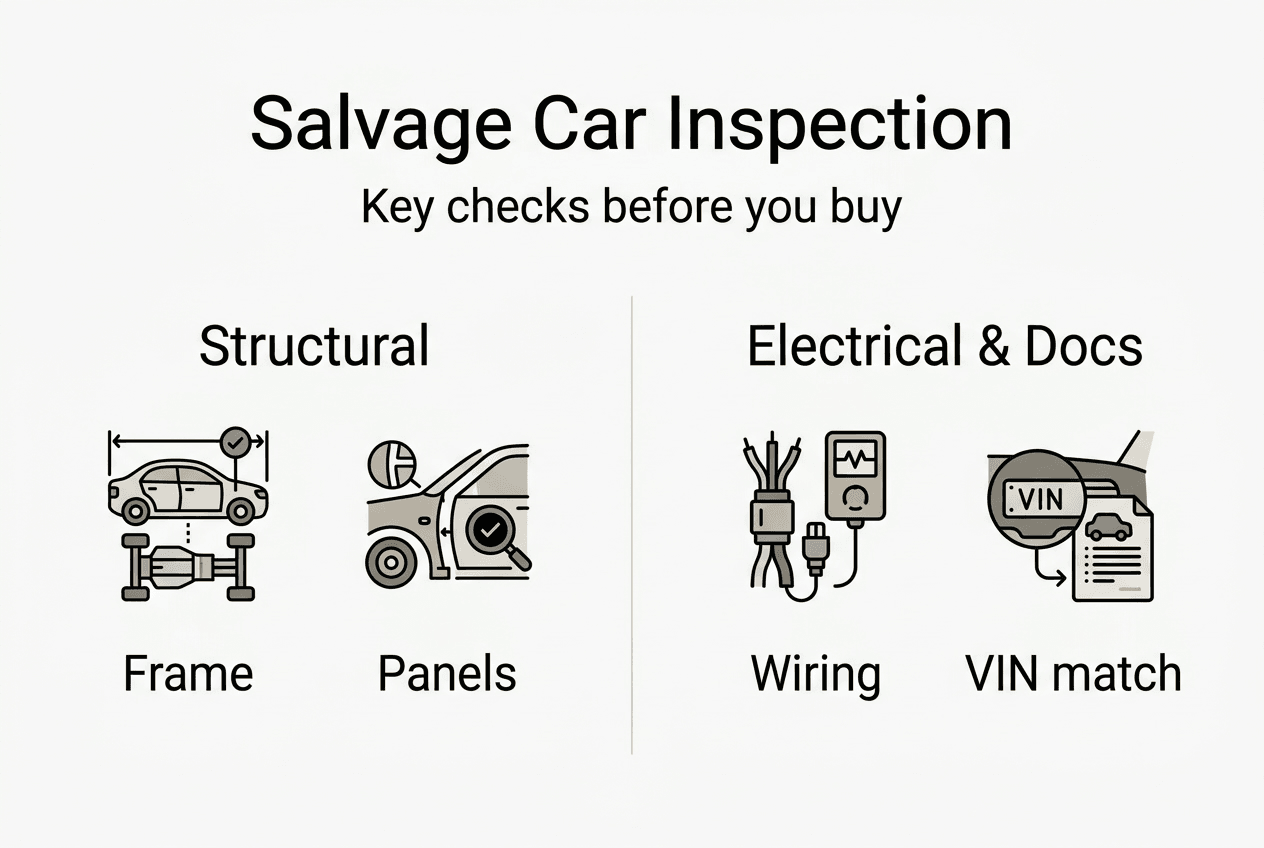
- VIN Plate Verification: The officer verifies that the public VIN on the dashboard, federal safety label on the door jamb, and secondary confidential VIN stampings across the frame or body match the title documents exactly and show no signs of tampering, cut welds, or illegal replacement.
- Parts Audit: The officer compares all replaced body panels, mechanical components, and frame sections against the receipts you provided.
- Component Stamping Checks: Many vehicle components feature factory confidential numbers or micro-stamped VINs. The inspector cross-references these physical numbers with state and national law enforcement databases (such as NCIC) to verify the parts are not listed as stolen.
- Visual Assembly Check: The vehicle must be fully assembled and structurally complete. Unfinished project cars, vehicles missing major body panels, or cars lacking essential safety equipment (e.g., windshields, installed restraint systems, functioning headlights) will be turned away.
Step 7: Converting to a Rebuilt Salvage Title
Once the officer verifies the vehicle's identity and confirms that all component receipts are legitimate, they will issue an official Ohio State Highway Patrol Inspection Certificate (Form HP106).
Final Administrative Steps
- Visit the Clerk of Courts Title Office: Take your OSHP Certificate of Inspection (HP106), your existing Salvage Title, and payment for title conversion fees to any County Clerk of Courts Title Office in Ohio.
- Issue the Rebuilt Title: The clerk cancels the salvage title and issues a new Ohio title branded "REBUILT SALVAGE." Standard title issuance fees apply (typically $15.00, plus any applicable county notary fees).
- Register the Vehicle: Take your newly issued Rebuilt Salvage title to an Ohio BMV Deputy Registrar. You can now register the vehicle, pay standard state registration fees, and purchase regular Ohio license plates.
Ohio Vehicle Title Status Comparison
To understand how a Rebuilt Salvage title compares to other legal vehicle statuses in Ohio, review the requirements and operational rules summarized below:
| Status Feature | Clean Title | Salvage Title | Rebuilt Salvage Title |
|---|---|---|---|
| Legal Road Use | Unrestricted public driving | Prohibited on public roads | Unrestricted public driving |
| BMV Registration | Eligible for plates | Ineligible for plates | Eligible for plates |
| Inspection Needed | None required | Required before titling change | Passed OSHP inspection |
| Title Brand | None (Clean) | Permanent "Salvage" | Permanent "Rebuilt Salvage" |
| Parts Documentation | N/A | Mandatory for repairs | Completed and recorded |
| Typical Resale Value | Standard Market Value | Scrap / Parts Value Only | 50%–70% of Clean Value |
| Insurance Coverage | Full Liability, Comp, & Collision | Cannot be insured for road use | Full Liability; Comp/Collision varies by carrier |
Common Reasons for Failing the Inspection
Knowing why vehicles fail the Ohio salvage inspection helps you avoid unnecessary delays, second appointments, or extra transportation costs.
1. Incomplete or Suspicious Receipts
If you present a handwritten receipt for a door or frame section that lacks the seller's full contact information, or if a used component invoice fails to list the donor vehicle’s 17-digit VIN, the OSHP officer will pause the inspection. The inspection will not proceed until valid, verifiable documentation is submitted.
2. Mismatched or Tampered VIN Tags
If the inspector detects altered rivets on the dashboard VIN plate, cut-and-welded door jamb labels, or hidden chassis numbers that do not match the public VIN, the vehicle will be detained for a formal legal investigation by the Highway Patrol’s Theft Unit.
3. Missing Airbag or Restraints
If the vehicle originally came equipped with supplemental restraint systems (airbags) that were deployed during the accident, they must be fully replaced and reinstalled. Presenting a vehicle with missing airbag modules, deployed steering wheel covers, or bypassed SRS warning lights can result in an immediate inspection failure.
4. Presenting an Unfinished Vehicle
The vehicle must be completely assembled, painted (if structural welding was performed), and in safe driving condition. Bringing a "work-in-progress" shell on a trailer with missing fenders, unsecured bumpers, or dangling wiring harnesses will lead to rejection.
Legal and Safety Disclaimer
This article provides general administrative and procedural information regarding vehicle titling and State Highway Patrol procedures under the laws of the State of Ohio. Vehicle regulations, statutory administrative fees, and inspection scheduling rules are subject to change by state legislative action or administrative rule updates.
A completed Ohio State Highway Patrol salvage inspection serves primarily as an anti-theft and identity verification process; it does not constitute a comprehensive mechanical safety warranty, frame alignment guarantee, or structural integrity endorsement by the State of Ohio or its agencies. Vehicle owners remain fully responsible for ensuring that all structural repairs comply with OEM safety standards before operating the vehicle on public roads.
Frequently Asked Questions
Can I drive a salvage-titled car directly to the inspection facility in Ohio?
No, operating a salvage-titled vehicle on public roadways is generally illegal in Ohio. The vehicle must be transported to the inspection facility on a flatbed trailer, car hauler, or via a licensed commercial towing service. Contact your local BMV Deputy Registrar to ask if your vehicle qualifies for any temporary transit permits.
Is the Ohio State Highway Patrol salvage inspection a safety check?
No. The OSHP inspection is primarily an anti-theft and identity verification procedure authorized under ORC 4505.111. While the officer ensures the vehicle is fully assembled and visually intact, the inspection does not certify frame alignment, mechanical reliability, or internal engine safety. You should have a certified independent mechanic evaluate structural repairs before highway use.
What happens if I buy a used part from a private seller who doesn't know the donor VIN?
If you cannot provide the donor vehicle's full 17-digit VIN for a major used component, the inspecting officer cannot verify whether the component came from a stolen vehicle. In most cases, the inspector will reject the part, and you will be required to replace it with a component that includes full, traceable paperwork or a documented donor VIN.
How much does the entire salvage inspection and title conversion process cost in Ohio?
The direct administrative costs set by the state include:
- BMV Inspection Receipt: $50.00 (plus ~$3.50 service fee)
- Rebuilt Salvage Title Issuance: ~$15.00 (varies slightly by county clerk fees)
- Standard Registration & License Plate Fees: Varies based on vehicle type and local tax district (typically $60.00–$100.00).
Note: Towing costs and repair expenses are separate.
Can I get full insurance coverage on an Ohio Rebuilt Salvage vehicle?
Yes, most major auto insurance carriers will issue standard liability coverage for a vehicle with an Ohio Rebuilt Salvage title. However, availability for comprehensive and collision coverage varies by insurer. Some insurance companies limit coverage to liability only, while others may require an independent appraisal before offering full coverage.
Next Steps for Vehicle Owners
If you are preparing to rebuild a salvage vehicle in Ohio, follow these practical steps to keep your project moving forward:
- Audit Your Documentation: Before booking your OSHP appointment, organize all component invoices in a binder. Double-check that every used part receipt lists the full 17-digit donor VIN.
- Buy Your BMV Receipt: Purchase your $50 inspection receipt online or at a local Deputy Registrar office so you have your transaction number ready.
- Book Early: Inspection facilities in urban areas like Columbus, Cleveland, Cincinnati, and Dayton often book appointments weeks in advance. Schedule your appointment early to avoid project delays.
- Arrange Transportation: Confirm your flatbed trailer or towing service arrangements prior to your scheduled inspection date.
Image Gallery