How to Choose an Hourly Financial Advisor
Choosing an hourly financial advisor requires identifying your specific financial needs, verifying fee-only fiduciary credentials, checking regulatory compliance records, and comparing transparent hourly rates. By paying strictly for t...
Choosing an hourly financial advisor requires identifying your specific financial needs, verifying fee-only fiduciary credentials, checking regulatory compliance records, and comparing transparent hourly rates. By paying strictly for time spent rather than a percentage of assets under management, you receive unbiased, objective advice tailored to discrete financial projects or comprehensive check-ups.
Contents
Understanding the Hourly Financial Advisor Model
The financial advisory industry operates under several pricing models, but hourly fee-only planning has emerged as one of the most transparent and conflict-free ways to access professional guidance. In an hourly arrangement, you pay an advisor strictly for the time spent analyzing your situation, constructing a financial plan, or consulting on specific questions.
Unlike traditional wealth managers who charge an annual percentage of Assets Under Management (AUM)—typically around 1%—or commission-based brokers who earn revenue from selling specific investment or insurance products, hourly financial advisors bill in a manner similar to attorneys or Certified Public Accountants (CPAs). Rates in the industry generally range from $200 to $500 per hour, depending on the advisor's experience, geographic location, and technical specialization.
This structure creates a distinct set of operational dynamics:
- Conflict Minimization: Because the advisor does not earn commissions on product sales or take a ongoing cut of your portfolio, their recommendations remain uninfluenced by compensation incentives.
- Modular Planning: You can engage an advisor for a specific project, such as evaluating an early retirement offer or building a tax-efficient withdrawal strategy, without transferring your portfolio to their custodian.
- Fiduciary Commitment: True hourly advisors operate as fee-only fiduciaries, binding them legally and ethically to act in your best interest at all times during the engagement.
Disclaimer: This guide provides educational information regarding financial planning services and regulatory verification. It does not constitute individual legal, tax, or investment advice. Always consult a licensed professional for advice tailored to your personal circumstances.
When Does an Hourly Financial Advisor Make Sense?
While hourly advice is advantageous for many consumers, it is particularly well-suited for specific investor profiles and life circumstances. Understanding whether an hourly arrangement fits your needs prevents overpaying for unnecessary ongoing management.
Is an Hourly Advisor Right for You?
- [YES] Ideal Candidates:
- DIY investors needing a periodic professional check-up
- Individuals with specific project-based questions
- Accumulators wanting to keep investment costs ultra-low
- People experiencing single life events (marriage, inheritance)
- [NO] Alternative Models Preferred:
- Investors wanting complete hands-off asset delegation (AUM)
- High-net-worth families needing daily multi-family office oversight
Self-Directed Investors Seeking a Second Opinion
If you enjoy managing your own portfolio through low-cost index funds or ETFs, you likely do not need an asset manager charging 1% per year to rebalance your accounts. However, you may still want a professional Certified Financial Planner (CFP®) to audit your asset allocation, evaluate your tax strategy, or stress-test your retirement projections every few years.
Targeted Project-Based Financial Needs
Life transitions often trigger isolated financial questions. An hourly advisor can assist with:
- Analyzing a job offer, stock option package, or executive compensation plan.
- Determining optimal Social Security claiming strategies.
- Evaluating pension buyout options versus monthly annuities.
- Structuring college savings plans (such as 529s) for children or grandchildren.
- Conducting a post-divorce or post-inheritance estate and tax alignment check.
Accumulators Building Wealth
Younger investors or high earners who have not yet accumulated large asset bases often get turned away by traditional wealth management firms that enforce minimum asset thresholds (e.g., $500,000 or $1,000,000). Hourly advisors do not enforce asset minimums, enabling investors to receive top-tier planning regardless of current net worth.
Step-by-Step Process to Choose an Hourly Financial Advisor
Finding the right hourly financial advisor requires systematic research and thorough vetting. Follow this structured process to select a practitioner aligned with your financial goals.
- Step 1: Define Scope & Budget
- Step 2: Search Fee-Only Networks
- Step 3: Verify Credentials & CRD Records
- Step 4: Conduct Discovery Calls
- Step 5: Review Form ADV & Engagement Letter
Step 1: Define Your Scope of Engagement
Before contacting advisors, outline the precise problem you need to solve. Are you looking for a comprehensive baseline financial plan, or do you have a single question regarding tax-loss harvesting or Roth IRA conversions?
Defining your scope helps you estimate total costs. For example, a single-topic consultation might take 2 to 4 hours of advisor time, whereas a comprehensive baseline financial plan usually requires 8 to 15 hours, including data collection, analysis, and strategy delivery.
Step 2: Search Dedicated Fee-Only Professional Networks
Not all financial planning directories highlight hourly practitioners. Focus your search on professional networks that specifically require members to adhere to fee-only fiduciary standards:
- Garrett Planning Network: A network specifically dedicated to making hourly, fee-only financial planning accessible to individuals regardless of income or net worth.
- National Association of Personal Financial Advisors (NAPFA): The premier professional association of fee-only financial advisors in the United States.
- XY Planning Network (XYPN): Specializes in fee-only financial planning for Generation X and Generation Y clients, frequently offering hourly and monthly subscription arrangements.
Step 3: Verify Professional Credentials and Regulatory Records
Never rely solely on an advisor's marketing website. Verify their qualifications using official regulatory databases.
Check Credentials
Look for industry-recognized professional designations such as:
- CFP® (Certified Financial Planner): Requires rigorous coursework, passing a comprehensive board examination, thousands of hours of documented professional experience, and adherence to strict ethical standards.
- ChFC® (Chartered Financial Consultant): Advanced financial planning curriculum administered by The American College of Financial Services.
- CPA/PFS (Personal Financial Specialist): Held by CPAs who specialize in personal wealth and financial planning.
Audit Regulatory Disclosure Reports
Always check the advisor's background on the Securities and Exchange Commission (SEC) Investment Adviser Public Disclosure (IAPD) database or the Financial Industry Regulatory Authority (FINRA) BrokerCheck tool. Search by the individual's name or Central Registration Depository (CRD) number to review:
- Form ADV Part 2A Narrative Brochure: Details fee schedules, business practices, disciplinary history, and potential conflicts of interest.
- Disciplinary History: Discloses past customer disputes, regulatory sanctions, criminal charges, or civil judgments.
Step 4: Conduct Introductory Discovery Consultations
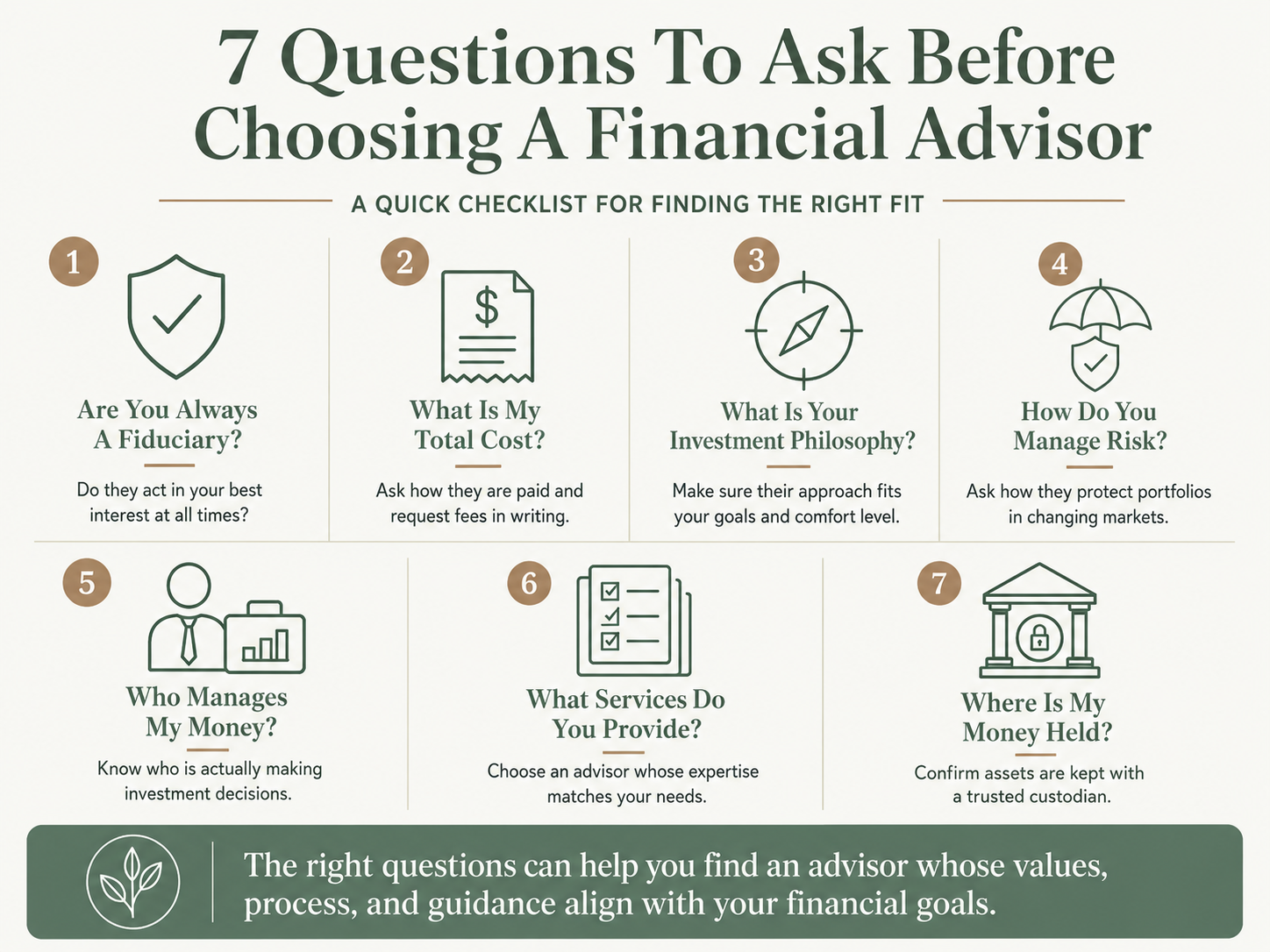
Most hourly advisors offer an initial 15- to 30-minute discovery call at no charge. Use this meeting to evaluate communication style, technical expertise, and operational transparency. Ask targeted questions to evaluate their suitability:
- Are you a fee-only fiduciary on 100% of your engagements? (The answer should be an unequivocal "yes.")
- How many hours do you estimate my specific project will take, and do you cap your billing?
- What is your experience handling clients in my specific financial situation?
- Will I receive a written financial plan with actionable implementation steps?
- Do you sell any financial products, or receive referral fees from insurance agents or custodians?
Step 5: Review and Sign the Engagement Letter
Before any work begins, the advisor must provide a formal engagement letter or agreement. This document must clearly state:
- The agreed-upon hourly rate and estimated total cost range.
- The exact scope of services to be provided.
- Retainer requirements (many advisors collect a portion of the estimated fee upfront, with the balance due upon delivery).
- Cancellation and refund policies.
Comparing Financial Advisory Pricing Models
To contextualize the value of hourly financial planning, compare how different advisory billing structures perform across key metrics:
| Metric / Feature | Hourly Fee-Only | AUM Fee-Only (Assets Under Management) | Fee-Based / Commission Hybrid |
|---|---|---|---|
| Primary Compensation | Billed per hour ($200–$500/hr) | Annual % of assets (typically 0.50%–1.25%) | Combination of fees, commissions, and product markups |
| Fiduciary Status | 100% Fiduciary across all services | 100% Fiduciary across all services | Dual-hatted: Fiduciary only when giving advice; Suitability standard when selling products |
| Asset Minimums | None | Often $250,000 to $1,000,000+ | Usually none |
| Best For | DIYers, project-specific needs, modular advice | Investors wanting full investment delegation | Consumers buying specific insurance policies or simple brokerage accounts |
| Conflict Potential | Minimal (billed strictly for time) | Low, though incentive exists to keep assets under direct management | High (incentive to recommend higher-commission products) |
| Implementation Responsibility | Client usually implements recommendations self-directed | Advisor directly manages and trades the portfolio | Advisor executes sales of proprietary/partner products |
Important Nuances: "Fee-Only" vs. "Fee-Based"
One of the most frequent traps consumers encounter is the subtle linguistic difference between Fee-Only and Fee-Based.
- Financial Advisor Types
- Fee-Only (Pure Fiduciary Model)
- Billed via Hourly, Flat Fee, or AUM
- Zero product commissions
- Legally required to put client first
- Fee-Based (Hybrid Compensation Model)
- Charges client fees (Hourly/AUM)
- AND earns commissions on products
- Switches between Fiduciary & Suitability
- Fee-Only (Pure Fiduciary Model)
Fee-Only Fiduciaries
Fee-only financial advisors earn revenue only directly from client fees. They cannot receive sales commissions, referral fees, soft-dollar kickbacks, or volume bonuses from fund companies, brokerages, or insurance firms. This structure ensures that when an hourly fee-only advisor recommends a course of action, it is motivated solely by your financial welfare.
Fee-Based Advisors
"Fee-based" sounds similar, but it represents a hybrid compensation model. Fee-based advisors can charge you an hourly rate or asset fee and earn commissions when you purchase annuities, life insurance, or front-load mutual funds through them. This dual capacity can create significant conflicts of interest, as the advisor may recommend products that yield compensation beyond their disclosed fee. Always demand explicit confirmation that an advisor is strictly Fee-Only.
Common Mistakes to Avoid When Hiring an Hourly Advisor
Even when targeting hourly advisors, clients can stumble into predictable pitfalls that degrade the value of the engagement.
- Arriving Unprepared for Meetings: Because you are paying by the hour, disorganized documentation directly increases your bill. Organize tax returns, portfolio statements, insurance policies, and estate documents before your first working session.
- Failing to Clarify Scope Creep: Unexpected financial questions often arise during planning. Ensure your advisor agrees to notify you before exceeding the initial hourly estimate.
- Assuming the Advisor Will Execute Trades: Hourly advisors typically provide advice, written plans, and allocation models, but they generally leave trade execution to you within your personal brokerage accounts (e.g., Vanguard, Fidelity, Schwab). If you prefer complete delegation, confirm whether the advisor offers ongoing implementation or if you must perform the trades yourself.
- Ignoring Post-Plan Reviews: A financial plan is not a static document. Life changes such as career shifts, tax law adjustments, or birth of dependents alter your financial trajectory. Plan periodic hourly check-ups every 12 to 24 months.
Frequently Asked Questions
How much does an hourly financial advisor cost on average?
Most hourly financial advisors charge between $200 and $500 per hour. Highly specialized practitioners or those in major metropolitan areas may charge up to $600 per hour. A modular plan addressing a single topic usually takes 2 to 4 hours ($400–$2,000), while a full baseline plan takes 8 to 15 hours ($1,600–$6,000+).
Do hourly financial advisors manage investment accounts directly?
Generally, no. Most hourly advisors operate on a non-discretionary basis, providing clear instructions for you to execute trades within your existing brokerage, IRA, or 401(k) accounts. Some hourly advisors offer optional ongoing execution services, but self-directed implementation remains the standard for hourly engagements.
How do I confirm an advisor is genuinely Fee-Only?
Ask the advisor for a copy of their Form ADV Part 2A narrative brochure, filed with the SEC or state regulator. Look at Item 5 ("Fees and Compensation"). A true fee-only advisor will explicitly state that they do not receive commissions, sales loads, or 12b-1 distribution fees for product sales.
Is an hourly advisor better than paying a 1% AUM fee?
It depends on your preference and asset size. If you have a $1,000,000 portfolio, a 1% AUM fee costs $10,000 per year indefinitely. An hourly advisor might charge $2,500 for a thorough annual review, saving you $7,500 annually while providing comparable strategic guidance. However, if you lack the discipline or time to manage trades yourself, an AUM manager's ongoing direct oversight may offer added peace of mind.
What documents should I prepare before working with an hourly advisor?
To maximize efficiency, gather recent pay stubs, tax returns (past two years), investment and bank statements, 401(k) option menus, mortgage and debt details, insurance policies (life, disability, property), and existing estate planning documents (wills, trusts, powers of attorney).
Next Steps to Take Action
If an hourly advisory model aligns with your financial priorities, take these immediate steps to start your selection process:
- Summarize Your Goals: Write down your primary financial questions and list all accounts and assets.
- Search Recognized Directories: Visit the Garrett Planning Network or NAPFA to find 3 to 4 fee-only hourly advisors operating in your state or working virtually.
- Perform Background Audits: Search each candidate's CRD number on the SEC IAPD database to review Form ADV Part 2A and check for past regulatory actions.
- Schedule Discovery Calls: Book free initial consultations with your top candidates, using the vetting questions detailed above.
- Compare Scope and Costs: Review the proposed engagement letters and cost estimates before making your final selection.
Image Gallery