Understanding Physician Assistant Malpractice Insurance Coverage
Physician assistant (PA) malpractice insurance—officially termed professional liability insurance—protects PAs against financial loss and legal liability resulting from alleged medical negligence, errors, or omissions during patient ca...
Physician assistant (PA) malpractice insurance—officially termed professional liability insurance—protects PAs against financial loss and legal liability resulting from alleged medical negligence, errors, or omissions during patient care. Coverage typically pays for legal defense costs, court fees, settlements, and judgment awards up to specified policy limits, safeguarding both the practitioner's financial security and medical license.
Contents
Disclaimer
This article is for informational purposes only and does not constitute formal legal or financial advice. Insurance regulations, policy terms, and scope of practice requirements vary by state, employer, and insurer. PAs should consult a licensed insurance broker or healthcare attorney to evaluate individual liability needs.
Essential Components of PA Malpractice Insurance
Medical professional liability insurance for physician assistants is designed to address the specific legal and clinical exposure inherent in modern collaborative medical practice. As physician assistants execute diagnostic evaluations, prescribe medications, perform procedures, and manage complex acute and chronic illnesses, their exposure to malpractice claims parallels the operational reality of healthcare delivery. Understanding the essential structure of a malpractice policy is necessary to ensure adequate protection.
Core PA Malpractice Policy Coverage Components:
- Direct Liability & Financial Protection
- Settlement awards
- Defense attorney fees
- Expert testimony
- Court fees
- Administrative & Regulatory Protection
- State Board defense
- HIPAA compliance proceedings
- Billing audit fees
- Deposition costs
- Supplemental & Practice Protections
- Moonlighting
- Volunteer care
- Good Samaritan acts
- Loss of earnings
Direct Medical Liability Coverage
At its core, a malpractice insurance policy covers allegations of medical error, delay in diagnosis, improper treatment, surgical errors, or failure to refer a patient to a specialist. When a patient files a lawsuit naming a PA as a defendant, the insurance policy triggers two primary forms of financial protection:
- Indemnity Payments: Money paid to compensate a plaintiff through a court judgment or an out-of-court settlement.
- Defense Costs: Legal fees, expert witness charges, court reporting fees, and administrative expenses necessary to construct a defense. Crucially, most standard policies pay defense costs in addition to policy limits, meaning legal defense expenses do not reduce the total funds available to pay settlements or judgments.
Administrative and Regulatory Board Protection
Malpractice claims are not the only threat to a PA's career. Disciplinary actions initiated by state medical boards, allegations of health records privacy violations under HIPAA, or billing audit investigations by federal or private payors present serious administrative exposure.
Standard individual policies usually include an administrative defense endorsement. This benefit pays for legal representation if a patient files a complaint directly with the state licensing board. Because an adverse board ruling can lead to license suspension or revocation, administrative legal defense is vital for career preservation.
Scope of Practice and Supervisory Requirements
Malpractice policies explicitly condition coverage on practicing within state law and established collaborative practice agreements (CPAs) or practice agreements with supervising/collaborative physicians. If a PA performs clinical duties outside their legal scope of practice, state regulation, or delegatory agreement, an insurer may deny coverage for an ensuing claim. As state legislative frameworks transition many PAs from direct supervision toward collaborative practice models, insurance policies must mirror these shifting regulatory frameworks.
Claims-Made vs. Occurrence Policies: Key Differences
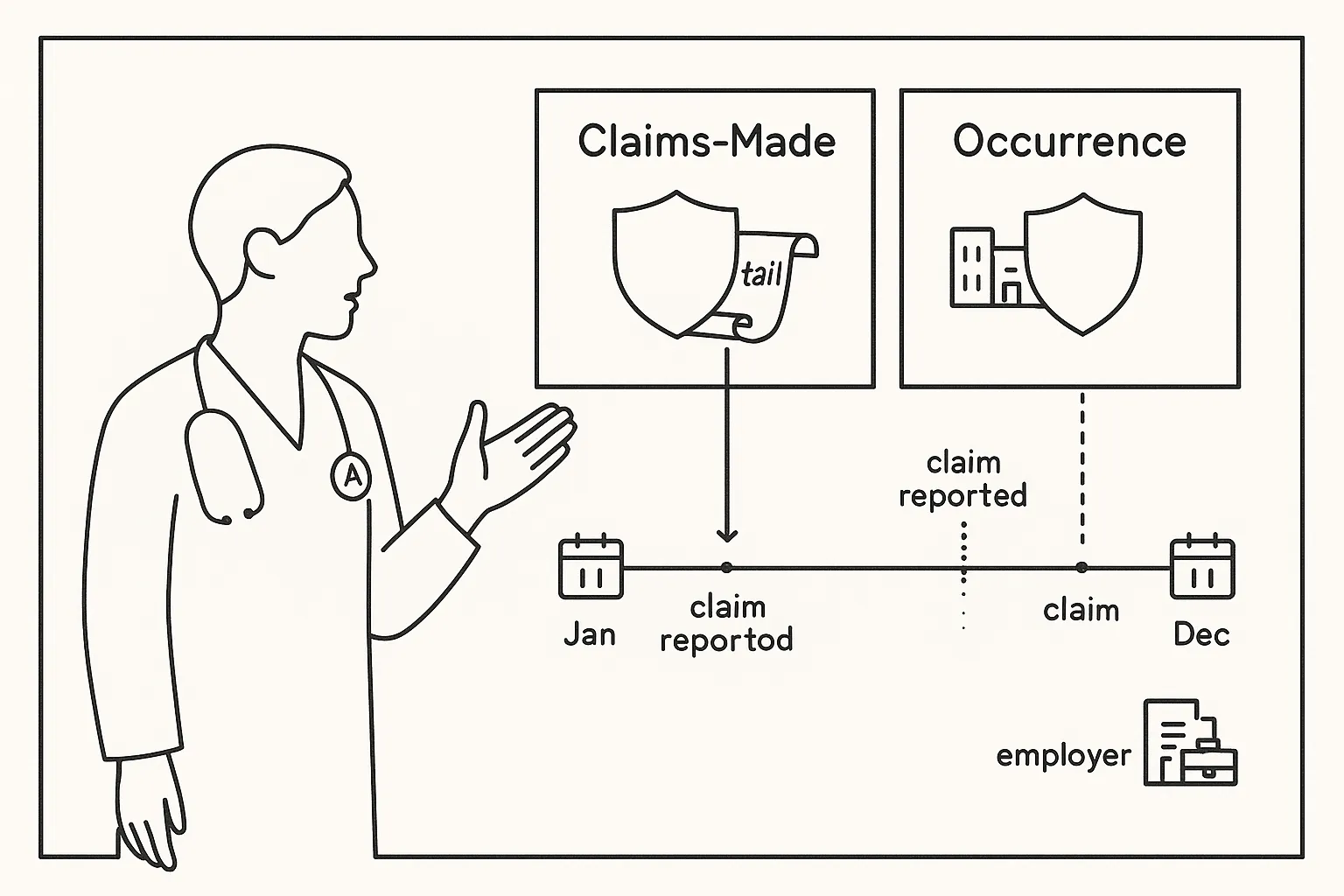
Selecting the correct policy structure is one of the most critical decisions a physician assistant makes. Professional liability insurance is primarily written under two structural formats: Claims-Made and Occurrence policies. The distinction lies in when an incident occurs versus when the lawsuit is officially filed.
- Claims-Made Policy
- Incident Occurs: Year 1
- Claim Filed: Year 3
- Coverage Status: Covered ONLY with active policy or purchased Tail Coverage
- Occurrence Policy
- Incident Occurs: Year 1
- Claim Filed: Year 3
- Coverage Status: Covered automatically because policy was active when incident occurred
Claims-Made Policies
A claims-made policy provides coverage only if both the alleged incident occurred and the resulting claim is reported while the policy remains continuously active.
- Retroactive Date: Every claims-made policy has a retroactive date (often the policy's original inception date). The policy covers incidents occurring on or after this retroactive date, provided the claim is filed during the policy term.
- Step-Up Premium Structure: Claims-made premiums start relatively low in year one and increase incrementally over the first four to five years ("stepping up") until reaching a mature rate, reflecting the cumulative exposure to past patient interactions.
- The Need for Extended Reporting Periods (Tail Coverage): When a claims-made policy is canceled, non-renewed, or terminated due to a job change, coverage for past acts ceases immediately unless an Extended Reporting Period (ERP)—commonly known as tail coverage—is purchased. Tail coverage ensures that claims reported in the future for care delivered while the policy was active remain fully covered. Tail coverage typically costs 150% to 250% of the mature annual policy premium as a one-time charge.
Occurrence Policies
An occurrence policy covers any incident that takes place during the policy period, regardless of when the claim or lawsuit is eventually filed—even if it is brought years after the policy has expired or the PA has retired.
- Permanent Coverage for the Policy Year: Because coverage is tied to the date of the clinical event, there is no need to purchase tail coverage when leaving an employer, switching carriers, or retiring.
- Higher Initial Cost: Premiums for occurrence policies are higher from year one because the insurer prices in the long-term risk of future claims arising from that year's work.
- Availability Limits: Occurrence policies are less common in private hospital employment settings today due to higher upfront costs for employers, though individual PA policies through major specialty providers frequently offer them.
Prior Acts (Nose) Coverage
As an alternative to purchasing tail coverage from an outgoing insurer, a PA changing jobs can sometimes purchase Prior Acts coverage (also called "nose coverage") from their new insurance carrier. Nose coverage transfers the retroactive date from the old policy to the new policy, maintaining unbroken coverage for past clinical work without requiring a separate tail purchase from the previous company.
Policy Limits and Endorsements Explained
Evaluating malpractice coverage requires a thorough understanding of policy limits and optional contract modifications known as endorsements.
Per-Claim vs. Aggregate Limits
Policy coverage is expressed as two numbers separated by a slash, such as $1,000,000 / $3,000,000 (often referenced as $1M/$3M):
- Per-Claim Limit ($1,000,000): The maximum amount the insurance company will pay for any single claim, settlement, or court judgment.
- Aggregate Limit ($3,000,000): The maximum total amount the insurer will pay for all claims filed against the policyholder during a single policy year.
While $1M/$3M remains the industry standard for most outpatient and inpatient physician assistants, higher-risk specialties—such as neurosurgery, orthopedic surgery, emergency medicine, and obstetrics—may require higher limits ($2M/$4M or $2M/$6M), depending on employer agreements and regional litigation risk.
| $1,000,000 Per-Claim | $3,000,000 Aggregate |
|---|---|
| Maximum payout for a single medical malpractice claim or judgment. | Maximum total payout for all claims filed within a single policy year. |
Essential Endorsements and Policy Clauses
- Consent to Settle Clause: A crucial contract provision governing whether an insurer can settle a lawsuit without the PA’s explicit approval. PAs should look for a "pure consent clause," which allows the policyholder to refuse a settlement offer and force the insurer to fight the suit in court.
- Hammer Clause (Modified Consent): If a policy contains a "hammer clause," and the PA refuses to consent to a settlement recommended by the insurer, the insurer’s financial liability is capped at the settlement offer amount. The PA becomes personally responsible for any eventual judgment or legal costs exceeding that offer.
- Moonlighting Coverage: Employer-provided malpractice policies almost exclusively restrict coverage to work performed within that specific employer's practice. If a PA performs independent locum tenens work, volunteers, or works part-time at an urgent care facility, an individual policy or specific moonlighting endorsement is required.
- Loss of Earnings Benefit: Reimburses the PA for missed work wages when required to attend depositions, arbitrations, or trial proceedings.
Employer-Provided Insurance vs. Individual Malpractice Policies
Many PAs rely entirely on employer-provided malpractice insurance through hospitals, health systems, or private medical groups. While employer coverage is a valuable benefit, reliance on group policies introduces distinct legal and financial vulnerabilities.
- Employer-Provided Coverage
- Shared limits across practice
- Defense prioritizes employer
- No coverage for outside work
- Potential gaps during transitions
- Employer controls tail decisions
- Individual Supplemental Coverage
- Separate individual limits
- Personal defense attorney
- Full moonlighting/volunteer cover
- Dedicated license board defense
- Tail/portability control rests with the PA
Shared vs. Separate Policy Limits
In many practice settings, an employer includes PAs on a corporate policy with shared limits. Under a shared limit arrangement, all clinicians named on the policy draw from the same aggregate pool of insurance dollars. If a co-worker or supervising physician is sued and exhausts the aggregate limit in a catastrophic judgment, insufficient coverage may remain for other defendants named in subsequent suits during that policy year. Securing an individual policy or ensuring an employer policy provides individual separate limits guarantees dedicated financial protection.
Conflicts of Interest in Defense Representation
When a malpractice lawsuit names both a healthcare facility and an employed PA, the employer’s insurer assigns legal counsel to represent both parties. However, legal strategies can diverge:
- The facility’s legal strategy might attempt to place full responsibility for a clinical mistake on the PA’s execution of a task.
- Conversely, the PA's defense might rely on systemic facility failures, inadequate staffing, or unclear physician supervision protocols.
In such scenarios, a single assigned attorney faces a conflict of interest. Holding an individual supplemental policy grants the PA independent legal counsel whose sole professional loyalty is to defend the PA's personal interest and license.
Coverage Gaps During Career Transitions
When leaving an employer, PAs holding employer-provided claims-made policies face significant vulnerability if the employment contract does not clearly stipulate who pays for tail coverage. If the employer refuses to pay for the tail policy, the departing PA must either pay a steep out-of-pocket sum or risk going bare for past acts performed at that practice.
Comparison of PA Malpractice Coverage Options
The following table summarizes the operational mechanisms, costs, and structural trade-offs across common PA malpractice coverage options:
| Coverage Model | Primary Advantage | Main Limitation | Tail Requirement | Typical Cost Profile |
|---|---|---|---|---|
| Claims-Made (Individual) | Lower initial annual premiums; clear retroactive tracking. | Requires tail coverage purchase upon policy cancellation or carrier change. | Yes (ERP required unless nose coverage purchased). | Incremental step-up over 4–5 years; mature cost varies by state/specialty. |
| Occurrence (Individual) | No tail coverage ever required; seamless long-term protection. | Higher upfront cost; less common in certain group distribution channels. | No | Consistently higher fixed annual premium from Year 1. |
| Employer-Provided (Shared Limits) | Paid by employer; zero direct administrative burden for PA. | Limits shared with entity/physicians; potential conflict of interest in defense. | Varies by employment contract terms. | Fully covered by employer (non-wage compensation). |
| Supplemental Individual Policy | Provides independent legal defense; covers license board disputes and outside work. | Secondary to employer coverage for primary clinical claims inside employer scope. | Varies based on whether policy is claims-made or occurrence. | Highly affordable ($500–$1,500/year for standard limits). |
Practical Steps to Evaluate and Secure the Right Malpractice Policy
Navigating professional liability coverage requires a methodical approach to contract review, risk management, and administrative tracking.
PA Malpractice Policy Evaluation Workflow:
- Step 1: Employer Audit
- Obtain Certificate of Insurance (COI); check tail obligations.
- Step 2: Limit Check
- Verify per-claim and aggregate limits meet local specialty norms.
- Step 3: Gap Analysis
- Identify moonlighting exposure, volunteer work, and board risks.
- Step 4: Supplemental
- Secure individual coverage to close all defense gaps.
Step 1: Request and Review Your Certificate of Insurance (COI)
Every PA should request a current Certificate of Insurance from their employer’s risk management department annually. The COI details:
- The insurance carrier's name and financial strength rating.
- Policy type (Claims-Made vs. Occurrence).
- Policy limits ($1M/$3M or higher) and whether limits are individual or shared.
- Retroactive date for claims-made policies.
Step 2: Audit Employment Contract Language for Tail Responsibilities
Before signing an employment contract, review the malpractice clause carefully. Ensure the contract explicitly addresses tail coverage responsibility:
- Ideal clause: The employer agrees to purchase and pay for full tail coverage upon termination of employment regardless of cause.
- Vetting restrictive clauses: Avoid contracts that obligate the PA to pay for tail coverage if terminated without cause, or that use tail costs as a financial penalty for departing the practice.
Step 3: Verify Alignment with Scope of Practice and State Law
Ensure that clinical responsibilities match the covered procedures on your policy. PAs adding specialized procedures (e.g., aesthetic injections, surgical assisting, joint injections, or emergency airway management) must confirm that the insurer has listed these clinical competencies within their risk category. The American Academy of Physician Associates (AAPA) provides updated state-by-state scope of practice profiles to assist PAs in verifying regulatory compliance.
Step 4: Evaluate the Need for Individual Supplemental Coverage
If your primary practice provides shared-limit claims-made coverage without board defense protections, purchasing a standalone supplemental policy is an effective risk mitigation strategy. Professional organizations like AAPA partner with carriers such as the Healthcare Providers Service Organization (HPSO) to offer portable individual policies designed specifically for PAs.
Step 5: Maintain Continuous Records
Retain copies of all historical Certificates of Insurance, policy declarations pages, job descriptions, collaborative practice agreements, and employment contracts permanently. If a claim arises five or ten years later regarding care delivered early in your career, having clear documentation of carrier names, policy numbers, and retroactive dates is essential to establishing coverage. Additional details regarding practitioner claims history and reporting standards can be referenced through the federal National Practitioner Data Bank (NPDB).
Frequently Asked Questions
Do physician assistants need their own malpractice insurance if their employer provides coverage?
While employer-provided coverage fulfills mandatory state requirements, holding an individual policy is strongly recommended. Employer policies prioritize protecting the business entity, share policy financial limits among multiple staff members, and generally omit coverage for license defense, volunteer activities, or secondary moonlighting work. An individual policy ensures dedicated legal representation focused solely on the PA's interests.
How much does PA malpractice insurance cost on average?
Individual malpractice insurance premiums for PAs typically range between $1,000 and $3,500 annually for a standard $1M/$3M policy. Costs vary based on geographic location, clinical specialty, procedural risk, and whether the policy is occurrence-based or claims-made. Surgical specialties, emergency medicine, and high-litigation states require higher premiums than outpatient primary care in low-litigation regions.
What is tail coverage, and who is responsible for paying for it?
Tail coverage (an Extended Reporting Period endorsement) extends the time frame during which a claim can be filed under a claims-made policy after the policy has ended. Responsibility for paying for tail coverage depends entirely on the employment contract. Some employers cover the full cost, others split the fee, and some require the PA to pay out-of-pocket unless specific tenure thresholds are met.
Does PA malpractice insurance cover moonlighting or volunteer work?
Employer-provided malpractice insurance almost never covers clinical work performed outside that employer's specific practice setting. To cover moonlighting, part-time secondary clinical work, or formal volunteer medical services, PAs must secure an individual policy or add an explicit endorsement covering those distinct clinical activities.
What happens if a malpractice claim exceeds my policy limits?
If a court awards a judgment exceeding your per-claim policy limit (for example, a $2.5 million judgment on a $1 million limit policy), the insurance company pays up to the $1 million limit. The PA and any co-defendants remain personally liable for the remaining $1.5 million balance, which can lead to wage garnishment, asset liquidation, or personal bankruptcy. This potential risk highlights the importance of matching policy limits to regional award trends.
How does a consent-to-settle clause affect a PA's career?
A consent-to-settle clause determines whether an insurance company can settle a malpractice lawsuit without the PA's written permission. Because settlements are reported to the National Practitioner Data Bank (NPDB) and can negatively impact credentialing and employment prospects, PAs should look for policies with a pure consent clause rather than a strict "hammer clause."
Strategic Recommendations for Practice Protection
Securing robust malpractice insurance coverage requires proactive oversight rather than passive reliance on employer human resource departments. To maintain complete professional protection throughout a career:
- Conduct an Annual Coverage Audit: Request an updated Certificate of Insurance annually and verify that your clinical duties match the policy's stated scope of practice.
- Negotiate Tail Language Prior to Employment: Secure contractual commitments requiring the employer to pay for extended reporting periods upon separation.
- Maintain Personal Supplemental Liability Coverage: Invest in an individual portable policy to ensure independent legal defense and coverage for licensing board matters.
- Document Thoroughly: Maintain a lifelong personal archive of past coverage certificates, collaborative agreements, and policy declarations pages.
Image Gallery