Why Universal Life Insurance Has Backfired for Many: The Rising Cost of Complexity
Universal Life (UL) insurance has backfired for many policyholders because the internal cost of insurance rises as the insured ages, often outpacing the interest earned on the policy’s cash value. When these policies are underfunded or...
Universal Life (UL) insurance has backfired for many policyholders because the internal cost of insurance rises as the insured ages, often outpacing the interest earned on the policy’s cash value. When these policies are underfunded or market interest rates underperform the original "projections," the cash value is depleted to cover costs. This creates a "death spiral" where policyholders must pay massive, unexpected premiums to keep the coverage from lapsing.
Contents
The Architectural Flaw: How Universal Life Works
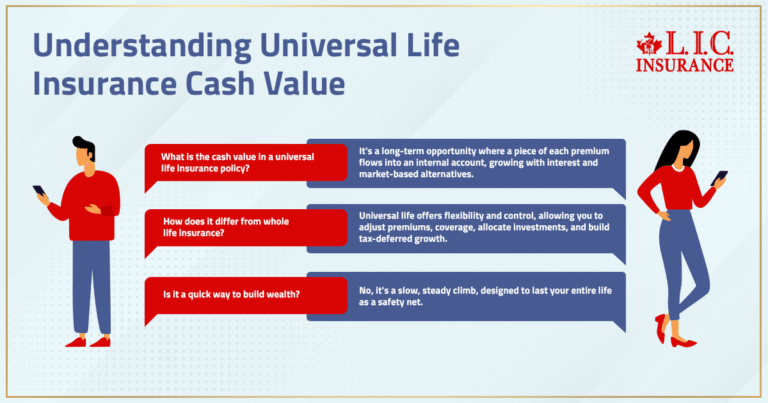
To understand why so many policies are failing in 2026, one must first understand the fundamental mechanics of Universal Life. Unlike Whole Life insurance, which features fixed premiums and guaranteed death benefits, Universal Life was designed as a "flexible" product. It unbundles the two main components of a permanent policy: the death benefit and the cash value accumulation.
In a UL policy, the premiums paid by the policyholder are credited to a cash account. Every month, the insurance company deducts the Cost of Insurance (COI) and various administrative fees from this account. The COI is not a flat rate; it is based on the insured's "attained age." As the policyholder grows older, the statistical likelihood of death increases, and the COI rises exponentially.
In the 1980s and 1990s, when many of these policies were sold, interest rates were high. Agents presented "illustrations"—hypothetical projections of future value—based on double-digit interest rates. Many policyholders were told they could pay a "planned premium" that was much lower than a Whole Life premium, and the high interest rates would cover the rising costs in later years. As interest rates plummeted and remained low for decades, those projections failed to materialize. The "flexible premium" became a trap: policyholders paid the minimum suggested amount, which was insufficient to build a buffer against the rising COI of old age.
The Three Primary Reasons for Policy Failure
While underfunding is the most common culprit, the "backfire" usually stems from a combination of economic and structural factors that converge as the policyholder reaches their 70s or 80s.
1. The Historical Interest Rate Mismatch
Most legacy UL policies were built on the assumption that interest rates would stay above 6% or 7%. When rates sat near zero for much of the early 21st century, the cash value in these policies grew at a crawl. Because the internal expenses (COI) continued to rise regardless of market performance, the insurance company began "cannibalizing" the principal cash value to pay the monthly fees. By the time interest rates began to normalize in the mid-2020s, many policies had already depleted their reserves beyond the point of recovery.
2. The Rising Cost of Insurance (COI)
The COI is the actual price of the "pure" insurance protection. For a 40-year-old, this cost is negligible. For an 85-year-old, it is astronomical. In a healthy policy, the cash value grows large enough that the "amount at risk" for the insurance company decreases, which keeps the COI manageable. However, if the cash value remains low, the insurance company is on the hook for nearly the entire death benefit. To compensate for this risk, they charge high COI rates, which can sometimes exceed $5,000 or $10,000 a month for older insured individuals with underfunded accounts.
3. Aggressive Illustrations and Mis-selling
For years, the life insurance industry relied on "static illustrations." These documents showed how a policy might perform if interest rates stayed exactly the same for 40 years. They rarely highlighted the "guaranteed" side of the ledger, which showed what would happen if interest rates hit the contractual minimum (often 2% or 3%). Many consumers treated these projections as guarantees, leading them to pay the minimum premium for years, unaware that they were effectively "hollowing out" their own life insurance.
Comparing Policy Types and Risk Profiles
Not all Universal Life policies carry the same level of risk. Understanding the variations is crucial for anyone currently holding a policy or considering a settlement.
| Policy Type | Primary Mechanism | Risk Factor | Common Failure Mode |
|---|---|---|---|
| Traditional UL | Fixed interest rate set by the carrier. | Low interest rate environments. | Cash value depletion due to rising COI. |
| Variable UL (VUL) | Cash value invested in sub-accounts (stocks/market). | Market volatility and sequence of returns risk. | Market crashes occurring while COI is at its peak. |
| Indexed UL (IUL) | Interest linked to a market index (e.g., S&P 500) with caps/floors. | High fees and "participation rate" changes. | Index returns failing to meet the "cap" needed to cover costs. |
| Guaranteed UL (GUL) | No cash value focus; focus on secondary guarantees. | Premium timing and "no-lapse" requirements. | Lapsing the policy because a single payment was late. |
The "Lapse-and-Tax" Trap: A Hidden Financial Danger
One of the most devastating ways Universal Life backfires is through the tax consequences of a policy lapse. When a policy enters a "death spiral," the owner may decide to simply let it go. However, if there was a policy loan outstanding—a common tactic used to access cash value in earlier years—the IRS treats the forgiven loan as taxable income to the extent that the policy's total value exceeds the "basis" (the total premiums paid).
In 2026, we are seeing "phantom income" crises where seniors lose their life insurance coverage and simultaneously receive a 1099-R for hundreds of thousands of dollars in "gains" that they never actually saw in cash. This occurs because the policy loans were used to pay the escalating premiums internally. When the policy terminates, those loans are considered "paid" by the surrender of the policy, triggering a massive tax bill during a time when the policyholder is often on a fixed income.
Modern Complications: The Shift to Indexed Universal Life (IUL)
While older "Fixed" Universal Life policies failed due to low interest rates, newer Indexed Universal Life (IUL) policies have backfired for different reasons. IULs are often marketed as having "market upside with no downside" because they have a 0% floor. However, the high internal fees and the use of "multipliers" or "bonuses" often make these policies extremely sensitive to performance.
If the market index returns are flat for several years, the 0% floor does not protect the policyholder from the internal COI and administrative fees. In 2026, many IUL holders who purchased policies in the 2010s are discovering that the "caps" (the maximum interest they can earn) have been lowered by insurance companies, while the "participation rates" have been reduced. This makes it mathematically impossible for the policy to sustain itself without significant additional capital.
How to Determine if Your Policy is at Risk
If you own a Universal Life policy, you should not wait for a "Grace Period" notice to arrive in the mail. By that time, it is often too late to save the coverage without a massive lump-sum payment.
- Request an In-Force Illustration: This is the most important step. Ask the insurance carrier for a projection based on "current assumptions" and another based on "guaranteed assumptions." Specifically, ask the illustration to show what premium is required to keep the policy in force until age 100 or 105.
- Check the "Net Amount at Risk": If the cash value is shrinking while the death benefit remains static, your policy is likely in a decline phase.
- Evaluate Loan Balances: If you have taken loans against the policy, determine the interest rate being charged on the loan versus the interest being credited to the policy. If there is a "negative spread," the loan is accelerating the policy's collapse.
Remedial Actions for Failing Policies
If an in-force illustration shows that your policy will lapse within the next 5 to 10 years, you have several options, though none are without trade-offs.
- Increase Premiums: This is the most direct solution. By overfunding the policy now, you can rebuild the cash value buffer and reduce the Net Amount at Risk, which lowers future COI charges.
- Reduce the Death Benefit: By lowering the face amount of the policy (e.g., moving from a $1 million benefit to $500,000), you immediately lower the monthly COI charges. This can often extend the life of a policy for decades without requiring higher premiums.
- The 1035 Exchange: You may be able to roll the remaining cash value into a Guaranteed Universal Life (GUL) policy or an annuity. A GUL functions more like a Whole Life policy, with a guaranteed premium that will not change, providing more certainty for the future.
- Life Settlements: If the insured is over 70 or has declining health, the policy may be valuable to a third-party investor. In a life settlement, you sell the policy for a lump sum that is higher than the cash surrender value but lower than the death benefit. The investor then takes over the premium payments and collects the benefit upon the insured's death.
- Reduced Paid-Up Insurance: Some policies allow you to stop paying premiums entirely in exchange for a significantly smaller, but guaranteed, death benefit.
Frequently Asked Questions
Why did my agent say I could stop paying premiums after 10 years?
This was a common sales pitch known as "vanishing premiums." It relied on the assumption that high interest rates would grow the cash value enough to cover all future costs. When interest rates dropped, the "vanished" premiums had to reappear, often at much higher levels, because the projected growth never happened.
Can the insurance company legally raise my costs?
Yes. Almost all Universal Life contracts allow the insurer to adjust the Cost of Insurance (COI) and administrative fees up to a "contractual maximum" stated in the policy. As long as they stay below that ceiling, they can increase your internal costs to reflect their own administrative expenses or changes in mortality expectations.
If my policy lapses, do I get any money back?
You only receive the "Cash Surrender Value," which is the total cash value minus any surrender charges and outstanding loans. In a failing policy, this amount is often close to zero. Furthermore, as mentioned previously, a lapse with outstanding loans can trigger a significant tax liability.
Is Whole Life insurance safer than Universal Life?
Generally, yes, in terms of predictability. Whole Life insurance has guaranteed premiums, guaranteed death benefits, and guaranteed cash value growth. However, Whole Life is significantly more expensive at the outset. Universal Life was designed for those who wanted lower initial costs and flexibility, but that flexibility shifted the economic risk from the insurance company to the policyholder.
Final Recommendation
For those holding a Universal Life policy in 2026, the most dangerous action is inaction. The internal mechanics of these policies are designed to accelerate toward failure once the cash value drops below a certain threshold. Contact your insurance carrier or a fee-only financial advisor immediately to request an in-force illustration. If the data shows a projected lapse, evaluate whether the death benefit is still necessary. If it is, consider a 1035 exchange into a guaranteed product or a reduction in the face amount to stabilize the policy. If the benefit is no longer needed, explore a life settlement before the cash value is entirely consumed by the rising cost of insurance.
Image Gallery