The Definitive List of All Nick Shows: Complete Catalog and Eras of Nickelodeon Television
Exploring the list of all Nick shows reveals decades of animation and live-action television history that shaped global pop culture, from pioneering 1990s Nicktoons to modern streaming hits. This comprehensive catalog organizes the net...
Exploring the list of all Nick shows reveals decades of animation and live-action television history that shaped global pop culture, from pioneering 1990s Nicktoons to modern streaming hits. This comprehensive catalog organizes the network's output by era, genre, and production milestones, offering deep insights into the programming evolution of Nickelodeon.
Contents
Evolution of Nickelodeon Programming Eras
Nickelodeon's programming strategy shifted dramatically since its launch as the Pinwheel network in 1977 and its 1979 rebranding. Understanding this historical progression helps frame how the network developed its signature tone, creator-driven models, and multi-platform distribution strategies.
The Pre-Nicktoons and Live-Action Foundation (1979–1990)
Before original animation defined the brand, Nickelodeon relied on imported foreign animation, acquired series, and groundbreaking live-action variety and game shows.
- Pinwheel: The foundational preschool series that established the network's early identity.
- You Can't Do That on Television: A Canadian sketch comedy series that introduced the iconic green slime and set the irreverent, kid-centric tone of the network.
- Double Dare: Hosted by Marc Summers, this messy physical challenge game show proved that game formats could thrive on cable children's television.
- Finders Keepers and Outta Control: Early attempts at interactive home-viewer and studio game formats.
The Golden Age of Nicktoons (1991–2000s)
The launch of the Nicktoons banner in 1991 revolutionized television animation by giving creative control directly to animators rather than toy executives. This era birthed auteur-driven series with distinct visual styles and sophisticated writing.
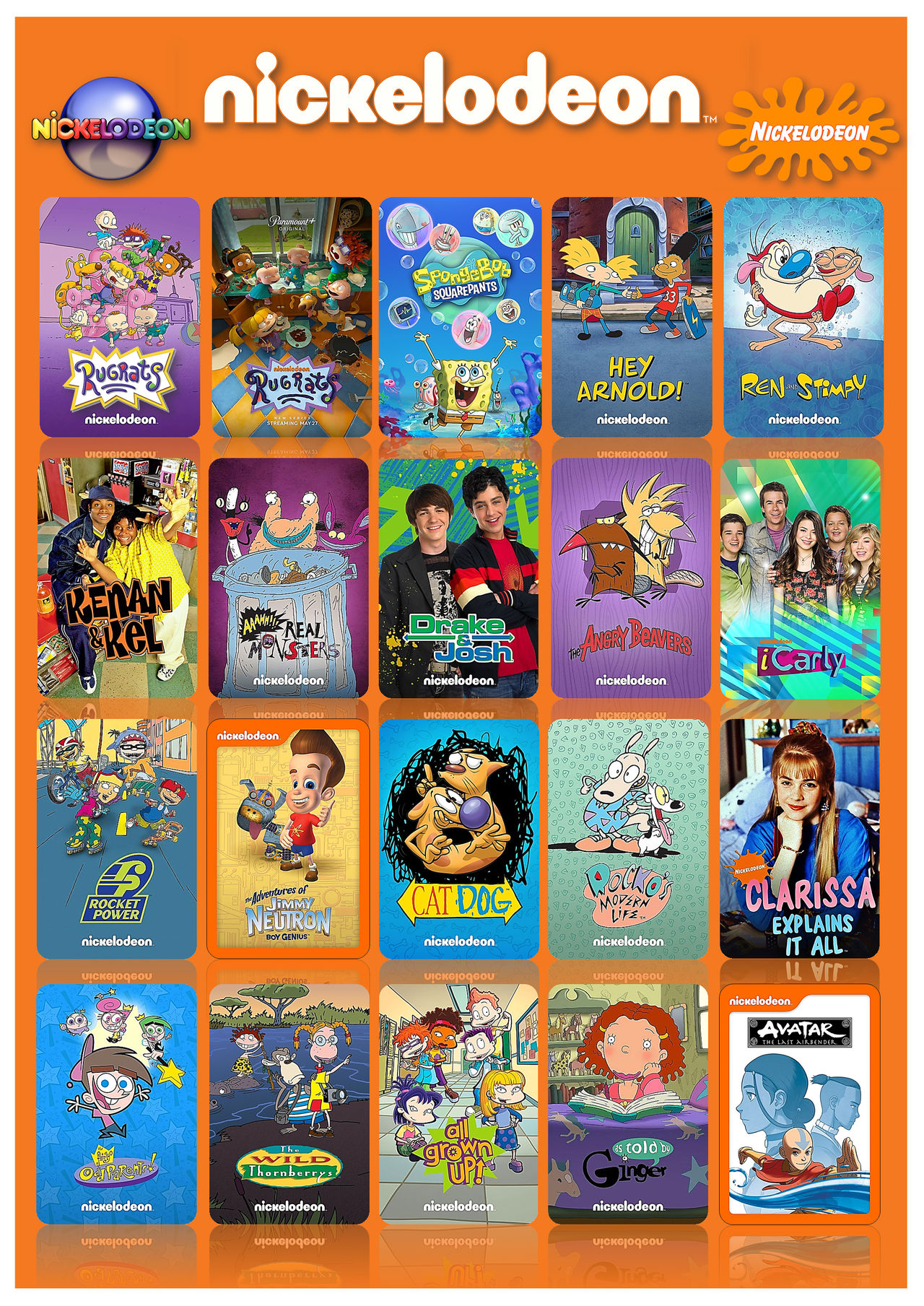
- Rugrats (1991–2004): Created by Arlene Klasky, Gábor Csupó, and Paul Germain, this series explored the world from a toddler's perspective and held the title of longest-running Nicktoon for over a decade.
- The Ren & Stimpy Show (1991–1995): John Kricfalusi's grotesque, highly detailed animation style broke traditional Saturday-morning rules and influenced an entire generation of alternative animators.
- Doug (1991–1994): Created by Jim Jinkins, this slice-of-life animated journal chronicled the awkward daily anxieties of an imaginative middle-schooler.
- Rocko's Modern Life (1993–1996): Joe Murray's surreal, satirical look at modern societal anxieties through the eyes of an Australian wallaby.
- SpongeBob SquarePants (1999–Present): Created by marine science educator Stephen Hillenburg, this cultural phenomenon remains the cornerstone of modern Nickelodeon television and merchandising.
The Sitcom Boom and Live-Action Expansion (2000s–2010s)
While animation maintained strong ratings, the 2000s saw the dominance of multi-camera and single-camera live-action sitcoms, largely driven by producers like Dan Schneider. These shows launched numerous teen music and acting careers.
- Drake & Josh (2004–2007): A quintessential step-sibling comedy starring Drake Bell and Josh Peck that defined mid-2000s teen sitcom writing.
- Ned's Declassified School Survival Guide (2004–2007): A single-camera comedy utilizing direct-to-camera fourth-wall breaks to offer humorous survival tips for middle school.
- iCarly (2007–2012): A pioneering series about webcasting that integrated early digital media culture into traditional television formats.
- Victorious (2010–2013): Set inside a Hollywood performing arts high school, blending musical numbers with ensemble sitcom tropes.
- The Loud House (2016–Present): Brought a massive resurgence to traditional 2D animation, centering on the chaotic household of an ambitious middle-schooler with ten sisters.
Categorized Master Catalog of Iconic Nick Shows
To navigate the expansive library of Nickelodeon content, the catalog below divides foundational and modern series across major network verticals.
| Show Title | Premiere Year | Finale Year / Status | Primary Genre | Target Demographic |
|---|---|---|---|---|
| Rugrats | 1991 | 2004 | Animation | Children / Family |
| The Ren & Stimpy Show | 1991 | 1995 | Animation | All Ages / Cult |
| Doug | 1991 | 1994 (Moved to Disney in 1996) | Animation | Children / Tweens |
| Rocko's Modern Life | 1993 | 1996 | Animation | All Ages / Satire |
| Aaahh!!! Real Monsters | 1994 | 1997 | Animation | Children |
| Hey Arnold! | 1996 | 2004 | Animation | Children / Tweens |
| The Angry Beavers | 1997 | 2001 | Animation | Children |
| CatDog | 1998 | 2005 | Animation | Children |
| The Wild Thornberries | 1998 | 2004 | Animation | Children / Family |
| SpongeBob SquarePants | 1999 | Ongoing | Animation | All Ages |
| The Fairly OddParents | 2001 | 2017 (Rebooted 2024) | Animation | Children / Tweens |
| Avatar: The Last Airbender | 2005 | 2008 | Action Animation | Tweens / Teens / Adults |
| Drake & Josh | 2004 | 2007 | Live-Action Sitcom | Tweens / Teens |
| iCarly | 2007 | 2012 | Live-Action Sitcom | Tweens / Teens |
| The Loud House | 2016 | Ongoing | Animation | Children / Family |
The Animation Giants: Nicktoons Legacy
The Nicktoons brand altered the economics of cable television by demonstrating that original animated series could match the cultural reach of theatrical feature films.
Action and Adventure Animation
While comedy dominated the early slate, mid-2000s programming introduced serialized narrative arcs with intricate world-building, high production values, and mature storytelling.
- Avatar: The Last Airbender (2005–2008): Combining Eastern philosophy, martial arts action, and serialized character development, creators Michael Dante DiMartino and Bryan Konietzko crafted one of the most critically acclaimed animated series in television history.
- The Legend of Korra (2012–2014): A mature sequel series that addressed sociopolitical conflict, industrialization, and psychological trauma within the established bending universe.
- Teenage Mutant Ninja Turtles (2012–2017): A CGI-animated reboot that balanced deep martial arts continuity with comedic character dynamics and expansive science-fiction plots.
The Live-Action Sitcom Ecosystem
Nickelodeon's live-action studio model relied heavily on soundstage filming with live studio audiences or single-camera cinematic setups.
Production Formulas and Creative Hubs
Shows filmed at Nickelodeon Studios at Universal Studios Florida (1990–2005) and later at the Nickelodeon on Sunset stages in Hollywood established a standardized studio system for young actors.
- All That (1994–2005, 2019–2020): Serving as a sketch comedy training ground for future stars like Kenan Thompson, Amanda Bynes, and Nick Cannon, this series functioned as a Saturday Night Live for kids.
- Kenan & Kel (1996–2000): A classic physical comedy vehicle highlighting the dynamic chemistry of its lead actors through structured running gags and fourth-wall interactions.
- Zoey 101 (2005–2008): Set at a fictional California boarding school, this single-camera series explored interpersonal teen dynamics without the constraints of a traditional multi-cam laugh track.
Preschool Programming: Nick Jr. Contributions
Programming tailored for toddlers under six represents a cornerstone of Nickelodeon's weekday broadcast block, combining education with cognitive interactivity.
Educational Frameworks in Preschool Television
Shows on Nick Jr. implement developmental psychology research to ensure cognitive retention and social-emotional learning milestones.
- Blue's Clues (1996–2006): Pioneered participatory television by encouraging preschool viewers to physically and verbally respond to on-screen prompts, utilizing repeating formats to build confidence.
- Dora the Explorer (2000–2019): Integrated foundational bilingual (Spanish-English) vocabulary, map-reading skills, and active problem-solving frameworks into linear adventure narratives.
- PAW Patrol (2013–Present): Produced in partnership with Spin Master, this rescue-themed CG animation combines emergency services literacy with cooperative teamwork models.
Frequently Asked Questions
What was the very first Nicktoon ever broadcast?
The first three Nicktoons—Rugrats, The Ren & Stimpy Show, and Doug—all premiered on the exact same day: August 11, 1991. This simultaneous launch established the network's original animation block.
Who created SpongeBob SquarePants and when did it premiere?
SpongeBob SquarePants was created by marine biologist and animator Stephen Hillenburg, premiering officially on May 1, 1999, following the Kids' Choice Awards. It remains the longest-running original series on the network.
Are all classic Nickelodeon shows available on streaming platforms?
Streaming availability varies by licensing agreements, international territories, and platform partnerships. Major streaming hubs like Paramount+ host a vast majority of the classic Nicktoon and live-action library, though certain acquired series or specific seasons may require digital purchase or rotation.
What is the difference between Nickelodeon and Nick Jr.?
Nickelodeon is the primary broad-audience network targeting children, tweens, and families with animation and live-action sitcoms. Nick Jr. operates as a specialized programming block and dedicated channel focusing exclusively on educational and developmental content for preschoolers aged two to six.
How did the Nicktoons era change television animation?
Before 1991, cable networks primarily aired syndicated reruns or toy-commercial cartoons. Nickelodeon gave creators complete artistic freedom and higher production budgets, proving that creator-driven animation could attract broad demographic audiences and drive massive consumer product lines.
Strategic Guide to Exploring the Nickelodeon Catalog
- Identify Your Preferred Era: Decide whether you want nostalgic 1990s hand-drawn animation, 2000s multi-camera teen sitcoms, or modern serialized action adventures.
- Check Platform Availability: Access streaming services like Paramount+ or digital storefronts where comprehensive archives are indexed by release year and franchise.
- Explore Creator Filmographies: Follow specific creators—such as Stephen Hillenburg, Craig Bartlett, or Butch Hartman—to trace distinct artistic styles across different decades of production.
- Review Continuity and Reboots: Distinguish between original runs and modern revivals, such as the CG-animated Rugrats reboot or recent Fairly OddParents expansions, to understand character timelines.
Image Gallery