Progressive Commercial Auto Certificate of Insurance Sample: A Detailed 2026 Guide
A Progressive commercial auto certificate of insurance (COI) is a standardized document, typically issued on an ACORD 25 form, that provides summarized proof of active business vehicle coverage. It outlines policy effective dates, cove...
A Progressive commercial auto certificate of insurance (COI) is a standardized document, typically issued on an ACORD 25 form, that provides summarized proof of active business vehicle coverage. It outlines policy effective dates, coverage limits for liability and physical damage, and identifies the insurer, the policyholder, and the certificate holder requesting the proof.
Contents
Navigating the requirements of commercial insurance can be a complex task for business owners, contractors, and fleet managers. Whether you are entering a new contract, leasing a facility, or bidding on a government project, providing a professional and accurate certificate of insurance is a non-negotiable step in the verification of risk management.
As of 2026, Progressive Commercial remains one of the largest providers of business vehicle insurance in the United States. Understanding how their certificate of insurance is structured, what information it must contain, and how to obtain one is essential for maintaining operational compliance and securing new business opportunities.
What is a Progressive Commercial Auto Certificate of Insurance?
A certificate of insurance is not an insurance policy itself; rather, it is a summary of the most important aspects of an existing policy. For Progressive commercial auto customers, this document is usually formatted using the ACORD 25 template, which is the industry standard recognized by brokers, lenders, and government agencies.
The primary purpose of the COI is to provide "evidence of insurance" to a third party (the certificate holder) without requiring the policyholder to share their entire multi-page policy contract. It serves as a snapshot of coverage at a specific moment in time. However, it is vital to remember that the COI is for informational purposes only. It does not amend, extend, or alter the coverage afforded by the actual Progressive policy. If there is a conflict between the certificate and the policy, the policy language dictates the legal reality of the coverage.
The Role of Progressive as the Carrier
Progressive Commercial operates through several different underwriting companies depending on the state and the specific risk profile. When looking at a sample COI, you will often see names like Progressive Casualty Insurance Company, Progressive Specialty Insurance Company, or United Financial Casualty Company listed under the "Insurers Affording Coverage" section. Knowing which specific Progressive entity carries your risk is important for legal and claims-filing purposes.
Structural Breakdown of a Progressive COI Sample
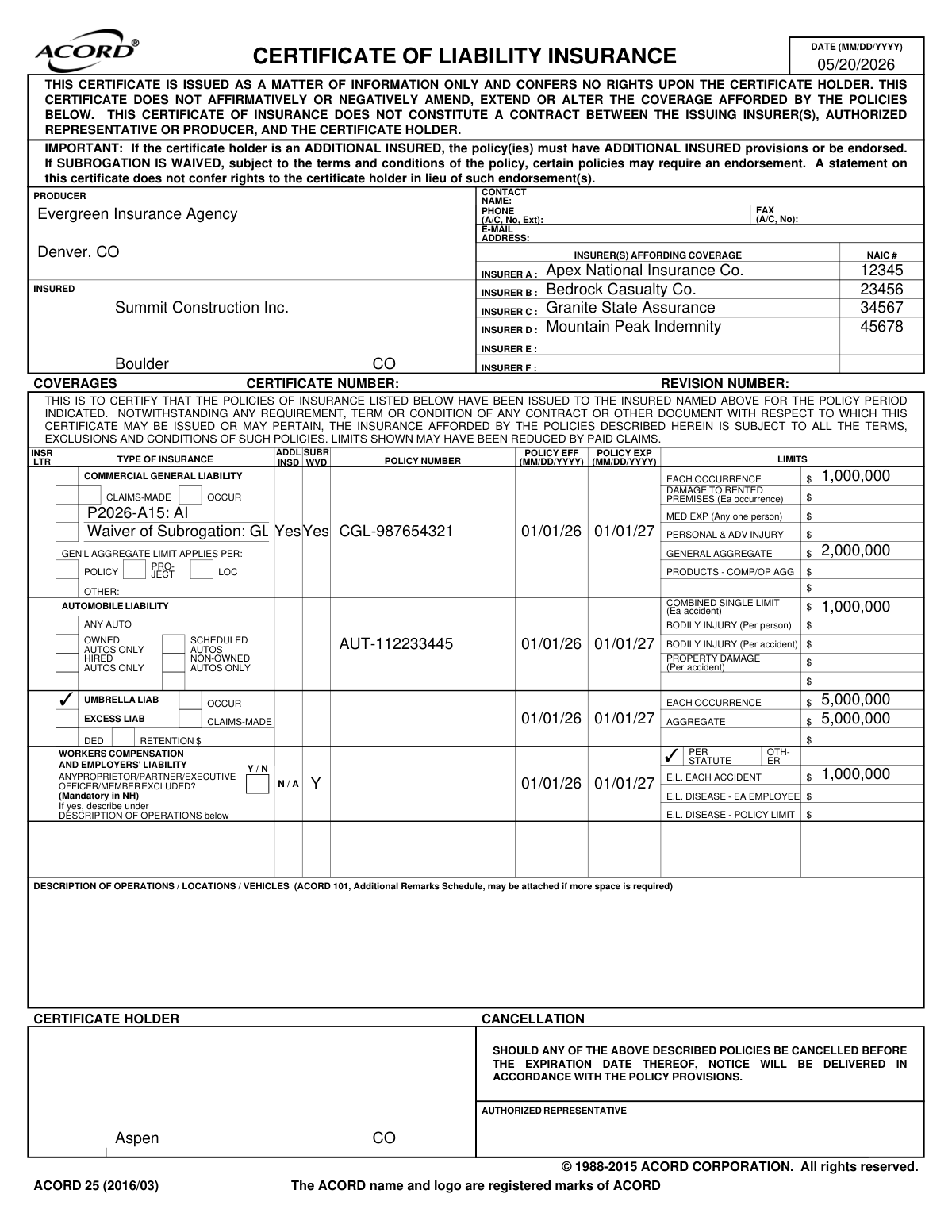
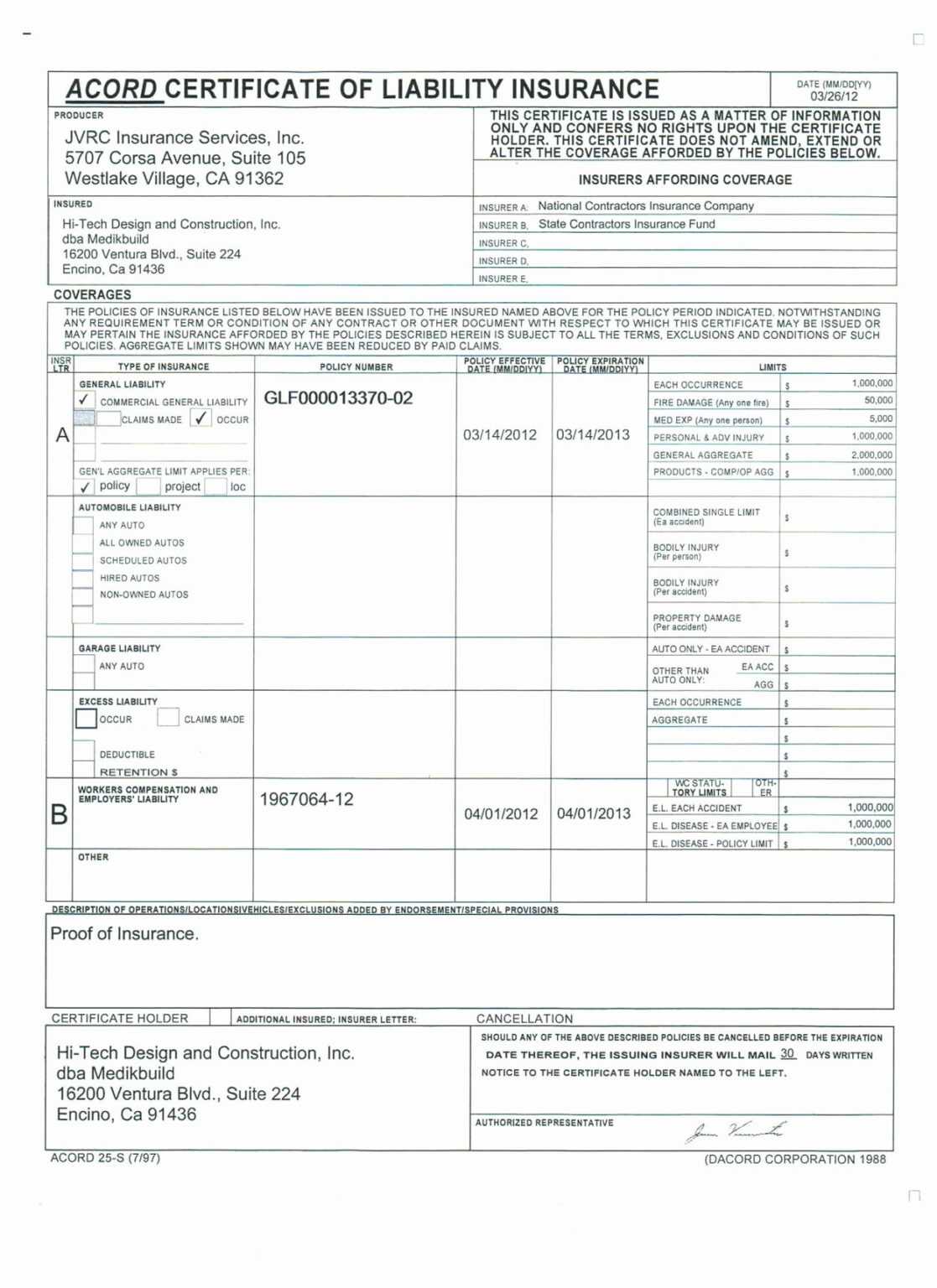
To understand what a valid Progressive commercial auto COI looks like, one must examine the specific fields of the ACORD 25 form. Each section serves a distinct legal and administrative purpose.
1. Header Information: Producer and Insured
The top left of the document identifies the Producer. This is the insurance agency or broker who manages the policy. If you purchased your policy directly through Progressive, this section may list Progressive's direct contact information.
The Insured section must exactly match the legal name of your business as registered with the Secretary of State or your local business licensing authority. Discrepancies here—such as using a "Doing Business As" (DBA) name without the legal entity name—can lead to the rejection of the certificate by your clients.
2. Insurers Affording Coverage
This section assigns a letter (A, B, C, etc.) to the specific insurance companies providing the coverage. In a standard Progressive commercial auto sample, "Insurer A" is usually the Progressive entity providing the primary auto liability. This allows the document to reference which company provides which coverage in the rows below.
3. Coverages and Policy Limits
This is the "meat" of the certificate. For commercial auto insurance, the following fields are critical:
- Policy Number: A unique identifier for your Progressive account.
- Effective and Expiration Dates: These must show that the policy is currently active.
- Automobile Liability: This section indicates what types of vehicles are covered. Common markers include "Any Auto," "All Owned Autos," "Scheduled Autos," or "Hired and Non-Owned Autos."
- Liability Limits: This lists the maximum amount Progressive will pay in the event of an accident. Usually, this is expressed as a Combined Single Limit (CSL), such as $1,000,000.
4. Description of Operations / Vehicles / Exclusions
This text box is often where specific requirements from a contract are addressed. For example, if a client requires you to list a specific project name or requires a "Waiver of Subrogation," that language is inserted here. It may also list specific VIN numbers if the policy is a "Scheduled Auto" policy rather than an "Any Auto" policy.
5. Certificate Holder
The bottom left box identifies the person or entity requesting the proof of insurance. This is not you; it is your client, landlord, or the general contractor. Their name and full mailing address must be included for the document to be considered a formal notice of insurance.
How to Obtain Your Progressive Commercial Auto COI in 2026
In 2026, Progressive has streamlined the process of generating certificates of insurance through digital platforms. There are three primary methods to secure a COI:
The Progressive Commercial Online Portal
Most business owners prefer the self-service route. By logging into the Progressive Commercial policyholder site, you can:
- Navigate to the "Documents" or "Certificates" tab.
- Select "Create New Certificate."
- Enter the name and address of the Certificate Holder.
- Add any specific language required in the "Description of Operations" (subject to underwriting approval).
- Download the PDF instantly.
Mobile App Integration
The Progressive mobile app has been updated for 2026 to allow users to generate and email COIs directly from a smartphone. This is particularly useful for contractors or truck drivers who are on a job site and need to provide proof of insurance immediately to gain access to a facility.
Contacting Your Agent
If your contract requires complex endorsements—such as "Primary and Non-Contributory" language or "Additional Insured" status for a specific entity—you should contact your Progressive agent. They have the authority to issue certificates that include these specialized legal provisions, ensuring your document meets the exact specifications of your contract.
Key Coverage Limits and Definitions
When reviewing a Progressive commercial auto COI, you will encounter specific insurance terminology. Understanding these terms ensures you are carrying the correct amount of risk.
| Coverage Component | Standard Limit Example | Purpose |
|---|---|---|
| Combined Single Limit (CSL) | $1,000,000 | The total amount paid for all bodily injury and property damage in one accident. |
| Hired & Non-Owned Auto | Included/Excluded | Covers liability for vehicles you rent or employee vehicles used for business. |
| Medical Payments | $5,000 | Covers medical expenses for you or your passengers regardless of fault. |
| Uninsured Motorist (UM) | Matches Liability | Protects you if you are hit by a driver with no insurance. |
| Comprehensive/Collision | Actual Cash Value (ACV) | Covers physical damage to your own business vehicles. |
The Difference Between "Any Auto" and "Scheduled Autos"
If your COI has a checkmark next to "Any Auto," you have the broadest form of coverage. It means that any vehicle you own, hire, or use for business is covered. If the checkmark is next to "Scheduled Autos," only the specific vehicles listed on your policy (and sometimes listed by VIN on the COI) are covered. Many large contracts, especially in construction or logistics, require "Any Auto" coverage to mitigate the risk of an unlisted vehicle causing a loss.
Why Clients Require a Progressive COI
The request for a COI is a fundamental part of risk transfer. When a company hires a subcontractor or a transport provider, they want to ensure that if an accident occurs involving the provider’s vehicle, the provider’s insurance (Progressive) will pay for the damages.
Without a COI, the hiring company’s own insurance would potentially have to cover the loss, which would lead to higher premiums and a worse loss history for them. Furthermore, in many industries, it is a regulatory requirement to verify that all parties on a job site carry minimum levels of liability and workers' compensation insurance.
Verifying Authenticity and Preventing Fraud
As a certificate holder receiving a Progressive COI from a vendor, verification is a critical step. Insurance fraud via forged COIs is a persistent issue in the commercial sector.
- Check the Producer Contact: Ensure the agency listed is a legitimate Progressive representative. You can often verify an agency through your state's Department of Insurance website.
- Verify the Policy Status: You can contact Progressive’s commercial customer service or use their online verification tools to confirm that the policy number listed is active and matches the name of the insured.
- Watch for Manual Alterations: Look for fonts that don't match or blurred text in the limits section, which may indicate someone has tampered with a PDF to show higher limits than they actually have.
- Expiration Monitoring: A COI only proves coverage on the day it was issued. In 2026, many companies use automated tracking software to alert them when a vendor’s Progressive policy is nearing its expiration date, prompting a request for a renewal certificate.
Common Mistakes to Avoid When Issuing a COI
Errors on a certificate can lead to project delays or breach of contract claims. To ensure your Progressive COI is accepted the first time, avoid these common pitfalls:
- Incorrect Holder Information: Ensure the Certificate Holder's legal name is spelled correctly. If the contract says "City of Los Angeles," don't just put "The City."
- Insufficient Limits: If your contract requires $2,000,000 in liability but your Progressive policy only has $1,000,000, the COI will be rejected. You may need an Umbrella or Excess Liability policy to bridge the gap.
- Missing Endorsements: Many clients require being named as an "Additional Insured." Simply listing their name in the Certificate Holder box does not grant them this status. Your agent must specifically add the Additional Insured endorsement to your policy for it to be reflected accurately on the COI.
- Expired Forms: Ensure you are using the most current version of the ACORD 25 form. While older versions are sometimes accepted, some modern compliance departments will reject any form that is out of date.
FAQ
Does a Progressive COI guarantee coverage for the whole year?
No. A COI is a snapshot of the policy at the time of issuance. If the policyholder stops paying their premiums or cancels the policy the day after the COI is issued, the certificate does not "keep" the coverage active. Most COIs include a disclaimer stating that the insurer will "endeavor" to notify the certificate holder if the policy is canceled, but this is rarely a legal guarantee.
Can I get a COI if I only have personal auto insurance with Progressive?
Generally, no. A standard ACORD 25 commercial certificate is designed for commercial policies. If you use your personal vehicle for business, you should speak with a Progressive agent about a Commercial Auto Policy. Personal policies often have exclusions for business use, and a personal "ID Card" is usually not accepted as a substitute for a professional COI in business contracts.
How much does it cost to get a Progressive COI?
Progressive does not typically charge a fee for issuing a standard certificate of insurance. It is considered a part of the policyholder's service. However, if you need to increase your policy limits or add specific endorsements (like "Additional Insured" or "Waiver of Subrogation") to meet a client's requirements, your premium may increase.
What should I do if my client requires "Primary and Non-Contributory" language?
This is a common requirement in construction. It means that your Progressive policy will pay first in the event of a claim, and the client’s insurance will not be asked to contribute. You must ask your Progressive agent to add this specific endorsement to your policy. Once added, the wording can be included in the "Description of Operations" section of your COI.
Is a digital copy of a Progressive COI legally valid?
Yes, in 2026, digital PDF copies of COIs are the industry standard and are legally recognized for most contractual and regulatory purposes. Very few entities still require a "wet signature" or an original paper copy sent via mail.
Final Recommendation
When managing your Progressive commercial auto insurance, treat the certificate of insurance as a vital business asset. Always double-check that the insured name matches your legal business entity and that your liability limits meet or exceed your contractual requirements. To maintain maximum professional credibility, utilize the Progressive online portal to generate clean, accurate, and timely certificates for your clients. If you encounter complex requirements such as "Waiver of Subrogation" or "Additional Insured" status, consult with an authorized Progressive agent to ensure your policy is properly endorsed before the certificate is issued.
Image Gallery