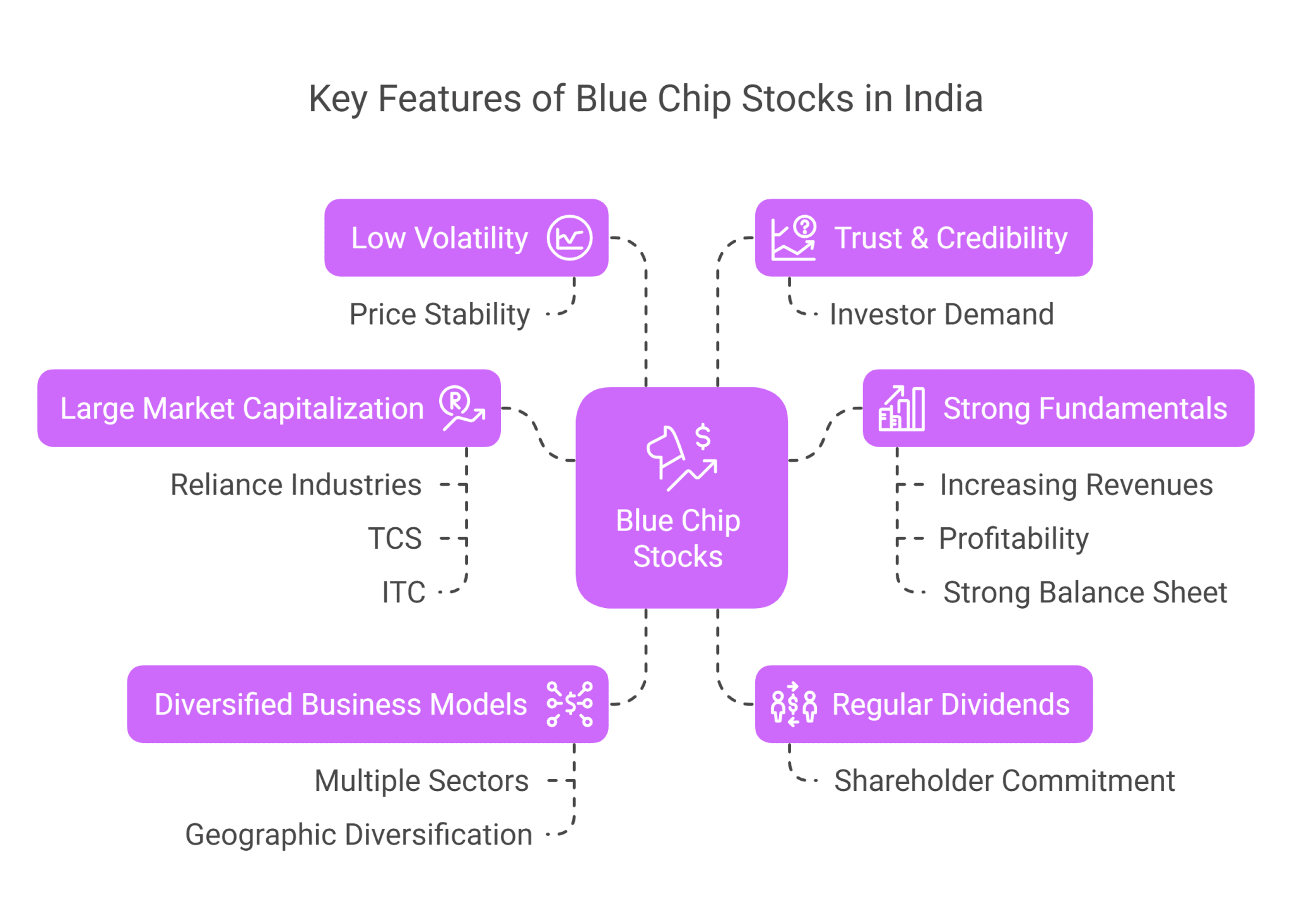
10 Examples of Blue Chip Stocks for a Stable Portfolio in 2026
Blue chip stocks are shares of well-established, financially sound companies that lead their industries and have a long history of stable earnings and dividend payments. Key examples include industry giants like Apple, Microsoft, Coca-...
Blue chip stocks are shares of well-established, financially sound companies that lead their industries and have a long history of stable earnings and dividend payments. Key examples include industry giants like Apple, Microsoft, Coca-Cola, Johnson & Johnson, Walmart, and JPMorgan Chase, which provide investors with reliable long-term growth and lower volatility.
Contents
For investors navigating the market in 2026, blue chip stocks represent the "gold standard" of equity ownership. These companies are typically characterized by multi-billion dollar market capitalizations, household name recognition, and the ability to weather economic downturns more effectively than smaller, more speculative firms. While no investment is entirely without risk, blue chips are the foundation of many retirement portfolios and institutional holdings because of their proven resilience and consistent shareholder returns.
What Defines a Blue Chip Stock?
The term "blue chip" originated in the early 1920s, borrowed from the game of poker, where blue chips held the highest value. In modern finance, a blue chip stock is defined by several specific criteria that separate it from the broader market.
Market Capitalization and Leadership
A blue chip company is almost always a "large-cap" stock, usually with a market valuation exceeding $10 billion, though many examples today are valued in the hundreds of billions or even trillions. Beyond size, these companies are leaders in their respective sectors. They often possess a "wide moat"—a term popularized by Warren Buffett—referring to a significant competitive advantage that protects their market share from rivals.
Financial Stability and Dividend History
Consistency is the hallmark of a blue chip. These firms demonstrate reliable earnings growth over decades, not just years. Perhaps most importantly for income-focused investors, blue chips often have a track record of paying—and frequently increasing—dividends. Many are classified as "Dividend Aristocrats" (S&P 500 companies that have increased dividends for at least 25 consecutive years) or "Dividend Kings" (50+ years).
Inclusion in Major Indices
Blue chips are the constituents of major stock market indices such as the Dow Jones Industrial Average (DJIA), the S&P 500, and the Nasdaq-100. Their performance often serves as a barometer for the health of the overall economy.
10 Essential Examples of Blue Chip Stocks
The following 10 companies represent diverse sectors of the economy, illustrating the variety of industries where blue chip stability can be found.
1. Apple Inc. (AAPL)
Apple is the quintessential modern blue chip. As of 2026, it remains a dominant force in global technology, driven by the iPhone ecosystem, wearable tech, and a rapidly expanding services division. Apple’s strength lies in its incredible brand loyalty and its "walled garden" software environment, which makes it difficult for customers to switch to competitors. With a massive cash reserve and a commitment to aggressive share buybacks and growing dividends, Apple provides both capital appreciation and income stability.
2. Microsoft Corporation (MSFT)
Microsoft has successfully transitioned from a legacy software provider to a cloud computing powerhouse. Its Azure platform is a leader in enterprise infrastructure, while its Office 365 suite remains the standard for global business productivity. Microsoft’s revenue streams are highly diversified across gaming (Xbox), professional networking (LinkedIn), and artificial intelligence integrations. Its consistent triple-A credit rating—a rarity in the corporate world—underscores its exceptional financial health.
3. The Coca-Cola Company (KO)
Coca-Cola is the definitive "recession-proof" blue chip. Regardless of the economic climate, consumer demand for beverages remains relatively inelastic. Operating in over 200 countries, Coca-Cola owns a massive portfolio of brands beyond its namesake soda, including water, sports drinks, and juices. It is a "Dividend King," having increased its annual dividend for over 60 consecutive years, making it a favorite for conservative income investors.
4. Johnson & Johnson (JNJ)
As a leader in the healthcare sector, Johnson & Johnson provides stability through its pharmaceutical and med-tech divisions. Following the spin-off of its consumer health business (Kenvue), J&J has focused more intensely on high-margin drug development and innovative medical devices. The constant demand for healthcare services and life-saving medications ensures that J&J remains a defensive powerhouse in any portfolio.
5. JPMorgan Chase & Co. (JPM)
JPMorgan Chase is the largest bank in the United States and a global leader in investment banking and asset management. Led by a long-tenured management team, the bank maintains what it calls a "fortress balance sheet," designed to withstand severe market shocks. Its scale allows it to invest heavily in technology, maintaining a competitive edge over smaller regional banks and fintech startups.
6. Walmart Inc. (WMT)
Walmart is the world’s largest retailer and a critical pillar of the U.S. economy. Its "Everyday Low Price" strategy makes it the destination of choice for consumers during inflationary periods. In recent years, Walmart has successfully integrated its physical footprint with a robust e-commerce and delivery platform, effectively competing with digital-native retailers while leveraging its massive physical inventory.
7. Visa Inc. (V)
Visa operates at the heart of the global financial system. It does not issue cards or extend credit; instead, it provides the technology infrastructure that allows electronic payments to happen. Because it takes a small percentage of every transaction processed on its network, Visa benefits directly from the long-term global shift away from cash toward digital payments. Its high profit margins and low capital expenditure requirements make it a high-quality blue chip.
8. The Procter & Gamble Company (PG)
Procter & Gamble is the parent company of household staples like Tide, Gillette, and Crest. These are products that consumers buy regardless of whether the economy is booming or in a recession. P&G’s ability to pass on cost increases to consumers through brand power (pricing power) helps it maintain margins even during periods of high inflation. Like Coca-Cola, it is a legendary dividend payer with decades of consistent increases.
9. McDonald’s Corporation (MCD)
McDonald’s is as much a real estate company as it is a fast-food giant. By owning the land on which its franchises sit and collecting rent and royalties, McDonald’s generates highly predictable cash flows. Its global brand recognition and ability to adapt its menu to local tastes ensure its continued relevance. Its "all-weather" business model has allowed it to raise dividends consistently for nearly half a century.
10. Chevron Corporation (CVX)
Representing the energy sector, Chevron is one of the "supermajors." It maintains a disciplined approach to capital spending and has one of the strongest balance sheets in the oil and gas industry. Chevron is valued by investors for its ability to generate significant free cash flow, which it uses to fund a reliable and growing dividend, even when commodity prices are volatile.
Comparative Analysis of Top Blue Chips
| Company | Ticker | Sector | Key Strength | Dividend Status |
|---|---|---|---|---|
| Apple | AAPL | Technology | Ecosystem & Brand Loyalty | Growth & Buybacks |
| Microsoft | MSFT | Technology | Cloud & Enterprise Dominance | Consistent Growth |
| Coca-Cola | KO | Consumer Staples | Global Distribution | Dividend King |
| J&J | JNJ | Healthcare | Pharmaceutical Innovation | Dividend King |
| JPMorgan | JPM | Financials | Fortress Balance Sheet | Industry Leader |
| Walmart | WMT | Consumer Staples | Scale & Logistics | Dividend Aristocrat |
| Visa | V | Financials | Transaction Infrastructure | High Margins |
| P&G | PG | Consumer Staples | Essential Household Brands | Dividend King |
| McDonald's | MCD | Consumer Cyclical | Real Estate & Franchising | Dividend Aristocrat |
| Chevron | CVX | Energy | Capital Discipline | Dividend Aristocrat |
The Role of Blue Chips in a Diversified Portfolio
While growth stocks (like emerging tech or biotech firms) offer the potential for massive returns, they also carry a high risk of total loss. Blue chip stocks serve a different purpose: wealth preservation and steady compounding.
Risk Mitigation
During market corrections or "bear markets," blue chips tend to fall less than the broader market. Because these companies have deep pockets and essential products, investors view them as "safe havens." This lower volatility helps investors stay the course during turbulent times without panicking.
The Power of Reinvested Dividends
For long-term investors, the real magic of blue chips comes from Dividend Reinvestment Plans (DRIPs). By automatically using dividend payments to buy more shares, investors can benefit from the power of compounding. Over a 20-year horizon, a significant portion of the total return from stocks like P&G or Coca-Cola often comes from dividends rather than just stock price appreciation.
Inflation Protection
Many blue chips possess "pricing power." Because they sell essential goods or have dominant market positions, they can raise prices when their own costs go up without losing their customer base. This makes them an effective hedge against inflation, which can erode the value of cash and fixed-income investments like bonds.
Common Mistakes When Investing in Blue Chips
Even though blue chips are considered "safe," investors should avoid these common pitfalls:
- Confusing "Big" with "Safe": Not every large company is a blue chip. A company can have a massive market cap but be saddled with debt or facing terminal industry decline (e.g., legacy department stores or declining fossil fuel firms without a transition plan).
- Ignoring Valuation: Even a great company can be a bad investment if you pay too much for it. Always look at the Price-to-Earnings (P/E) ratio relative to historical averages.
- Lack of Diversification: Holding only tech blue chips (like Apple and Microsoft) leaves you exposed to sector-specific downturns. A balanced blue-chip portfolio should span healthcare, staples, financials, and industrials.
- Setting and Forgetting: While blue chips require less active management, "forever" is a long time. Investors should still review quarterly earnings to ensure the company's competitive advantage (its "moat") isn't eroding.
Frequently Asked Questions
Are blue chip stocks guaranteed to make money?
No investment is guaranteed. While blue chips are historically more stable, individual companies can fail or lose market dominance due to technological shifts or poor management. However, as a group, they have historically outperformed the market on a risk-adjusted basis over long periods.
How many blue chip stocks should I own?
For most individual investors, owning 10 to 15 blue chip stocks across different sectors provides significant diversification. Alternatively, investors can buy an Exchange-Traded Fund (ETF) that tracks the Dow Jones or the S&P 500 to gain exposure to hundreds of blue chips at once.
Do blue chip stocks grow as fast as startups?
Generally, no. Blue chips are mature companies. They have already captured much of their market share, so their growth is typically slower and steadier. Investors trade the "moonshot" potential of a startup for the "sleep-well-at-night" security of an established giant.
What is the difference between a blue chip and a value stock?
Many blue chips are also value stocks (trading at a reasonable price relative to earnings), but not all. Some blue chips, like Microsoft or Visa, are considered "growth" blue chips because they still maintain high double-digit revenue growth despite their massive size.
Final Recommendation for Investors
If you are building a portfolio in 2026, blue chip stocks should likely form the core of your equity allocation. For those starting out, consider beginning with "Dividend Aristocrats" to ensure you are selecting companies with a proven commitment to shareholders. Before investing, verify the current debt-to-equity ratios and payout ratios of these firms to ensure their dividends remain sustainable in the current interest rate environment.
Disclaimer: This article is for informational purposes only and does not constitute financial, legal, or investment advice. Consult with a certified financial advisor before making any investment decisions.
Image Gallery