How to Navigate Northern California Amtrak Stations: A Complete Traveler's Guide
Navigating Northern California Amtrak stations requires understanding key regional hubs, available rail routes, and multi-modal transit connections across the Greater Bay Area and Central Valley. Whether transferring between regional p...
Navigating Northern California Amtrak stations requires understanding key regional hubs, available rail routes, and multi-modal transit connections across the Greater Bay Area and Central Valley. Whether transferring between regional passenger trains like the Capitol Corridor and long-distance lines or connecting to local subways, buses, and ferries, mastering station layouts, ticketing systems, and Thruway bus connections ensures efficient travel across the region.
Contents
Understanding Northern California's Amtrak Network
Northern California features one of the busiest passenger rail corridors in the United States. Unlike simpler transit networks, Amtrak operations in Northern California are split between state-supported regional services—managed by joint powers authorities in partnership with Caltrans—and national long-distance intercity routes. Knowing which service line operates out of your target station helps you anticipate platform layouts, boarding procedures, and ticketing rules.
Regional Routes
- Capitol Corridor: Runs between San Jose Diridon and Sacramento/Auburn, traveling through Silicon Valley, the East Bay, and the Carquinez Strait. It operates as an unreserved regional service with frequent daily departures. Detailed schedules and route maps are managed directly by the Capitol Corridor Joint Powers Authority.
- San Joaquins: Connects the San Francisco Bay Area and Sacramento to the Central Valley, running south through Fresno to Bakersfield. Operated under the governance of the San Joaquin Joint Powers Authority, this route relies heavily on integrated motorcoach connections to reach Southern California and coastal destinations.
Long-Distance Interstate Routes
- Coast Starlight: A daily route connecting Los Angeles to Seattle, making key Northern California stops at San Jose, Oakland, Emeryville, Sacramento, and Dunsmuir.
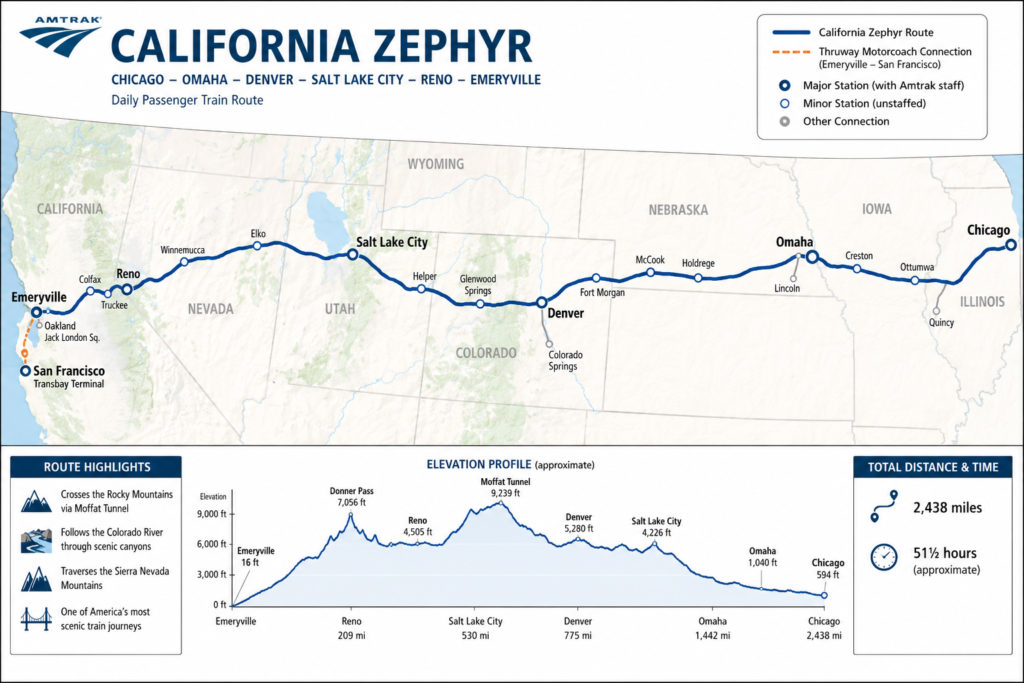
- California Zephyr: Daily service running from Emeryville to Chicago via Sacramento, crossing the Sierra Nevada mountains with stops in Truckee and Reno.
Northern California Rail Connections:
- California Zephyr
- San Jose Diridon
- Caltrain / VTA Light Rail
- Sacramento Valley (SAC)
- Emeryville (EMY)
- SF Thruway Bus / BART Transfers
- San Jose Diridon
Major Station Hubs and Layouts
Navigating Northern California stations efficiently depends on understanding the unique operational layout of each major hub. Facilities range from massive multi-modal transit centers to historic depots and streamlined transfer platforms.
Sacramento Valley Station (SAC)
Located at 401 I Street on the edge of Downtown Sacramento, Sacramento Valley Station is the primary rail junction in the region. It serves as a major station for the Capitol Corridor, San Joaquins, Coast Starlight, and California Zephyr.
- Station Layout: The historic 1926 station building houses ticketing counters, waiting rooms, customer service, and baggage facilities. Passengers access the train platforms via a extended pedestrian walkway and tunnel system. Allow at least 7 to 10 minutes to walk from the main terminal building to the boarding platforms.
- Transit Connections: Sacramento Regional Transit (SacRT) light rail (Gold Line) stops directly outside the station, providing direct access to Downtown, Midtown, and Folsom. Local and express SacRT buses also board along I Street.
- Parking & Drop-Off: Short-term and long-term paid parking lots are located directly west and north of the main terminal. Dedicated passenger drop-off zones sit directly in front of the primary entrance.
Emeryville Station (EMY)
Located at 5885 Horton Street, Emeryville serves as the primary gateway for rail passengers bound for San Francisco, as direct passenger rail tracks do not cross the San Francisco–Oakland Bay Bridge.
- Station Layout: Emeryville features a modern, single-building terminal with clear lines of sight. It includes an indoor waiting hall, ticket counter, automated kiosks, and a full-service baggage check desk. Platforms are situated directly behind the main waiting area, accessible via an overhead pedestrian bridge equipped with elevators and stairs.
- Thruway Bus Operations: Amtrak Thruway buses pull up along a dedicated roadway directly adjacent to the trackside entrance. Passengers transferring to San Francisco step off the train and board dedicated motorcoaches staged under covered bays.
Richmond Station (RIC)
Situated at 1700 Nevin Avenue, Richmond is engineered specifically for rapid intermodal transfers between Amtrak regional trains and the Bay Area Rapid Transit (BART) system.
- Station Layout: Richmond features a dual-level platform design. Amtrak Capitol Corridor and San Joaquins trains use the ground-level heavy rail tracks, while BART operates on an elevated structure above.
- Cross-Platform Transfer: A central pedestrian bridge equipped with elevators and escalators connects the Amtrak platform directly to the BART faregates. Transferring passengers can move between Amtrak and BART in under 3 minutes without leaving the station precinct.
San Jose Diridon Station (SJC)
Located at 65 Cahill Street, Diridon Station is Silicon Valley’s main passenger rail terminal, linking Amtrak regional services with local commuter rail and light rail.
- Station Layout: The station features a spacious historic depot building with ticketing, waiting rooms, and restrooms. A broad pedestrian subway tunnel runs beneath the tracks, leading to platforms 1 through 9. Clear digital display boards in the main hall and tunnel indicate departure tracks.
- Connecting Transit: Diridon provides direct connections to Caltrain (for service along the SF Peninsula), Santa Clara Valley Transportation Authority (VTA) Light Rail, Altamont Corridor Express (ACE) trains, and regional VTA bus lines.
Oakland Jack London Square (OKJ)
Positioned at 245 2nd Street, Oakland Jack London Square offers a urban rail experience in close proximity to the waterfront.
- Station Layout: The facility consists of a glass-fronted modern terminal building. Tracks run at street level alongside the station building. Passengers access trains directly from ground-level platforms.
- Transit Connections: Passengers can walk three blocks to the Jack London Square ferry terminal for SF Bay Ferry departures to San Francisco and Alameda, or board AC Transit local buses along Broadway.
Comparing Major Northern California Amtrak Stations
The following table summarizes key operational features, connecting transit systems, and platform configurations across primary Northern California stations:
| Station Name & Code | Key Amtrak Routes Served | Major Transit Connections | Baggage & Amenities | Transfer Complexity |
|---|---|---|---|---|
| Sacramento Valley (SAC) | Capitol Corridor, San Joaquins, Coast Starlight, California Zephyr | SacRT Light Rail (Gold Line), SacRT Bus, Yolobus | Full ticket office, checked baggage, waiting room, cafe | Moderate (long tunnel walk to platforms) |
| Emeryville (EMY) | Capitol Corridor, San Joaquins, Coast Starlight, California Zephyr | Amtrak Thruway Bus (SF connection), Emery Go-Round | Full ticket office, checked baggage, quiet waiting area | Low (direct motorcoach staging adjacent to tracks) |
| Richmond (RIC) | Capitol Corridor, San Joaquins | BART (Orange & Red Lines), AC Transit | Automated ticketing kiosks, sheltered platform seating | Low (seamless elevated bridge transfer to BART) |
| San Jose Diridon (SJC) | Capitol Corridor, Coast Starlight | Caltrain, VTA Light Rail, ACE, Amtrak Thruway | Ticket office, checked baggage, waiting hall, parking structures | Moderate (subway tunnel access to multiple platforms) |
| Oakland Jack London (OKJ) | Capitol Corridor, San Joaquins, Coast Starlight | SF Bay Ferry, AC Transit, Broadway Shuttle | Ticket office, checked baggage, indoor seating area | Low (ground-level platform layout) |
| Martinez (MTZ) | Capitol Corridor, San Joaquins, Coast Starlight, California Zephyr | County Connection, Tri Delta Transit | Ticket office, checked baggage, historic depot hall | Low (compact station layout with clear track access) |
How San Francisco Thruway Transfers Work
Because no train tracks link the East Bay directly across the Bay Bridge into downtown San Francisco, Amtrak uses dedicated Thruway Motorcoach buses to transport passengers into the city.
San Francisco Thruway Transfers:
- Amtrak Train (Arrives at Emeryville - EMY)
- Step off train onto platform
- Follow signs to dedicated Thruway bus bays
- Board bus bound for Salesforce Transit Ctr
Navigating the Emeryville Connection
- Guaranteed Connections: When booking your Amtrak ticket, select your final destination as San Francisco (station code SFC for Salesforce Transit Center or designated curb stops). Booking a combined train-bus itinerary guarantees your connection; if the train is delayed, the connecting Thruway bus is held or rescheduled.
- Boarding at Emeryville: Upon arriving at Emeryville, exit the train onto the platform and walk around the station building toward the designated bus loading lane. Bus drivers check your single combined ticket prior to boarding.
- Luggage Handling: If you checked baggage at your origin station for a San Francisco destination, station staff automatically transfer your checked luggage from the baggage car to the underside luggage compartment of the Thruway motorcoach.
Ticketing, Fares, and Regional Transit Transfers
Understanding the distinct ticketing rules across Northern California rail operators avoids delays at boarding gates and onboard ticket checks.
Reserved vs. Unreserved Routes
- Capitol Corridor: Uses an unreserved ticketing model. A ticket purchased for a Capitol Corridor route is valid on any Capitol Corridor train operating between the specified origin and destination within its validity period. Seating is first-come, first-served.
- San Joaquins & Long-Distance Lines: Require reserved ticketing. Passengers must travel on the exact train date and departure time listed on their ticket, as seat inventory is managed per departure.
Transit Pass Integration and Clipper Cards
- Clipper Card: The unified contactless transit card used across the Bay Area (BART, Caltrain, SF Muni, AC Transit, VTA, SF Bay Ferry). Amtrak trains do not accept Clipper Cards directly for fare payment. You must purchase an Amtrak ticket separately via the Amtrak app, website, ticket counter, or platform kiosk.
- Transit Transfer Vouchers: Passengers riding the Capitol Corridor can request a free transit transfer pass from the conductor or through digital promotions. This voucher grants a free transfer to connecting local bus systems, including AC Transit, County Connection, Sacramento Regional Transit, and VTA buses.
Station Facilities, Accessibility, and Bicycle Policy
ADA Accessibility
All primary Northern California Amtrak stations comply with Americans with Disabilities Act (ADA) requirements. Facilities feature accessible ticketing desks, wheelchair lifts or level-boarding platforms, accessible restrooms, and designated parking spaces.
- Platform Heights: Newer or retrofitted stations (such as Richmond and Sacramento) feature high-level platforms or mobile lift devices to assist passengers with mobility devices during boarding.
- Assistance Services: Passengers requiring red cap or conductor assistance with boarding or luggage should notify Amtrak when booking or alert station staff at least 30 minutes before scheduled departure.
Bicycle Carriage and Locker Storage
Northern California is highly bike-friendly, and Amtrak accommodates cyclists through both onboard transit and station storage options:
- Onboard Storage (Capitol Corridor & San Joaquins): Trains feature dedicated bicycle cars or designated lower-level racks in passenger cars. Passengers can roll their bikes directly onto the train free of charge without dismantling them. Spaces are limited and available on a first-come, first-served basis.
- Long-Distance Trains: The Coast Starlight and California Zephyr require reservation of bike slots in advance for a nominal fee, with bikes stored in the baggage car or dedicated onboard racks.
- Station Lockers: Major stations like Emeryville, Sacramento, and San Jose offer secure electronic bike lockers (such as BikeLink lockers) for passengers leaving their bicycles at the station overnight.
Practical Troubleshooting and Travel Tips
To ensure smooth travel through Northern California Amtrak hubs, keep these operational guidelines in mind:
- Arrive with Adequate Lead Time: For unreserved regional trains (Capitol Corridor) without checked luggage, arrive 15 minutes before departure. For long-distance trains (Coast Starlight, California Zephyr) or itineraries requiring checked baggage, arrive 45 to 60 minutes early.
- Monitor Live Tracking: Rail traffic through Northern California shares tracks with Freight operators (Union Pacific). Download the Amtrak mobile app or check the Capitol Corridor real-time train status tool to monitor delays before arriving at the platform.
- Baggage Cut-off Times: Checked baggage desks at hubs like Sacramento, Emeryville, and San Jose close strictly 45 minutes prior to scheduled train departures. Excess carry-on items that exceed Amtrak size limits (28 x 22 x 11 inches) must be checked or adjusted before boarding.
Frequently Asked Questions
How do I get to downtown San Francisco from a Northern California Amtrak station?
The most seamless route is taking an Amtrak train to Emeryville Station (EMY) and transferring to a dedicated Amtrak Thruway bus bound for the Salesforce Transit Center in San Francisco. Alternatively, passengers can board a Capitol Corridor or San Joaquins train to Richmond Station (RIC) and make a cross-platform transfer directly to a San Francisco-bound BART train.
Can I use my Clipper Card to pay for Amtrak train fares in Northern California?
No. Clipper Cards are accepted across Bay Area regional systems like BART, Caltrain, and local buses, but Amtrak requires its own distinct ticket. You can purchase Amtrak tickets using the Amtrak app, website, station ticket windows, or self-service kiosks located inside stations.
Which Northern California Amtrak stations offer full checked baggage service?
Full-service stations offering checked baggage include Sacramento Valley (SAC), Emeryville (EMY), Oakland Jack London Square (OKJ), San Jose Diridon (SJC), and Martinez (MTZ). Unstaffed or smaller platform stops (such as Berkeley, Hayward, or Suisun-Fairfield) do not handle checked baggage.
How does the transfer between BART and Amtrak work at Richmond Station?
At Richmond Station, Amtrak trains arrive at ground level while BART trains operate on an elevated upper platform. Passengers exit the Amtrak train, take an elevator or escalator up to the station concourse, pass through the BART faregates using a Clipper Card or mobile payment, and proceed directly to the BART platform.
Are bicycles allowed on Northern California Amtrak trains?
Yes. Regional services like the Capitol Corridor and San Joaquins offer unreserved, roll-on bicycle storage on a first-come, first-served basis. Long-distance trains such as the Coast Starlight and California Zephyr require advance reservations for bike storage in the baggage car.
Next Steps for Your Journey
To plan your trip across Northern California’s passenger rail network:
- Download the Amtrak App: Store digital e-tickets, receive gate alerts, and track live train locations in real time.
- Verify Route Maps: Review connection points at Capitol Corridor and San Joaquins to coordinate multi-modal bus or transit vouchers.
- Set Up Clipper Mobile Payment: If transferring to BART, Caltrain, or local buses at stations like Richmond or San Jose, load funds onto your digital wallet or Clipper Card prior to departure.
Image Gallery