What is ICS 100? Introduction to the Incident Command System Explained
ICS 100, officially designated by FEMA as IS-100.c, is a foundational training course that introduces the Incident Command System (ICS). It establishes standardized operational structures, common terminology, and management principles...
ICS 100, officially designated by FEMA as IS-100.c, is a foundational training course that introduces the Incident Command System (ICS). It establishes standardized operational structures, common terminology, and management principles for first responders, healthcare professionals, and emergency personnel to effectively coordinate multi-agency responses during natural disasters, security emergencies, or planned public events.
Contents
The Incident Command System represents the operational backbone of disaster management in the United States. Designed to eliminate chaos, jurisdictional friction, and communication failures during complex emergencies, ICS 100 provides the baseline knowledge necessary for any individual who may deploy or support operations during a local, state, or federal response.
The Origins and Purpose of the Incident Command System
The Incident Command System was developed in the 1970s following a series of catastrophic wildfires in Southern California. Response agencies identified that operational failures were rarely caused by a lack of equipment or tactical skill; instead, failures stemmed from breakdowns in interagency communications, disorganized leadership hierarchies, and conflicting operational terminology. Multiple agencies responding to the same fire used incompatible radio codes and competing command structures, leading to compromised public safety and misallocated resources.
To solve this, the FIRESCOPE (Firefighting Resources of California Organized for Potential Emergencies) program engineered a standardized on-scene emergency management framework. That framework evolved into the modern Incident Command System. Following the terrorist attacks of September 11, 2001, the federal government issued Homeland Security Presidential Directive 5 (HSPD-5), which mandated the creation of the National Incident Management System (NIMS).
Under NIMS, the Incident Command System was codified as the national standard for all on-scene emergency incident management. ICS 100 serves as the primary gateway into this framework, ensuring that whether an emergency involves a five-person search-and-rescue mission or a multi-state hurricane recovery effort, all participating personnel operate under the same organizational playbook.
Core Principles Taught in ICS 100
ICS 100 introduces fundamental management concepts that distinguish crisis leadership from standard daily administration. Rather than relying on rigid, peacetime bureaucratic processes, ICS employs flexible, modular principles that expand or contract depending on the severity of the hazard.
1. Common Terminology and Plain Language
One of the most critical rules established in ICS 100 is the strict prohibition of agency-specific jargon and 10-codes (e.g., "10-4" or "10-33"). Because a single incident can involve municipal police, private ambulance contractors, state transportation crews, and the National Guard, communications must use clear text (plain language). Common terminology also applies to organizational elements, position titles, and facility designations.
2. Chain of Command and Unity of Command
ICS establishes an unbroken line of authority that eliminates conflicting orders:
- Chain of Command: The orderly line of authority along which orders are passed from superior to subordinate throughout the incident organization.
- Unity of Command: The foundational management rule stating that every individual deployed at an incident reports directly to only one designated supervisor. This ensures responders do not receive contradictory directives from multiple agency leaders.
3. Unified Command vs. Single Incident Commander
While Unity of Command governs individual reporting relationships, the overall management of an incident can take two forms:
- Single Command: Used when an incident occurs within a single jurisdiction without overlapping legal or functional authorities (e.g., a local house fire managed solely by the municipal fire department).
- Unified Command: Implemented when an incident crosses political borders or involves multiple agencies with distinct legal responsibilities (e.g., a hazardous chemical spill affecting a railway, a navigable river, and residential properties). Under Unified Command, designated agency leaders jointly manage the crisis, developing a single, shared set of incident objectives without compromising individual agency authorities.
4. Manageable Span of Control
Supervisory overload is a frequent point of failure in rapid-onset disasters. ICS 100 defines the operational "span of control" as the number of individuals or resources that one supervisor can effectively manage.
The standard ICS span of control ranges from three to seven subordinates, with five considered optimal. When a supervisor's direct reports exceed seven, the organizational structure must expand by activating additional divisions, groups, or units to maintain safety and accountability.
5. Incident Action Planning (IAP)
Coordinated response requires proactive planning rather than reactive decision-making. Central to ICS is the development of an Incident Action Plan (IAP). For small incidents, an IAP may be oral and concise; for large, multi-day incidents, it is a formal, written document outlining tactical objectives, assignments, safety warnings, and communication plans for a specific operational period (typically 12 to 24 hours).
6. Standardized Incident Facilities
ICS 100 teaches responders how to locate and utilize specific operational hubs established during an incident:
- Incident Command Post (ICP): The on-scene location where the Incident Commander oversees operations. There is only one ICP per incident.
- Staging Area: A designated temporary location where available personnel and equipment wait for tactical assignment.
- Base: The primary location where logistics and support operations occur (often housing coordinating personnel, sleeping facilities, and long-term supplies).
- Camp: A temporary geographic site within the general incident area equipped to provide food, water, and sanitary services to responders when the primary Base is distant.
The ICS Organizational Hierarchy
The structure introduced in ICS 100 is built around the Incident Commander (IC) and two primary operational groups: the Command Staff and the General Staff.
[Incident Commander] | +--- [Command Staff: Public Information Officer, Safety Officer, Liaison Officer] | +--- [General Staff: Operations, Planning, Logistics, Finance/Admin]
The Command Staff
The Command Staff reports directly to the Incident Commander to handle critical functions related to safety, communication, and interagency collaboration:
- Public Information Officer (PIO): Serves as the central clearinghouse for media inquiries, public safety warnings, and community briefings, preventing contradictory statements from leaking to the press.
- Safety Officer: Assesses hazardous conditions, monitors responder safety protocols, and holds the unilateral operational authority to halt any tactical activity that presents an imminent danger to life.
- Liaison Officer: Coordinates communication between the Incident Command and external partner agencies, nongovernmental organizations (NGOs), or private utility operators supporting the response.
The General Staff (Functional Sections)
When an incident scales up, the Incident Commander delegates tactical and functional management across four operational sections, remembered by the acronym FLOP (Finance, Logistics, Operations, Planning):
- Operations Section: Directs all tactical operations to resolve the incident, save lives, and protect property. Responders carrying out field actions report to Operations.
- Planning Section: Gathers, evaluates, and tracks intelligence about the incident. Planning tracks resource status, monitors weather patterns, and prepares the formal Incident Action Plan.
- Logistics Section: Procures all support services required to sustain the response, including food, water, medical services for responders, communications hardware, and ground transportation.
- Finance/Administration Section: Monitors all incident-related costs, manages vendor contracts, handles worker injury claims, and documents operational expenses for state and federal reimbursement.
Who is Required to Take ICS 100?
Compliance with NIMS requires jurisdictions and organizations that receive federal preparedness grants to mandate ICS 100 for key personnel. The course is not restricted to traditional emergency responders.
Target Audiences and Operational Roles
- First Responders: All full-time, part-time, and volunteer firefighters, police officers, emergency medical technicians (EMTs), and paramedics.
- Healthcare Personnel: Doctors, charge nurses, hospital administrators, and emergency management coordinators who utilize the Hospital Incident Command System (HICS).
- Public Works and Utilities: Municipal water engineers, electric utility line crews, and road clearance supervisors responding to infrastructure breakdowns.
- Education and Campus Safety: School superintendents, facility managers, and university campus security staff responsible for mass casualty or evacuation operations.
- Disaster Relief Volunteers: Members of the American Red Cross, Community Emergency Response Teams (CERT), and Voluntary Organizations Active in Disaster (VOAD).
- Corporate Risk Managers: Safety officers, facility leads, and environmental health and safety (EHS) professionals executing enterprise business continuity plans.
Comparing ICS 100 with Other NIMS and ICS Training Courses
FEMA's Emergency Management Institute (EMI) administers a progressive series of Independent Study (IS) courses. Understanding where ICS 100 fits within this sequence clarifies training pathways for career advancement and compliance.
| Course Code | Official Course Title | Primary Target Audience | Core Competency & Focus | Prerequisites |
|---|---|---|---|---|
| IS-100.c | Introduction to the Incident Command System (ICS 100) | All entry-level emergency personnel, volunteers, support staff | Basic ICS structure, common terminology, foundational chain of command | None |
| IS-200.c | Basic Incident Command System for Initial Response (ICS 200) | Single-resource leaders, field supervisors, unit leaders | Management of small, initial-response incidents; field leadership duties | IS-100 |
| IS-700.b | An Introduction to the National Incident Management System | All emergency management stakeholders across all levels | Broad NIMS concepts: resource management, multiagency coordination (MAC), public information | None |
| IS-800.d | National Response Framework (NRF), An Introduction | Mid-level emergency managers, agency executives, planners | National response architecture; integration of federal, state, and local support | None |
| ICS 300 | Intermediate ICS for Expanding Incidents | Incident commanders and division heads for expanding incidents | Multi-agency coordination, operational planning cycles, complex resource management | IS-100, IS-200, IS-700, IS-800 |
| ICS 400 | Advanced ICS for Complex Incidents | Senior executives, multi-agency leaders, emergency directors | Command of large, major complex incidents (Type 1 and 2), area command | ICS 300 |
How to Register, Complete, and Verify ICS 100 (Step-by-Step)
The official ICS 100 course (current course designation: IS-100.c) is offered completely free of charge online through the FEMA Emergency Management Institute (EMI). The course takes roughly two to three hours to complete.
Step 1: Obtain a FEMA Student Identification (SID) Number
Before accessing any FEMA training or examination material, you must register for a FEMA SID. This unique identifier tracks your training records across federal and state agencies without exposing your Social Security number.
- Navigate to the official FEMA Student Identification System portal.
- Complete the identity registration process by entering your contact details.
- Save your 10-digit FEMA SID and security questions.
Step 2: Access Course IS-100.c on FEMA EMI
- Visit the FEMA Emergency Management Institute Independent Study (EMI-IS) website.
- Search the course catalog for "IS-100.c: Introduction to the Incident Command System, ICS 100."
- Download the interactive web-based materials or the downloadable course text and review slides.
Step 3: Complete the Interactive Learning Modules
The course is divided into distinct thematic units:
- Course Overview: The rationale and history of standard incident management.
- ICS Features and Principles: Terminology, management by objectives, and span of control.
- General Staff Functions: Detailed duties of Operations, Planning, Logistics, and Finance.
- Command Staff Functions: Roles of the Safety, Liaison, and Public Information Officers.
- Unified Command and Incident Facilities: Structural execution under complex jurisdictions.
Step 4: Take the Final Independent Study Examination
- At the conclusion of the material, click the link to take the final exam.
- Enter your FEMA SID and legal name exactly as registered.
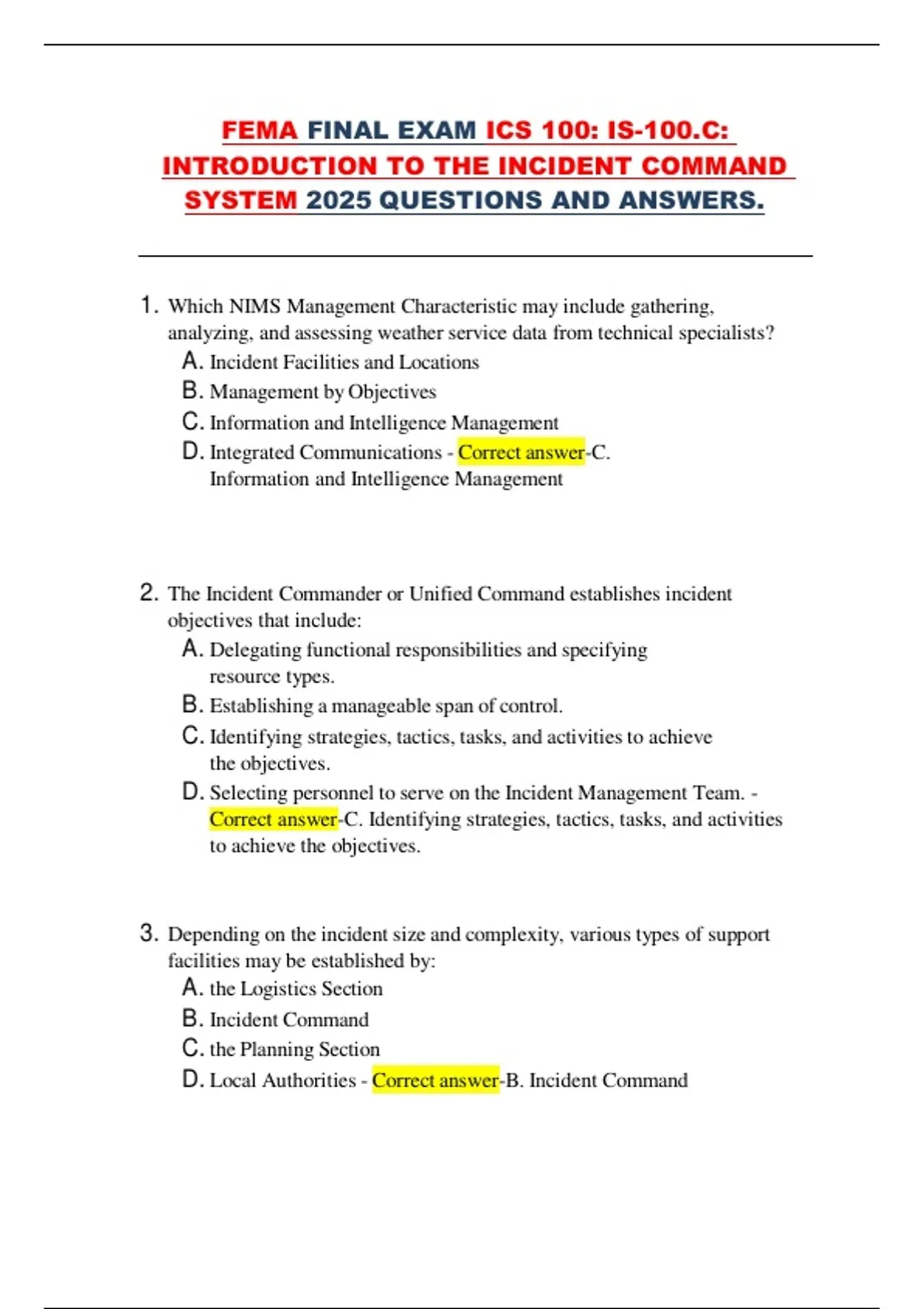
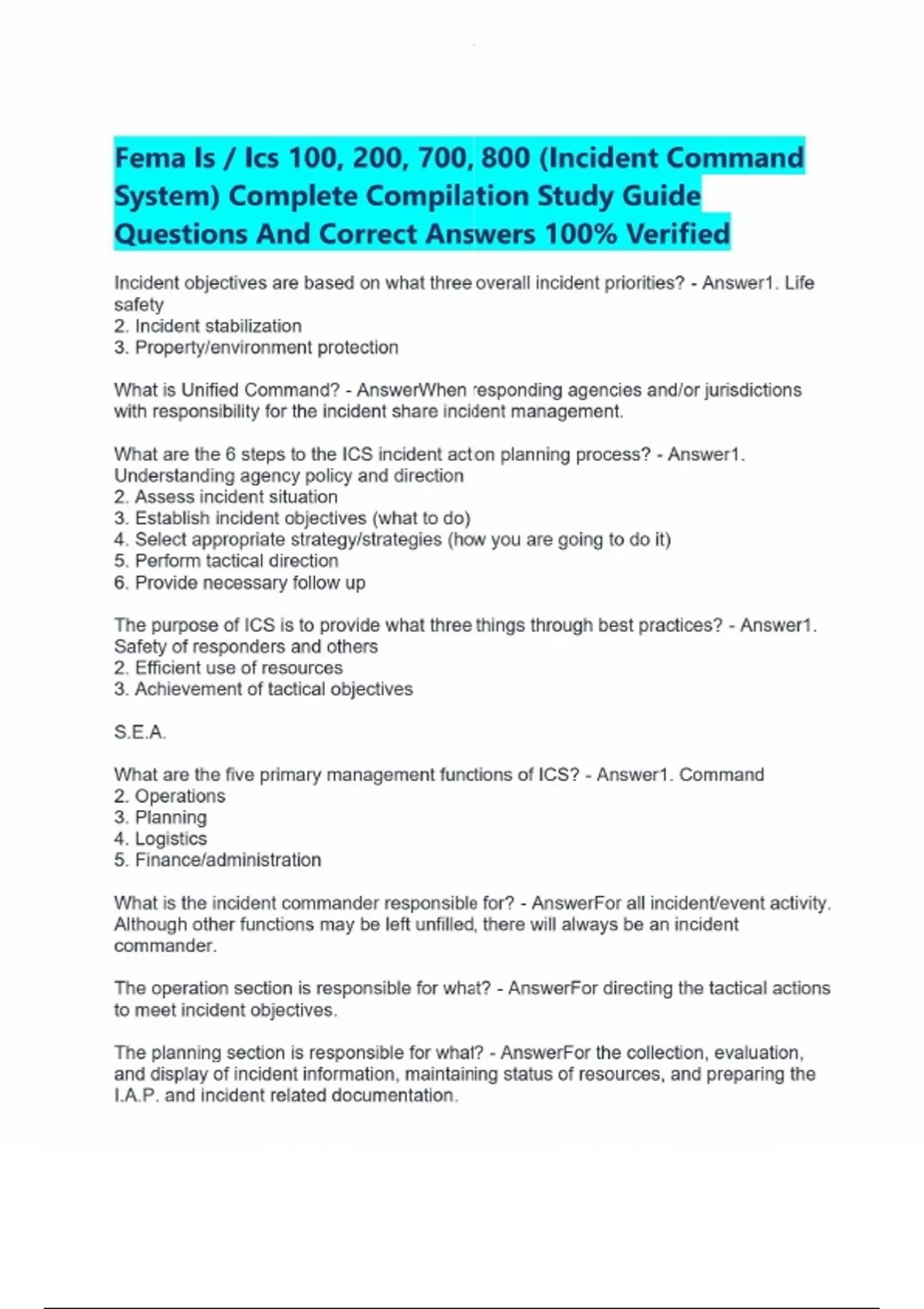
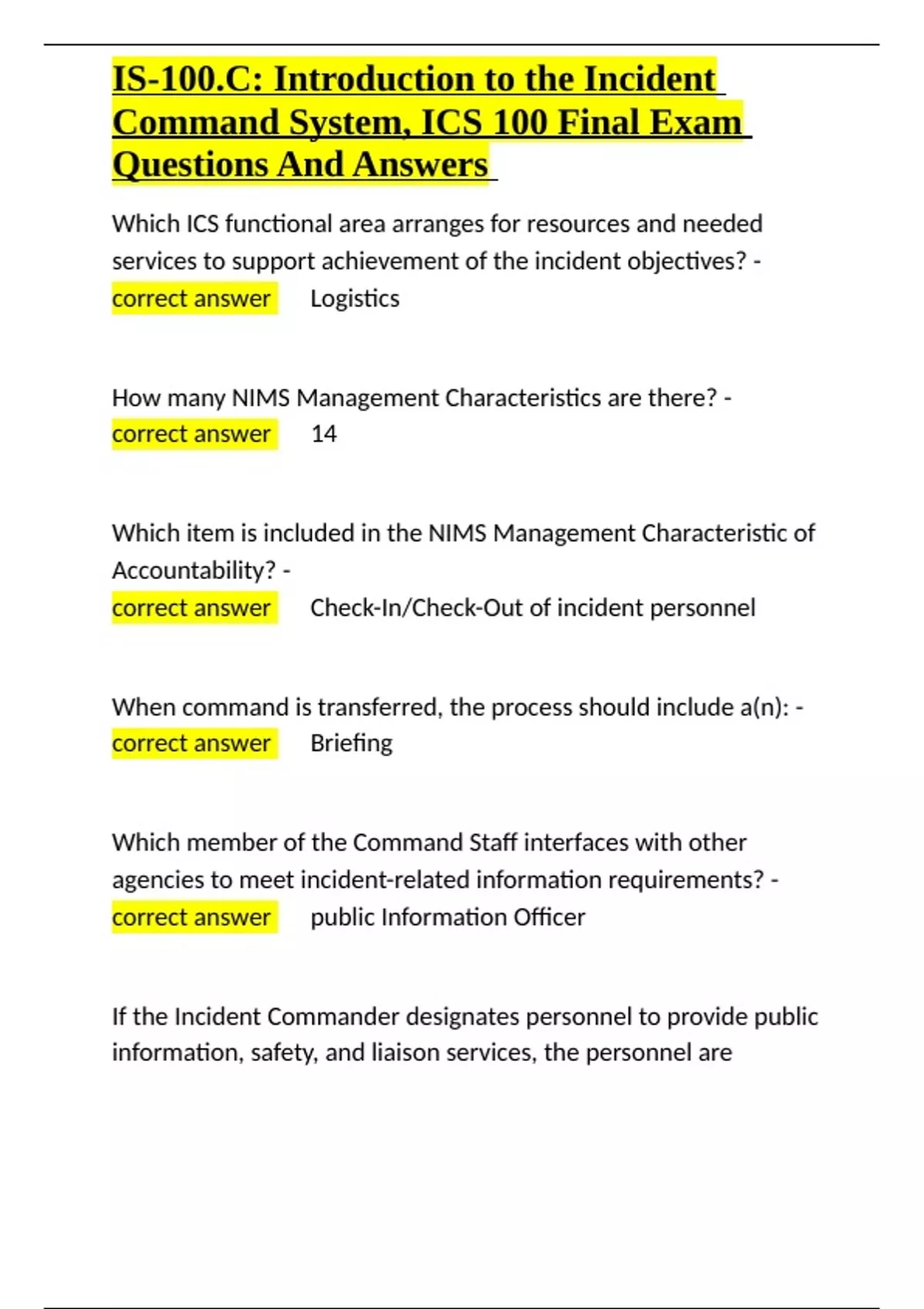
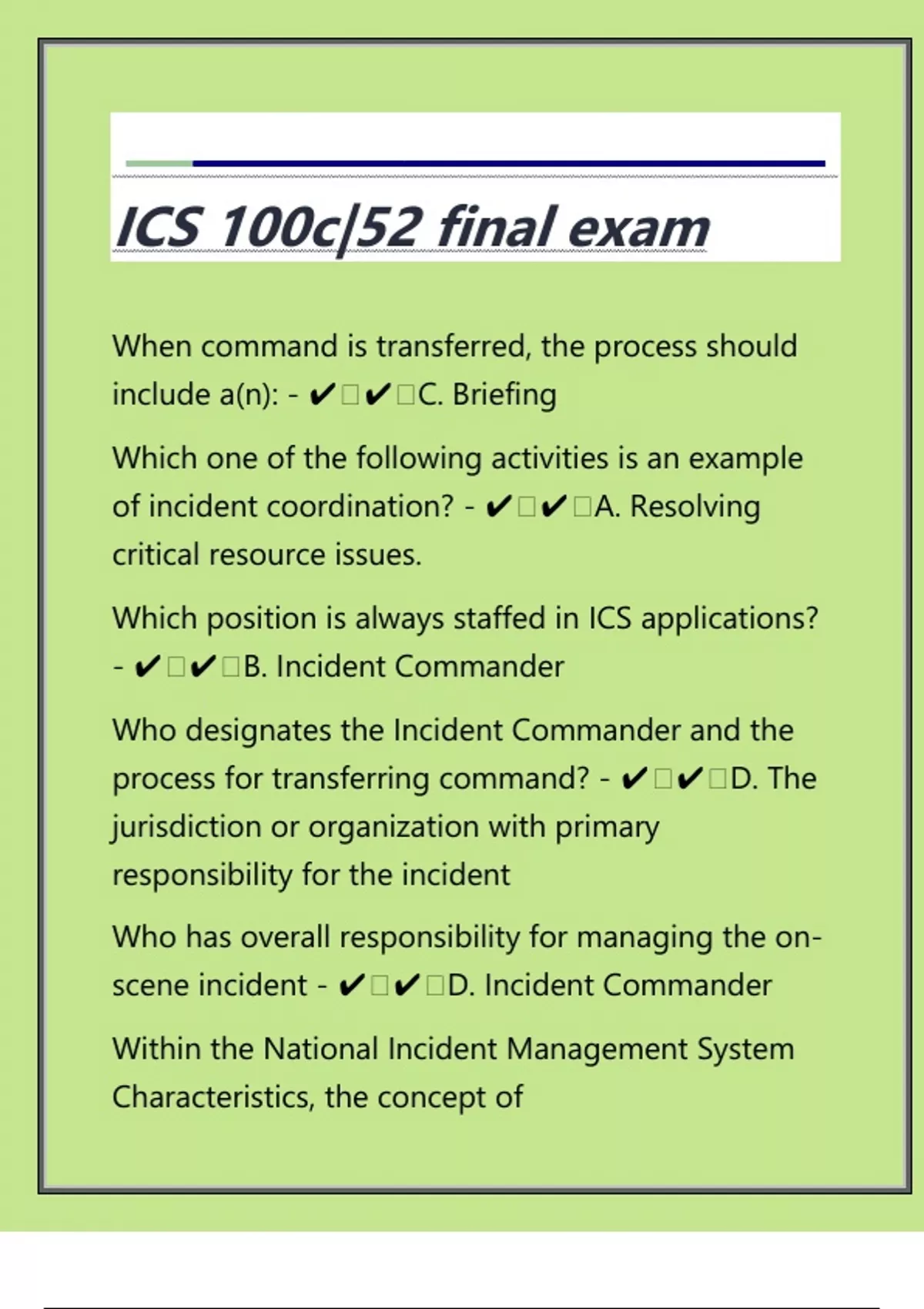
- Complete the unproctored, multiple-choice examination.
- You must achieve a score of 75% or higher to pass.
Step 5: Receive and Store Your Official Certification
Upon successful completion, FEMA generates a secure, verifiable electronic certificate delivered via email within 24 to 48 hours. The certificate includes your name, completion date, course version, and continuing education units (typically 0.2 CEUs). Download and retain this PDF for your employer's compliance audits.
Common Mistakes Responders Make with ICS Principles
While the concepts in ICS 100 appear straightforward on paper, practical implementation in real-world emergencies frequently breaks down due to human error and ingrained operational habits.
Common Operational Failure Modes
Bypassing the Chain of Command (Freelancing): Personnel attempting to solve problems without operational authorization create severe tactical risks and tracking problems for the Incident Commander. All actions must align with the approved Incident Action Plan.
Overburdening the Span of Control: Supervisors often resist delegating authority, leading to one individual attempting to direct 10 or 15 crews. This bottlenecks communications and slows critical safety notifications.
Reverting to Agency Jargon on Interagency Radios: Responders in high-stress scenarios frequently revert to local radio codes. If an officer calls out "10-50" to mean a traffic collision, responding paramedics from an adjoining county may misunderstand the status of the scene. Plain text is mandatory.
Frequently Asked Questions
Is ICS 100 free to take?
Yes, ICS 100 (IS-100.c) is 100% free when accessed directly through the FEMA Emergency Management Institute website. Third-party testing companies may charge training fees, but the official FEMA course and its recognized certificate carry no registration or testing costs.
The course is federally funded to maintain national emergency readiness across civilian and governmental sectors. Anyone with an internet connection can enroll, complete the lessons, and receive official credit without payment.
Does an ICS 100 certificate expire?
No, official FEMA ICS 100 certificates do not carry a formal expiration date. Once you earn the certificate, the credential remains on your permanent FEMA EMI transcript.
However, many individual fire departments, police agencies, and hospital accreditation bodies (such as The Joint Commission) require personnel to take a refresher course or complete an updated version (such as IS-100.c) every three to five years to ensure familiarity with modern standards.
What is the difference between ICS 100 and IS-700?
ICS 100 teaches tactical, on-scene emergency command operations, while IS-700 explains the overarching National Incident Management System (NIMS) governance framework.
In operational terms, ICS 100 focuses on managing the personnel and tactics directly at the site of the incident (the Incident Command Post, Staging Area, and field teams). IS-700 explains how the whole community—including off-site Emergency Operations Centers (EOCs), resource allocation systems, and policy groups—supports that on-scene command.
Can civilians or private business employees take ICS 100?
Yes, ICS 100 is open to anyone worldwide, including private citizens, non-profit volunteers, and corporate risk professionals.
FEMA provides the course to the public to promote national resilience. Completing ICS 100 is strongly recommended for corporate business continuity teams, facility safety managers, and neighborhood disaster volunteers seeking practical organizational training.
What happens if you fail the FEMA ICS 100 exam?
If you fail the final examination (scoring below 75%), there is no permanent penalty or public record of failure.
You can immediately review the course materials and retake the final exam through the FEMA portal. The system generates a randomized version of the test questions to ensure knowledge retention across all core learning objectives.
Mastering the Basics of Crisis Management
Operational safety during an emergency depends entirely on structured coordination. By taking ICS 100, emergency personnel, healthcare workers, and community volunteers develop the baseline vocabulary and structural discipline required to operate alongside local, state, and federal teams.
To formalize your credentials, register for a FEMA Student Identification number on the official federal portal, complete the IS-100.c course material, and maintain your documentation to ensure full compliance with regional and national emergency preparedness standards.
Image Gallery