Myths About Auto Insurance for Bad Records: What Is Really True?
Drivers with poor driving records often encounter widespread misinformation regarding coverage availability, premium calculations, and rate recovery timelines. In reality, bad driving records increase premiums and alter underwriting cl...
Drivers with poor driving records often encounter widespread misinformation regarding coverage availability, premium calculations, and rate recovery timelines. In reality, bad driving records increase premiums and alter underwriting classifications, but state laws, non-standard market insurers, and strict lookback periods ensure that coverage remains accessible while offering concrete pathways to rebuild an affordable insurance profile.
Contents
Understanding High-Risk Auto Insurance Ratings
Auto insurance carriers evaluate applicant risk through statistical modeling designed to predict the probability of future claims. When a driver accumulates moving violations, at-fault accidents, license suspensions, or major offenses such as Driving Under the Influence (DUI), insurers reclassify the driver into a non-standard or high-risk tier.
To determine rates, underwriters analyze two main data sources:
- Motor Vehicle Records (MVR): Issued by your state's Department of Motor Vehicles (DMV) or Bureau of Motor Vehicles (BMV), the MVR tracks traffic convictions, license statuses, moving violations, and points assessed against your license.
- Comprehensive Loss Underwriting Exchange (C.L.U.E.) Reports: Managed by LexisNexis, C.L.U.E. reports track your auto insurance claim history—including paid claims, zero-dollar claims, and open inquiries—typically for up to seven years.
Insurers weigh these records against their proprietary rating algorithms. While a clean record qualifies a driver for preferred or standard underwriting tiers with baseline rates, a bad record shifts the policyholder into non-standard territory. Non-standard auto insurance is not a separate product with different legal protections; rather, it is standard auto insurance priced with higher actuarial surcharges to compensate for elevated risk.
Disclaimer: Auto insurance regulations, lookback periods, and filing mandates vary significantly by state and jurisdiction. The following analysis provides general informational guidance. Drivers seeking specific policy advice should consult a licensed insurance agent or state department of insurance.
Separating Fact from Fiction: 7 High-Risk Insurance Myths
Myth 1: "A bad driving record makes it impossible to get legally insured."
The Reality: You can almost always obtain coverage, regardless of your driving record.
A common fear among drivers who have experienced license suspensions or multiple violations is that insurance companies will universally refuse to write them a policy. While preferred standard carriers (such as direct-to-consumer digital brands focusing exclusively on low-risk drivers) may issue formal non-renewals or quote outright rejections, the broader insurance market includes specialized carriers designed specifically for high-risk drivers.
Companies operating in the non-standard auto insurance market specialize in underwriting drivers with multiple tickets, at-fault collisions, or severe traffic offenses. Furthermore, every state enforces mandatory financial responsibility laws and provides a safety net through assigned risk plans (often coordinated by the Auto Insurance Plan Service Office, or AIPSO). If a driver is rejected by multiple private insurers in the voluntary market, the state's residual market mechanism assigns that driver to a participating auto insurer in the state, guaranteeing access to minimum legal coverage limits.
Myth 2: "Insurers penalize you for your entire driving history forever."
The Reality: Underwriting lookback periods strictly limit how far back insurers can assess points and violations for pricing.
Many drivers believe that a reckless driving charge or a speeding ticket from ten years ago permanently inflates their annual premiums. In practice, state regulations and carrier underwriting guidelines restrict the "lookback period"—the specific timeframe insurers evaluate when calculating rates.
For standard moving violations (such as speeding, failure to yield, or running a red light) and at-fault minor accidents, most insurers enforce a lookback window of 36 to 60 months (3 to 5 years). Once a violation passes the lookback threshold, standard carriers generally remove the premium surcharge associated with that specific incident.
Major infractions, such as DUIs, DWIs, or felony traffic violations, carry longer evaluation periods. In several states, a DUI impacts insurance rates for 5 to 10 years (for instance, California state law under Proposition 103 requires a 10-year lookback for DUI convictions when determining Good Driver discount eligibility). However, once the legally mandated lookback period expires, the infraction no longer permits carriers to assess ongoing surcharges on your policy.
Myth 3: "An SR-22 is an expensive type of insurance policy."
The Reality: An SR-22 is not an insurance policy; it is a simple administrative certificate of financial responsibility attached to an existing policy.
The misconception that an "SR-22 policy" is a costly, standalone insurance product causes widespread confusion. An SR-22 (or FR-44 in states like Florida and Virginia for high-limit requirements) is merely a state-mandated certificate that an insurance carrier files directly with the DMV. This document verifies that the driver maintains at least the state's minimum legal liability coverage limits.
The cost to file the SR-22 document itself is typically a minor, one-time administrative fee ranging from $15 to $25. The actual increase in your annual costs comes from the underlying conviction or driving violation (such as driving without insurance, a DUI, or driving on a suspended license) that triggered the SR-22 requirement in the first place, not the form itself. Additionally, if an SR-22 policy lapses or cancels, the insurer is legally required to submit an SR-26 form to notify the state, which results in an immediate license suspension.
Myth 4: "Your rate drops automatically the exact day a ticket reaches its lookback age limit."
The Reality: Rate adjustments usually occur at policy renewal, not mid-term, unless explicitly requested.
When a moving violation reaches its three-year or five-year anniversary, drivers often expect their insurance premium to plummet instantly. Auto insurance policies are binding contracts that run for fixed terms, typically 6 or 12 months. Insurers calculate premiums based on the data present at the precise start of that policy term.
Unless you actively request your carrier to re-run your Motor Vehicle Record mid-term or switch carriers, your current rate usually remains locked until your upcoming policy renewal date. Furthermore, some carriers do not automatically re-pull MVR reports at every single renewal due to administrative costs. Proactively contacting your carrier near your renewal date to confirm that an expired violation has been removed from your active surcharge calculation is essential for capturing savings.
Myth 5: "Switching insurance companies wipes your driving record clean."
The Reality: MVR and C.L.U.E. reporting databases follow you across all insurance providers.
A persistent myth suggests that by changing auto insurance carriers, a driver can "reset" their profile and leave tickets or claims behind. When applying for a new policy, every auto insurer utilizes your Social Security Number, driver's license number, and full legal name to run automated background checks through centralized databases, including LexisNexis, state DMV databases, and insurance claim exchanges.
Attempting to omit prior accidents or moving violations on an application does not work. Automated underwriting tools pull your complete MVR and C.L.U.E. history before binding the contract. Intentionally withholding information about convictions can be classified as material misrepresentation, which gives the carrier legal grounds to void the policy retroactively or deny coverage in the event of a claim.
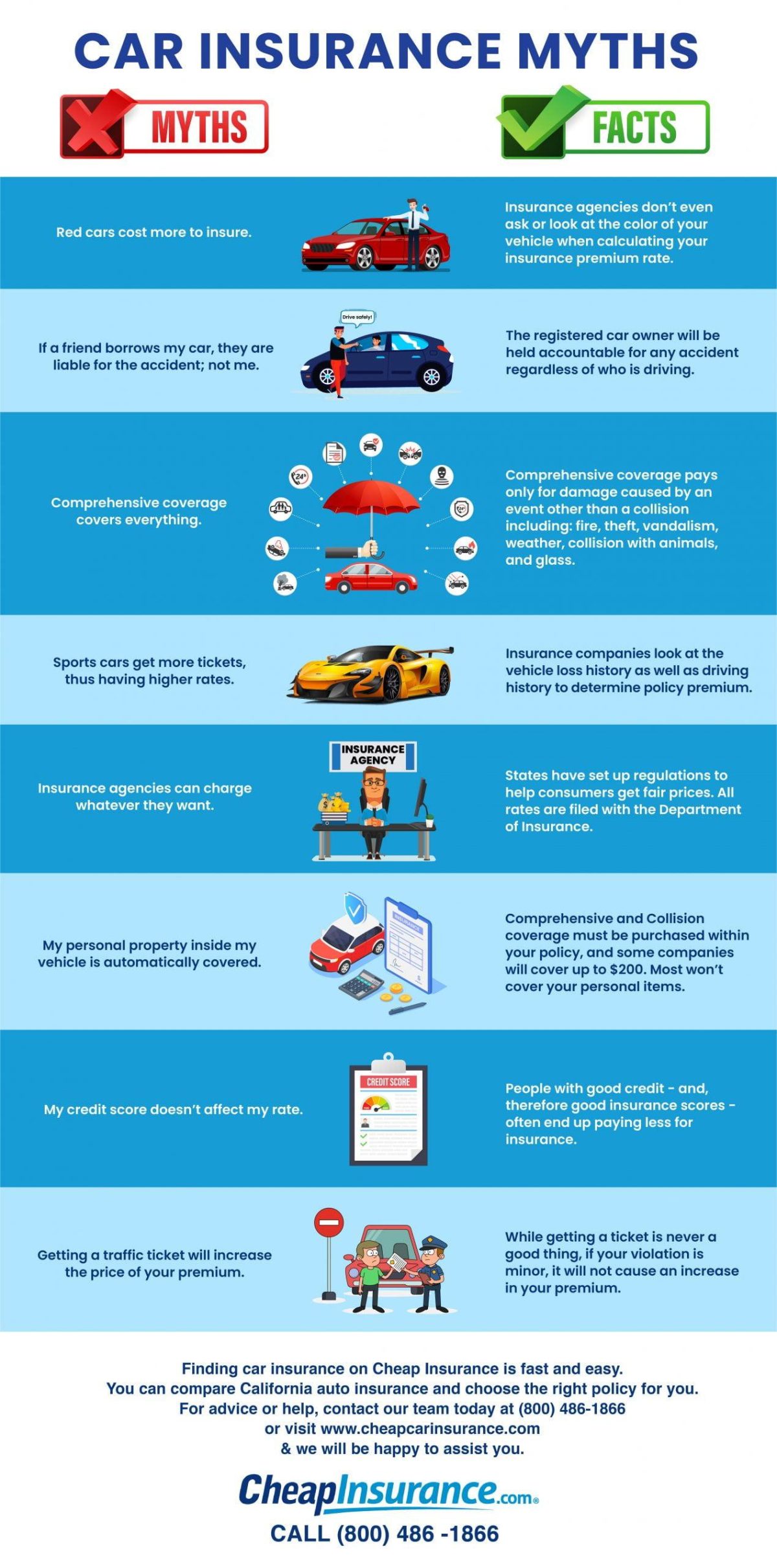
Myth 6: "Car color increases your insurance rate after a moving violation."
The Reality: Vehicle color is completely absent from insurance underwriting algorithms and vehicle identification numbers.
A surprisingly durable myth claims that red cars—or brightly colored vehicles—pay higher insurance premiums, especially if the driver already has a bad record. Vehicle Identification Numbers (VINs) contain specific data regarding a car's year, make, model, engine size, trim level, assembly plant, and safety features. VIN decoders used by insurance underwriters do not record exterior paint color.
Carriers establish physical damage and liability rates based on vehicle weight, crash-test safety scores, repair expense data, statistics regarding theft rates for that model, and horsepower. Paint color plays zero role in rate calculations for clean-record or high-risk drivers alike.
Myth 7: "High-risk drivers should only buy state minimum liability coverage."
The Reality: Carrying only minimum liability limits can expose high-risk drivers to catastrophic financial liabilities and higher long-term rate structures.
Drivers facing high premiums due to a poor record often attempt to cut costs by dropping their coverage down to state mandatory minimum liability limits and removing physical damage coverage (Collision and Comprehensive). While lowering coverage limits reduces immediate premium costs, it creates severe long-term financial risks:
- Inadequate Financial Protection: State minimum limits (such as $25,000 for bodily injury per person) are often insufficient to pay for medical costs or structural damage caused in a serious accident. If damages exceed your policy limit, the injured party can sue you personally, placing your personal assets and future wages at risk.
- Treated as High-Risk by Future Insurers: Insurers view drivers who select bare minimum limits as higher statistical risks over time. When your driving record cleans up, transition back to standard or preferred carriers often requires a history of carrying higher liability limits (such as $100,000/$300,000/$100,000) to qualify for competitive rates.
Comparative Analysis: Standard vs. High-Risk Auto Policies
Understanding the operational differences between standard auto coverage and high-risk coverage helps drivers navigate quotes, policy limits, and maintenance requirements effectively.
| Feature / Metric | Standard Auto Insurance Policy | High-Risk (Non-Standard) Auto Policy |
|---|---|---|
| Target Driver Profile | Clean driving record, zero to 1 minor ticket, no recent at-fault claims | Multiple tickets, recent at-fault accidents, DUI convictions, or SR-22 mandates |
| Typical Violation Lookback | 3 years for minor violations | 3 to 7+ years depending on state law and violation severity |
| Policy Term Options | 6-month or 12-month policy terms | Frequently restricted to 6-month terms |
| SR-22 / FR-44 Filings | Offered by select carriers; often requires transfer to risk division | Frequently available directly from non-standard specialty carriers |
| Payment Options | Flexible plans (monthly pay, auto-pay, low initial down payment) | Higher down payments; strict cancellation grace periods for missed payments |
| Premium Discounts | Good Driver, vanishing deductibles, bundling, safe-driver telematics | Defensive driving courses, continuous coverage, anti-theft, pay-in-full discounts |
| Market Access | Standard private voluntary market | Non-standard market specialty carriers or State Assigned Risk Pools (AIPSO) |
Actionable Steps to Reduce Rates with a Bad Record
Rebuilding a affordable auto insurance profile requires proactive steps. Drivers dealing with high rates or non-standard designations can apply several key strategies to control costs:
- Maintain Continuous Coverage
- Take Defensive Driving Courses
- Select Higher Deductibles
- Review MVR & Audit Records
1. Avoid Any Gap in Coverage
Lapsing on your auto insurance—even for a few days—instantly categorizes you as a high-risk driver to future underwriters, regardless of your driving record. Maintain continuous coverage without gaps. If you need to switch providers to find lower rates, ensure your new policy takes effect before cancelling your prior policy.
2. Take a State-Approved Defensive Driving Course
Many state insurance departments mandate that carriers offer a premium discount (typically 5% to 10%) to drivers who complete an accredited driver improvement or defensive driving course. In some jurisdictions, taking an approved course can also remove active points from your official state driver's license record, reducing the overall impact on your MVR.
3. Adjust Deductibles Strategically
If your auto policy includes Comprehensive and Collision coverages, increasing your out-of-pocket deductible—for instance, raising it from $250 to $500 or $1,000—can significantly lower your total monthly premium. Ensure that the chosen deductible is an amount you can realistically afford to pay out of pocket in the event of a crash.
4. Audit Your Motor Vehicle Record for Errors
Inaccuracies on MVRs occur more frequently than expected. Expired tickets, incorrect violation severity codes, or accidents wrongfully attributed as "at-fault" can artificially inflate your premium. Order an official copy of your driving record directly from your state DMV/BMV. If you locate errors, file a formal dispute with the state agency to have the entry corrected, then submit the updated MVR to your insurer.
5. Consider Telematics or Usage-Based Insurance (UBI) Cautiously
Telematics programs monitor your real-time driving behavior—including hard braking, rapid acceleration, late-night driving, and speed—via a mobile app or plugged-in OBD-II device. While telematics programs offer significant discounts for safe driving habits, high-risk drivers should proceed carefully: some carriers assess surcharges if the telematics data records aggressive driving patterns.
Frequently Asked Questions
How long does a DUI stay on your driving record for auto insurance?
In most states, a DUI conviction impacts your insurance rates for 3 to 5 years. However, several states enforce longer lookback windows. For example, California law evaluates DUIs for 10 years when determining eligibility for state-mandated Good Driver discounts. Always check your specific state's insurance statutes for exact timelines.
What is the difference between an SR-22 and an FR-44?
An SR-22 is a state certificate verifying that a driver carries the state's standard minimum liability insurance limits. An FR-44 is a separate certificate required in select states (such as Florida and Virginia) for severe violations like DUIs, requiring the driver to purchase liability coverage limits significantly higher than standard state minimums (often $100,000/$300,000/$50,000).
Can an insurance company cancel your policy immediately after a major ticket?
In most states, insurers cannot cancel an active policy mid-term simply because you received a moving violation, unless you committed fraud or had your driver's license suspended or revoked. However, the carrier can issue a non-renewal notice at the end of your current 6-month or 12-month policy term, declining to offer coverage for the subsequent term.
Does a zero-dollar claim or non-fault accident affect a bad driving record?
While a non-fault accident or zero-dollar claim generally does not result in an "at-fault" surcharge, it is still logged on your C.L.U.E. report. Multiple non-fault claims within a short window can cause some underwriters to remove discretionary loss-free discounts, increasing your net annual premium.
Practical Recommendation for High-Risk Drivers
If you are managing an auto policy with recent violations, accidents, or filing requirements, follow this structured plan to lower costs over time:
- Obtain Official Copies of Your Records: Order your official MVR from your state DMV and request a free copy of your C.L.U.E. personal report from LexisNexis. Verify that all listed dates, violation types, and claim amounts are accurate.
- Shop the Non-Standard Market via Independent Brokers: Captive agents work with a single carrier, whereas independent insurance brokers represent dozens of regional, national, and specialty high-risk insurance companies. An independent agent can cross-shop non-standard carriers to find competitive pricing for your specific profile.
- Set Calendar Reminders for Key Expiration Dates: Note the exact dates when tickets, points, or SR-22 requirements expire from your record. Contact your carrier immediately prior to the renewal date following those milestones to verify that all expired surcharges are removed.
Image Gallery