Defining Frisbee: A Comprehensive Guide to the Iconic Flying Disc
A Frisbee is a brand-name gliding toy and sporting apparatus, characterized by its airfoil cross-section and ability to fly when thrown with a spinning motion. While the name is a registered trademark of Wham-O, it is colloquially used...
A Frisbee is a brand-name gliding toy and sporting apparatus, characterized by its airfoil cross-section and ability to fly when thrown with a spinning motion. While the name is a registered trademark of Wham-O, it is colloquially used to define any aerodynamic plastic disc designed for flight through lift and gyroscopic stability.
Contents
The term "Frisbee" exists in a unique space between a corporate product and a generic cultural object. To truly define a Frisbee, one must look past the plastic rim and explore the intersection of 20th-century history, the complex physics of aerodynamics, and the legal nuances of trademark law. Whether used for a casual game on the beach or a highly competitive professional sport, the Frisbee remains one of the most aerodynamically efficient hand-thrown objects ever created.
The Origins and Etymology of the Frisbee
The definition of the Frisbee is rooted in a surprising piece of Americana: the pie tin. In the late 19th century, students at Yale University and other New England colleges discovered that the empty, lightweight metal tins from the Frisbie Pie Company of Bridgeport, Connecticut, could be thrown and caught. These students would often shout "Frisbie!" to alert passersby of the incoming metal plate.
However, the commercial definition we recognize in 2026 began with Fred Morrison. In 1948, Morrison and partner Warren Franscioni developed a plastic version of these flying tins, capitalising on the post-WWII fascination with UFOs and "flying saucers." This early iteration was called the "Flyin-Saucer." By 1955, Morrison improved the design and sold the rights to the toy company Wham-O.
Wham-O founders Richard Knerr and Arthur "Spud" Melin heard the college slang "Frisbie" and, in 1957, renamed their product the "Frisbee," intentionally changing the spelling to avoid legal conflict with the pie company. This transition from a metal bakery tin to a precision-engineered plastic disc defined the modern era of the toy. By the mid-1960s, the Frisbee was no longer just a novelty; it was becoming a standardized piece of sporting equipment.
The Physics of Flight: How a Frisbee Works
To define a Frisbee technically, one must describe it as a rotating airfoil. Unlike a ball, which relies purely on momentum and projectile motion, a Frisbee generates lift through its interaction with the air. This involves two primary principles of fluid dynamics: Bernoulli’s Principle and Newton’s Third Law.
Bernoulli’s Principle and Lift
The top of a Frisbee is curved, while the bottom is hollowed out. As the disc moves through the air, the air traveling over the curved top must move faster than the air underneath it. According to Bernoulli’s Principle, faster-moving air exerts less pressure than slower-moving air. This pressure differential creates an upward force called lift, allowing the Frisbee to stay airborne far longer than a non-aerodynamic object.
Gyroscopic Stability
A Frisbee is useless without a spin. The rotation of the disc provides gyroscopic stability, which allows it to resist "tumbling" or flipping over during flight. The angular momentum generated by the spin keeps the disc’s orientation stable relative to the ground. In 2026, high-speed camera analysis used in professional sports continues to show that the stability of a disc is directly proportional to its rotational velocity at the moment of release.
The Role of the Rim
The rim of the Frisbee serves two purposes. First, it acts as a structural stabilizer, concentrating mass at the outer edge to increase the moment of inertia (enhancing the gyroscopic effect). Second, it creates a "lip" that catches the air, contributing to the lift-generating pressure pocket underneath the disc.
The Trademark vs. The Generic Term
In legal and professional contexts, defining a "Frisbee" requires a distinction between the brand and the category. Wham-O holds the trademark for the word "Frisbee." Consequently, organizations that govern professional sports cannot use the word in their official names or documentation.
This has led to the rise of the term "flying disc." For instance, the World Flying Disc Federation (WFDF) and USA Ultimate use this generic terminology to avoid trademark infringement. This phenomenon is known in the legal world as "genericide"—when a brand name becomes so common that it risks losing its trademark status (similar to "Kleenex" or "Band-Aid").
Despite this, the general public in 2026 almost exclusively uses "Frisbee" to describe any disc-shaped plastic toy. For the consumer, the definition is functional; for the lawyer, it is proprietary.
Technical Specifications and Material Evolution
Modern discs are a far cry from the brittle plastics of the 1950s. To meet the demands of various sports, the technical specifications of a disc are strictly controlled.
Weight and Diameter
The standard definition of a professional-grade disc, particularly for the sport of Ultimate, is a weight of 175 grams and a diameter of approximately 27 centimeters. This specific weight-to-surface-area ratio provides the ideal balance between wind resistance and float time. In contrast, discs used for Disc Golf are smaller (around 21-23 cm) and denser, often weighing between 150g and 180g, designed for maximum distance or precision putting rather than easy catching.
Material Composition
Most high-quality discs are manufactured using polyethylene. This material is preferred because it remains flexible across a range of temperatures, preventing the disc from shattering upon impact. In 2026, there is an increasing move toward bio-based plastics and recycled polymers to reduce the environmental footprint of mass-produced sporting goods. These "green" discs must still meet the rigid structural requirements of traditional polyethylene to maintain flight integrity.
Comparison of Common Flying Disc Types
The following table distinguishes between the various types of discs based on their intended use, weight, and flight characteristics.
| Disc Type | Weight (Standard) | Diameter | Primary Characteristic | Common Use |
|---|---|---|---|---|
| Ultimate Disc | 175g | 27 cm | High loft, stable flight | Team sports, catching |
| Golf Driver | 165g - 175g | 21 cm | High speed, sharp edge | Long-distance accuracy |
| Freestyle Disc | 160g | 26 cm | Deep rim, smooth plastic | Tricks and "nail delays" |
| Recreational | 100g - 140g | Varies | Light, easy to throw | Backyard play, children |
| Dog Disc | 100g - 150g | 23 cm | Soft, puncture-resistant | Canine competition |
Major Disciplines: What Can You Do With a Frisbee?
Defining the Frisbee also involves defining the sports that have grown around it. These disciplines have evolved from simple "toss and catch" into internationally recognized competitive activities.
Ultimate (formerly Ultimate Frisbee)
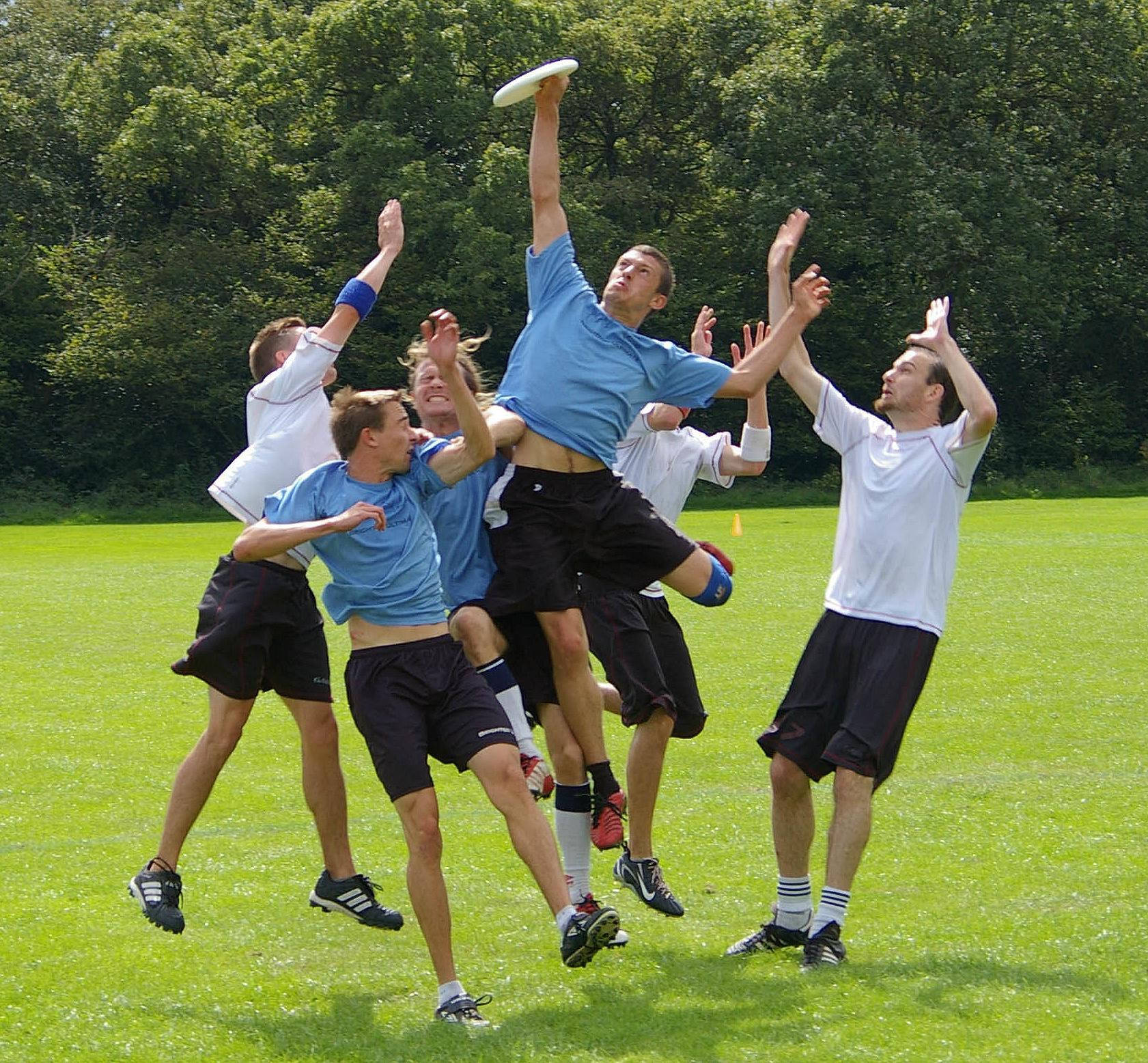
Ultimate is a non-contact team sport played on a field similar to American football. Players move the disc by passing it from teammate to teammate; once a player catches the disc, they must stop and establish a pivot foot. Points are scored by catching the disc in the opposing team's end zone. Ultimate is unique for its "Spirit of the Game," a tradition of self-refereeing even at the highest levels of competition.
Disc Golf
Disc golf follows the same basic rules as traditional ball golf but uses a disc and a specialized metal basket. Players throw a series of "drivers," "mid-ranges," and "putters" to complete a course in the fewest throws possible. The Professional Disc Golf Association (PDGA) provides the official standards for equipment used in these sanctioned events.
Freestyle
Freestyle is an artistic discipline where players perform choreographed routines set to music. It involves complex tricks like "air brushing" (striking the edge of the disc to keep it spinning) and "nail delays" (balancing the spinning disc on a fingernail). This requires a disc with a specifically smooth under-surface to reduce friction.
Guts
Guts is one of the oldest disc sports, involving two teams standing 14 meters apart. The goal is to throw the disc as hard as possible at the opposing team. If the receiving team fails to catch the disc with one hand, the throwing team scores a point. This sport emphasizes power and reaction speed.
Maintenance and Care for Longevity
To keep a disc performing according to its aerodynamic definition, proper maintenance is required. Over time, a disc will develop "nicks" and "burrs" on the rim from hitting pavement or trees. These imperfections create turbulence, which can cause the disc to "turn over" or wobble during flight.
- Sanding: Lightly use fine-grit sandpaper to smooth out rough edges on the rim.
- Warp Correction: If a disc becomes warped (tacoed), it can often be fixed by submerging it in hot (not boiling) water for a few minutes and then placing it on a flat surface with a heavy book on top.
- Storage: Always store discs flat. Storing them on their side or under heavy weight can permanently distort the flight plate, ruining the aerodynamic properties.
Frequently Asked Questions
Is there a difference between a "Frisbee" and a "Flying Disc"?
Technically, yes. "Frisbee" is a registered trademark owned by Wham-O. "Flying disc" is the generic term used for the object and by official sporting bodies like the World Flying Disc Federation (WFDF). In common usage, however, the terms are interchangeable.
Why do some Frisbees have ridges on the top?
These ridges, often called "flight rings" or "Headrick rings" (after Ed Headrick, who patented them), act as turbulators. They create a thin layer of turbulent air on the surface of the disc, which actually helps the air stay attached to the curve of the disc longer, reducing drag and increasing stability.
What is the official weight for an Ultimate Frisbee?
The official weight for a disc used in competitive Ultimate is 175 grams. This standard was popularized by the Discraft Ultra-Star, which has been the official disc of USA Ultimate for decades.
Can any disc be used for Disc Golf?
While you can throw a recreational Frisbee on a disc golf course, it is not recommended. Disc golf discs are specifically designed with sharper edges and higher densities to travel much faster and cut through the wind, whereas a standard catching disc is too buoyant and slow for effective golf play.
How fast can a Frisbee fly?
In professional settings, disc golf "drivers" have been clocked at speeds exceeding 80 mph (129 km/h). Standard recreational throws typically travel between 20 and 30 mph.
What is the best material for a dog Frisbee?
For dogs, you should look for discs made of soft, flexible elastomers or rubbers rather than hard polyethylene. These materials are puncture-resistant and much gentler on a dog's teeth and gums during high-speed catches.
Professional Recommendation
If you are looking to purchase a disc in 2026 for general recreation or to start playing a team sport, the 175g Ultimate-style disc remains the gold standard. Its predictable flight path and comfortable rim make it the most versatile choice for all skill levels. For those interested in precision sports, ensure you select a disc that is specifically approved by the PDGA or USA Ultimate to ensure it meets current aerodynamic and safety regulations.
Image Gallery