Understanding the Electron Configuration for a Neutral Atom of Sodium
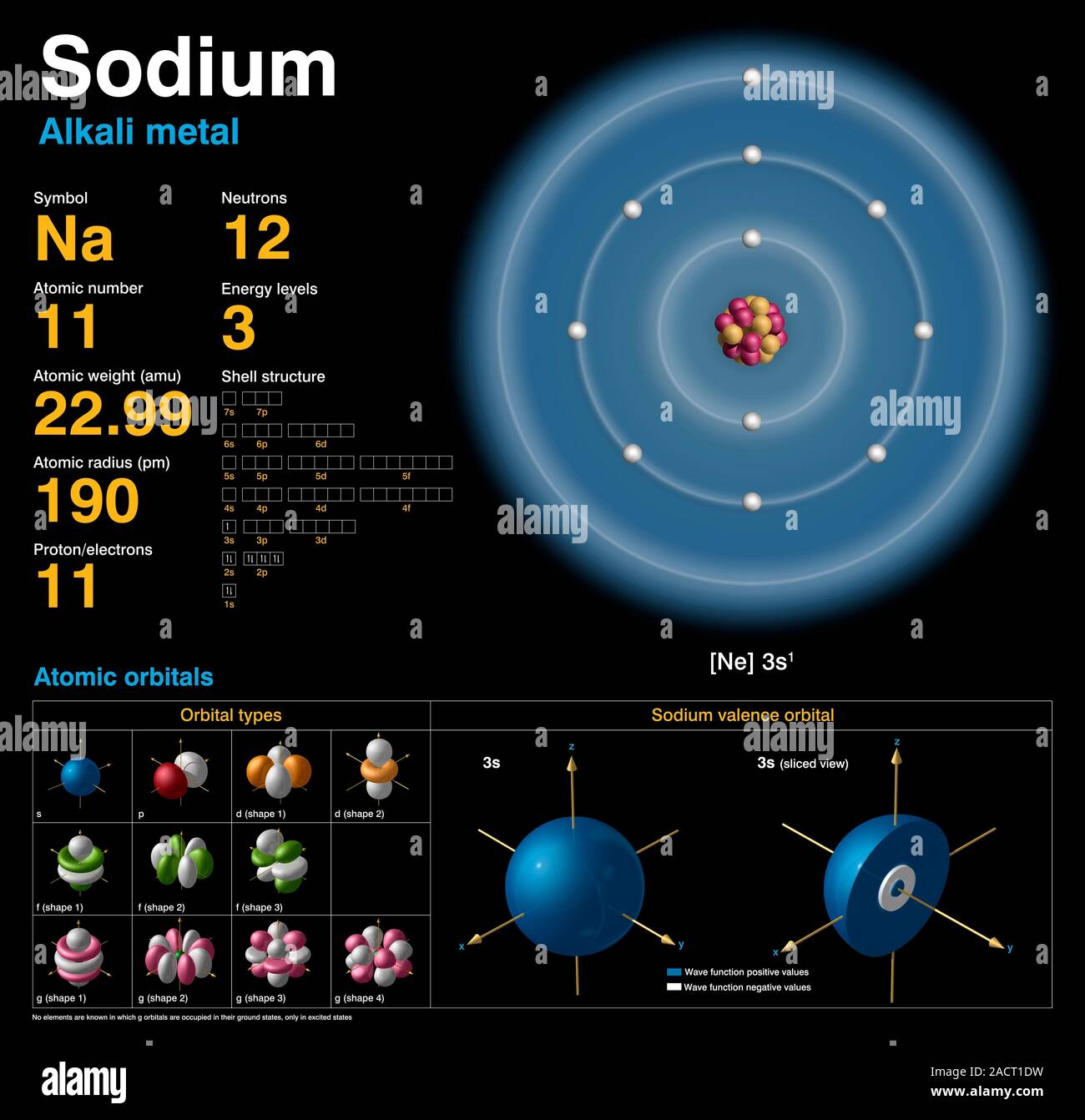
The electron configuration for a neutral atom of sodium is $1s^2 2s^2 2p^6 3s^1$, which is abbreviated in noble gas notation as $[\text{Ne}] 3s^1$. Because a neutral sodium atom has an atomic number of 11, it possesses 11 protons and 1...
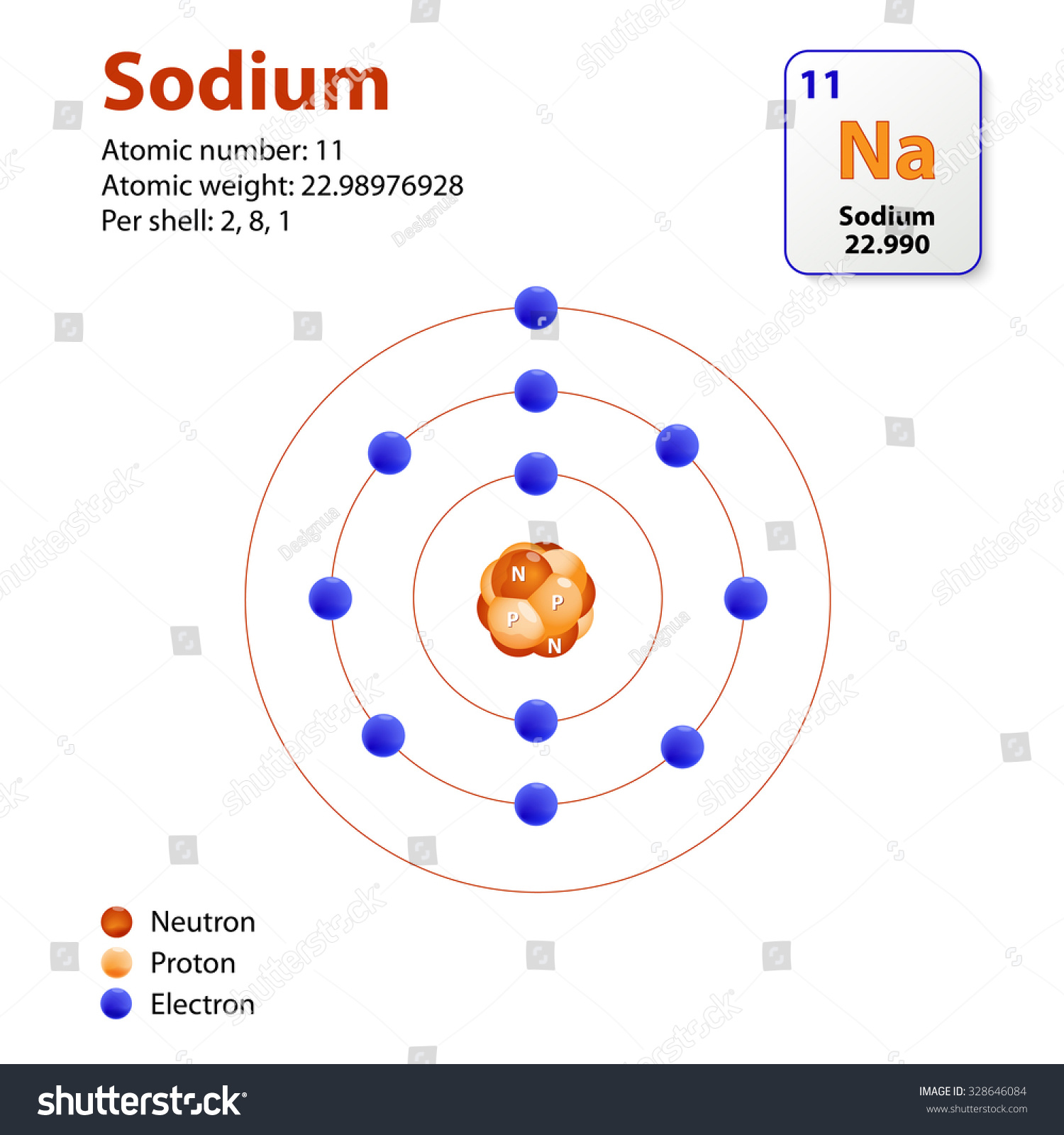
The electron configuration for a neutral atom of sodium is $1s^2 2s^2 2p^6 3s^1$, which is abbreviated in noble gas notation as $[\text{Ne}] 3s^1$. Because a neutral sodium atom has an atomic number of 11, it possesses 11 protons and 11 electrons. These electrons systematically fill atomic orbitals by increasing energy levels, leaving one valence electron in the outermost shell.
Contents
Understanding how electrons distribute themselves within sodium provides the foundation for predicting how this alkali metal behaves in chemical reactions, bonds with other elements, and transitions into a stable ion. By analyzing the fundamental quantum rules governing atomic structure, students and researchers can determine not just where sodium's electrons reside, but why that specific arrangement drives its pronounced chemical reactivity.
Fundamentals of Sodium's Atomic Structure
Every element on the periodic table is defined by its atomic number, denoted by the symbol $Z$. Sodium occupies the eleventh position on the table, giving it an atomic number of 11. This number represents the quantity of positively charged protons located within the nucleus.
In an uncharged, neutral atom, the overall electrical charge must balance out to zero. Consequently, a neutral sodium atom contains exactly 11 negatively charged electrons orbiting its nucleus. While the mass number of sodium's most abundant stable isotope ($^{23}\text{Na}$) indicates the presence of 12 neutrons ($23 - 11 = 12$), chemical properties and electron configurations are determined entirely by the 11 electrons.
Atomic electrons do not orbit the nucleus in fixed, circular tracks like planets around a star. Instead, quantum mechanics describes them as occupying regions of three-dimensional space called atomic orbitals. These orbitals are grouped into principal energy levels (shells) designated by the principal quantum number $n$ ($n = 1, 2, 3, \dots$), and subshells designated by letters ($s, p, d, f$). Each subshell can accommodate a fixed maximum number of electrons:
- $s$ subshells have 1 orbital and hold up to 2 electrons.
- $p$ subshells have 3 orbitals and hold up to 6 electrons.
- $d$ subshells have 5 orbitals and hold up to 10 electrons.
- $f$ subshells have 7 orbitals and hold up to 14 electrons.
To construct the electron configuration of sodium, these 11 electrons must be placed into available subshells according to three universal physical principles.
Governing Quantum Principles: Aufbau, Pauli, and Hund
Determining the ground-state electron configuration of any neutral atom requires adhering to three fundamental quantum mechanics guidelines.
1. The Aufbau Principle
The term Aufbau originates from the German word for "building up." The Aufbau principle dictates that electrons occupy the lowest-energy atomic orbitals available before filling higher-energy states. The relative energy of orbitals generally follows the $(n + l)$ rule, where $n$ is the principal quantum number and $l$ is the azimuthal (orbital angular momentum) quantum number.
The standard order of subshell filling begins at the lowest energy level and proceeds as follows: $$1s \rightarrow 2s \rightarrow 2p \rightarrow 3s \rightarrow 3p \rightarrow 4s \rightarrow 3d \rightarrow \dots$$ For sodium, with only 11 electrons, only the first four subshells ($1s$, $2s$, $2p$, and $3s$) are needed.
2. The Pauli Exclusion Principle
Formulated by Wolfgang Pauli in 1925, this principle asserts that no two electrons within an atom can possess an identical set of four quantum numbers ($n, l, m_l, m_s$). Because the spin projection quantum number ($m_s$) can only hold values of $+\frac{1}{2}$ (spin-up) or $-\frac{1}{2}$ (spin-down), an individual spatial orbital can hold a maximum of two electrons, and those two electrons must have opposing spins.
3. Hund's Rule of Maximum Multiplicity
Hund's rule addresses subshells that contain multiple degenerate orbitals (orbitals with identical energy), such as the three distinct orbitals in a $p$ subshell ($p_x, p_y, p_z$). Under this rule, electrons occupy degenerate orbitals singly with parallel spins before any orbital receives a second, spin-paired electron. This arrangement minimizes electron-electron repulsion within the subshell. In sodium, Hund's rule is observed when populating the $2p$ subshell.
Step-by-Step Derivation of Sodium's Configuration
Distributing sodium's 11 electrons into their respective ground-state orbitals follows a clear sequential process.
Total electrons to place: 11
Step 1: Populate the First Energy Level ($n = 1$)
The first shell contains only an $s$ subshell ($1s$). An $s$ orbital accommodates a maximum of two electrons with paired spins.
- Subshell filled: $1s^2$
- Electrons used: 2
- Electrons remaining: $11 - 2 = 9$
Step 2: Populate the Lowest Subshell of the Second Energy Level ($n = 2$)
Moving to the second principal energy level, the lowest-energy option is the $2s$ subshell. Like the $1s$ orbital, the $2s$ orbital accommodates up to two electrons.
- Subshell filled: $2s^2$
- Electrons used in this step: 2 (cumulative: 4)
- Electrons remaining: $9 - 2 = 7$
Step 3: Populate the $2p$ Subshell
The second energy level also contains a $p$ subshell ($2p$), which consists of three degenerate orbitals ($2p_x, 2p_y, 2p_z$). Following Hund's rule, three electrons enter each orbital singly with parallel spins, and the next three electrons pair up with them. The $2p$ subshell is filled to its maximum capacity of six electrons.
- Subshell filled: $2p^6$
- Electrons used in this step: 6 (cumulative: 10)
- Electrons remaining: $7 - 6 = 1$
At this stage, the first and second energy levels are completely full. A total of 10 electrons are placed, matching the electron configuration of the noble gas neon ($1s^2 2s^2 2p^6$).
Step 4: Populate the Third Energy Level ($n = 3$)
With the second shell saturated, the eleventh and final electron moves to the third principal energy level. Following the Aufbau sequence, the next available subshell is $3s$. Because only one electron remains, the $3s$ subshell is left half-filled.
- Subshell populated: $3s^1$
- Electrons used in this step: 1 (cumulative: 11)
- Electrons remaining: 0
Combining each component in order yields the complete, ground-state electron configuration of a neutral sodium atom: $$1s^2 2s^2 2p^6 3s^1$$
Full Notation vs. Condensed Noble Gas Notation
In chemical documentation, electron configurations can be expressed in either standard (expanded) notation or condensed (noble gas) notation. Both notations are scientifically accurate, but they serve different practical needs.
| Attribute | Full (Expanded) Notation | Condensed (Noble Gas) Notation |
|---|---|---|
| Written Format | $1s^2 2s^2 2p^6 3s^1$ | $[\text{Ne}] 3s^1$ |
| Components Shown | All core and valence electrons | Preceding noble gas core + valence electrons |
| Core Electron Count | 10 electrons ($1s^2 2s^2 2p^6$) | Represented by $[\text{Ne}]$ |
| Valence Electron Count | 1 electron ($3s^1$) | 1 electron ($3s^1$) |
| Primary Use Case | Introductory orbital mechanics, quantum assignments | General chemistry, reaction equations, molecular orbital analysis |
Condensed notation replaces the fully filled inner shells with the chemical symbol of the preceding noble gas enclosed in brackets. For sodium, the preceding noble gas is neon ($Z = 10$). Writing $[\text{Ne}] 3s^1$ immediately emphasizes the single valence electron responsible for sodium's chemical interactions, omitting the stable, non-reactive core.
Detailed Orbital and Quantum Number Distribution
Each of the 11 electrons in a neutral sodium atom occupies a distinct quantum state defined by four quantum numbers:
- $n$ (Principal Quantum Number): Specifies the main energy level ($1, 2, 3$).
- $l$ (Azimuthal / Angular Momentum Quantum Number): Specifies orbital shape ($s=0, p=1, d=2, f=3$).
- $m_l$ (Magnetic Quantum Number): Specifies spatial orientation (ranges from $-l$ to $+l$).
- $m_s$ (Spin Quantum Number): Specifies electron spin direction ($+\frac{1}{2}$ or $-\frac{1}{2}$).
The table below outlines how all 11 electrons are distributed within neutral sodium:
| Electron # | Shell ($n$) | Subshell ($l$) | Orbital ($m_l$) | Spin ($m_s$) | Cumulative Electron Total |
|---|---|---|---|---|---|
| 1 | 1 | $s$ ($0$) | 0 | $+\frac{1}{2}$ | 1 |
| 2 | 1 | $s$ ($0$) | 0 | $-\frac{1}{2}$ | 2 ($1s$ filled) |
| 3 | 2 | $s$ ($0$) | 0 | $+\frac{1}{2}$ | 3 |
| 4 | 2 | $s$ ($0$) | 0 | $-\frac{1}{2}$ | 4 ($2s$ filled) |
| 5 | 2 | $p$ ($1$) | $-1$ | $+\frac{1}{2}$ | 5 |
| 6 | 2 | $p$ ($1$) | 0 | $+\frac{1}{2}$ | 6 |
| 7 | 2 | $p$ ($1$) | $+1$ | $+\frac{1}{2}$ | 7 |
| 8 | 2 | $p$ ($1$) | $-1$ | $-\frac{1}{2}$ | 8 |
| 9 | 2 | $p$ ($1$) | 0 | $-\frac{1}{2}$ | 9 |
| 10 | 2 | $p$ ($1$) | $+1$ | $-\frac{1}{2}$ | 10 ($2p$ filled) |
| 11 | 3 | $s$ ($0$) | 0 | $+\frac{1}{2}$ | 11 ($3s$ half-filled) |
The eleventh electron—sodium's valence electron—is characterized by the quantum set $(n=3, l=0, m_l=0, m_s=+\frac{1}{2})$. This outer electron resides further from the nucleus than the inner 10 electrons, shielded from the full positive pull of the 11 protons.
Orbital Diagram Representation
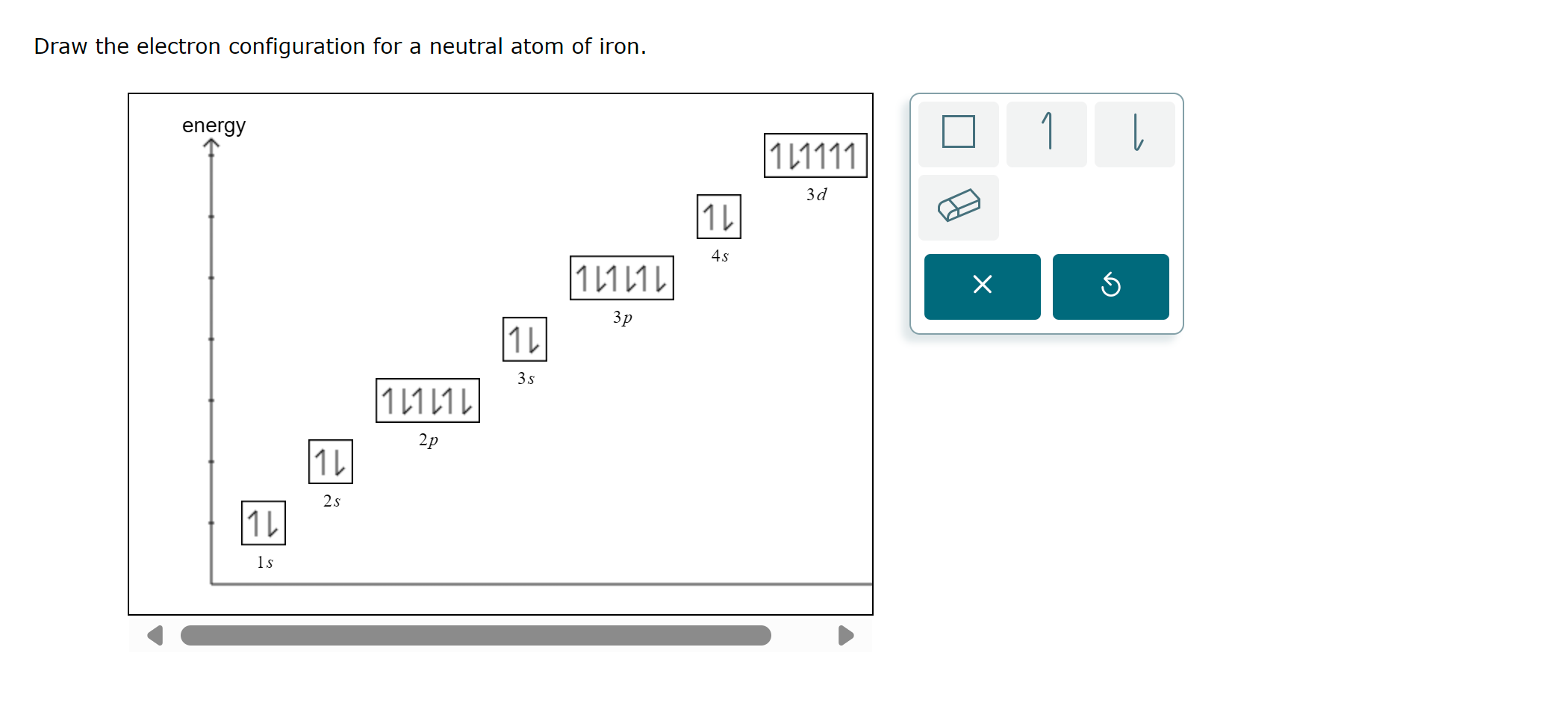
An orbital diagram visually conveys electron distribution and spin orientations using boxes, lines, or circles to represent individual orbitals, with vertical arrows indicating electron spins:
- An up arrow ($\uparrow$) designates an electron with spin $+\frac{1}{2}$.
- A down arrow ($\downarrow$) designates an electron with spin $-\frac{1}{2}$.
For neutral sodium, the orbital diagram displays five fully occupied orbitals and one singly occupied orbital:
- $1s$ orbital: One box containing an antiparallel pair ($\uparrow\downarrow$).
- $2s$ orbital: One box containing an antiparallel pair ($\uparrow\downarrow$).
- $2p$ orbitals: Three degenerate boxes ($2p_x, 2p_y, 2p_z$), each containing an antiparallel pair ($\uparrow\downarrow$ $\uparrow\downarrow$ $\uparrow\downarrow$).
- $3s$ orbital: One box containing a single up arrow ($\uparrow$).
Because the $3s$ orbital contains an unpaired electron, neutral sodium has a net electronic spin, making individual gaseous sodium atoms paramagnetic (weakly attracted by an external magnetic field).
Chemical Implications of Sodium's Electron Configuration
An element's electron configuration determines its location on the periodic table and governs its chemical behavior.
Position on the Periodic Table
- Group 1 (Alkali Metals): Sodium sits in Group 1 because it has exactly one valence electron in its outermost $s$ subshell. All Group 1 elements share this $ns^1$ valence configuration (e.g., lithium is $2s^1$, potassium is $4s^1$).
- Period 3: Sodium occupies Period 3 because its outermost electron occupies the third principal energy shell ($n = 3$).
- s-Block: Because its highest-energy electron resides in an $s$ orbital, sodium belongs to the periodic table's $s$-block.
Ionization Energy and Cation Formation
Sodium's core electrons ($1s^2 2s^2 2p^6$) screen the single $3s^1$ electron from the nuclear charge of 11 protons. According to Slater's rules for calculating effective nuclear charge ($Z_{\text{eff}}$), the valence electron experiences a substantially attenuated pull from the nucleus.
Consequently, sodium exhibits a relatively low first ionization energy: $$\text{Na}(g) \rightarrow \text{Na}^+(g) + e^- \quad (\Delta H \approx 495.8\text{ kJ/mol})$$
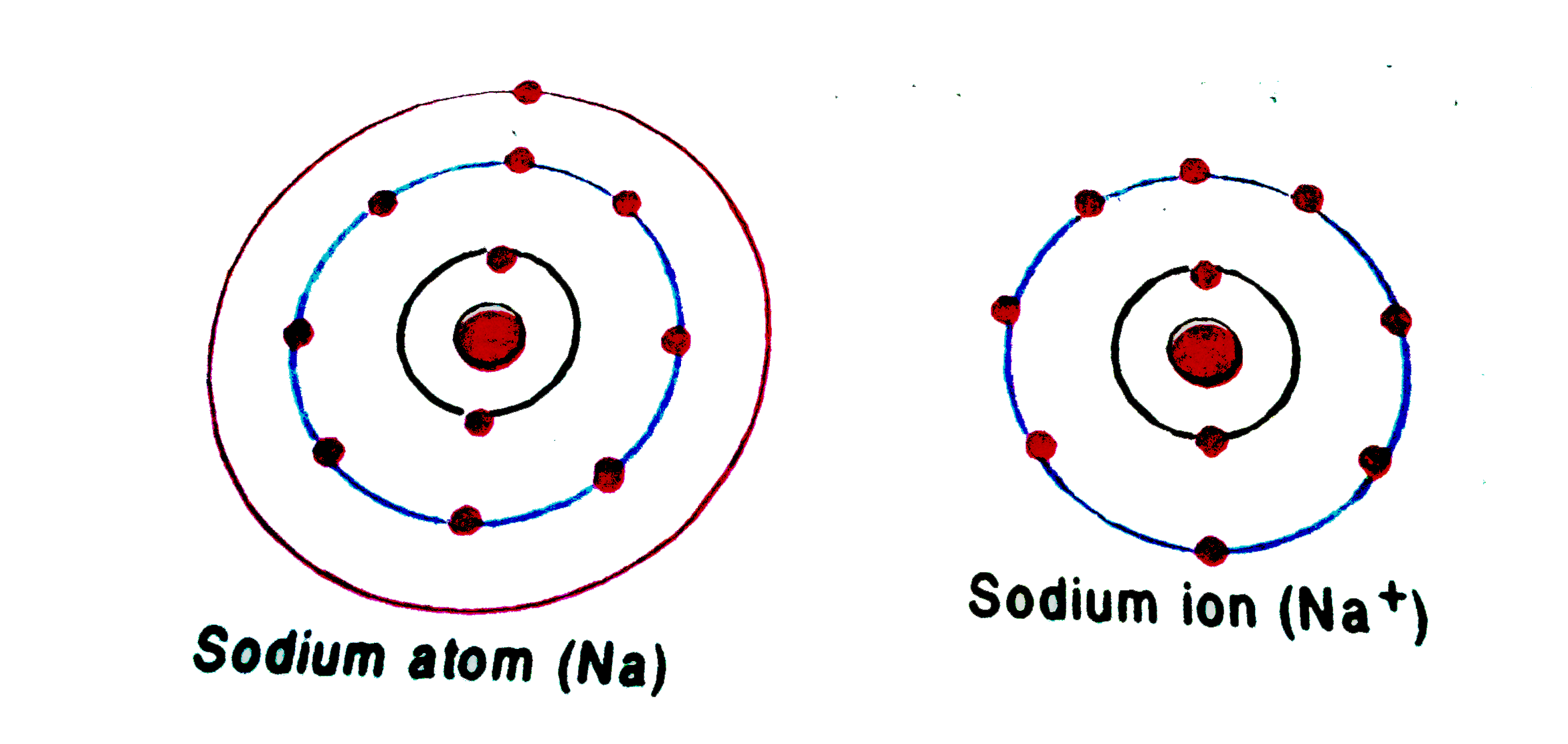
Losing this single valence electron yields the sodium cation ($\text{Na}^+$). The resulting electron configuration for $\text{Na}^+$ is $1s^2 2s^2 2p^6$, which matches the stable, closed-shell octet of the noble gas neon.
Conversely, sodium's second ionization energy is dramatically higher ($\approx 4,562\text{ kJ/mol}$). Removing a second electron requires pulling from a stable, closed $n=2$ core shell that sits much closer to the nucleus and experiences far less shielding. This enormous energy barrier explains why sodium readily forms compounds in the $+1$ oxidation state (such as $\text{NaCl}$, $\text{NaOH}$, and $\text{Na}_2\text{SO}_4$), but never forms stable $\text{Na}^{2+}$ ions under standard chemical conditions.
High Reactivity with Nonmetals and Water
Because removing its single valence electron produces an energetically favored noble gas configuration, metallic sodium reacts vigorously with electronegative elements:
- Halogens: Sodium donates its $3s^1$ electron to chlorine ($[\text{Ne}] 3s^2 3p^5$), allowing both elements to achieve stable octet configurations in the crystal lattice of sodium chloride ($\text{NaCl}$).
- Water: When placed in water, sodium rapidly transfers its outer electron to hydrogen ions, releasing hydrogen gas and forming sodium hydroxide in an exothermic reaction: $$2\text{Na}(s) + 2\text{H}_2\text{O}(l) \rightarrow 2\text{NaOH}(aq) + \text{H}_2(g)$$
Common Mistakes When Writing Sodium's Configuration
When practicing electron configurations, students frequently make several predictable errors:
Confusing the Neutral Atom with the Cation:
- Mistake: Writing $1s^2 2s^2 2p^6$ for neutral sodium.
- Correction: $1s^2 2s^2 2p^6$ corresponds to the sodium ion ($\text{Na}^+$), which has lost its outer electron. A neutral atom has 11 electrons, requiring the inclusion of $3s^1$.
Incorrect Noble Gas Reference:
- Mistake: Writing $[\text{Ar}] 3s^1$.
- Correction: Argon ($Z = 18$) comes after sodium on the periodic table. Condensed notation always uses the preceding noble gas with a lower atomic number, which for sodium is neon ($Z = 10$).
Subshell Superscript Errors:
- Mistake: Overfilling the $s$ subshell, such as writing $1s^2 2s^3 2p^5 3s^1$.
- Correction: An $s$ subshell contains only one orbital and can never hold more than 2 electrons under the Pauli exclusion principle.
Skipping Energy Levels:
- Mistake: Jumping directly to $3p$ or $3d$, such as writing $[\text{Ne}] 3p^1$.
- Correction: Under the Aufbau principle, the $3s$ subshell is lower in energy than $3p$ and $3d$ and must be populated first.
Frequently Asked Questions
What is the difference between the electron configuration of $\text{Na}$ and $\text{Na}^+$?
A neutral sodium atom ($\text{Na}$) has 11 electrons with a configuration of $1s^2 2s^2 2p^6 3s^1$, whereas the sodium cation ($\text{Na}^+$) has lost its single valence electron, leaving 10 electrons with a configuration of $1s^2 2s^2 2p^6$. This gives the $\text{Na}^+$ ion an identical electron layout (isoelectronic) to the noble gas neon, making it chemically stable.
Why does sodium have only one valence electron?
Sodium belongs to Group 1 of the periodic table and has an atomic number of 11. After completely filling its first two principal energy levels with 10 electrons ($1s^2 2s^2 2p^6$), only one electron remains to enter the third principal energy level ($3s^1$). Because valence electrons are defined as those occupying the outermost principal shell, sodium has exactly one valence electron.
What are the four quantum numbers for the valence electron of sodium?
The four quantum numbers for the eleventh electron in a neutral sodium atom are $n = 3$, $l = 0$, $m_l = 0$, and $m_s = +\frac{1}{2}$. The principal quantum number $n = 3$ marks the third energy level; $l = 0$ denotes an $s$ orbital; $m_l = 0$ indicates its single spatial orientation; and $m_s = +\frac{1}{2}$ represents its spin state.
Why is $[\text{Ne}] 3s^1$ preferred over the full configuration in chemical formulas?
Condensed notation emphasizes the chemically active valence shell while saving space. In chemical bonding and reactions, core electrons ($1s^2 2s^2 2p^6$) remain tightly bound and do not participate in bonding. Writing $[\text{Ne}] 3s^1$ highlights the single electron responsible for sodium's reactivity and oxidation states.
What happens to sodium's electron configuration in an excited state?
In an excited state, sodium's valence electron absorbs energy and jumps to a higher unoccupied orbital without changing the total count of 11 electrons. For example, absorbing a photon can promote the $3s^1$ electron to a $3p$ orbital, producing the temporary configuration $1s^2 2s^2 2p^6 3p^1$. When this electron drops back to the $3s$ ground state, it emits light at characteristic wavelengths (589.0 nm and 589.6 nm), producing the classic yellow-orange glow of sodium street lamps.
Practical Recommendations for Mastering Configurations
To gain confidence with electron configurations across the periodic table, apply these structured study steps:
- Memorize the Diagonal Rule (Aufbau Chart): Practice drawing the standard filling sequence ($1s, 2s, 2p, 3s, 3p, 4s, 3d, \dots$) from memory to avoid misplacing electrons in transition metals and higher energy levels.
- Always Check the Total Electron Count: Before finalizing an answer, sum all superscripts in the configuration. For neutral atoms, this total must match the element's atomic number ($Z$). For sodium: $2 + 2 + 6 + 1 = 11$.
- Practice Transitioning Between Ions and Atoms: Write out neutral configurations first, then systematically remove electrons from the highest principal energy level ($n$) to derive cation configurations, or add them to the lowest available orbital to derive anions.
- Link Configurations to Periodic Trends: Relate an element's outer electron configuration directly to its group number, atomic radius, and ionization energy to deepen your understanding of chemical behavior beyond basic memorization.
Image Gallery