Guide to Used Car Warranties for High-Mileage Vehicles
A warranty for a used car with high mileage—technically called a Vehicle Service Contract (VSC) or Mechanical Breakdown Insurance (MBI)—covers the cost of mechanical and electrical repairs after the original manufacturer warranty expir...
A warranty for a used car with high mileage—technically called a Vehicle Service Contract (VSC) or Mechanical Breakdown Insurance (MBI)—covers the cost of mechanical and electrical repairs after the original manufacturer warranty expires. Designed for vehicles with 80,000 to over 200,000 miles, these plans protect owners from unexpected, expensive repairs by covering critical systems like the engine, transmission, and drive axle.
Contents
Understanding High-Mileage Vehicle Service Contracts
As modern automobiles remain on the road longer, acquiring protection for high-mileage vehicles has become an essential financial planning consideration for used car buyers and current owners alike. While many drivers use the term "extended warranty" interchangeably with aftermarket protection, there are vital legal and administrative distinctions between true manufacturer warranties, third-party vehicle service contracts, and mechanical breakdown insurance.
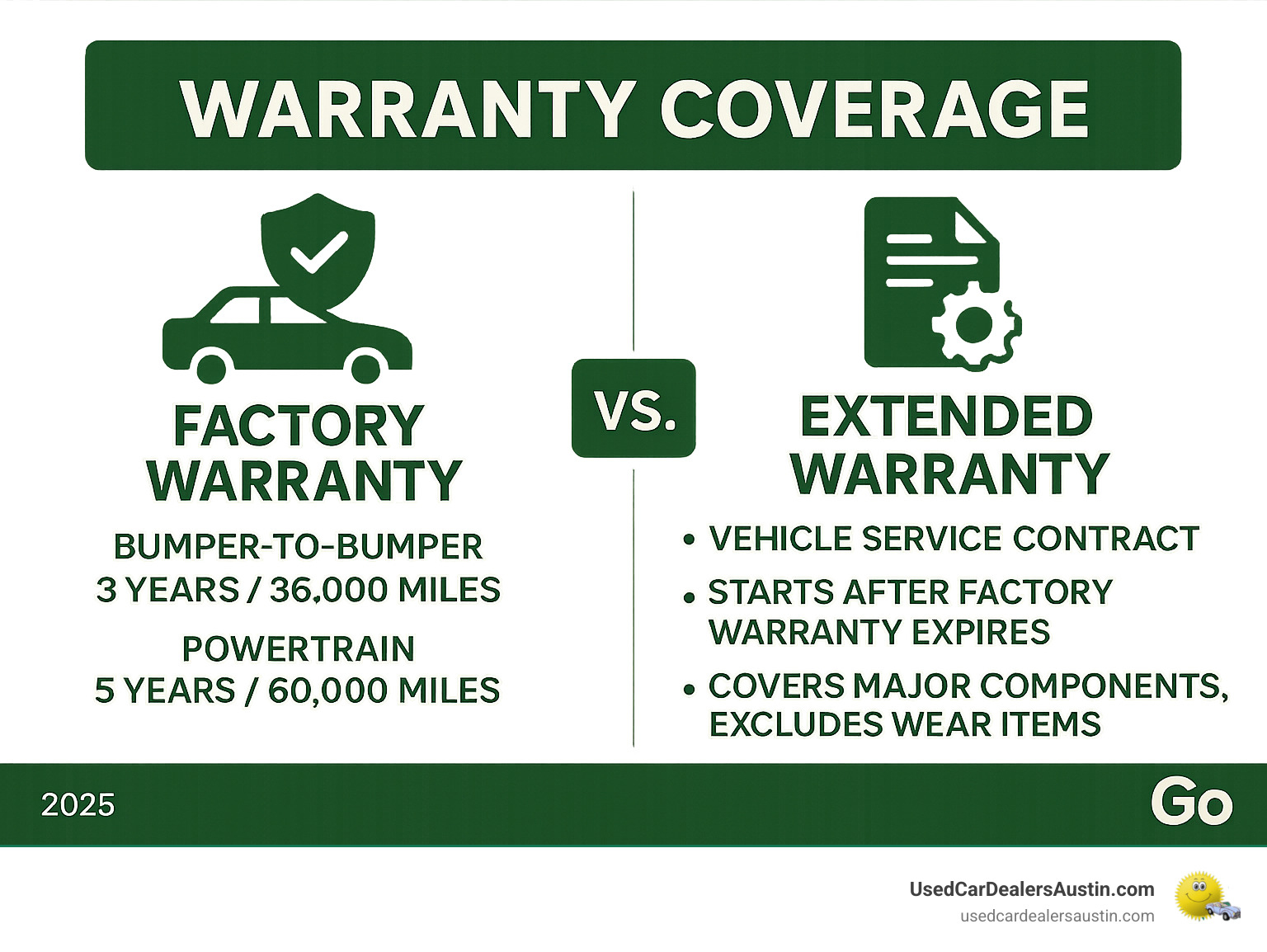
A factory warranty is an explicit guarantee provided directly by the auto manufacturer that comes included with the initial purchase of a new or Certified Pre-Owned (CPO) vehicle. Once a vehicle crosses key mileage thresholds—typically 36,000 to 60,000 miles for bumper-to-bumper coverage and 60,000 to 100,000 miles for powertrain coverage—the original manufacturer protection terminates.
At this stage, drivers seeking protection must turn to alternative structures:
- Vehicle Service Contracts (VSCs): These are independent contracts sold by third-party providers or dealerships. The contract administrator agrees to pay for specific repairs, labor, and replacement parts listed within the agreement for a set duration or mileage limit.
- Mechanical Breakdown Insurance (MBI): Regulated strictly by state insurance commissions, MBI offers similar coverage to a VSC but is structured as an insurance policy. In states like California, third-party protection plans for consumers are primarily regulated under insurance statutes to enforce consumer protection standards.
When a vehicle reaches high mileage—generally defined by the industry as any odometer reading exceeding 80,000 miles—the probability of mechanical failure increases significantly due to heat cycling, friction, and component degradation. Consequently, high-mileage protection plans are structured around specific risk profiles, balancing higher premium costs against the elevated likelihood of catastrophic component failures.
Types of Warranty Tiers for High-Mileage Vehicles
Coverage options for high-mileage vehicles differ substantially from the comprehensive "exclusionary" contracts available for newer cars. While newer vehicles often enjoy plans that cover every component except for a short list of excluded maintenance items, high-mileage plans are predominantly "stated-component" (inclusionary) policies. If a specific part is not explicitly named in the contract, it is not covered.
| Coverage Hierarchy | Details |
|---|---|
| 1. Exclusionary Coverage | Highest Protection (Rare >100k mi) |
| 2. Stated Component Coverage | Comprehensive Mid-Tier Protection |
| 3. Powertrain Plus Coverage | Core Components + Key Systems |
| 4. Powertrain Coverage | Essential Drive System Protection |
1. Powertrain Coverage
Powertrain plans represent the foundational level of protection available for older or high-mileage cars. They cover the essential components required to make the vehicle move:
- Engine: Internal lubricated parts including pistons, crankshaft, connecting rods, camshafts, valves, timing gears, and the engine block or cylinder heads (if damaged by an internal lubricated part failure).
- Transmission: Automatic or manual transmission internal parts, torque converter, vacuum modulator, and transmission case.
- Drive Axle System: Front-wheel, rear-wheel, all-wheel (AWD), or four-wheel drive (4WD) assembly components, including differential gears, drive shafts, universal joints, and constant velocity (CV) joints.
Because powertrain repairs carry the highest labor and replacement costs—often ranging from $3,000 to over $8,000—this tier provides critical protection against vehicle-ending repair bills at a baseline price point.
2. Powertrain Plus (Enhanced Powertrain)
Enhanced powertrain plans expand basic coverage to include auxiliary systems that frequently experience age-related degradation. In addition to core drive line components, these policies typically cover:
- Air Conditioning & Heating: Compressor, clutch, condenser, and evaporator core.
- Electrical Systems: Alternator, starter motor, voltage regulator, and windshield wiper motors.
- Fuel System: Fuel pump, fuel injection pump, and delivery lines.
- Cooling System: Water pump, radiator fan motor, and thermostat.
3. Stated Component (Inclusionary) Coverage
Stated component plans act as mid-to-high-tier coverage for vehicles under specific mileage caps (often up to 120,000 or 150,000 miles). These policies contain detailed lists covering hundreds of parts across the steering, suspension, anti-lock braking systems (ABS), high-tech electronics, and power window/lock actuators. If a part failure occurs, the claim adjuster verifies whether the exact component name appears in the contract language.
4. High-Mileage Exclusionary Coverage
While rare for vehicles with over 100,000 miles, select specialty providers offer exclusionary plans up to 120,000 or 150,000 miles for well-maintained, newer-model-year cars. Exclusionary policies cover everything on the vehicle except specific listed items such as routine maintenance parts (brake pads, spark plugs, fluids), body panels, trim, and wear-and-tear items.
High-Mileage Protection Comparison
The following table compares standard high-mileage service contract tiers, outlining typical coverage scopes, eligible mileage windows, and common repair scenarios:
| Plan Tier | Typical Odometer Eligibility | Key Components Covered | Common Repairs Covered | Average Monthly Cost Range |
|---|---|---|---|---|
| Powertrain | Up to 150,000–250,000 miles | Engine, Transmission, Drive Axles, Internal Lubricated Parts | Torque converter replacement, engine block failure, differential rebuild | $60 – $100 / month |
| Powertrain Plus | Up to 150,000–200,000 miles | Powertrain + Starter, Alternator, Water Pump, A/C Compressor | Water pump replacement, alternator failure, A/C compressor failure | $80 – $130 / month |
| Stated Component | Up to 100,000–150,000 miles | Major Mechanicals, Steering, Suspension, Braking, Electrical | Steering rack replacement, ABS module, power window motors | $100 – $160 / month |
| Exclusionary | Up to 100,000–120,000 miles | All vehicle components except explicitly excluded wear items | Electronic control modules, infotainment units, complete suspension rebuilds | $130 – $200 / month |
Key Factors Impacting Eligibility and Pricing
When shopping for a high-mileage used car warranty, providers evaluate several risk variables to determine contract eligibility, maximum coverage limits, and premium pricing.
Odometer Reading and Vehicle Age
The primary metric used by administrators is the current vehicle mileage combined with the model year. As vehicles pass specific milestones—such as 100,000, 150,000, and 200,000 miles—the available pool of providers shrinks, and coverage levels systematically downgrade from stated component to basic powertrain plans.
Pre-Existing Conditions
No standard vehicle service contract covers pre-existing conditions. A pre-existing condition is defined as any mechanical breakdown, component wear, or defect present prior to the contract purchase date or during the mandatory waiting period.
Most contracts enforce a waiting period of 30 days and 1,000 miles from the signup date before claims can be submitted. This prevents consumers from purchasing a plan to cover a failure that has already occurred. Administrators may request service records or send an independent inspector to evaluate fluid conditions, diagnostic trouble codes (DTCs), and wear patterns to verify when a failure began.
Maintenance Tracking and Receipts
To keep a high-mileage contract valid, owners must strictly follow the manufacturer’s recommended maintenance schedule. Contract terms routinely stipulate that routine services—such as engine oil changes, transmission fluid flushes, coolant renewals, and belt inspections—must be performed at specified intervals.
Failure to produce verifiable, itemized receipts showing date, mileage, and vehicle identification number (VIN) for past maintenance can lead to claim denials. According to guidelines set by the Federal Trade Commission (FTC), consumers have the right to use independent repair facilities or perform their own maintenance, but they must maintain meticulous documentation to prove proper care.
Critical Fine Print and Exclusions to Watch For
Evaluating a vehicle service contract requires a thorough examination of the sample contract contract language before purchase. Paying close attention to standard exclusions prevents unexpected out-of-pocket costs at the repair shop.
Mechanical Breakdown vs. Normal Wear and Tear
Standard high-mileage contracts protect against "mechanical breakdown"—defined as the total failure of a covered part to perform its intended function. However, as vehicles age, parts undergo gradual wear and tear without failing completely.
- Strict Mechanical Breakdown Contracts: Only pay if a part breaks completely or snaps. If a piston ring wears down over time, causing excess oil consumption without structural snapping, the claim may be denied.
- Wear-and-Tear Coverage Addendums: Superior high-mileage policies explicitly include coverage for parts that have worn beyond the manufacturer's allowable tolerances, even if total physical failure has not yet occurred.
Commercial Use and Vehicle Modifications
Using a vehicle for commercial purposes (such as ride-sharing, delivery services, towing, or snowplowing) typically voids standard consumer service contracts unless a specific commercial use endorsement is purchased. Similarly, aftermarket modifications—such as suspension lift kits, oversized tires, custom engine tuning, or deleted emissions equipment—can trigger immediate claim denial for related mechanical failures.
Claim Caps and Total Liability Limits
High-mileage contracts often include strict financial limits on total payouts:
- Per-Repair Limit: Maximum amount payable for a single repair visit (e.g., $4,000 max per claim).
- Aggregate Policy Limit: Maximum total payouts across the entire contract term (e.g., capped at the current National Automobile Dealers Association [NADA] clean trade-in value of the vehicle at the time of repair).
How to Evaluate Providers and File Claims Successfully
Navigating contract acquisition and claim procedures requires a structured approach to ensure maximum financial protection.
- Step 1: Detect Breakdown & Safely Halt Vehicle Operation
- Step 2: Transport Vehicle to an ASE-Certified Repair Facility
- Step 3: Present Contract Details Prior to Disassembly or Repairs
- Step 4: Facility Obtains Claim Pre-Authorization from Administrator
- Step 5: Inspector Verification & Claim Approval/Payment
Step 1: Verify Provider Licensing and Financial Backing
Before purchasing a policy, confirm that the contract seller or administrator is backed by a reputable insurance carrier. Look for plans backed by an A.M. Best rating of A- (Excellent) or higher. This ensures that even if the contract broker goes out of business, an underlying insurance company remains legally obligated to pay legitimate claims.
Step 2: Confirm Repair Facility Acceptance
Ensure the policy permits repairs at any certified facility nationwide. Superior contracts allow work to be completed at any facility employing technicians certified by National Institute for Automotive Service Excellence (ASE), as well as franchised dealership service centers. Avoid plans that restrict you to a narrow network of repair shops.
Step 3: Follow the Pre-Authorization Protocol
The most common reason for claim denial is authorizing repair work before the administrator issues a official authorization number.
- Stop Operating the Vehicle: Continued operation after a warning light or failure occurs can be classified as negligence, voiding coverage for consequential damage.
- Contact Claims Administrator: Have the shop diagnose the issue and contact the claims department directly with an itemized estimate.
- Third-Party Inspection: For major claims (typically over $1,000), the administrator may send an independent inspector to verify the failure and review fluid levels.
- Receive Authorization: Work must begin only after the administrator provides a formal authorization code. The provider pays the shop directly via corporate card, leaving you responsible only for your agreed deductible.
Frequently Asked Questions
Can I get a warranty on a car with over 150,000 miles?
Yes. Specialized third-party providers offer powertrain and stated-component service contracts for vehicles with up to 200,000 or even 250,000 miles. However, these plans focus primarily on core mechanical components like the engine and transmission rather than luxury electronics or trim items.
How much does a high-mileage used car warranty cost?
On average, high-mileage plans cost between $800 and $1,500 per year of coverage, depending on the age, make, model, current mileage, and selected deductible (typically $50 to $200 per visit). Payment plans are usually structured as monthly installments over 12 to 24 months.
Will a high-mileage contract cover existing oil leaks?
No. Pre-existing oil leaks or fluid seepages that exist prior to contract inception or during the standard 30-day/1,000-mile waiting period are excluded from coverage. Gaskets and seals are typically covered only when replacement is required in conjunction with a covered major mechanical failure.
What is the difference between an auto dealer VSC and direct-to-consumer plans?
Dealership-sold service contracts are often rolled directly into auto financing loans, meaning you pay interest on the cost of the plan. Direct-to-consumer third-party plans allow you to pay separately in interest-free monthly installments, but require thorough verification of provider reputation and solvency.
Does performing my own oil changes void the service contract?
Not automatically, but it creates risk. If you perform self-maintenance, you must retain precise records, date-stamped purchase receipts for oil and filters, and a logbook recording the exact vehicle mileage at each service. If a lubrication-related claim arises and receipts are incomplete, the claim may be denied.
Practical Recommendation
When purchasing a warranty for a high-mileage used car, evaluate your vehicle's current market value against potential repair liabilities. If your vehicle is reliable, worth under $4,000, and simple to repair, building a dedicated emergency savings account may be more cost-effective than purchasing a contract.
However, if you own a complex modern vehicle with high component repair costs and cannot easily absorb an unexpected $3,000 to $5,000 repair bill, a powertrain plus or stated-component contract offers vital protection. Always request a full, unedited sample contract before paying, verify that the policy covers normal wear and tear, and ensure the administrator holds an A-rating or better from A.M. Best.
Image Gallery