How Asset Allocation Models by Age Work: A Comprehensive Guide to Lifecycle Investing
Asset allocation models by age work by systematically shifting a portfolio’s mix of investments—typically stocks, bonds, and cash—to align with an individual’s remaining time until retirement. As an investor ages, these models generall...
Asset allocation models by age work by systematically shifting a portfolio’s mix of investments—typically stocks, bonds, and cash—to align with an individual’s remaining time until retirement. As an investor ages, these models generally reduce exposure to volatile equities (stocks) and increase holdings in stable fixed-income assets (bonds) to prioritize capital preservation over aggressive growth.
Contents
Asset allocation is the most significant driver of long-term investment performance, often outweighing individual stock selection or market timing. For investors navigating the financial landscape of 2026, understanding how these models evolve over a lifetime is essential for balancing the need for wealth accumulation with the necessity of protecting that wealth as retirement approaches. This strategy relies on the principle that a younger investor has a higher "human capital" (future earning potential) and a longer time horizon to recover from market downturns, whereas an older investor must rely on their "financial capital" for immediate living expenses.
The Core Components of Age-Based Asset Allocation
To understand how these models function, one must first identify the primary building blocks used to construct them. In 2026, while new alternative assets have gained some traction, the core of most age-based models remains focused on three primary asset classes:
1. Equities (Stocks)
Equities represent ownership in companies. They are the primary engine of growth in a portfolio but come with higher volatility. In age-based models, equities are heavily weighted during the early years of a career to harness the power of compounding interest. Over decades, the higher expected returns of stocks are designed to outpace inflation and build the bulk of an investor's nest egg.
2. Fixed Income (Bonds)
Fixed income assets are essentially loans made by the investor to a government or corporation in exchange for regular interest payments. Bonds typically offer lower returns than stocks but provide a "cushion" during equity market crashes. As an investor nears retirement, the model increases bond allocation to reduce the risk of a significant portfolio drawdown at a time when they can least afford it.
3. Cash and Cash Equivalents
This category includes money market funds, certificates of deposit (CDs), and high-yield savings accounts. While these offer the lowest returns, they provide immediate liquidity and absolute capital preservation. In 2026, with interest rates stabilized after the fluctuations of the early 2020s, cash equivalents play a strategic role in the "bucket strategy" for retirees.
Popular Mathematical Models for Age-Based Allocation
Financial advisors and automated platforms use several heuristic rules and sophisticated algorithms to determine the "correct" ratio of assets. While no single rule fits everyone, these models provide a foundational framework.
The Rule of 100, 110, and 120
The most traditional model is the Rule of 100. To find your ideal stock percentage, you subtract your age from 100. For example, a 30-year-old would hold 70% stocks and 30% bonds. However, as life expectancy has increased in 2026, the Rule of 110 or Rule of 120 has become more common.
- Rule of 110: (110 - Age = Stock %) - Designed for a moderate risk tolerance.
- Rule of 120: (120 - Age = Stock %) - Designed for aggressive growth and longer life spans, ensuring the portfolio does not run out of money in a 30-year retirement.
The Glide Path and Target Date Funds
Most modern investors encounter age-based allocation through Target Date Funds (TDFs). These funds use a "glide path," which is a predetermined schedule that automatically changes the asset mix over time. There are two main types of glide paths:
- "To" Retirement: The asset allocation becomes most conservative exactly at the target retirement date and remains static thereafter.
- "Through" Retirement: The allocation continues to become more conservative for 10 to 15 years after the retirement date, acknowledging that retirees may still need growth to combat inflation over a long lifespan.
Asset Allocation by Life Stage: A Detailed Breakdown
How a model behaves depends entirely on which life stage the investor occupies. Each decade requires a different balance between risk and reward.
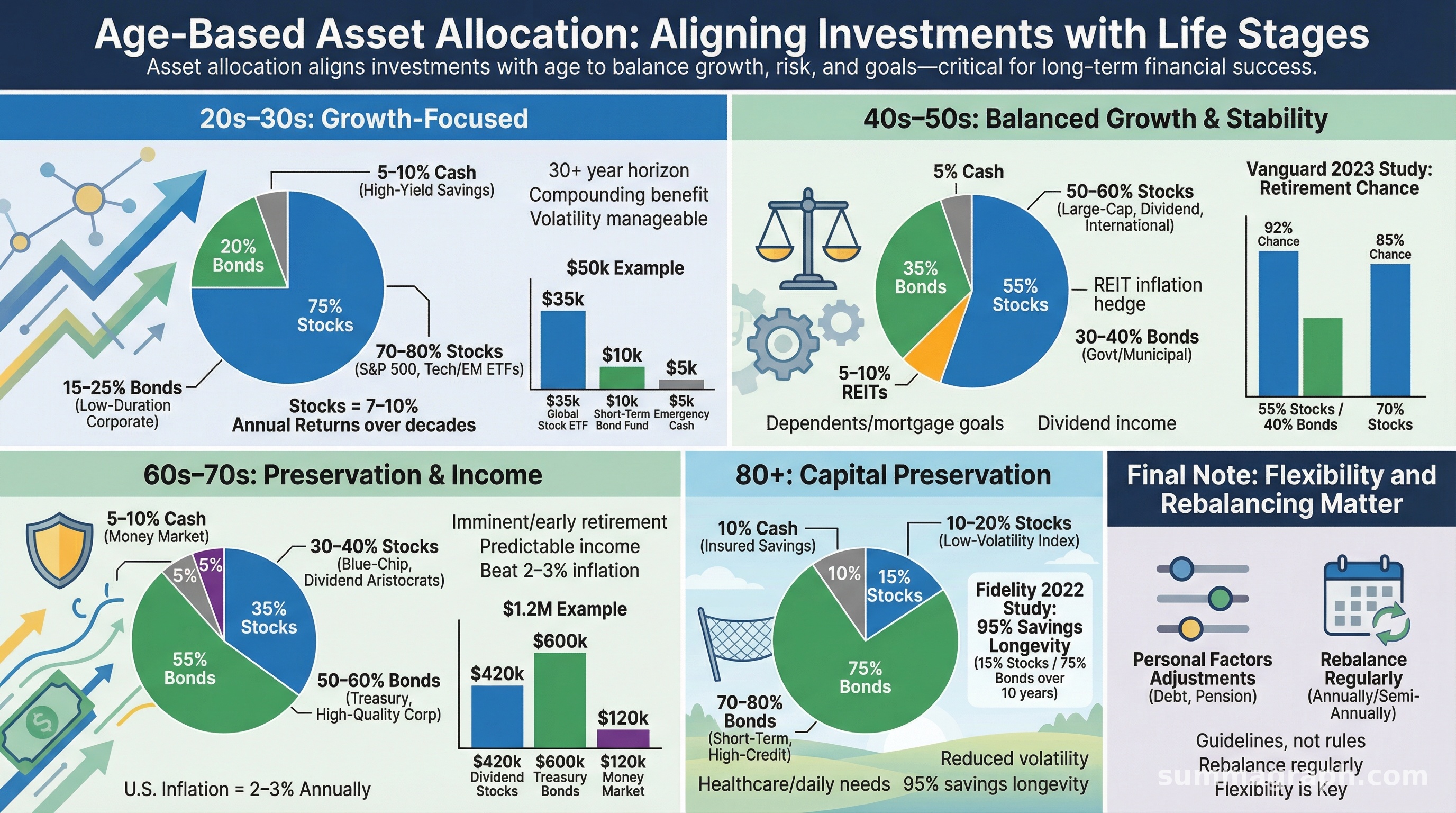
The Accumulation Phase (Ages 20–39)
During this phase, the primary goal is maximum growth. Because the retirement date is 30 to 40 years away, short-term market crashes (even those losing 30-40% of value) are statistically likely to be recovered and surpassed.
- Typical Allocation: 90% to 100% Equities; 0% to 10% Bonds.
- Strategy: Focus on diversified index funds, including international exposure. The "cost" of being too conservative at this age is the loss of compounding, which can result in hundreds of thousands of dollars in "missed" wealth by age 65.
The Consolidation Phase (Ages 40–54)
In mid-career, investors often reach their peak earning years. The focus begins to shift slightly toward protecting the gains already made while still seeking growth. This is often referred to as the "Sandwich Generation" phase, where investors may be balancing retirement savings with college tuition for children.
- Typical Allocation: 70% to 80% Equities; 20% to 30% Bonds.
- Strategy: Introduction of more stable dividend-paying stocks and increased exposure to intermediate-term government bonds.
The Pre-Retirement Phase (Ages 55–65)
This is the most critical window, often called the "Fragile Decade." A major market downturn just before retirement can be devastating because the investor does not have time to wait for a recovery before they need to start withdrawing funds. This is known as Sequence of Returns Risk.
- Typical Allocation: 50% to 60% Equities; 40% to 50% Bonds/Cash.
- Strategy: Significant shift toward capital preservation. Models in 2026 emphasize "inflation-protected" securities (like TIPS) to ensure purchasing power remains intact.
The Retirement Phase (Age 66+)
Once employment income stops, the portfolio must generate a "paycheck." However, it is a mistake to move 100% into cash or bonds, as the investor may still have 20 to 30 years of life ahead.
- Typical Allocation: 30% to 50% Equities; 50% to 70% Bonds/Cash.
- Strategy: Maintaining enough equity exposure to prevent the portfolio from being eroded by inflation, while keeping enough in bonds/cash to cover 3–5 years of living expenses regardless of market conditions.
Comparative Asset Allocation Models (Sample 2026 Data)
The following table illustrates how a moderate "Rule of 110" model compares to a more aggressive "Rule of 120" model across different ages.
| Age | Moderate Model (Rule of 110) | Aggressive Model (Rule of 120) | Typical Risk Profile |
|---|---|---|---|
| 25 | 85% Stocks / 15% Bonds | 95% Stocks / 5% Bonds | High Growth / High Volatility |
| 35 | 75% Stocks / 25% Bonds | 85% Stocks / 15% Bonds | Growth Oriented |
| 45 | 65% Stocks / 35% Bonds | 75% Stocks / 25% Bonds | Balanced Growth |
| 55 | 55% Stocks / 45% Bonds | 65% Stocks / 35% Bonds | Conservative Growth |
| 65 | 45% Stocks / 55% Bonds | 55% Stocks / 45% Bonds | Income & Preservation |
| 75 | 35% Stocks / 65% Bonds | 45% Stocks / 55% Bonds | Capital Preservation |
The Mechanics of Rebalancing
An asset allocation model is not a "set it and forget it" tool. Because different assets grow at different rates, a portfolio will naturally "drift" over time. If the stock market has a particularly strong year, a 70/30 portfolio might become a 78/22 portfolio. This means the investor is now taking on more risk than the model intended.
Rebalancing is the process of selling assets that have performed well and buying assets that have underperformed to return to the original target allocation. This forces the investor to "buy low and sell high." In 2026, most robo-advisors and 401(k) platforms offer automatic rebalancing, but for those managing their own accounts, an annual or semi-annual review is standard practice. Failure to rebalance can lead to "portfolio creep," where an investor unknowingly carries the risk level of a 30-year-old while they are actually 60.
Factors That May Overrule Age-Based Models
While age is a primary factor, it is not the only one. Personal circumstances can and should influence how strictly an investor follows a generic age-based model.
- Risk Tolerance: Some investors are psychologically unable to handle a 20% drop in their portfolio without panicking and selling. If this is the case, a more conservative allocation than their age suggests may be appropriate to prevent emotional decision-making.
- Net Worth and Spending Needs: An investor with a $10 million portfolio who only needs $100,000 a year to live can afford to be more aggressive (or more conservative) than a "standard" model suggests, as their survival does not depend on market fluctuations.
- Other Income Sources: If an investor has a guaranteed government pension or significant real estate income, they may choose a higher equity allocation in their liquid portfolio because their "bond-like" income is already secured elsewhere.
- Health and Longevity: Investors with a family history of extreme longevity (living into their late 90s) should lean toward the Rule of 120 to ensure they do not outlive their assets.
Frequently Asked Questions
Does asset allocation guarantee I won't lose money?
No. Asset allocation is a risk management strategy, not a guarantee against loss. Even a conservative 30/70 portfolio can lose value if both the stock and bond markets decline simultaneously, as occurred in 2022. However, asset allocation is designed to minimize the magnitude of losses and ensure the portfolio's risk level is appropriate for the investor's timeline.
When should I start shifting to a more conservative model?
Most models suggest a gradual shift rather than a sudden change. If you are using a Target Date Fund, this happens automatically every year. If you are managing your own portfolio, it is common to begin decreasing equity exposure by 1% to 2% each year starting in your late 40s or early 50s.
Are alternative investments like crypto or gold included in these models?
In 2026, many sophisticated models include a 5% to 10% allocation to "Alternatives." This category can include commodities, real estate investment trusts (REITs), or digital assets. These are generally treated as part of the "growth" or "equity" portion of the model due to their high volatility, rather than the "safe" bond portion.
How do interest rates in 2026 affect age-based models?
Higher interest rates generally make the "fixed income" portion of a model more attractive. When bond yields are high, investors can meet their retirement goals with less risk. Conversely, in the low-rate environments of the past, many were forced to hold more stocks (the "TINA" effect—There Is No Alternative) just to get a return, which increased their overall risk.
Is the 60/40 portfolio dead?
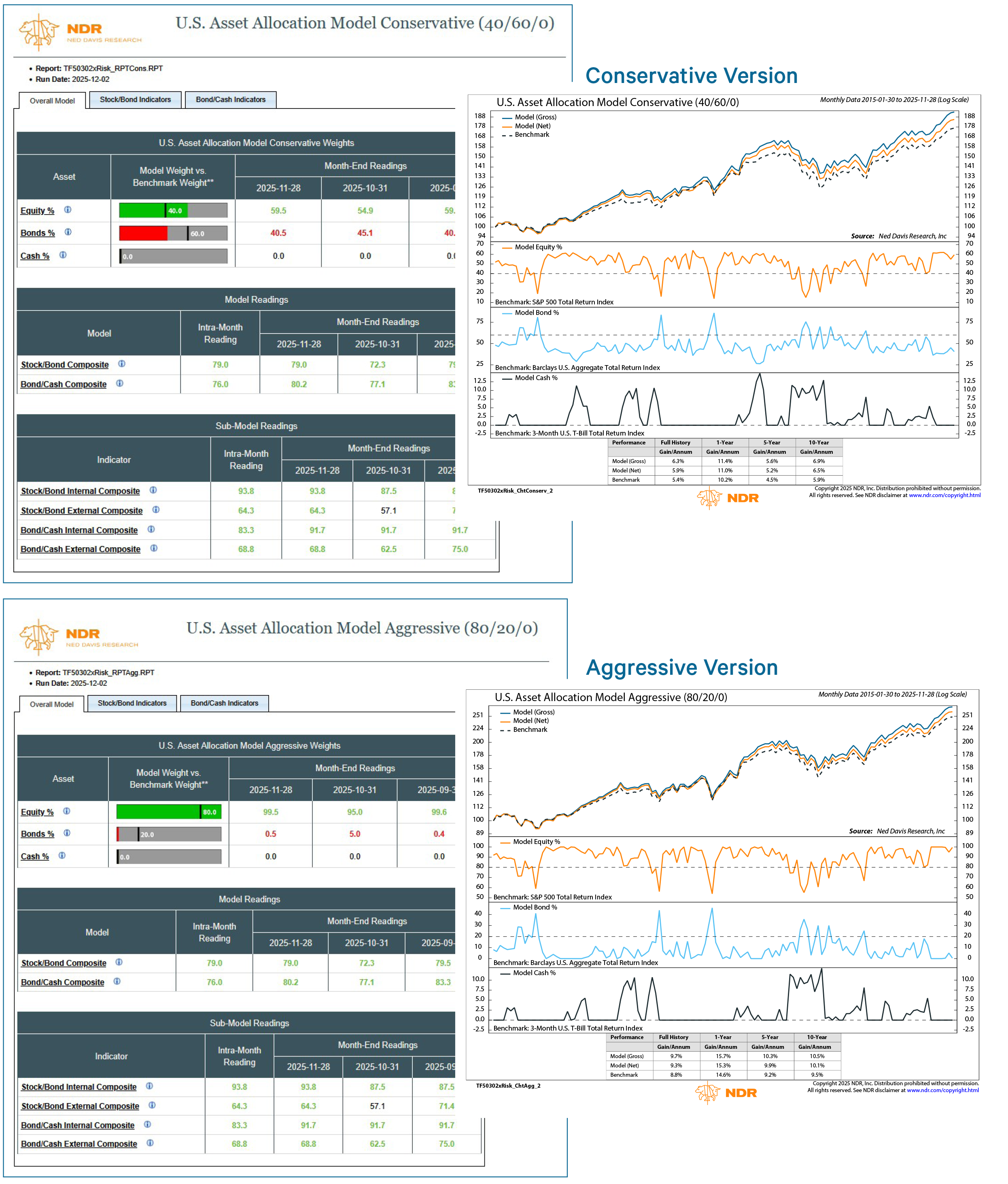
The 60% stock and 40% bond split is a classic moderate model. While critics often claim it is "dead" during periods of bond market volatility, it remains a benchmark for balanced investing in 2026. Its effectiveness depends on the negative correlation between stocks and bonds; when stocks fall, bonds usually rise (or hold steady), though this relationship is not perfect.
Practical Recommendation
For most investors, the most effective way to implement an age-based asset allocation model is to utilize a low-cost Target Date Fund (TDF) within a tax-advantaged account like a 401(k) or IRA. This removes the emotional burden of rebalancing and ensures the "glide path" is followed precisely as you age.
If you prefer a custom approach, start by calculating your stock-to-bond ratio using the Rule of 110 and adjust based on your specific health, pension status, and comfort with market swings. Review your allocation every year on a specific date (such as your birthday or the start of the year) to ensure your portfolio hasn't drifted more than 5% from its target. For complex estates or high-net-worth individuals, consulting with a fee-only fiduciary financial advisor is recommended to tailor these general models to specific tax and legacy goals.
Image Gallery