Comprehensive Guide to California Highway Patrol Radio Codes and 11-Codes for 2026
California Highway Patrol (CHP) radio codes are specialized alphanumeric signals used by officers and dispatchers to communicate efficiently across the state's vast public safety frequencies. As of 2026, these codes primarily consist o...
California Highway Patrol (CHP) radio codes are specialized alphanumeric signals used by officers and dispatchers to communicate efficiently across the state's vast public safety frequencies. As of 2026, these codes primarily consist of standard 10-codes, CHP-specific 11-codes, and references to the California Penal and Vehicle Codes, ensuring rapid, clear, and secure information exchange during traffic enforcement and emergency response.
Contents
The Architecture of CHP Radio Communications in 2026
The California Highway Patrol maintains one of the most complex statewide radio networks in the United States. Unlike local police departments that have migrated almost exclusively to 700/800 MHz digital trunked systems, the CHP continues to utilize a robust "Low Band" VHF system (39 MHz to 45 MHz) for wide-area coverage, supplemented by modern digital P25 Phase 2 systems in urban corridors.
This hybrid infrastructure requires a standardized language to minimize airtime usage. Radio codes serve three primary purposes: brevity, clarity in high-stress environments, and a basic level of privacy against casual eavesdropping. While the federal government has encouraged "Plain Talk" or "Clear Speech" for inter-agency interoperability, the CHP retains its legacy code system because it is deeply ingrained in the training and operational speed of its members.
In 2026, dispatcher roles have evolved to integrate these voice codes with Computer-Aided Dispatch (CAD) text alerts. However, the verbal "10-code" or "11-code" remains the authoritative method for confirming officer status, requesting emergency backup (11-99), or identifying specific traffic hazards.
Essential CHP 11-Codes: Traffic and Emergency Situations
The "11-series" codes are unique to California law enforcement and are the hallmark of CHP radio traffic. While 10-codes are general, 11-codes almost always refer to specific actions on the roadway or immediate tactical needs.
| Code | Meaning | Context and Response Protocol |
|---|---|---|
| 11-10 | Take a Report | Used when an officer is assigned to document a non-emergency incident. |
| 11-24 | Abandoned Vehicle | Identification of a vehicle left on the shoulder or right-of-way. |
| 11-25 | Traffic Hazard | Debris, animals, or pedestrians causing a danger to motorists. |
| 11-41 | Ambulance Required | Request for immediate medical emergency services at the scene. |
| 11-44 | Deceased Person | Notification that a fatality has occurred; often triggers Coroner notification. |
| 11-48 | Transportation Required | Usually refers to providing a ride to a stranded motorist or witness. |
| 11-79 | Accident - Ambulance Sent | Confirms that a collision has occurred and medical help is en route. |
| 11-80 | Accident - Serious Injury | Indicates a major collision with life-threatening injuries. |
| 11-81 | Accident - Minor Injury | Indicates a collision where injuries are present but not life-threatening. |
| 11-82 | Accident - Property Damage | Indicates a "fender bender" or collision with no reported injuries. |
| 11-83 | Accident - No Details | Initial report of a collision where the severity is currently unknown. |
| 11-84 | Direct Traffic | Instructions for an officer to manually manage vehicle flow at a scene. |
| 11-85 | Tow Truck Required | Request for a rotation tow or specific service for a disabled vehicle. |
| 11-98 | Meet Officer | A non-emergency request for two units to converge at a specific location. |
| 11-99 | Officer Needs Help | The highest priority emergency; indicates an officer is in immediate danger. |
Standard 10-Codes for Dispatch and Status
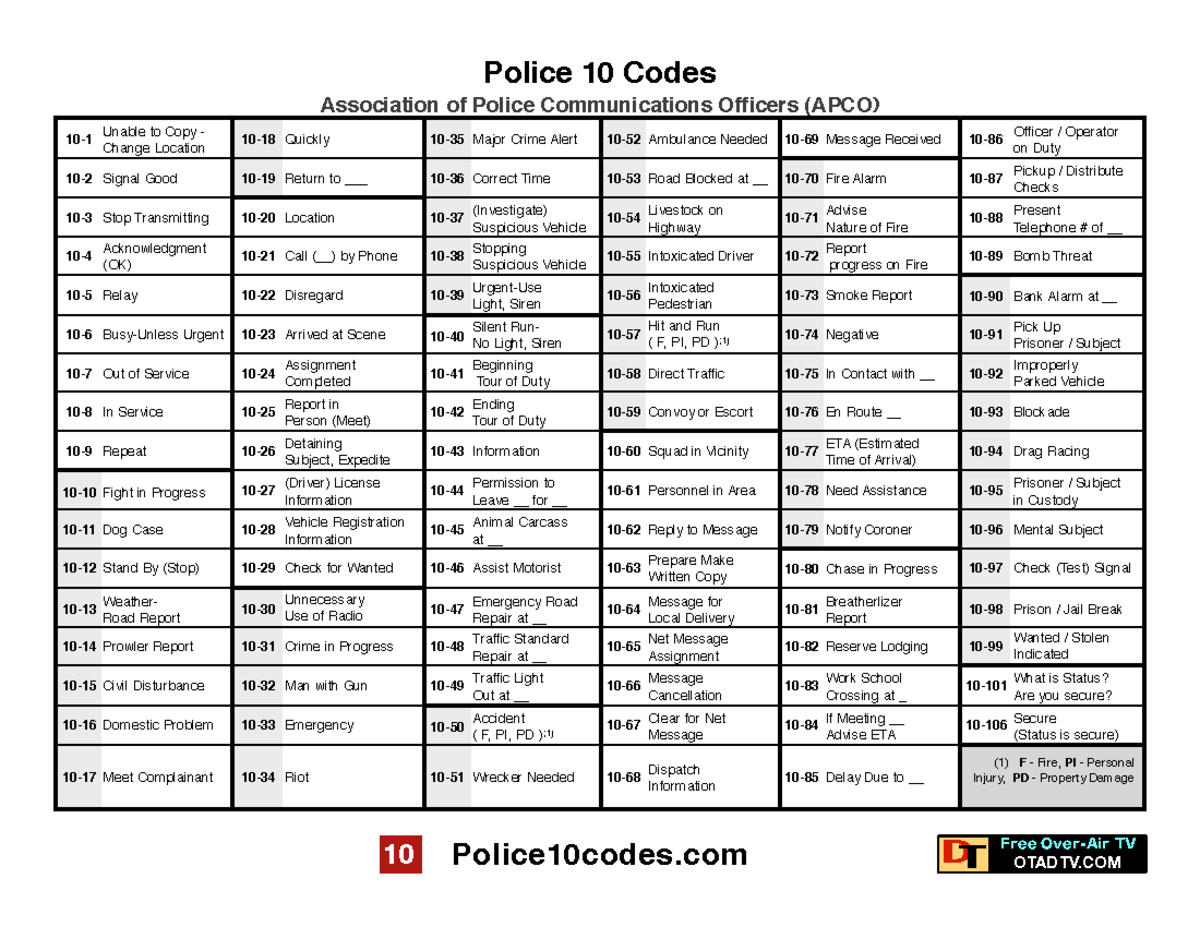
While 11-codes handle the "what," 10-codes generally handle the "how" and the status of the units involved. These are standardized across many California agencies but have specific nuances within the CHP's 2026 operational guidelines.
Operational Status and Acknowledgment
In the fast-paced environment of a CHP dispatch center, codes like 10-4 and 10-20 are the bedrock of communication. 10-4 signifies that a message has been received and understood, while 10-20 is the universal query for an officer's current geographic coordinates. In 2026, while GPS-enabled CAD systems provide real-time locations, the verbal 10-20 remains a critical safety check to verify that an officer's physical location matches their digital footprint.
Information Retrieval and Databases
When an officer initiates a traffic stop, they utilize 10-27 and 10-28 to check driver's license and vehicle registration status through the California Law Enforcement Telecommunications System (CLETS). A 10-29 check follows to determine if the individual or vehicle is "wanted" for a crime or listed as stolen. These codes ensure that the officer receives critical safety information regarding the suspect's history before they approach the vehicle for a second time.
Common CHP 10-Codes List
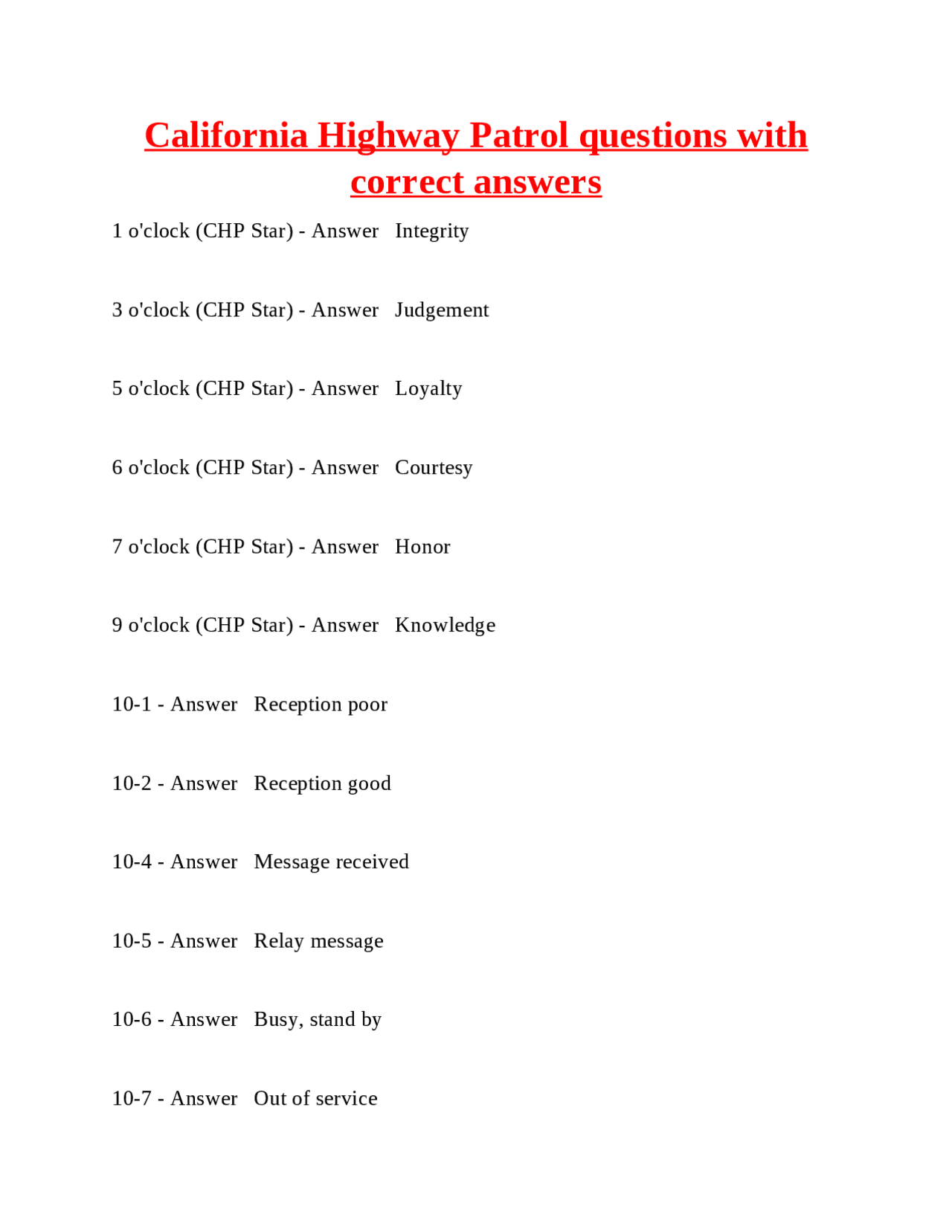
- 10-1: Receiving Poorly (Signal is weak or distorted)
- 10-2: Receiving Well (Signal is clear)
- 10-6: Busy, unless urgent
- 10-7: Out of Service (End of shift or off-duty)
- 10-8: In Service (Available for calls)
- 10-10: Off-duty (Similar to 10-7, often used for meal breaks)
- 10-15: Prisoner in Custody (Transporting a suspect)
- 10-19: Return to Station
- 10-21: Telephone the Station/Dispatch
- 10-22: Cancel Last Assignment
- 10-23: Arrived at Scene
- 10-35: Confidential Information (Usually precedes a sensitive broadcast)
- 10-36: Correct Time
- 10-97: Arrived at Scene (Often used interchangeably with 10-23)
- 10-98: Finished with Assignment
Penal Code and Vehicle Code Shorthand
The CHP frequently uses sections of the California Penal Code (PC) and Vehicle Code (VC) as shorthand identifiers for crimes and violations. This allows the officer to describe the nature of a stop or an arrest without lengthy narrative explanations.
- 148 PC: Resisting or obstructing an officer.
- 187 PC: Homicide/Murder.
- 211 PC: Robbery.
- 459 PC: Burglary.
- 20001 VC: Hit and run resulting in injury or death.
- 20002 VC: Hit and run resulting in property damage only.
- 23103 VC: Reckless driving.
- 23152 VC: Driving under the influence (DUI).
- 23153 VC: DUI causing injury.
- 10851 VC: Stolen vehicle (Grand Theft Auto).
Technical Infrastructure and Frequency Designations
As of 2026, the CHP organizes its radio traffic into "Color" designated frequencies. Each regional dispatch center (Communications Center) operates on specific pairs. For example, a unit might be told to "Switch to Blue" or "Stay on Green."
- VHF Low Band (Extender System): Officers wear a "Mobile Radio Extender" (SVR) on their belts. When they leave the patrol vehicle, their handheld radio (UHF/700MHz) transmits to the car, which then repeats the signal over the powerful 100-watt Low Band system to the dispatch tower. This ensures coverage in California's deep canyons and rural deserts where cellular and high-frequency digital signals fail.
- P25 Digital Migration: In high-density areas like Los Angeles, the Bay Area, and San Diego, the CHP has integrated P25 Phase 2 digital interoperability channels. These allow for clearer audio and better encryption capabilities when handling sensitive tactical operations.
- Encryption Status: While many local police departments have moved to full encryption in 2026, the CHP maintains many "Clear" (unencrypted) dispatch channels for general patrol to facilitate coordination with other agencies and public transparency, though tactical and car-to-car channels are typically encrypted.
Comparison of Code Systems: 10-Codes vs. Plain Language
| Feature | 10-Code / 11-Code System | Plain Language (Clear Speech) |
|---|---|---|
| Brevity | High - Single phrases replace sentences. | Low - Requires full descriptive sentences. |
| Clarity | High for trained personnel; Low for others. | High for all agencies and the public. |
| Security | Minimal - Obscures meaning from casual listeners. | None - Intent is immediately obvious. |
| Standardization | Agency-specific; varies by county. | Universal; follows FEMA/NIMS standards. |
| 2026 Usage | Primary for CHP internal operations. | Primary for multi-agency disaster response. |
Step-by-Step: How a CHP Radio Exchange Occurs
Understanding the codes requires knowing the rhythm of the exchange. In 2026, the protocol remains disciplined to ensure airtime is available for emergencies.
Step 1: Initial Contact
The officer initiates contact by stating their unit ID (e.g., "79-S1") and the channel they are on. The dispatcher acknowledges with the time or the unit ID.
Step 2: Identification of Action
The officer provides a code for their action. "79-S1, 10-6, 11-25 on Northbound I-5, south of main." (Unit is busy with a traffic hazard).
Step 3: Information Request
The officer may request a "27-28-29" (License, Registration, and Warrants check). The dispatcher will run the data through CLETS/NCIC.
Step 4: Status Update
If the situation escalates, the officer might broadcast a "Code 3" (Emergency - lights and sirens) or "11-41" (Need ambulance). If the situation is resolved, they broadcast "10-98" or "Code 4" (Under control).
Troubleshooting Common Communication Failures
Despite the advanced tech of 2026, radio interference and human error occur.
- 10-1 (Poor Reception): If an officer is in a "dead spot," they may use their vehicular repeater or move to higher ground.
- "Step-on" (Simultaneous Transmission): When two units talk at once, the dispatcher will usually say "Station calling, standby" or "Break, break" to clear the air.
- Code 4 Confusion: "Code 4" is perhaps the most vital phrase. It means "Everything is fine; no further assistance is needed." If an officer fails to respond to a status check, dispatch will assume the opposite and start a "11-99" response.
Frequently Asked Questions
What does 11-99 mean for the California Highway Patrol?
11-99 is the most urgent radio code used by the CHP, signifying "Officer Needs Help" in a life-threatening situation. When this code is broadcast, all available units—regardless of jurisdiction—respond "Code 3" (emergency lights and sirens) to the officer's last known 10-20 (location). It is strictly reserved for situations where an officer is under attack, in a major physical struggle, or otherwise in immediate peril.
Why does the CHP still use 10-codes instead of plain English in 2026?
The CHP continues to use 10-codes and 11-codes because of the significant speed and efficiency they provide on a statewide radio system that is often congested. A single code like "11-82" communicates "traffic accident with property damage" much faster than speaking the full sentence. Furthermore, the specialized nature of Highway Patrol work (primarily traffic and vehicle code enforcement) makes the 11-series codes highly effective for their specific mission.
What is the difference between a 10-code and an 11-code?
10-codes are general-purpose law enforcement signals used for status updates and information requests (e.g., 10-4 for acknowledgment). 11-codes are specific to the California Highway Patrol and certain other California agencies, primarily focusing on roadway incidents, traffic collisions, and immediate field requirements (e.g., 11-85 for a tow truck).
Does 10-33 mean the same thing as 11-99?
No. In the CHP system, 10-33 is a request for "Emergency Radio Traffic Only," which clears the channel of all non-essential communication because an incident is unfolding. 11-99 is an actual call for physical assistance for an officer in danger. While they are often used during the same incident, they serve different functional purposes on the radio net.
How can I listen to CHP radio codes in 2026?
In 2026, many CHP frequencies remain accessible via high-end digital scanners capable of receiving P25 Phase 2 and VHF Low Band. However, some tactical and car-to-car frequencies are encrypted for officer safety. Public-facing dispatch frequencies for most rural and suburban areas are generally unencrypted, though listening is subject to California state laws regarding the use of scanners during the commission of a crime.
Practical Recommendations for Scanner Enthusiasts and Professionals
For those monitoring CHP communications in 2026, it is essential to have a multi-band antenna capable of capturing the 39-45 MHz range. Many modern digital scanners struggle with Low Band unless they are specifically tuned for it. Additionally, understanding the "Phonetic Alphabet" used by CHP is vital for copying license plates (e.g., Adam, Boy, Charles, David instead of Alpha, Bravo, Charlie, Delta).
When listening, always cross-reference the 11-codes with the location. An "11-25" (Hazard) in the middle of a Los Angeles freeway is a high-priority event, while the same code on a rural road in Modoc County may be handled with less urgency. Monitoring these codes provides a real-time window into the safety and operational flow of California’s massive transportation infrastructure.
Image Gallery