Understanding Alarm System Ratings: Grades, Standards, and Compliance Explained
Alarm system ratings define a security system's technical capability to resist physical tampering, bypass attempts, and environmental stress. Standardized frameworks like the European EN 50131 security grades and North American Underwr...
Alarm system ratings define a security system's technical capability to resist physical tampering, bypass attempts, and environmental stress. Standardized frameworks like the European EN 50131 security grades and North American Underwriters Laboratories (UL) certifications categorize systems by threat level, component resilience, and signal transmission reliability to ensure proper property protection and insurance compliance.
Contents
Why Alarm System Ratings Matter for Property Protection
Selecting a security system based solely on brand reputation or price often leads to inadequate protection or denied insurance claims. Alarm system ratings provide an objective, standardized metric for assessing whether a specific installation can withstand the realistic threats facing a given property.
For commercial facility managers, high-net-worth homeowners, and risk management specialists, understanding these ratings is essential for three primary reasons:
- Insurance Compliance: Property insurance policies frequently mandate minimum security grades or UL-listed installations as a prerequisite for coverage. If a break-in occurs and the installed alarm system falls below the required standard, insurers may reduce payouts or reject claims entirely.
- Threat-Matched Resilience: A basic residential alarm cannot resist sophisticated signal jamming or mechanical tampering. Rating frameworks ensure that high-value assets are protected by systems designed to defeat specialized burglary equipment.
- Operational Reliability: Security ratings evaluate not only intruder detection but also power backup capacity, environmental durability, and signal transmission speed during power outages or line cuts.
The European Standard: EN 50131 Security Grades
In Europe and the United Kingdom (where it is implemented alongside British Standard BS 8243 and PD 6662 guidelines), the EN 50131 series is the benchmark for intruder and hold-up alarm systems. The standard classifies security systems into four distinct grades based on the anticipated knowledge, tools, and motivation of potential intruders.
| Grade 1: Low Risk | Grade 2: Med-Low | Grade 3: Med-High | Grade 4: High Risk |
|---|---|---|---|
| Simple Intruders | Basic Knowledge | Advanced Tools | High Risk |
Grade 1: Low Risk
Grade 1 systems are designed for properties where the risk of theft is minimal, and intruders are expected to have little to no knowledge of security alarm operations.
- Intruder Profile: Opportunistic thieves relying on physical force without specialized tools.
- Typical Application: Low-risk residential properties, internal doors, or outbuildings without significant valuations.
- Technical Mandates: Basic motion detection, simple door contacts, and standard local sounders. Grade 1 systems rarely qualify for central monitoring or police dispatch.
Grade 2: Low-to-Medium Risk
Grade 2 is the standard entry point for most residential homes and small, low-risk commercial premises (such as small offices or retail shops without high-value inventory).
- Intruder Profile: Intruders with limited knowledge of alarm systems who carry basic hand tools like screwdrivers, crowbars, or small hammers.
- Typical Application: Standard residential homes, ground-floor apartments, and small commercial offices.
- Technical Mandates: All system components (control panels, motion sensors, keypads) must resist basic physical tampering. Motion sensors must cover primary access routes, and standby power backup must maintain operation during short power outages.
Grade 3: Medium-to-High Risk
Grade 3 systems protect properties containing substantial financial assets, sensitive data, or high-value physical inventory.
- Intruder Profile: Experienced burglars with comprehensive knowledge of alarm system wiring, wireless frequencies, and sensor mechanics. Intruders are expected to carry advanced electronic tools, scope equipment, and power drills.
- Typical Application: Commercial businesses, warehouses, jewelry stores, pharmacies, high-net-worth residences, and financial branches.
- Technical Mandates:
- Anti-Masking Protection: Detectors must alert the control panel if an intruder attempts to spray paint, cover, or obstruct the sensor lens while the system is disarmed.
- Fault and Tamper Isolation: Wire runs and wireless channels must detect subtle resistance changes, frequency jamming, or enclosure tampering.
- Dual-Path Transmission: Alarm signals must transmit across multiple independent networks (such as Ethernet combined with cellular 4G/5G).
Grade 4: High Risk
Grade 4 represents the highest security tier under EN 50131, applied to sites where national security, critical infrastructure, or extraordinary financial assets are at risk.
- Intruder Profile: Highly organized criminal groups or sophisticated actors with deep technical expertise, specialized penetration tools, and the ability to prepare detailed breach plans.
- Typical Application: Bank vaults, defense facilities, government archives, and high-value art galleries.
- Technical Mandates: Complete system redundancy, continuous line monitoring with instant fault signaling, advanced anti-jamming wireless algorithms, and heavy structural armoring for control hardware.
EN 50131 Security Grades Comparison
The following table summarizes the core technical specifications and operational requirements across the four EN 50131 security grades:
| Feature / Metric | Grade 1 | Grade 2 | Grade 3 | Grade 4 |
|---|---|---|---|---|
| Target Risk Level | Low | Low-to-Medium | Medium-to-High | High |
| Intruder Skill Level | Minimal / Opportunistic | Limited knowledge & basic hand tools | Experienced & advanced equipment | Sophisticated / Professional planning |
| Primary Building Type | Low-value residential | Standard residential & small retail | Commercial, high-value residential, banking | Defense, bank vaults, critical infrastructure |
| Anti-Masking Required? | No | Optional / No | Mandatory | Mandatory |
| Standby Power Backup | 12 Hours | 12 Hours | 30 to 60 Hours (12 hrs if mains failure reported) | 60 Hours (24 hrs if mains failure reported) |
| Tamper Detection | Opening enclosure | Opening & removal from surface | Opening, removal, & anti-masking | Advanced physical & electronic tamper detection |
| Signal Paths | Single path (Local/PSTN) | Single or Dual path | Mandatory Dual Path | Mandatory Dual Path with high-frequency polling |
Environmental Classes and Physical Hardware Ratings
A security rating evaluates system logic, but physical components must also survive environmental wear and mechanical interference. Alarm components are rated using Environmental Classes and Ingress Protection (IP) codes.
EN 50131 Environmental Classes
Sensors, control panels, and sirens are assigned an Environmental Class (Class I through IV) to match their operational environment:
- Class I (Indoor General): Designed for climate-controlled indoor environments where temperatures remain stable (e.g., living rooms, private offices).
- Class II (Indoor Unconditioned): Rated for indoor spaces subject to temperature fluctuations and condensation (e.g., unheated warehouses, corridors, garages).
- Class III (Outdoor Sheltered): Built for outdoor areas not directly exposed to heavy rain or direct sunlight (e.g., covered loading docks, open carports).
- Class IV (Outdoor General): Fully weather-resistant components capable of operating under extreme weather, driving rain, dust storms, and wide temperature swings.
Ingress Protection (IP) Ratings for Alarm Hardware
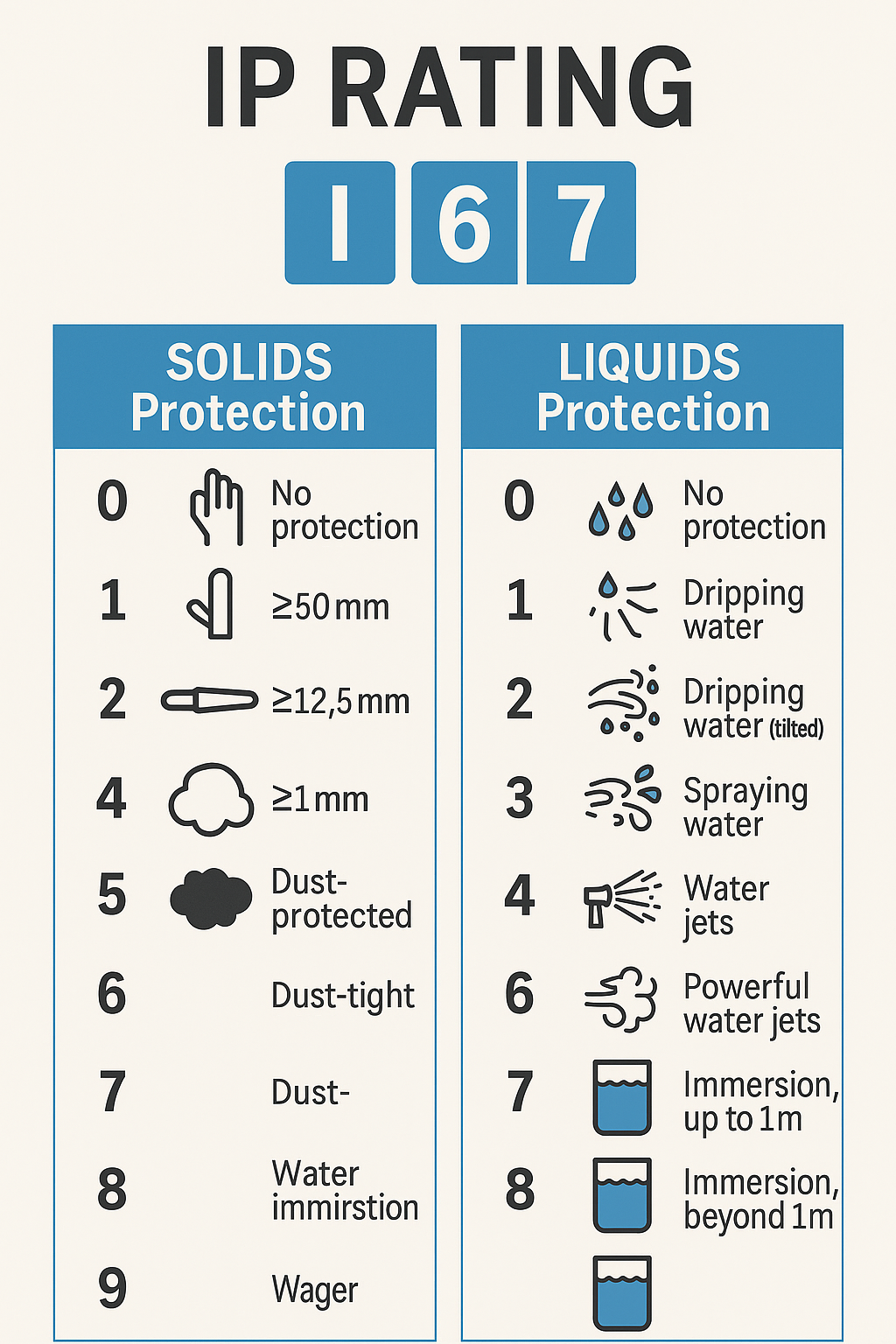
Outdoor sounders, perimeter beam detectors, and external keypads use international standard IEC 60529 IP ratings to define resistance to solids and liquids:
IP 6 5
- Solid Protection (6 = Dust-tight)
- Liquid Protection (5 = Water jets)
IP65: Fully dust-tight enclosure protected against low-pressure water jets from any direction. Suitable for standard exterior sirens.
IP66: Protected against powerful water jets and heavy seas, essential for exposed coastal or industrial security perimeters.
IP67: Submersible enclosure suitable for sensors in flood-prone inspection pits or low-lying fence lines.
North American Alarm Standards: UL and CP-01 Certifications
In North America, alarm system performance is governed primarily by Underwriters Laboratories (UL) standards and the ANSI/SIA CP-01 standard managed by the Security Industry Association.
Primary UL Standards for Burglar Alarms
Unlike the European numeric grade system, UL rates alarm systems based on specific equipment types, installation practices, and monitoring configurations:
- UL 681 (Installation and Classification of Burglar and Holdup Alarm Systems): Governs physical installation standards for commercial banking and mercantile properties. It specifies wiring methods, space protection, and perimeter barrier coverage.
- UL 1610 (Central-Station Burglar-Alarm Units): Defines safety and operational requirements for commercial control panels connected to remote monitoring stations.
- UL 1023 (Household Burglar-Alarm System Units): Covers residential alarm equipment safety and operational limits.
ANSI/SIA CP-01: False Alarm Reduction
False alarms strain public safety resources and result in costly municipal fines. The ANSI/SIA CP-01 Standard mandates specific panel features to minimize accidental activations:
- Auto-stay arming modes (automatically bypassing interior sensors if no exit door is opened).
- Entry and exit delay time minimums (preventing instant alarms upon entering).
- Abort windows allowing users to cancel false transmissions within 15 to 45 seconds.
Alarm Transmission System (ATS) Ratings & Signal Monitoring
An alarm system is only as effective as its communication link to the property owner or Central Monitoring Station (CMS). Signaling systems are categorized under standards such as EN 50136 using Alarm Transmission System (ATS) categories or Data Path (DP) levels.
| ATS Category | Transmission Path | Maximum Fault Reporting Time |
|---|---|---|
| ATS 2 (SP2) | Single Path (IP) | 25 Hours |
| ATS 4 (DP2) | Dual Path (IP/4G) | 1 to 5 Minutes |
| ATS 6 (DP4) | High-Security Dual | 10 to 60 Seconds |
- Single Path Transmission (SP): The system relies on one communication method—typically broadband IP or a cellular connection. If an intruder cuts the internet line, the system loses connectivity until the cut is recognized during routine polling cycles (which can take several hours on low-tier systems).
- Dual-Path Transmission (DP): The system uses two independent pathways (e.g., primary Ethernet backed up by cellular 4G/5G). If the primary network drops, the secondary path instantly takes over to transmit the alarm signal.
- Polling Frequency & Fault Reporting: High-security ATS categories require short polling intervals (heartbeat checks). For high-risk facilities, an ATS 5 or ATS 6 rating ensures that if both communication paths are severed, the monitoring station is notified of a line failure within seconds.
How Insurance Companies Use Security Ratings
Insurance providers evaluate alarm ratings to determine policy eligibility, premium discounts, and payout conditions following a loss event.
Mandatory Minimum Ratings for Commercial Coverage
Insurers routinely specify mandatory minimum system grades based on property type and contents valuation:
- Small Retail / Commercial Office: Typically requires an EN 50131 Grade 2 system with dual-path signaling.
- High-Value Inventory / Pharmacies / Warehouses: Typically mandates an EN 50131 Grade 3 system installed by an accredited security company (such as NSI or SSAIB in the UK).
- Financial Services & Vaults: Requires Grade 4 hardware paired with high-frequency ATS signal monitoring.
Unaccredited Installations and Claim Rejections
Installing Grade 3 hardware does not guarantee compliance if the installation itself is uncertified. Insurers often require system installation, commissioning, and annual maintenance to be conducted by certified security installers. Failing to provide a valid Certificate of Testing or proof of an ongoing maintenance contract can void theft coverage during an insurance audit.
Step-by-Step: Selecting the Correct Alarm Rating for Your Property
To ensure appropriate physical protection and regulatory compliance, follow this structured evaluation process:
Step 1: Conduct Threat & Asset Assessment
Step 2: Review Insurance Policy Requirements
Step 3: Determine Environmental & Physical Needs
Step 4: Select Matching Hardware Grade (EN Grade / UL Level)
Step 5: Verify Installer Accreditation & Signal Monitoring
Conduct a Threat and Asset Risk Assessment: Calculate the total replacement value of physical assets on-site. Identify potential entry points, structural vulnerabilities, and the likelihood of targeted theft versus opportunistic trespass.
Review Insurance Requirements: Consult your insurance broker or policy documentation to identify any required security grades, dual-path signaling mandates, or central station monitoring conditions.
Determine Environmental Conditions: Assess operating conditions for all component locations. Select Class I/II rated equipment for indoor climate-controlled spaces and Class IV (IP65+) rated hardware for outdoor perimeters.
Select System Components Matching the Required Grade: Ensure that all system components—including motion sensors, door contacts, control panels, keypads, and external sirens—match or exceed the target grade.
Note: A security system defaults to the rating of its lowest-graded component. Installing a Grade 2 door contact on a system with a Grade 3 control panel reduces the entire system's certified rating to Grade 2.
Verify Installer Accreditation and Certification: Work with qualified installation firms certified by recognized industry bodies (e.g., NSI Gold/Silver, SSAIB, or UL-Listed Alarm Installers). Request a formal Certificate of Compliance upon completion.
Frequently Asked Questions
What is the difference between a Grade 2 and Grade 3 alarm system?
Grade 2 alarm systems protect against opportunistic intruders using simple hand tools, making them suitable for standard homes and low-risk offices. Grade 3 systems protect against experienced thieves using specialized electronic tools, drills, and scope equipment. Grade 3 components must feature advanced anti-masking technology (detecting when sensors are covered or painted) and require longer battery backup capacity.
Can I install a Grade 3 alarm system myself?
While high-grade DIY security hardware exists, self-installation usually voids official Grade 3 compliance. Insurance policies typically mandate that Grade 3 systems be designed, installed, commissioned, and maintained by an accredited third-party security firm to guarantee correct placement, tamper protection, and verified signaling.
What happens if one component in my alarm system has a lower grade than the rest?
Under international security standards, an alarm system's overall certification is limited by its weakest component. If a system utilizes a Grade 3 panel and Grade 3 motion sensors but includes a Grade 1 door contact, the total system rating drops to Grade 1.
What is anti-masking on an alarm sensor?
Anti-masking is a required feature for EN 50131 Grade 3 and Grade 4 sensors. It detects when an intruder attempts to blind or block a motion sensor's field of view using spray paint, tape, paper, or plastic covers while the system is disarmed. When masked, the sensor signals a fault condition to the control panel.
Do IP ratings determine security protection levels?
No. IP (Ingress Protection) ratings measure a device's physical resistance to dust and moisture ingress. While high IP ratings (such as IP65 or IP66) ensure that outdoor sensors withstand heavy rain and harsh weather, they do not indicate a system's resistance to deliberate electronic or physical tampering.
Practical Guidance for System Owners
When purchasing or upgrading a property alarm system, avoid selecting equipment based on marketing terminology like "commercial grade" or "bank level." Instead, require your security provider to specify the exact EN 50131 security grade, Environmental Class, and ATS signaling category in writing. Obtain an official certificate of installation and file it with your property insurer to confirm that your building remains fully covered against theft, break-ins, and unauthorized entry.
EDITORIAL CATEGORY METADATA:
Image Gallery