Permanent Life Insurance for Independent Contractors: Securing Your Business and Family
Permanent life insurance offers independent contractors a reliable way to secure lifetime financial protection while accumulating cash value that can serve as a flexible business asset. Unlike traditional corporate benefits packages th...
Permanent life insurance offers independent contractors a reliable way to secure lifetime financial protection while accumulating cash value that can serve as a flexible business asset. Unlike traditional corporate benefits packages that automatically include group term life coverage, self-employed professionals must personally navigate the underwriting process to safeguard their families and income streams.
Contents
Understanding Permanent Life Insurance for Freelancers and 1099 Workers
Operating as an independent contractor, freelancer, or gig economy worker provides immense professional freedom, but it also strips away the safety net traditionally provided by a W-2 employer. When an income earner passes away unexpectedly, a household reliant on 1099 revenue faces immediate financial disruption. Permanent life insurance addresses this vulnerability by remaining in force for the entire life of the insured, provided premiums are paid, while simultaneously building a tax-advantaged financial reserve.
Unlike term life insurance, which expires after a set period such as 10, 20, or 30 years, permanent policies never sunset due to age. For independent contractors whose retirement timelines may look unconventional or whose income fluctuates from month to month, this lifetime guarantee ensures that coverage remains intact during fluctuating business cycles. Furthermore, the living benefits embedded within permanent coverage allow policyholders to access cash accumulation during their working years, offering a unique hybrid of protection and liquidity.
Core Types of Permanent Policies Available to the Self-Employed
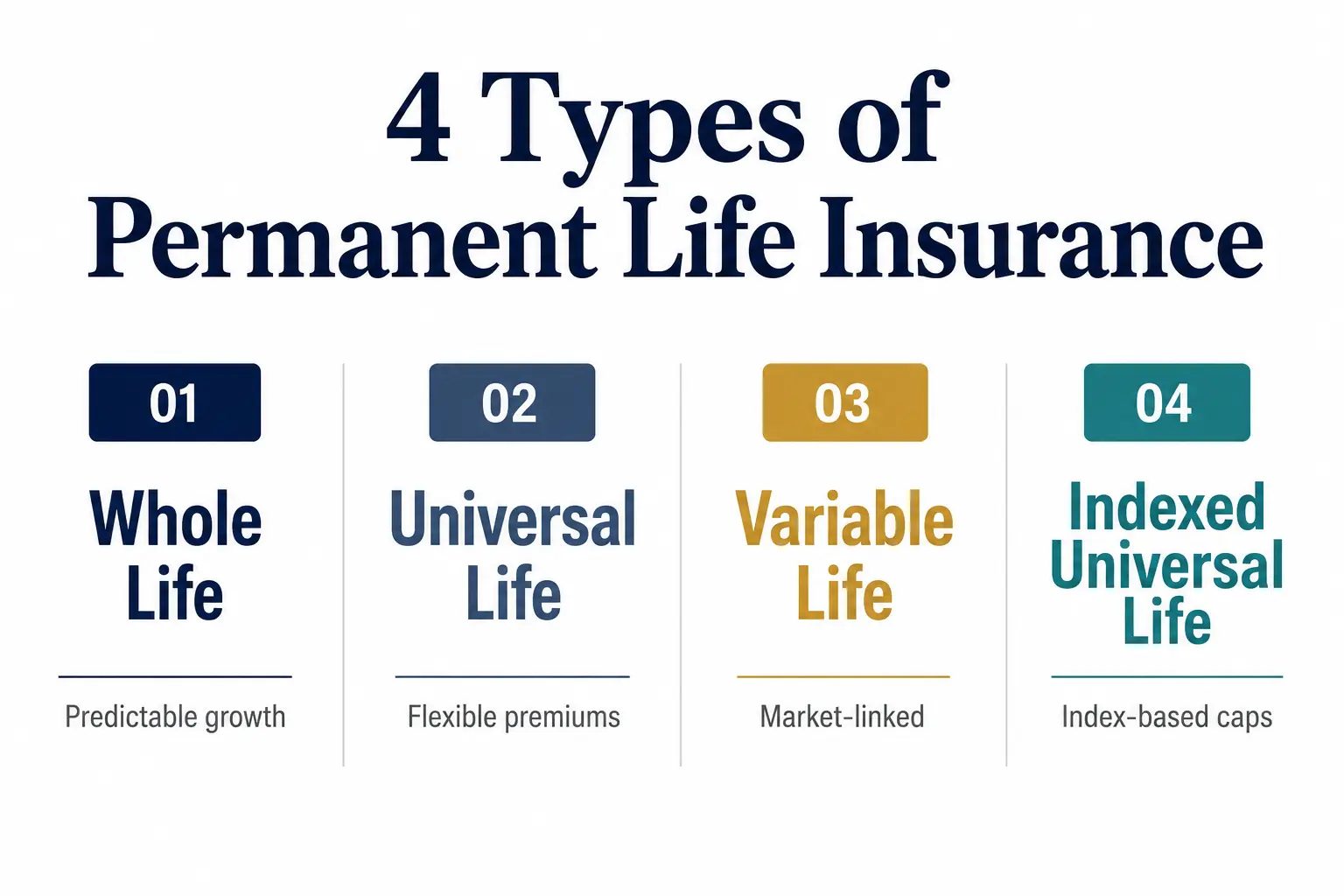
Navigating the marketplace requires understanding the distinct mechanics of various permanent life insurance structures. Each option provides lifelong coverage and cash value growth, but they differ significantly in risk profile, cost predictability, and growth potential.
Whole Life Insurance
Whole life insurance is the most traditional and predictable form of permanent coverage. It features fixed, level premiums that never increase over the life of the policy, a guaranteed death benefit, and a guaranteed minimum rate of return on the cash value component. Additionally, many traditional whole life policies are issued by mutual companies that pay annual dividends, which can be used to purchase additional paid-up insurance, reduce out-of-pocket premiums, or be taken as cash. For risk-averse contractors who want absolute certainty in their financial planning, whole life provides a stable, unshakeable foundation.
Universal Life (UL) Insurance
Universal life insurance introduces flexibility into permanent coverage. Unlike whole life, UL policies allow the policyholder to adjust premium payments and death benefits within specified contract limits, provided the accumulated cash value is sufficient to cover internal policy costs. If a contractor experiences a lean business quarter, they can temporarily reduce their premium payments by drawing from accumulated cash value. Conversely, during high-earning years, they can pump additional funds into the policy up to IRS-mandated limits to accelerate cash accumulation.
Indexed Universal Life (IUL) and Variable Universal Life (VUL)
Indexed universal life and variable universal life policies tie the cash value growth potential to market performance without requiring direct equity market ownership. IUL credits interest based on the upward movement of an external financial index, such as the S&P 500, while typically offering a zero-percent floor to protect principal from market downturns. VUL policies allow policyholders to invest their cash value directly into sub-accounts that mimic mutual funds, offering higher growth potential alongside the risk of market losses. These products require active monitoring and suit contractors with higher risk tolerances.
Key Advantages of Permanent Coverage for Independent Business Owners
For self-employed professionals, permanent life insurance functions as much more than a death benefit payout. It is a sophisticated financial instrument that addresses several unique vulnerabilities associated with entrepreneurship.
| Benefit Feature | Practical Application for Independent Contractors |
|---|---|
| Guaranteed Lifetime Protection | Coverage stays active regardless of age or health |
| Tax-Advantaged Cash Accumulation | Builds a liquid emergency reserve outside banks |
| Policy Loans and Withdrawals | Access business capital without credit checks |
| Asset Protection (State Dependent) | Shields cash value from certain legal creditors |
Access to Cash Value for Business Liquidity
Cash value builds on a tax-deferred basis, meaning you do not pay income taxes on the growth while it remains inside the policy. Independent contractors frequently face cash flow crunches due to delayed client payments, equipment failures, or seasonal slumps. Policyholders can borrow against their cash value via policy loans or make direct withdrawals. Because you are essentially borrowing from the insurance carrier using your cash value as collateral, traditional credit checks, underwriting hoops, and rigid repayment schedules are eliminated.
Estate Planning and Business Continuity
If you operate as a sole proprietor, single-member LLC, or partner in a small firm, your business value is often tied directly to your personal labor. Permanent life insurance can fund a buy-sell agreement, ensuring that surviving business partners have immediate liquidity to buy out your share from your heirs. For families, the tax-free death benefit provides immediate liquidity to settle outstanding business debts, commercial leases, or equipment loans that might otherwise force a fire sale of business assets.
Evaluating the Costs and Underwriting Realities
Securing permanent life insurance as an independent contractor requires a clear-eyed evaluation of costs and the underwriting process. Because permanent policies last a lifetime and build cash value, their initial premium costs are substantially higher than term life insurance for the same death benefit amount.
Underwriters evaluate applicants based on age, medical history, family background, tobacco use, and lifestyle factors. For self-employed individuals, underwriters may also scrutinize income verification. Because independent contractors often utilize business write-offs and deductions to lower their taxable adjusted gross income (AGI), proving true earning capacity can occasionally require submitting two years of federal tax returns, profit and loss statements, or bank statements rather than a simple W-2 statement. Working with an independent insurance broker who understands self-employed tax structures is critical to matching your financial profile with the right carrier.
Common Pitfalls to Avoid When Buying Coverage
Independent contractors are accustomed to managing risk independently, but making critical missteps in the life insurance market can prove costly.
- Overestimating Future Cash Flow: Committing to a high permanent premium during a banner year without accounting for potential income volatility can cause policy lapses later. Ensure the base premium is manageable during conservative income projections.
- Treating Insurance Solely as an Investment: While the cash value growth is attractive, permanent life insurance is fundamentally an insurance product designed for risk mitigation, not a replacement for diversified retirement accounts like a Solo 401(k) or SEP-IRA.
- Ignoring Rider Customization: Failing to attach essential riders—such as waiver of premium or chronic illness riders—leaves contractors completely unprotected if a disability temporarily halts their ability to generate 1099 income.
Frequently Asked Questions
Can I write off permanent life insurance premiums as a business expense?
In most cases, individual permanent life insurance premiums are considered personal, non-deductible expenses. According to Internal Revenue Service (IRS) guidelines, if the business owner is the insured party, the business cannot deduct the premium payments, even if the policy is used for business liquidity. Consult a certified public accountant to review your specific entity structure.
How do policy loans affect my permanent life insurance?
Taking a loan against your cash value reduces both your net cash value and the ultimate death benefit payout dollar-for-dollar if the loan remains unpaid at the time of death. While you do not technically have to make mandatory monthly repayments to the insurance carrier, interest accrues on the outstanding balance. Allowing interest to outpace cash value growth can cause the policy to lapse, triggering a potentially severe taxable event.
What happens if I have a lean month and cannot pay my premium?
Depending on the policy structure, you have options. If your permanent policy has accumulated sufficient cash value, you can utilize a provision called the automatic premium loan (APL), where the insurer borrows against your cash value to pay the premium. Alternatively, universal life policies allow you to temporarily skip or reduce payments as long as the cash value buffer remains positive.
Is permanent insurance better than term insurance for freelancers?
Neither is objectively better; they serve entirely different financial functions. Term life insurance is ideal for covering temporary liabilities, such as a 30-year mortgage or raising young children, at a low cost. Permanent insurance is designed for lifetime needs, estate planning, and accumulating tax-advantaged cash value. Many independent contractors build a blended portfolio utilizing both strategies.
How does underwriting work for contractors with fluctuating income?
Insurance carriers evaluate your financial insurability by looking at your net worth and average earnings over the past two years. If your income varies widely year-to-year, underwriters typically average your earnings or look closely at your Schedule C or business tax filings to justify the requested death benefit amount.
Next Actions for Independent Contractors
Securing the right permanent life insurance policy begins with auditing your long-term financial obligations and personal risk tolerance. Calculate your family's income replacement needs, evaluate whether you require lifetime protection or temporary coverage, and assess your current cash flow stability. Schedule a consultation with an independent insurance broker who has experience working with self-employed professionals, 1099 workers, and small business owners. Request side-by-side quotes for whole life and universal life products to determine which structure aligns seamlessly with your overarching financial roadmap.
Image Gallery