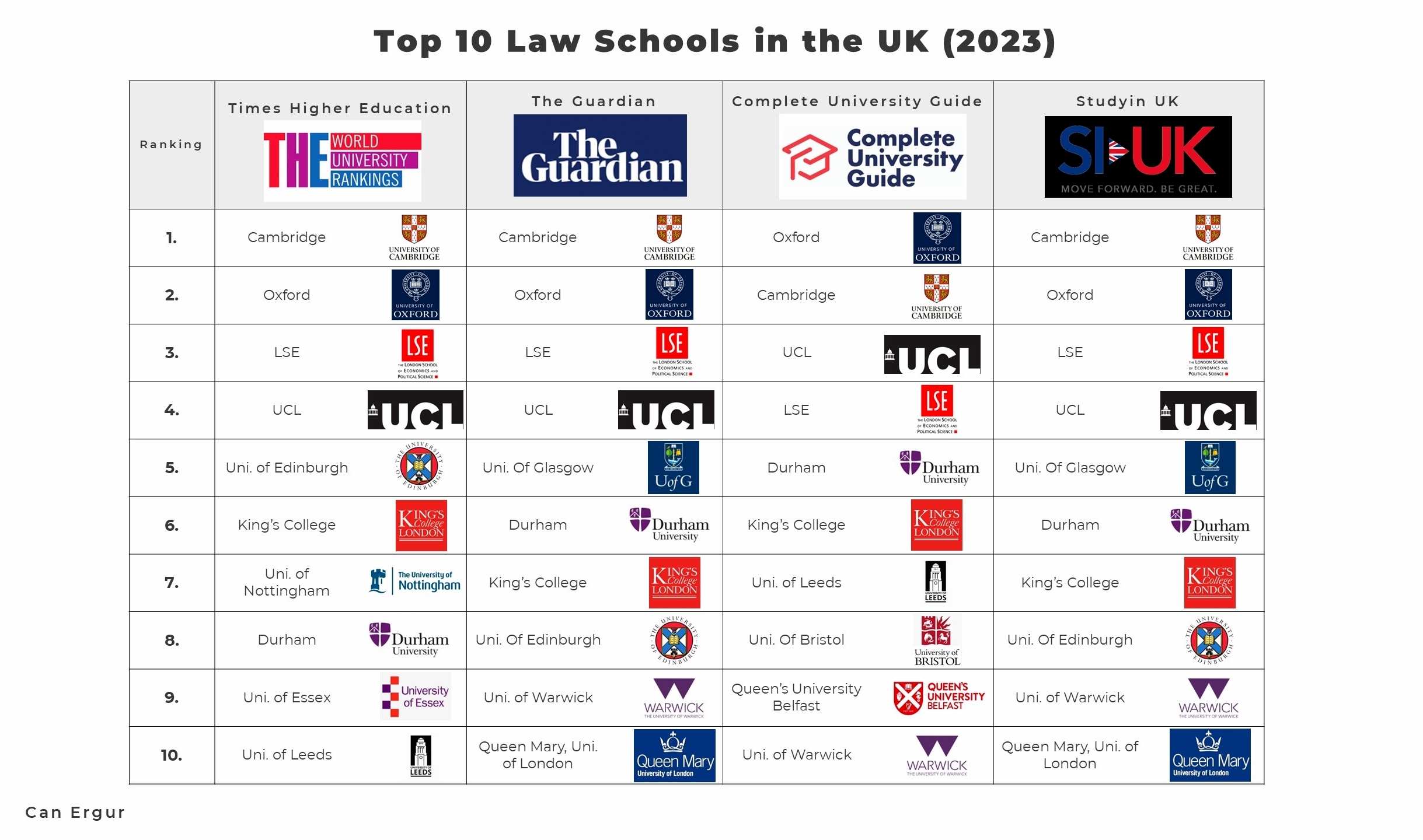
Ranking the Top Five Law Schools in England for 2026
The top five law schools in England for 2026 are the University of Oxford, the University of Cambridge, the London School of Economics and Political Science (LSE), University College London (UCL), and King’s College London (KCL). These...
The top five law schools in England for 2026 are the University of Oxford, the University of Cambridge, the London School of Economics and Political Science (LSE), University College London (UCL), and King’s College London (KCL). These institutions consistently lead national and global rankings due to their rigorous academic standards, research output, and exceptional graduate employability within "Magic Circle" law firms and prestigious chambers.
Contents
The landscape of legal education in England is defined by a blend of centuries-old tradition and modern adaptation to the Solicitors Qualifying Examination (SQE). For students aiming to secure a training contract or pupillage at the highest levels, selecting the right institution is a critical decision that influences their career trajectory for decades. While many universities offer high-quality legal training, the "Golden Triangle" institutions in Oxford, Cambridge, and London remain the most influential in terms of prestige and industry connections.
Understanding Law School Rankings in England
When evaluating the top law schools, several metrics are utilized to determine their standing in 2026. These include entry standards (UCAS points and LNAT scores), student-to-staff ratios, graduate prospects, and research quality as measured by the Research Excellence Framework (REF).
International rankings, such as the QS World University Rankings and the Times Higher Education (THE) rankings, often place a higher weight on academic reputation and research citations. Conversely, domestic rankings like the Guardian University Guide emphasize student satisfaction and value-added scores. For most prospective students, a synthesis of these rankings provides the most accurate picture of an institution's power. In 2026, the elite tier remains remarkably stable, though the competition between the London-based colleges and the ancient universities has intensified as modern legal practice becomes increasingly globalized.
1. University of Oxford: Faculty of Law
The University of Oxford continues to hold the premier position for legal studies in 2026. The Oxford Law Faculty is unique for its tutorial system, where students meet in groups of two or three with a senior academic. This pedagogical approach demands an intense level of preparation and critical thinking that is rarely matched by lecture-heavy programs.
Academic Focus and the Tutorial System
At Oxford, the primary undergraduate degree is the BA in Jurisprudence. The curriculum is deeply rooted in the philosophical and theoretical underpinnings of the law. Students are expected to engage with primary sources—cases and statutes—rather than relying solely on textbooks. The tutorial system ensures that every student receives personalized feedback on their weekly essays, fostering an environment where legal arguments are dissected and defended in real-time.
Admissions and the LNAT
Entry into Oxford Law is famously competitive. In 2026, applicants must sit the Law National Aptitude Test (LNAT) before their interview. Oxford places significant weight on the LNAT score and the subsequent interview performance, looking for "legal aptitude"—the ability to process complex information and construct logical arguments—rather than prior knowledge of the law.
2. University of Cambridge: Faculty of Law
The University of Cambridge remains the chief rival to Oxford, offering a rigorous and prestigious environment for aspiring lawyers. The Cambridge Law Faculty is housed in the iconic David Williams Building and benefits from the Squire Law Library, one of the most extensive legal collections in the UK.
The Law Tripos
The undergraduate degree is known as the Law Tripos. While it covers the foundational "seven foundations of legal knowledge" required for professional exemption, it also allows for extensive specialization in the final years. Cambridge is particularly renowned for its expertise in international law and private law. The supervision system (similar to Oxford’s tutorials) provides students with intensive, small-group teaching led by world-leading experts.
Career Trajectory
Cambridge graduates are highly sought after by top-tier commercial law firms and the Bar. The university’s "Careers Service" maintains deep-rooted links with international organizations and domestic chambers, ensuring that students have access to high-level networking opportunities throughout their three years of study.
3. London School of Economics and Political Science (LSE)
LSE Law School is arguably the most "industry-connected" law school in England. Located in the heart of London, it is a short walk from the Royal Courts of Justice and the commercial headquarters of the City of London.
A Global and Commercial Perspective
The LSE LLB program is distinguished by its focus on law within its social, political, and economic contexts. In 2026, LSE is particularly favored by students aiming for careers in corporate law, banking, and international arbitration. The student body is exceptionally international, reflecting the school’s global outlook. LSE does not just teach the law as it is; it challenges students to think about what the law should be in a globalized economy.
Research and Selectivity
LSE consistently ranks near the top for research impact. Its academics are frequently involved in advising governments and international bodies. This research-led teaching means students are often learning about legal developments from the very individuals who are shaping them. The entry requirements for LSE remain among the highest in the country, often requiring AAA at A-level or equivalent.
4. University College London (UCL): Faculty of Laws
UCL Laws is situated in Bentham House, a facility that underwent major redevelopment to provide state-of-the-art learning spaces. UCL was the first university in England to admit students of all religions and the first to admit women on equal terms with men, a legacy of inclusivity that continues to define its culture in 2026.
Innovation in Legal Education
UCL is known for integrating practical legal skills with academic theory. Its Center for Access to Justice allows students to engage in pro bono work, providing legal advice to the community under the supervision of qualified solicitors. This early exposure to the "law in action" is a significant advantage for students preparing for the SQE.
The Integrated LLB/LLM Path
UCL offers various combined pathways, including the popular "Law with a Year Abroad" programs. These allow students to study the legal systems of jurisdictions such as the USA, Australia, or Singapore. In an increasingly interconnected legal market, this international experience is highly valued by global law firms like Linklaters, Freshfields, and Clifford Chance.
5. King’s College London (KCL): Dickson Poon School of Law
The Dickson Poon School of Law at King’s College London rounds out the top five. Following a massive endowment in the early 2010s, King’s has solidified its place as a global powerhouse for legal education, particularly in the fields of transnational law and technology law.
Strategic Location and Specializations
Located in Somerset House on the Strand, KCL is at the epicenter of London’s legal district. It is positioned perfectly between the City and Westminster, allowing for a curriculum that balances commercial interests with public policy and human rights. In 2026, KCL is recognized as a leader in "Law and Technology," addressing the legal challenges of AI, blockchain, and digital privacy.
The Professional Connection
KCL maintains a dedicated careers team specifically for law students, facilitating mentorship programs with senior partners at international firms. Their "Professional Law Institute" bridges the gap between undergraduate study and the SQE, ensuring that graduates are technically proficient and ready for the demands of modern practice.
Comparative Overview of the Top 5 Law Schools
The following table compares key metrics for the 2026 academic year. Note that tuition fees for international students are subject to annual review and vary by college in Oxford and Cambridge.
| Institution | LNAT Required | Typical A-Level Offer | Approx. International Fee (2026) | Primary Focus |
|---|---|---|---|---|
| University of Oxford | Yes | A*AA | £40,000 - £48,000 | Jurisprudence / Tutorial-based |
| University of Cambridge | Yes | A*AA | £38,000 - £45,000 | Academic Rigor / Tripos System |
| LSE | Yes | A*AA | £28,000 - £32,000 | Corporate & Social Context |
| UCL | Yes | A*AA | £29,000 - £34,000 | Global Outlook / Research |
| King's College London | Yes | A*AA | £27,000 - £33,000 | Transnational & Tech Law |
Admissions Requirements and the LNAT in 2026
For all five of these institutions, the admission process is about more than just top grades. Because nearly every applicant possesses predicted A* or A grades, the Law National Aptitude Test (LNAT) has become the primary differentiator.
The LNAT is divided into two sections:
- Multiple Choice: Assessing reading comprehension, interpretation, and logical reasoning.
- The Essay: Assessing the ability to construct a coherent, persuasive argument in written form.
In 2026, many of these universities use automated screening for the multiple-choice section, but the essay remains a vital component of the holistic review process. Prospective students should begin preparing for the LNAT at least six months before their application deadline, focusing on critical thinking skills rather than rote memorization of legal facts.
Career Outcomes: The SQE and Bar Training
By 2026, the Solicitors Qualifying Examination (SQE) is the firmly established route for qualifying as a solicitor in England and Wales. While the top five law schools focus on the "academic" side of law (the LLB), they have adapted their curricula to ensure students are well-prepared for the SQE1 (functioning legal knowledge) and SQE2 (practical legal skills) assessments.
Graduates from these institutions are highly competitive in the "Training Contract" market. Most "Magic Circle" and "Silver Circle" firms recruit their cohorts two years in advance, often providing sponsorship for the SQE preparation courses and exams. For those aiming for the Bar, these five schools provide a strong foundation for the Bar Practice Course (BPC), with many students securing scholarships from the Inns of Court based on the prestige of their undergraduate institution.
Financial Considerations and Scholarships
The cost of legal education at a top-five school is significant, particularly for international students. In 2026, home student fees remain capped (currently at £9,250 per year), but international fees have seen steady increases.
However, these institutions also offer some of the most robust scholarship programs in the UK:
- The Dickson Poon Scholarships (KCL): Offers significant financial support to high-achieving undergraduates.
- UCL Global Undergraduate Scholarships: Aimed at international students from low-income backgrounds.
- Oxford/Cambridge College Grants: Individual colleges often have "hardship funds" or merit-based bursaries that are not always advertised at the university level.
FAQ
Do I need to study Law at A-level to apply to these schools?No. In fact, many admissions tutors at Oxford and Cambridge prefer subjects that develop rigorous analytical skills, such as History, Mathematics, Philosophy, or English Literature. Law at A-level is neither a requirement nor a disadvantage, provided your other subjects show sufficient academic breadth.
Is it harder to get into the London schools (LSE/UCL) or Oxbridge?While Oxford and Cambridge have the lowest acceptance rates, the ratio of applicants to places at LSE is often higher due to the massive volume of international applications. All five are considered "highly selective," meaning only about 5% to 15% of applicants receive an offer.
Does the specific college I choose at Oxford or Cambridge affect my law degree?The curriculum and exams are centralized by the university faculty. However, your college determines who your tutors are for the first two years and provides your accommodation and pastoral care. Some colleges have larger law "societies" or more dedicated law fellows, but the degree awarded is the same regardless of the college.
Can I practice law internationally with an English law degree?Yes. English Common Law is the foundation of many legal systems worldwide (including those in the US, Canada, Australia, Hong Kong, and Singapore). Graduates from these top five schools are highly mobile and frequently find work in international arbitration, human rights, and global corporate law.
Final Recommendation
Choosing between the top five law schools in England for 2026 should depend on your preferred learning style and career goals. If you thrive in a highly personal, intensely academic environment, Oxford or Cambridge are the gold standards. If you want to be at the heart of the global legal market with immediate proximity to major firms and courts, LSE, UCL, or King’s College London offer an unparalleled urban and professional experience. Regardless of the choice, a degree from any of these "Top Five" institutions remains one of the most powerful credentials in the global legal profession.
Image Gallery