How to Localize a Website for Global Users: A Comprehensive 2026 Guide
To localize a website for global users, you must go beyond simple translation by adapting your content, design, and technical infrastructure to meet the specific cultural, linguistic, and functional expectations of a target region. Thi...
To localize a website for global users, you must go beyond simple translation by adapting your content, design, and technical infrastructure to meet the specific cultural, linguistic, and functional expectations of a target region. This process involves internationalization (i18n), implementing hreflang tags, adjusting UX for various languages, and ensuring regional legal compliance.
Contents
Website localization (L10n) is the comprehensive process of adapting an existing website to a local economy and culture. In 2026, as global digital markets become increasingly fragmented and AI-driven search experiences demand hyper-relevant local content, a "one-size-fits-all" approach to web presence is no longer viable. Success requires a sophisticated blend of technical precision and cultural empathy.
The Critical Distinction: Translation vs. Localization
Many organizations confuse translation with localization. Translation is the process of converting text from one language to another. While essential, it is only a single component of a broader localization strategy. Localization encompasses the entire user experience, ensuring that a user in Tokyo feels as much "at home" on your site as a user in New York or Berlin.
True localization addresses non-textual elements such as currency, date formats, units of measure, local regulations, and even color symbolism. For example, while red might signify danger or passion in North America, it often represents prosperity and luck in many East Asian cultures. Ignoring these nuances can lead to brand alienation or, in some cases, total market failure.
Step 1: Internationalization (i18n) as the Foundation
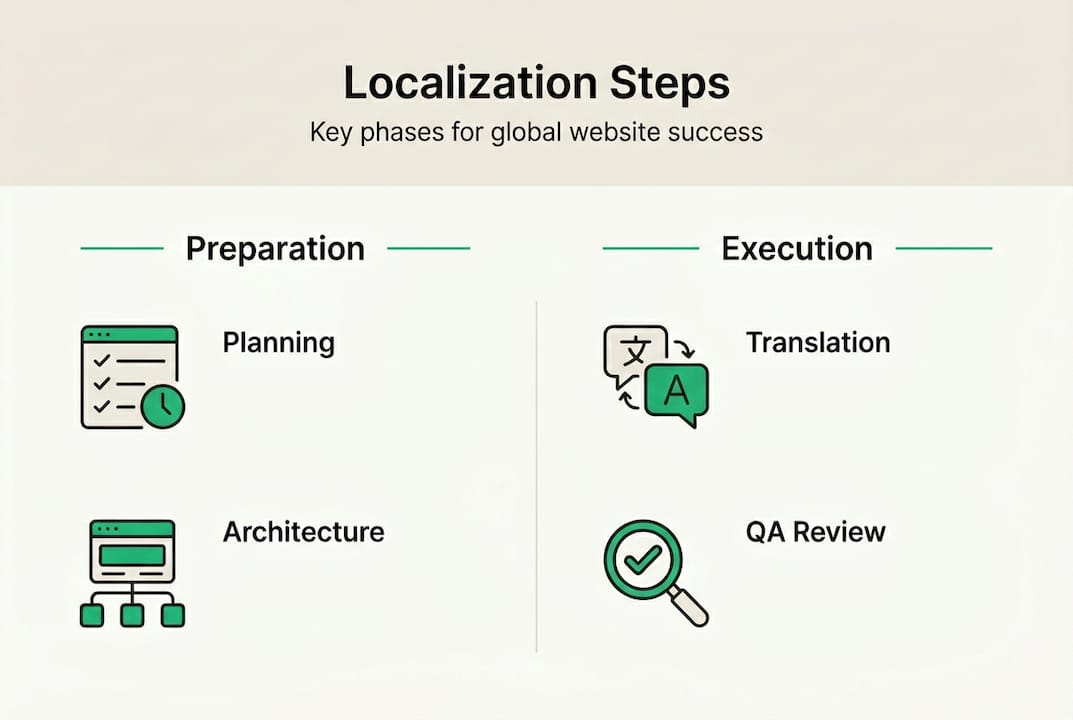
Before you can localize, you must internationalize. Internationalization is the architectural phase where developers ensure the website's code can support multiple languages and formats without requiring re-engineering for every new market.
Decoupling Content from Code
In a standard website, text is often hard-coded into the HTML. To prepare for global users, you must move all strings—including navigation menus, buttons, and error messages—into external resource files (typically JSON or XML). This allows translation management systems (TMS) to pull content for translation without touching the source code.
Unicode and Character Encoding
Ensure your database and web server use UTF-8 encoding. As of 2026, this is the global standard, supporting almost every character set in existence, including complex scripts like Devanagari, Kanji, and Arabic. Failure to use UTF-8 results in "mojibake"—the display of garbled text or "tofu" blocks where characters should be.
Step 2: Choosing the Optimal URL Structure
Your choice of URL structure significantly impacts your International SEO performance and user trust. There are three primary configurations used in 2026, each with specific trade-offs regarding cost, authority, and maintenance.
| Structure | Example | Pros | Cons |
|---|---|---|---|
| ccTLDs | example.fr |
Strongest local signal; highest trust for users. | Expensive to maintain; requires separate SEO authority. |
| Subdirectories | example.com/fr/ |
Consolidates domain authority; easy to set up. | Weaker local signal than ccTLDs; can clutter main site. |
| Subdomains | fr.example.com |
Allows for different hosting locations/servers. | Domain authority is split; users may find them less "local." |
For most mid-sized enterprises, subdirectories are the recommended approach as they allow the localized versions to inherit the "SEO juice" of the main root domain while remaining organized.
Step 3: Technical SEO and Hreflang Implementation
To ensure search engines serve the correct language version to the correct user, you must implement hreflang attributes. These tags tell Google and other search engines the relationship between different pages.
A common mistake is using hreflang to target a language only (e.g., en) when you should be targeting a locale (language and region, e.g., en-GB). If you have different pricing for Australia and the UK, using en-AU and en-GB prevents search engines from seeing these pages as duplicate content.
In 2026, search engines are increasingly sensitive to "return tags." If Page A links to its French version (Page B) via hreflang, Page B must link back to Page A. If the loop is broken, the tags may be ignored, leading to users landing on the wrong regional version of your site.
Step 4: Adapting UX and UI for Linguistic Diversity
A website designed for English often breaks when translated into other languages. This is known as the "expansion and contraction" problem.
- Text Expansion: Languages like German, Finnish, and Italian can take up to 35% more space than English for the same message. UI components like buttons and sidebars must be flexible or use CSS Flexbox/Grid to prevent text overflow.
- Vertical Space: Scripts like Thai or Arabic often have taller characters, requiring increased line-height to maintain readability.
- Right-to-Left (RTL) Support: For languages like Arabic, Hebrew, and Persian, the entire layout must be mirrored. This includes not just the text, but the placement of logos, navigation menus, and back buttons. Modern CSS properties like
logical properties(e.g.,margin-inline-startinstead ofmargin-left) make this transition significantly smoother.
Step 5: Cultural Transcreation and Content Adaptation
Transcreation is "creative translation." It involves taking a concept in one language and completely recreating it in another to maintain the original intent, style, tone, and context.
Marketing slogans are notoriously difficult to localize. A literal translation of a punchy English idiom might be nonsensical or even offensive in Portuguese. Transcreation ensures that the emotional resonance of your brand remains intact. Furthermore, consider imagery: a photo of a family at a backyard BBQ is a great "local" image for a US audience, but for a user in the UAE, a more culturally appropriate scene would involve local dress and social norms.
Step 6: Payment Gateways and Legal Compliance
A global website must function as a local business. This means integrating regional payment methods that users trust. While credit cards are dominant in the US, users in the Netherlands prefer iDEAL, Brazilians use Pix, and many Chinese consumers rely exclusively on Alipay or WeChat Pay.
Furthermore, you must navigate a complex web of regional regulations:
- GDPR (EU): Strict data privacy and cookie consent requirements.
- PIPL (China): Specific rules regarding the cross-border transfer of personal information.
- Accessibility Laws: Many regions, including the EU and the US, have strict legal requirements (such as WCAG 2.2) for website accessibility. Localized versions must also be compliant.
Step 7: Testing and Quality Assurance (LQA)
The final step is Linguistic Quality Assurance (LQA). This is not just a spell-check; it is a functional review of the localized site in a staging environment.
Reviewers should look for:
- Untranslated Strings: Buttons or tooltips that remained in the source language.
- Contextual Errors: Words that are technically correct but wrong for the context (e.g., a "Submit" button translated as "Yield" in a legal sense).
- Layout Breaks: Overlapping text or broken containers caused by long words.
- Functional Issues: Ensuring that localized forms accept regional phone number formats and postal codes.
FAQ
How does website localization affect SEO in 2026? Localization is a primary ranking factor for regional search. By providing content in the user's native language and using correct hreflang tags, you reduce bounce rates and increase engagement signals, which tells search engines your site is the most relevant result for that specific locale.
Is AI translation enough for a professional website? While AI and Large Language Models (LLMs) have become incredibly sophisticated by 2026, they still lack deep cultural context and "brand voice" consistency. A hybrid approach—AI for the initial draft followed by a human expert review—is currently the industry standard for high-quality localization.
What is the "x-default" hreflang tag?
The x-default tag is used to specify which version of the page should be shown to users who do not match any of your specific language/region tags. It is typically used for a landing page or a global gateway that allows users to select their country manually.
Do I need different servers for different countries? Not necessarily. While hosting a site on a local server in the target country can slightly improve loading speeds, using a robust Content Delivery Network (CDN) with global edge locations is generally sufficient to provide a fast experience for all users regardless of their physical location.
How often should I update my localized content? Localization is not a one-time project. Your localized sites should be updated simultaneously with your primary site. Using a "Continuous Localization" workflow, where your CMS is synced with your translation tool, ensures that new blog posts or product updates are translated and published in near real-time.
Practical Recommendation
Begin your localization journey by identifying your top three highest-potential markets through Google Analytics data. Instead of attempting to localize for 20 languages at once, focus on a "pilot" region. Perform a full internationalization audit of your code, implement a subdirectory structure, and hire a professional transcreation service to adapt your high-impact pages. Once the workflow is proven and you see a positive ROI in those specific markets, scale your efforts to additional regions.
Image Gallery