Precision Guide to Running the Mile on a Track: Standard Lap Calculations, Lane Variances, and Pacing Protocols
On a standard 400-meter outdoor track, one mile equals precisely 4 laps plus 9.34 meters (30 feet, 7.7 inches) in Lane 1. Because four full laps equal 1,600 meters, running exactly four laps leaves a runner 9.34 meters short of an offi...
On a standard 400-meter outdoor track, one mile equals precisely 4 laps plus 9.34 meters (30 feet, 7.7 inches) in Lane 1. Because four full laps equal 1,600 meters, running exactly four laps leaves a runner 9.34 meters short of an official 1,609.34-meter mile. Moving into outer lanes increases the lap distance significantly due to the larger radius of the turns.
Contents
The Precision Geometry of a Standard 400-Meter Oval
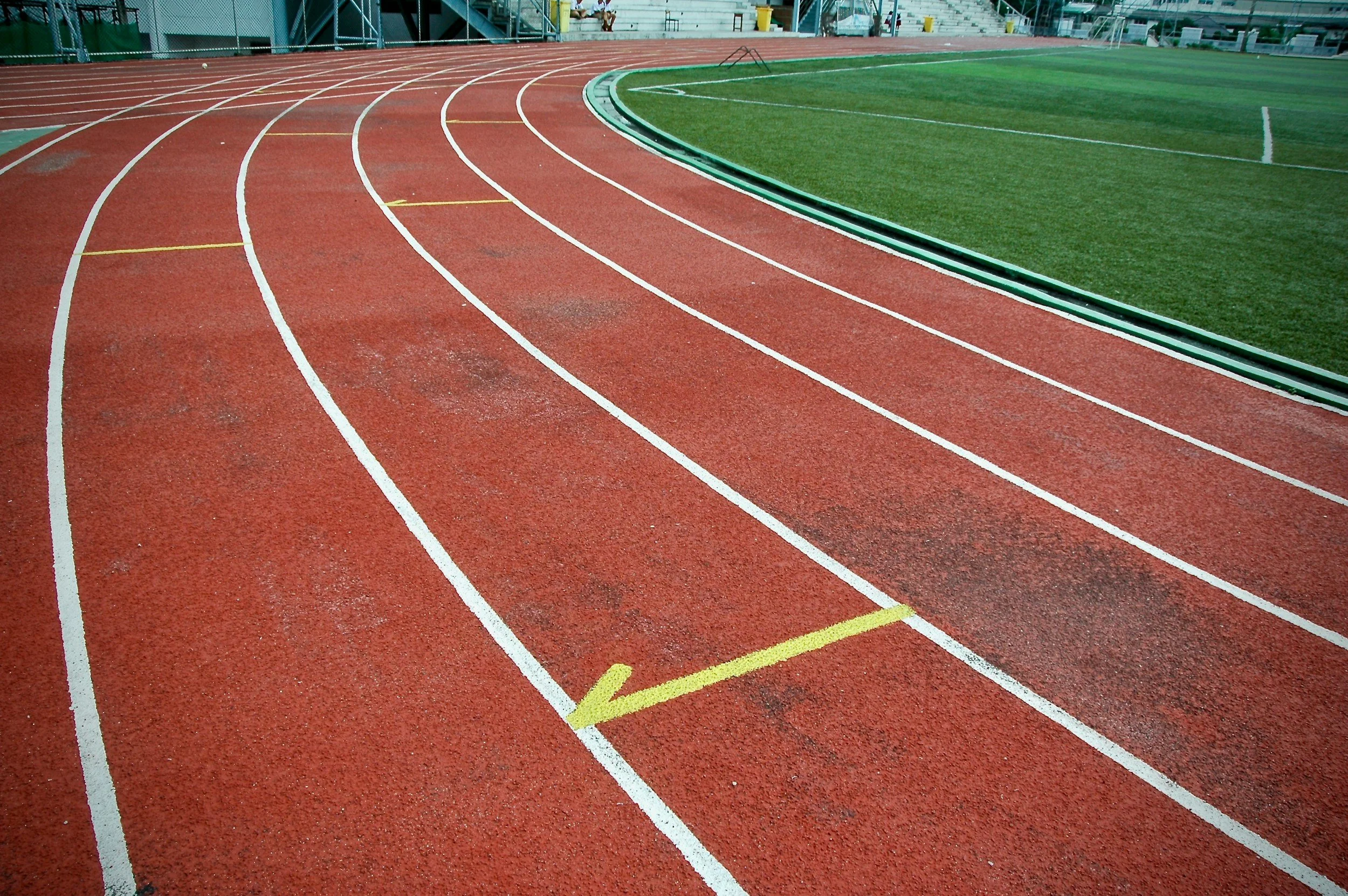
To measure and execute an exact track mile, you must first understand how modern running tracks are designed. World Athletics (the global governing body for track and field) specifies that a standard outdoor track consists of two equal straightaways and two equal semi-circular curves.
(No ASCII art, use descriptive text) ``` -> Ensure zero backticks, zero pre tags, zero ASCII flowcharts. In Lane 1, the theoretical running line is measured 30 centimeters (11.8 inches) away from the inside curb. If the track lacks a raised curb and uses a painted line instead, the measurement is taken 20 centimeters (7.9 inches) from the outer edge of the inside line. ### Key Dimensions of a World Athletics Standard Track * **Standard Lap Circumference (Lane 1):** 400.00 meters (1,312.34 feet). * **Straightaway Length:** 84.39 meters (276.87 feet) per side. * **Curve Radius (to measurement line):** 36.50 meters (119.75 feet). * **Standard Lane Width:** 1.22 meters (4.00 feet), including the 5-centimeter painted lane marker to the right. * **Exact One Mile Distance:** 1,609.344 meters (5,280.00 feet). Understanding these geometric constraints reveals why track running requires specific starting line offsets. A straight 1,600-meter run covers 99.42% of a true mile. While high school track meets frequently run the 1,600-meter event for timing simplicity, formal competitive mile events utilize a waterfall or staggered starting line marked exactly 9.34 meters behind the standard finish line. --- ## Lane Math: How Many Laps Make a Mile in Every Lane? When running in crowded conditions, during public open-track hours, or while passing other runners, staying in Lane 1 is not always possible. Because each lane expands outward by 1.22 meters, the circumference increases with every lane. The mathematical formula to calculate the additional distance per lap for outer lanes is: $$\text{Additional Distance per Lap} = 2 \times \pi \times \text{Lane Width Difference}$$ For a standard 1.22-meter lane width, each outer lane adds approximately 7.66 meters (25.13 feet) per lap compared to the lane directly inside it. | Lane Number | Per-Lap Distance (Meters) | Laps for 1,600 Meters | Laps for Exact Mile (1,609.34m) | Distance Covered in 4 Laps | | :--- | :--- | :--- | :--- | :--- | | **Lane 1** | 400.00 m | 4.000 Laps | 4 Laps + 9.34 m | 1,600.00 m (0.994 mi) | | **Lane 2** | 407.04 m | 3.931 Laps | 3.954 Laps | 1,628.16 m (1.012 mi) | | **Lane 3** | 414.70 m | 3.858 Laps | 3.881 Laps | 1,658.80 m (1.031 mi) | | **Lane 4** | 422.37 m | 3.788 Laps | 3.810 Laps | 1,689.48 m (1.050 mi) | | **Lane 5** | 430.03 m | 3.721 Laps | 3.742 Laps | 1,720.12 m (1.069 mi) | | **Lane 6** | 437.70 m | 3.655 Laps | 3.677 Laps | 1,750.80 m (1.088 mi) | | **Lane 7** | 445.36 m | 3.593 Laps | 3.614 Laps | 1,781.44 m (1.107 mi) | | **Lane 8** | 453.03 m | 3.532 Laps | 3.552 Laps | 1,812.12 m (1.126 mi) | Running four complete laps in Lane 8 covers 1,812.12 meters—over 202 meters further than a true mile. If you complete four laps in Lane 8, you have actually run 1.126 miles. --- ## The Metric Mile vs. The True Imperial Mile In modern athletics, confusion often arises between the **1,600-meter run**, the **1,500-meter run**, and the **1,609.34-meter Imperial Mile**. > **Official Competition Distance Metrics** > World Athletics and USA Track & Field (USATF) recognize the 1,500-meter run as the standard Olympic distance, often called the "metric mile." However, the traditional 1,609.34-meter mile remains an officially sanctioned world record event. High school associations predominantly run the 1,600-meter distance, which is 9.34 meters shorter than a true mile. ### Time Conversion Factors To convert performance times between these distances with high accuracy, coaches and sports scientists apply standardized conversion multipliers: 1. **1,600m to True Mile:** Multiply 1,600m time in seconds by **1.0058**. (Example: A 5:00.00 1,600m converts to a 5:01.74 mile). 2. **1,500m to True Mile:** Multiply 1,500m time in seconds by **1.0737** (or use the widely accepted elite baseline of adding roughly 17 to 18 seconds depending on overall pace). --- ## How to Set Up and Run an Exact Track Mile: Step-by-Step Execution To time an officially accurate 1-mile time trial on a standard 400m outdoor track without specialized race timing equipment, follow this standardized execution protocol.
(Use numbered lists for steps)
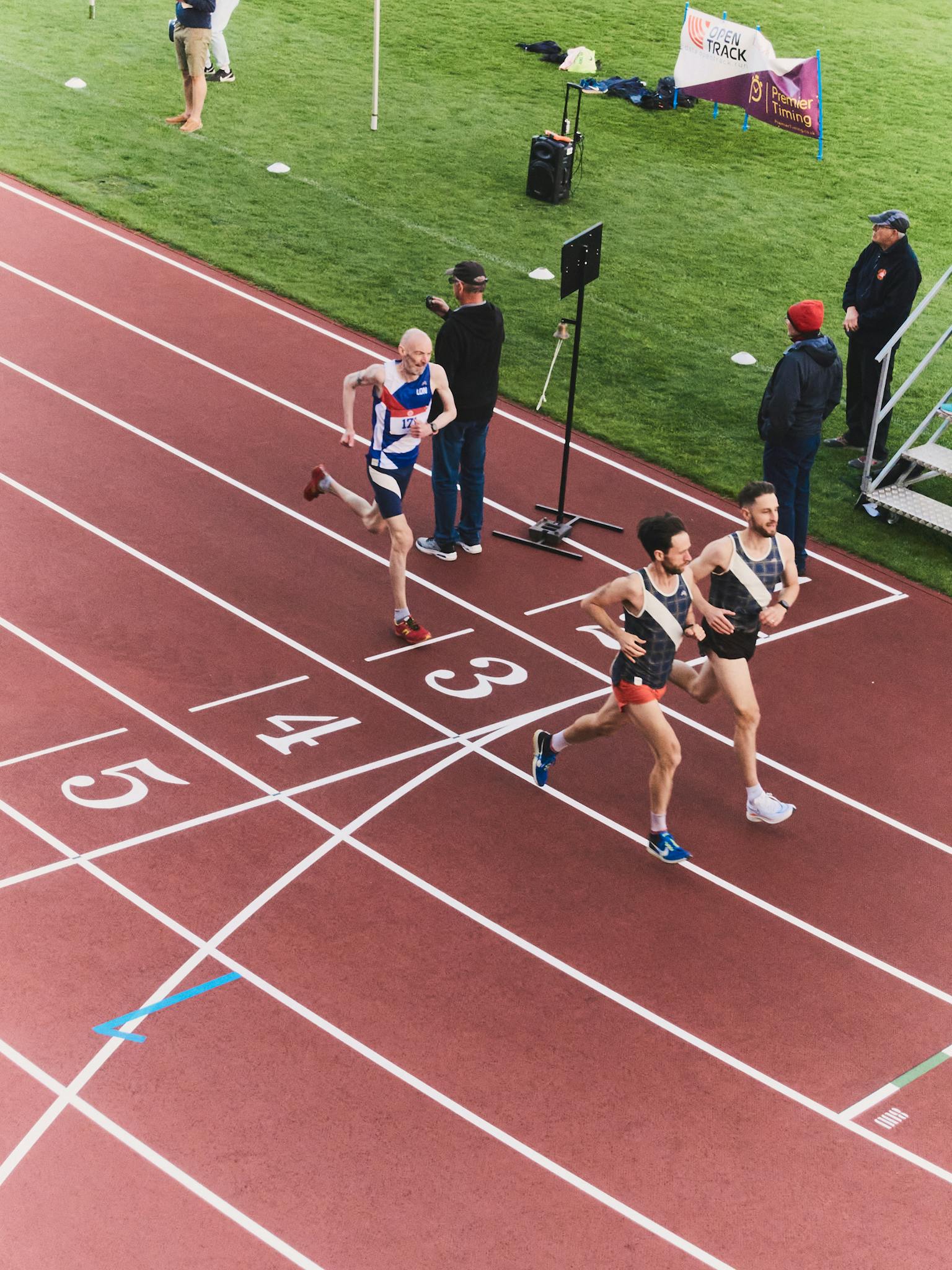
1. **Identify the Common Finish Line:** Locate the primary finish line painted across the track (typically at the end of the main home straightaway, adjacent to the grandstands). 2. **Mark the 9.34-Meter Waterfall Start Line:** Measure 9.34 meters (30 feet, 7.7 inches) backward (clockwise) from the common finish line along the inside curb of Lane 1. This curved starting line allows all runners to break smoothly toward Lane 1. 3. **Position Your Timer at the Finish Line:** The primary time begins when your front foot hits the track from the 9.34-meter starting mark. 4. **Complete the Initial 9.34-Meter Segment:** Sprint or stride through the common finish line for the first time. Your watch or hand timer should split here if tracking individual laps. 5. **Run Four Full Laps in Lane 1:** Maintain your line within 30 centimeters of the inner rail without stepping on or over the aluminum curb or white painted line. 6. **Finish at the Main Finish Line:** Stop the timer the exact moment your chest crosses the primary finish line at the end of your fourth full lap. > **Operational Safety Warning** > Avoid stepping on the raised aluminum curb or painted inside line during turns. Under USATF Rule 163, stepping on or inside the curb line with two consecutive strides during a turn results in immediate disqualification and invalidates official performance tracking. --- ## Why GPS Smartwatches Overcount Distance on Curved Tracks A frequent source of frustration for distance runners is that GPS smartwatches consistently record track miles as 1.03 to 1.08 miles per 4 laps. This error stems from hardware sampling rates and line-of-sight satellite positioning geometry. ### The Mechanics of Track GPS Drift Most modern GPS smartwatches sample positional coordinates once every second (1 Hz sampling). When running at a 7:00 per mile pace (approximately 3.8 meters per second), the watch takes discrete points along a continuous arc. * **Point Interpolation Error:** When connecting discrete GPS points around a 36.5-meter radius curve, the watch algorithm attempts to smooth the path, often pushing the calculated track path outward into Lanes 2 through 4. * **Satellite Geometry Reflection:** High stadium bleachers, fences, and body shadowing corrupt satellite signal reception (multipath interference), introducing positional noise of 1 to 3 meters. * **Cumulative Deviation:** A 2-meter outward calculation error on every curve adds up to nearly 50 extra meters over four laps, making a true 1,609m run register as roughly 1,660m on your wrist. ### Best Practices for Track Wearable Calibration 1. **Enable Native Track Mode:** Modern sports watches feature dedicated Track Run modes. These algorithms use map-matching logic to snap your run to a standard 400m oval once you complete 1.5 calibration laps in a specific lane. 2. **Manual Lap Button Override:** Disable Auto-Lap by distance. Manually press the lap/split button at the start/finish line every 400 meters to record accurate splits based on track geometry rather than internal GPS estimates. 3. **Select Dual-Frequency / Multi-Band GNSS:** Configure watch settings to use L1 + L5 dual-frequency satellite tracking to minimize signal reflection errors near bleachers. --- ## Track Etiquette and Rules for Distance Runners To maintain safety and operational efficiency during open track hours or shared workouts, runners must adhere to standard track etiquette guidelines: * **Direction of Travel:** Always run counter-clockwise unless explicitly directed otherwise by facility signage for surface wear balancing. * **Lane Usage Rules:** * **Lane 1 & 2:** Reserved strictly for fast workouts, speed intervals, and time trials. * **Lanes 3 through 5:** Designated for moderate tempo work and passing. * **Outer Lanes (6 through 8):** Reserved for warm-ups, cool-downs, walking, and fitness drills. * **Passing Protocol:** Pass slower runners on their right side. If you are approaching a slower runner in Lane 1 from behind, call out clearly "On your right!" before passing. Never force a runner inside onto the infield. * **Standing or Stopping:** Never stand or stop moving in Lanes 1 or 2. Clear the track surface immediately onto the turf infield or outer apron upon completing an interval. --- ## Structural Comparison of Track Surface Types The composition of a track surface directly influences foot strike mechanics, energy return, traction, and physical impact forces. | Surface Material | Composition & Construction | Energy Return / Elasticity | Weather Resistance | Typical Lifespan | Primary Application | | :--- | :--- | :--- | :--- | :--- | :--- | | **Poured Polyurethane (Full Depth)** | Solid polyurethane resin bound with embedded EPDM rubber granules. | High (Maximizes kinetic energy return for sprinting). | Exceptional (Impervious to water penetration and freeze-thaw cycles). | 15–20 Years | Elite University Facilities, International Stadiums, Olympic Venues. | | **Spray-Applied Polyurethane** | SBR rubber base layer topped with a spray-applied polyurethane foam coating. | Medium-High (Balanced cushioning and firm response). | Good (Permeable options require sub-drainage systems). | 10–12 Years | Standard High School Facilities, Municipal Sports Complexes. | | **Latex / Acrylic Surface** | Layered rubber particles bound with water-based acrylic or latex emulsion. | Medium-Low (Softer feel, higher shock absorption). | Fair (Prone to ultraviolet degradation over time). | 7–10 Years | Middle Schools, Community Parks, Local Recreational Tracks. | | **Crushed Cinder / Clay** | Compacted volcanic ash, slag, or crushed stone over gravel beds. | Low (Loose surface causes energy dissipation through slip). | Poor (Ruts during heavy rainfall; requires frequent grading). | Continuous Maintenance | Historical Tracks, Specialized Cross-Country Training Trails. | --- ## Target Split Table for Strategic Pacing Executing a fast, efficient track mile requires disciplined pacing. The most energy-efficient execution strategy is **even pacing** or a slight **negative split** (running the second half 1 to 2 seconds faster than the first half). Opening with an unsustainable sprint in lap 1 depletes glycogen stores and causes heavy lactate accumulation before the final turn. Below is a breakdown of targeted 400m splits for common mile finish times: | Target Mile Time | 9.34m Start Segment | Lap 1 Split (400m) | Lap 2 Split (800m) | Lap 3 Split (1,200m) | Lap 4 Split (1,609m) | Avg Pace / 400m | | :--- | :--- | :--- | :--- | :--- | :--- | :--- | | **4:30.00** | 1.56 sec | 67.11 sec | 67.11 sec | 67.11 sec | 67.11 sec | 67.11 sec | | **5:00.00** | 1.74 sec | 74.56 sec | 74.56 sec | 74.56 sec | 74.56 sec | 74.56 sec | | **5:30.00** | 1.91 sec | 82.02 sec | 82.02 sec | 82.02 sec | 82.02 sec | 82.02 sec | | **6:00.00** | 2.08 sec | 89.48 sec | 89.48 sec | 89.48 sec | 89.48 sec | 89.48 sec | | **6:30.00** | 2.26 sec | 96.93 sec | 96.93 sec | 96.93 sec | 96.93 sec | 96.93 sec | | **7:00.00** | 2.43 sec | 104.39 sec | 104.39 sec | 104.39 sec | 104.39 sec | 104.39 sec | | **8:00.00** | 2.78 sec | 119.30 sec | 119.30 sec | 119.30 sec | 119.30 sec | 119.30 sec | *Note: The 9.34m start segment time is calculated proportionally based on average velocity.* --- ## Frequently Asked Questions ### How many laps on an indoor track make a mile? On a standard 200-meter indoor track, one mile equals **8 full laps plus 9.34 meters**. On smaller indoor tracks (such as a 160-meter or 1/10-mile track common in older recreation centers), a full mile requires 10 full laps. ### Why does my GPS watch show more than 1.00 mile after running 4 laps? GPS smartwatches approximate curves using straight-line data points sampled once per second. This calculation technique consistently widens the apparent radius of the turns, resulting in an overestimation of 30 to 80 meters over a four-lap run. ### Is running 4 laps in Lane 2 equal to a mile? No. Four full laps in Lane 2 cover approximately 1,628.16 meters (1.012 miles). This is approximately 18.82 meters longer than a true mile and 28.16 meters longer than a standard 1,600-meter run. ### Where is the exact start line for a 1-mile race on a standard track? The true 1-mile start line is a curved white line located **9.34 meters behind the common finish line** in Lane 1. Runners start at this waterfall mark, complete the 9.34-meter initial segment, and then run four full 400-meter laps to finish at the primary finish line. ### How much distance do I add if I run in Lane 8 the whole time? Each lap in Lane 8 adds approximately 53.03 meters compared to Lane 1. Running four full laps in Lane 8 equals 1,812.12 meters (1.126 miles), which adds more than half a lap of extra distance. --- ## Maximizing Your Track Performance Accurate measurement is the foundation of effective athletic pacing. Whether training for a competitive track event, executing tactical interval workouts, or measuring personal physical fitness benchmarks, understanding track geometry ensures your data remains reliable. Use dedicated track mode settings on your wearable devices, select appropriate lane positioning for your target pace, and calculate your target splits based on standard 400-meter track geometry rather than uncalibrated GPS readings. **
Image Gallery