Federal Fair Credit Reporting: Rights, Regulations, and Consumer Protections
Federal fair credit reporting is governed primarily by the Fair Credit Reporting Act (FCRA), a federal statute that ensures the accuracy, fairness, and privacy of information in consumer reporting agency files. It grants individuals th...
Federal fair credit reporting is governed primarily by the Fair Credit Reporting Act (FCRA), a federal statute that ensures the accuracy, fairness, and privacy of information in consumer reporting agency files. It grants individuals the right to access their credit data, dispute inaccuracies, and restrict who can view their sensitive financial history for lending or employment purposes.
Contents
The federal landscape of credit reporting in 2026 remains anchored by the Fair Credit Reporting Act (FCRA), originally enacted in 1970 and significantly strengthened by subsequent amendments like the Fair and Accurate Credit Transactions Act (FACTA). This body of law regulates how consumer reporting agencies (CRAs)—including the "Big Three" (Equifax, Experian, and TransUnion)—collect, disseminate, and use consumer information. In an era where data is the primary currency for financial inclusion, understanding the nuances of federal fair credit reporting is essential for maintaining financial health and protecting personal identity.
The primary objective of these federal regulations is to provide a check against the immense power held by credit bureaus and the "furnishers" of information (such as banks, credit card issuers, and debt collectors). Without these protections, a single clerical error or an instance of identity theft could permanently bar a consumer from obtaining housing, employment, or affordable insurance. Federal law mandates that the information recorded must be accurate and that consumers have a clear, enforceable path to correction when it is not.
The Pillars of the Fair Credit Reporting Act
Federal fair credit reporting is built upon three foundational pillars: accuracy, fairness, and privacy. These pillars dictate every interaction between consumers, credit bureaus, and the entities that use credit data.
Accuracy is the most critical requirement. Under the FCRA, consumer reporting agencies are required to follow "reasonable procedures to assure maximum possible accuracy" of the information they report. This is not a standard of perfection, but it does require that CRAs have systems in place to catch obvious errors, such as "mixed files" where two people with similar names have their data merged, or the continued reporting of debts that have been discharged in bankruptcy.
Fairness dictates that negative information cannot haunt a consumer indefinitely. Federal law generally mandates that most negative credit information—such as late payments, foreclosures, and collections—must be removed from a credit report after seven years. Bankruptcies can remain for up to ten years. This "right to be forgotten" allows consumers to recover from financial mistakes and re-enter the credit market.
Privacy limits who can see a credit report. A credit report contains a wealth of sensitive data, including Social Security numbers, payment histories, and home addresses. Federal law restricts access to those with a "permissible purpose." This means a random individual or an unauthorized employer cannot simply pull your credit report out of curiosity. There must be a legitimate business need, typically involving an application for credit, insurance, or employment.
Essential Consumer Rights Under Federal Law
As of 2026, the Consumer Financial Protection Bureau (CFPB) and the Federal Trade Commission (FTC) continue to enforce a robust set of rights that every consumer should exercise. These rights are designed to level the playing field between individual citizens and multi-billion-dollar data corporations.
The Right to Access Your Information
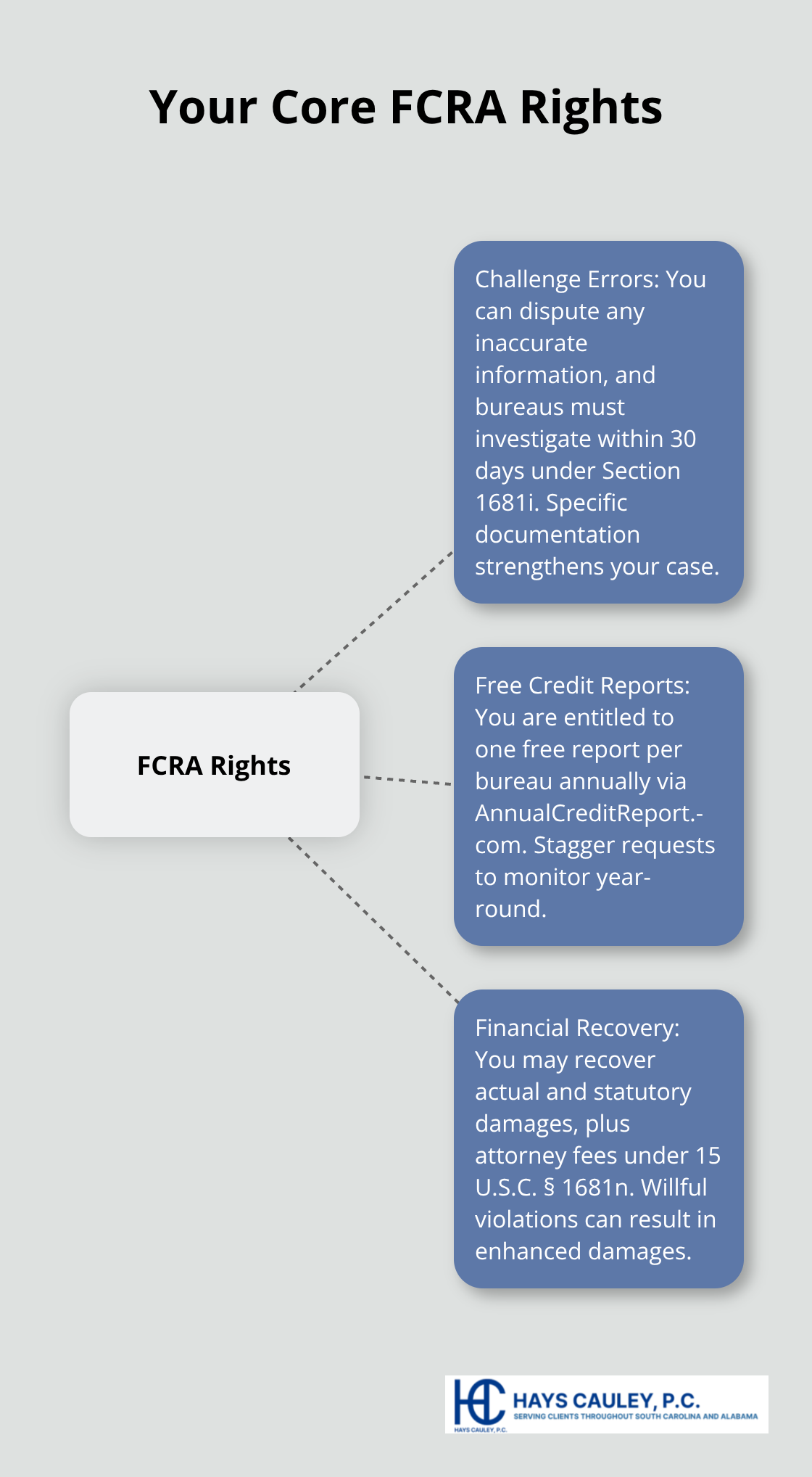
You have the legal right to know what is in your file. Under federal law, you are entitled to at least one free credit report every 12 months from each of the three national credit bureaus through the centralized portal, AnnualCreditReport.com. This right was expanded during the early 2020s to allow for more frequent weekly checks, a practice that has largely persisted to help consumers monitor for identity theft in a high-risk digital environment.
The Right to Be Notified of Adverse Actions
If a lender, landlord, or employer takes "adverse action" against you based on your credit report—such as denying a loan or refusing to hire you—they are federally mandated to provide you with a notice. This notice must include the name, address, and phone number of the agency that provided the report. This transparency allows you to investigate whether an error in your report caused the denial.
The Right to Dispute Inaccurate Information
If you identify an error in your report, the FCRA gives you the power to challenge it. Once you file a dispute with a credit bureau, they generally have 30 days (occasionally 45 days if you provide additional info during the process) to investigate the claim. They must also contact the furnisher of the data. If the information cannot be verified, it must be deleted or corrected.
The Right to Security Freezes and Fraud Alerts
To combat the ongoing threat of identity theft, federal law allows consumers to place a "security freeze" on their credit files free of charge. A freeze prevents prospective lenders from accessing your credit report, which effectively stops identity thieves from opening new accounts in your name. Fraud alerts, which require lenders to take extra steps to verify your identity, are also available for those who suspect their data has been compromised.
Obligations of Information Furnishers
While much focus is placed on the credit bureaus, federal fair credit reporting also imposes significant duties on the "furnishers"—the banks, retailers, and medical providers that send data to the bureaus. Under Section 623 of the FCRA, furnishers have a legal obligation to provide accurate information.
If a furnisher determines that they sent inaccurate data to a bureau, they must notify all bureaus to which they provided that data so the record can be corrected. Furthermore, if a consumer disputes a debt directly with the furnisher, the furnisher cannot report that debt to a credit bureau without also noting that the debt is "disputed."
The interaction between the consumer, the bureau, and the furnisher creates a tripartite system of accountability. When a consumer files a dispute with a bureau, the bureau sends a notice (often via an automated system called e-OSCAR) to the furnisher. The furnisher must then conduct a "reasonable investigation" of their own records. Failure by the furnisher to investigate properly is one of the most common grounds for consumer litigation under federal law.
Permissible Purposes: Who Can Access Your Report?
One of the most misunderstood aspects of federal fair credit reporting is the concept of "permissible purpose." The FCRA strictly limits the circumstances under which a consumer report can be released.
| User Category | Requirement for Access | Common Examples |
|---|---|---|
| Creditors | Application for credit or account review | Mortgage lenders, credit card issuers, auto loans |
| Employers | Written consent from the consumer | Pre-employment background checks, promotions |
| Insurers | Underwriting of insurance | Auto, home, or life insurance applications |
| Landlords | Evaluation of rental risk | Apartment applications, lease renewals |
| Government | Legal mandate or benefit eligibility | Child support enforcement, public assistance |
| Consumers | Self-request | Personal financial monitoring |
Employers face particularly stringent requirements. Before an employer can pull a credit report, they must provide a "clear and conspicuous" written disclosure to the applicant in a standalone document and obtain the applicant's written authorization. If the employer intends to take adverse action (like not hiring the person), they must provide a "pre-adverse action notice" along with a copy of the report and a summary of the consumer's rights before the final decision is made. This gives the applicant a chance to explain or dispute any negatives in the report.
The Dispute Process: A Step-by-Step Guide
Navigating a dispute requires precision. While many credit bureaus encourage using their online portals, consumer advocates often recommend sending disputes via certified mail with a return receipt to create a paper trail for potential legal action.
- Identify the Error: Circle the specific item on your credit report. This could be an account that doesn't belong to you, an incorrect balance, or a late payment that was actually on time.
- Gather Evidence: Collect copies of canceled checks, bank statements, or "paid in full" letters that prove your claim. Never send original documents.
- Draft the Dispute Letter: Clearly state what information is inaccurate and why. Explicitly request that the information be deleted or corrected.
- Submit to the Bureau: Send the letter to the bureau reporting the error. If all three are reporting it, you must file three separate disputes.
- Monitor the Timeline: The bureau has five days to forward your dispute to the furnisher. The entire investigation must typically be completed within 30 days.
- Review the Results: Once the investigation is complete, the bureau must provide you with a written report of the results and a free copy of your credit report if the dispute resulted in a change.
If the investigation does not resolve the issue to your satisfaction, federal law allows you to add a "consumer statement" of up to 100 words to your file. This statement is then visible to anyone who pulls your credit report, allowing you to provide your side of the story regarding a specific debt or circumstance.
Enforcement and Legal Remedies
The FCRA is not a toothless regulation; it provides for significant civil liability. If a credit bureau or furnisher willfully fails to comply with the law, a consumer can sue for actual damages or statutory damages (ranging from $100 to $1,000 per violation), as well as punitive damages and attorney's fees.
In cases of "negligent noncompliance," the consumer can sue for actual damages and attorney's fees. Because the law allows for the recovery of attorney's fees, many consumer law attorneys handle these cases on a contingency basis, meaning the consumer pays nothing out of pocket. This creates a powerful incentive for bureaus to maintain accurate records and take disputes seriously.
Federal oversight is also active. The CFPB maintains a public complaint database where consumers can report issues with credit bureaus. These complaints are often used by regulators to identify systemic failures and issue multi-million dollar fines against non-compliant agencies.
Summary of Best Practices for Consumers
To make the most of federal fair credit reporting protections in 2026, consumers should adopt a proactive stance toward their data:
- Audit Regularly: Use the free annual reports to check for errors before applying for a major loan like a mortgage.
- Opt-Out: If you want to reduce identity theft risk and junk mail, use the federal "Opt-Out" system (1-888-5-OPT-OUT) to stop credit bureaus from selling your name for prescreened credit offers.
- Secure Your Data: Use a security freeze if you do not plan on applying for credit in the near future. It is the most effective tool provided by federal law to stop unauthorized account openings.
- Document Everything: Keep a log of every phone call, letter, and notification received during a dispute process.
Frequently Asked Questions
Does federal law require my credit score to be free? While the FCRA requires bureaus to provide a free credit report, it does not strictly mandate a free credit score in all circumstances. However, you are entitled to a free score if it was used in an adverse action against you (like a loan denial) or if you are applying for a mortgage. Many modern credit card companies also provide free scores as a perk.
How long does a dispute take under the FCRA? Typically, the investigation must be completed within 30 days of the bureau receiving your dispute. This can be extended to 45 days if you provide new information during the investigation or if you filed your dispute through the official annual credit report site.
Can an employer check my credit without me knowing? No. Under federal law, an employer must get your written permission before they can request your credit report. They must also give you a specific disclosure that they intend to do so.
What happens if a bureau refuses to fix an error? If a bureau finishes an investigation and refuses to remove an item you believe is wrong, you have the right to sue for damages. You should consult a consumer protection attorney to evaluate if the bureau followed "reasonable procedures" as required by federal law.
Are medical debts reported differently under federal rules? Yes, there have been significant changes in how medical debts are handled. As of 2026, paid medical debts are generally not allowed on credit reports, and there is a significant waiting period (usually one year) before unpaid medical debt can appear, giving consumers more time to work with insurance and providers.
Practical Recommendation
If you discover a discrepancy in your credit history, your first step should be to download your official reports from AnnualCreditReport.com. Do not rely solely on third-party monitoring apps, as they may not show the full detail required for a legal dispute. Once you have the official reports, file your disputes via certified mail to ensure your rights under the Fair Credit Reporting Act are fully preserved and documented.
Image Gallery