2020 Jeep Wrangler Rubicon: Technical Analysis of an Off-Road Powerhouse
The 2020 Jeep Wrangler Rubicon represents the pinnacle of factory-built off-road performance in the JL generation, featuring heavy-duty Dana 44 axles, Tru-Lok electronic locking differentials, a Rock-Trac 4:1 transfer case, and an elec...
The 2020 Jeep Wrangler Rubicon represents the pinnacle of factory-built off-road performance in the JL generation, featuring heavy-duty Dana 44 axles, Tru-Lok electronic locking differentials, a Rock-Trac 4:1 transfer case, and an electronic sway-bar disconnect. Built for extreme terrain, it combines extreme mechanical crawl capability with modern daily-driving amenities.
Contents
The Engineering Behind the Rubicon Badge
The "Rubicon" name badge signifies far more than decorative trim; it represents a specialized mechanical architecture engineered specifically for low-speed crawlability, obstacle traversal, and extreme axle articulation. Built on the JL platform introduced for the 2018 model year, the 2020 Jeep Wrangler Rubicon refines this platform by blending traditional body-on-frame durability with lightweight aluminum body panels—including doors, hood, fenders, and swing gate—to reduce curb weight and lower the vehicle's center of gravity.
At the core of the Rubicon's off-road architecture is its heavy-duty suspension and drivetrain integration. Unlike lower Wrangler trims (such as the Sport or Sahara), the Rubicon utilizes wide-track Dana 44 axles both front and rear, high-clearance fender flares, and dedicated suspension geometry that accommodates larger factory tires without requiring immediate aftermarket modification. The result is a vehicle engineered from the assembly line to withstand high-impact rock crawling, deep mud extraction, and technical overland trails while remaining fully compliant with modern federal motor vehicle safety standards.
Powertrain Options for the 2020 Model Year
For the 2020 model year, Jeep expanded the Wrangler Rubicon's engine lineup, offering buyers three distinct propulsion choices tailored to different driving styles, elevation demands, and torque requirements.
- 2020 Rubicon Engine Choices
- 3.6L V6 Pentastar (285 hp) [260 lb-ft]
- 2.0L I4 Turbo (270 hp) [295 lb-ft]
- 3.0L V6 EcoDiesel (260 hp) [442 lb-ft]
3.6-Liter Pentastar V6
The naturally aspirated 3.6-liter Pentastar V6 remains the baseline engine, delivering 285 horsepower at 6,400 RPM and 260 lb-ft of torque at 4,800 RPM. This engine utilizes a light-weight aluminum block with a 60-degree V angle and dual overhead camshafts (DOHC) with variable valve timing (VVT).
- 6-Speed Manual (D478): Paired with the standard six-speed manual transmission, the 3.6L provides a mechanical connection favored by traditional purists, delivering an impressive crawl ratio of 84.1:1.
- 8-Speed Automatic (850RE): When equipped with the optional TorqueFlite 8-speed automatic, the 3.6L could be paired with standard Engine Stop-Start (ESS) or Chrysler’s eTorque mild-hybrid system. The eTorque system replaces the traditional alternator with a belt-driven motor-generator unit powered by a 48-volt lithium-ion battery pack, providing supplemental low-end torque during initial acceleration and smoothing out engine restart cycles.
2.0-Liter Inline-4 Turbo
The 2.0-liter turbocharged inline-4 engine generates 270 horsepower at 5,250 RPM and 295 lb-ft of torque at 3,000 RPM. Featuring a twin-scroll low-inertia turbocharger mounted directly to the cylinder head, this engine delivers peak torque significantly lower in the rev range than the 3.6L V6. For 2020, the 2.0L turbo was available with either direct ESS or the 48V eTorque system (depending on production timing and transmission selection). Its rapid torque delivery makes it exceptionally responsive on steep inclines and high-altitude trails where naturally aspirated engines lose output due to lower air density.
3.0-Liter EcoDiesel V6
Introduced to the Wrangler JL lineup for the 2020 model year, the 3.0-liter EcoDiesel V6 produces 260 horsepower and a class-leading 442 lb-ft of torque starting at just 1,400 RPM. Engineered by VM Motori and adapted for the Jeep platform, this engine features a block cast from compacted graphite iron (CGI), forged steel crankshaft and connecting rods, and a water-cooled variable-geometry turbocharger (VGT).
To manage the massive low-end torque output, EcoDiesel Rubicon models are mated exclusively to a heavy-duty TorqueFlite 8HP75 8-speed automatic transmission and heavy-duty Dana 44 axles with a 3.73:1 final drive gear ratio. While the EcoDiesel adds roughly 400 pounds of front-end curb weight and decreases maximum ground clearance slightly due to skid plate positioning for the selective catalytic reduction (SCR) system, its immense low-RPM grunt renders technical obstacle climbing almost effortless.
4x4 Hardware: Rock-Trac, Lockers, and Disconnects
What distinguishes the Rubicon from standard four-wheel-drive SUVs is its integrated system of mechanical traction controls designed specifically for zero-traction scenarios.
- Rubicon Off-Road Drivetrain Stack
- Electronic Front Sway-Bar Disconnect: Max Flex/Artic
- Tru-Lok Front & Rear Differential Lockers: 100% Lockup
- Heavy-Duty Dana 44 Axles (M210 Front / M220 Rear)
- Rock-Trac 4:1 Transfer Case: NV241-OR or MP3022 Full-Time
Rock-Trac 4WD System
Every 2020 Rubicon comes equipped with Jeep's Rock-Trac 4WD system. The standard system uses the NV241-OR manual transfer case, featuring a 4.0:1 low-range gear reduction ratio. When shifted into 4-Low (4L), engine torque is multiplied by a factor of four inside the transfercase before traveling to the axles.
For 2020, Jeep also offered an optional Rock-Trac Full-Time 4WD system (MP3022 transfer case), which adds a 4-Auto mode. This setting utilizes an internal wet clutch pack to automatically distribute torque between the front and rear axles based on wheel-slip conditions—allowing drivers to leave the vehicle in four-wheel drive on mixed-surfaced roads (such as patchy ice or wet asphalt) without causing drivetrain binding.
Tru-Lok Electronic Differential Lockers
Standard open or limited-slip differentials send power along the path of least resistance; if one wheel lifts into the air, all engine torque spins that free wheel while the grounded wheel receives nothing. The Rubicon's Tru-Lok front and rear electronic locking differentials physically lock the left and right axle shafts together via electromagnetic solenoids. When engaged via the dash-mounted toggle switch:
- Rear Lock: Can be engaged in 4-Low or 4-High (via Off-Road+ mode). Forces both rear tires to turn at identical speeds regardless of surface resistance.
- Front + Rear Lock: Locks all four wheels together. Torque is divided equally across both axles, ensuring maximum forward momentum even if three tires lose traction entirely.
Electronic Front Sway-Bar Disconnect
Wheel articulation—the ability of an axle to droop and push a tire down into contact with uneven ground—is typically limited by rigid anti-roll (sway) bars. The Rubicon features an electronic sway-bar disconnect system on the front axle. Activated by a cabin button, an actuator decouples the two halves of the front sway bar, increasing front wheel travel and articulation by up to 30 percent. This allows the chassis to remain relatively level over massive rocks while all four tires remain planted on the terrain. The system automatically reconnects when vehicle speed exceeds 18 mph for safety.
Technical Specifications and Factory Off-Road Geometry
Vehicle geometry dictates whether an SUV can clear obstacles without damaging its bodywork or high-centering on its frame. The 2020 Rubicon comes standard with 33-inch tires (285/70R17) mounted on 17x7.5-inch aluminum wheels, giving it superior approach, breakover, and departure angles out of the box.
| Technical Parameter | 2020 Rubicon 2-Door | 2020 Rubicon 4-Door (Unlimited) |
|---|---|---|
| Wheelbase | 96.8 inches | 118.4 inches |
| Overall Length | 166.8 inches | 188.4 inches |
| Overall Width | 73.8 inches | 73.8 inches |
| Ground Clearance | 10.8 inches | 10.8 inches |
| Approach Angle | 44.0 degrees | 43.9 degrees |
| Breakover Angle | 27.8 degrees | 22.6 degrees |
| Departure Angle | 37.0 degrees | 37.0 degrees |
| Water Fording Depth | 30.0 inches (at 5 mph) | 30.0 inches (at 5 mph) |
| Standard Axle Gear Ratio | 4.10:1 (Gas Engine) | 4.10:1 (Gas Engine) / 3.73:1 (EcoDiesel) |
| Front Axle Specification | Dana M210 Wide Track (Dana 44) | Dana M210 Wide Track (Dana 44) |
| Rear Axle Specification | Dana M220 Wide Track (Dana 44) | Dana M220 Wide Track (Dana 44) |
| Maximum Towing Capacity | 2,000 lbs | 3,500 lbs |
| Crawl Ratio (Manual / Auto) | 84.1:1 / 77.2:1 | 84.1:1 / 77.2:1 (Gas) or 70.3:1 (Diesel) |
Trail Performance vs. On-Road Driving Dynamics
The JL generation made vast leaps over its JK predecessor in terms of daily livability, noise isolation, and steering response, though the Rubicon remains a solid-axle utility vehicle at heart.
- JL Rubicon Performance Profile
- Trail Capability
- 84.1:1 Crawl Ratio
- Electronic Sway-Bar Disconnect
- 33-inch All-Terrain/Mud Tires
- Skids, Rock Rails, 30" Fording
- Highway Dynamics
- Electro-Hydraulic Steering
- Solid Axles (Wandering tendency)
- NVH improved over JK platform
- 8-Speed Auto improves MPG
- Trail Capability
Off-Road Capability
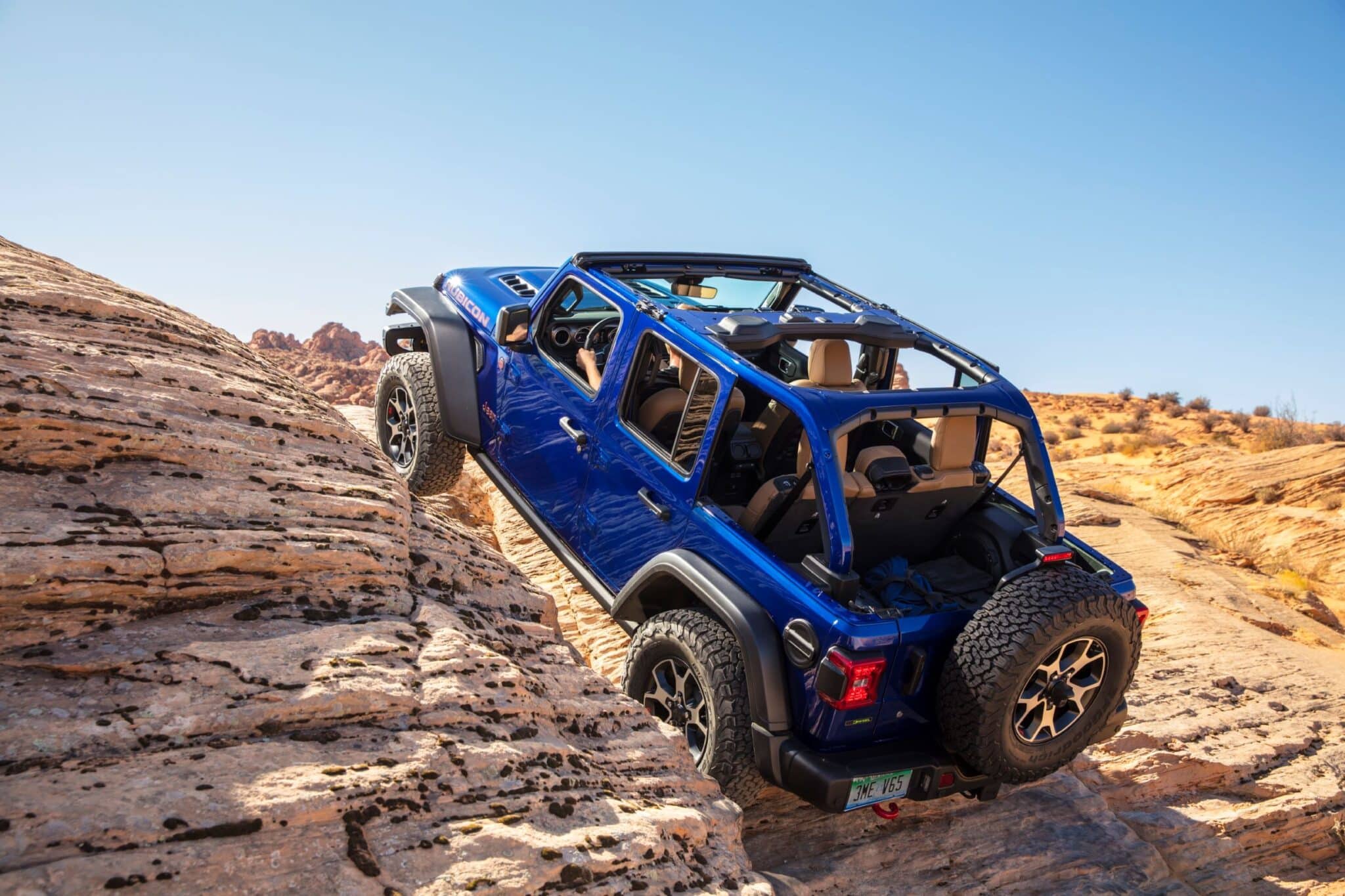
On severe trails rated 7 to 10 on standard difficulty scales, the Rubicon performs with minimal strain. The combination of 4.10 gearing and the 4:1 transfercase low-range enables precise throttle control at speeds under 1 mph. Drivers do not need to ride the brakes to control descent; engine braking in 4-Low provides controlled downhill crawls without wheel lockup. Standard body protection includes heavy-gauge steel rock rails to shield rocker panels, alongside steel skid plates covering the fuel tank, transfer case, and transmission oil pan.
On-Road Behavior
On paved highways, the Rubicon's wide-track solid axles and recirculating-ball electro-hydraulic steering system exhibit characteristic solid-axle traits. Compared to modern unibody crossover SUVs with independent suspension, steering effort requires small, continuous micro-corrections to maintain a straight line. High-speed stability is noticeable, but wind noise remains higher than conventional enclosed crossovers due to the removable roof, modular door hinges, and upright windshield geometry. However, the 8-speed automatic keeps engine RPM low at highway speeds, significantly improving fuel efficiency and cabin noise compared to older four-speed or five-speed Wranglers.
Known Issues, Maintenance Points, and Used Market Inspection (2026 Context)
When evaluating a used 2020 Jeep Wrangler Rubicon, potential buyers and mechanics must inspect several documented technical area code points specific to this production year.
Used 2020 Rubicon Inspection Checkpoints:
- Steering Gear Box: Check if TSB cast-iron unit installed
- Aluminum Corrosion: Inspect hinges, hood, tailgate edges
- EcoDiesel Fuel Pump: Verify Bosch CP4 HPFP recall completed
- Sway Bar Actuator: Scan for electronic circuit faults
- Locker Engagement: Test Tru-Lok front/rear switches in 4L
Aluminum Hinge and Panel Corrosion
The JL platform utilizes aluminum doors, hood, and tailgate mounted against steel hinges. Electrolytic reaction and factory paint prep defects can lead to bubbling paint around door hinges, hood edges, and tailgate seams. Buyers should closely inspect all hinge margins for paint lifting or white aluminum oxide powder.
Steering Box Play (TSB 08-074-20 / TSB 19-008-20)
Early JL models, including many 2020 builds, were manufactured with an electro-hydraulic aluminum steering gear box that suffered from internal play, resulting in excessive vehicle wander at highway speeds. FCA issued technical service bulletins (TSBs) authorizing dealers to replace the factory aluminum box with an updated cast-iron steering gear box and recalibrate the Power Steering Control Module (PSCM). Verifying whether this cast-iron upgrade has been installed is critical during a pre-purchase inspection.
EcoDiesel High-Pressure Fuel Pump (HPFP) Recall
Models equipped with the 3.0L EcoDiesel are subject to safety recalls regarding the Bosch CP4 high-pressure fuel pump. Premature wear of the pump's internal components can generate metal debris, contaminating the entire fuel system and causing unexpected engine shutdown. Buyers must confirm via official Mopar or NHTSA VIN checks that the recall remedy—which involves replacing the HPFP with an updated unit and flushing the fuel lines—has been completed.
Electronic Sway-Bar Actuator Vulnerability
The front sway-bar disconnect assembly sits low behind the front bumper. Water intrusion into the internal circuit board can cause the smart bar actuator to fail, resulting in a flashing "Sway Bar" light on the instrument cluster. Severe off-road usage without aftermarket skid plate protection or extended water immersion increases this risk. Replacement assemblies or aftermarket manual cable conversions are common remedies.
Comparing the 2020 Rubicon to Other Wrangler Trims
Understanding the component differences across the 2020 Wrangler trim lineup clarifies why the Rubicon commands a price premium on the secondary market.
| Feature / Hardware | Sport / Sport S | Sahara (4-Door Only) | Rubicon |
|---|---|---|---|
| Transfer Case | Command-Trac 2.72:1 Part-Time | Command-Trac 2.72:1 or Selec-Trac Full-Time | Rock-Trac 4.0:1 Part-Time or Full-Time |
| Front Axle | Dana M186 | Dana M186 | Heavy-Duty Dana M210 Wide Track |
| Rear Axle | Dana M200 | Dana M200 or Heavy-Duty M220 | Heavy-Duty Dana M220 Wide Track |
| Differentials | Open (Optional Trac-Lok LSD) | Open (Optional Trac-Lok LSD) | Tru-Lok Front & Rear Electronic Lockers |
| Front Sway Bar | Standard Rigid Bar | Standard Rigid Bar | Electronic Remote Disconnect |
| Axle Ratio | 3.45:1 | 3.45:1 | 4.10:1 (Gas) / 3.73:1 (Diesel) |
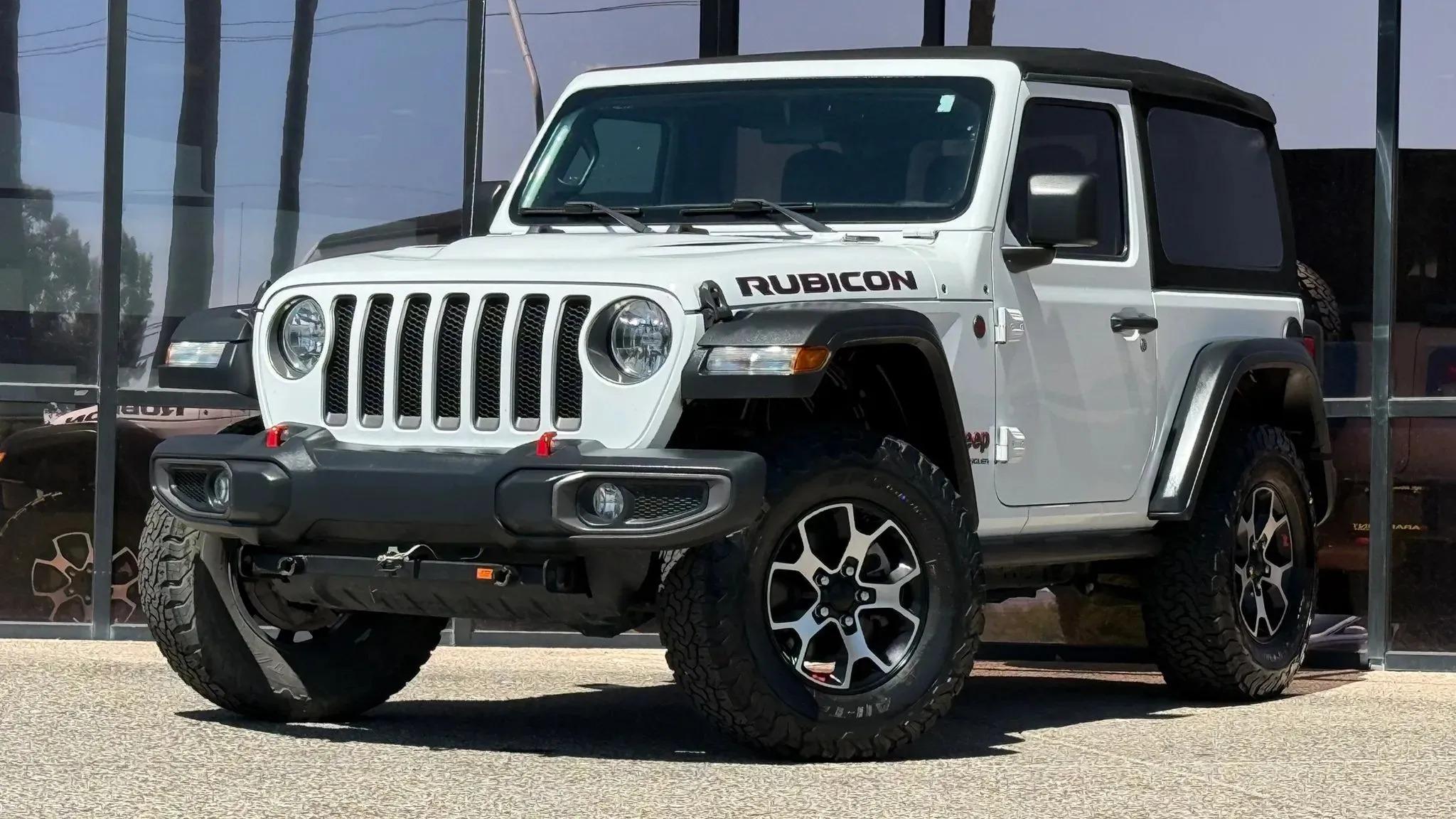
| Factory Tires | 31-inch Street/All-Terrain | 32-inch All-Season | 33-inch Falken Wildpeak M/T or BFG KO2 A/T |
Frequently Asked Questions
What is the crawl ratio on a 2020 Jeep Wrangler Rubicon?
When equipped with the 3.6L V6 and the 6-speed manual transmission, the 2020 Rubicon delivers an 84.1:1 crawl ratio. With the 8-speed automatic transmission and gas engines, the crawl ratio is 77.2:1. The EcoDiesel automatic variant features a 70.3:1 crawl ratio due to its 3.73:1 axle ratio.
Can you run 35-inch tires on a stock 2020 Rubicon without a lift?
Yes. Thanks to high-clearance fender flares and wide-track Dana 44 axles, a stock 2020 Rubicon can fit 35-inch tires with minimal clearance issues during highway driving. However, full suspension articulation during extreme off-roading may cause mild tire rubbing against the inner fender liners without a 2 to 2.5-inch suspension lift or aftermarket bump stop extensions.
How does the Rubicon’s Rock-Trac system differ from standard 4WD?
Standard Wranglers use the Command-Trac system with a 2.72:1 low-range ratio. The Rubicon's Rock-Trac system features a deeper 4.0:1 low-range gear reduction. This 4.0:1 ratio delivers significantly higher wheel torque at low speeds, enabling precise vehicle control over large rocks and steep obstacles without overheating the brakes.
Is the 2020 EcoDiesel Rubicon better for off-roading than the 3.6L V6?
The 3.0L EcoDiesel delivers 442 lb-ft of torque at 1,400 RPM, providing superior low-end power for rock crawling and heavy towing. However, the diesel powertrain adds roughly 400 pounds to the front axle, reduces payload capacity slightly, and requires Diesel Exhaust Fluid (DEF). For extreme technical crawling where low-RPM control matters most, the EcoDiesel excels; for high-speed desert running or simplicity, the 3.6L V6 is preferred.
What causes steering wander in the 2020 Wrangler Rubicon?
Steering wander is usually caused by the original factory aluminum steering gear box, which had internal play, combined with improper tire pressure or caster alignment angles. Chrysler released updated cast-iron steering gear boxes (under warranty TSBs) to solve this issue. Installing the cast-iron box and adjusting front alignment caster eliminates most highway wander.
Buyer Decision Summary
The 2020 Jeep Wrangler Rubicon remains one of the most capable factory-built off-road vehicles available on the market. Buyers seeking a daily driver for commuting or light gravel roads will find lower trims like the Sahara or Willys more cost-effective and comfortable.
However, for enthusiasts intending to tackle technical trails, high-altitude mountain passes, or severe rock crawls, the Rubicon's factory-installed equipment—specifically the wide-track Dana 44 axles, Tru-Lok lockers, 4.10 gearing, and electronic sway-bar disconnect—provides thousands of dollars in mechanical upgrades that would cost significantly more to replicate in the aftermarket. When shopping the used market, prioritize vehicles with complete service records, confirmed TSB steering gear upgrades, verified fuel pump recall completion on EcoDiesel models, and clean aluminum panel paint conditions.
Image Gallery