How to Create a CT LLC in 2026: The Complete Connecticut Business Formation Guide
To create a CT LLC in 2026, you must register with the Connecticut Secretary of the State by filing a Certificate of Organization through the online Business One-Stop portal. The process involves selecting a unique name, appointing a r...
To create a CT LLC in 2026, you must register with the Connecticut Secretary of the State by filing a Certificate of Organization through the online Business One-Stop portal. The process involves selecting a unique name, appointing a registered agent, and paying the $120 filing fee. This legal structure effectively separates your personal assets from your business liabilities while providing flexible tax options.
Contents
Establishing a Limited Liability Company (LLC) in Connecticut is a strategic move for entrepreneurs seeking to balance operational simplicity with robust legal protection. As of 2026, Connecticut has further streamlined its digital infrastructure, making the "Business One-Stop" portal the primary gateway for all new domestic and foreign entities. Whether you are launching a boutique in New Haven, a tech consultancy in Stamford, or a logistics firm in Hartford, the requirements for formation remain consistent across the state. This guide provides a technical deep dive into the legal prerequisites, filing procedures, and ongoing compliance mandates necessary to maintain your standing in the Constitution State.
Phase 1: Pre-Formation Requirements and Legal Name Selection
Before submitting any paperwork to the Secretary of the State (SOTS), you must satisfy specific naming conventions and structural requirements. Connecticut law, specifically under the Connecticut Uniform Limited Liability Company Act, dictates how an entity must be identified to ensure public transparency and prevent consumer confusion.
Connecticut Naming Guidelines
Your business name must be "distinguishable" from every other entity already on file with the SOTS. This means minor variations in punctuation, suffixes (like "LLC" vs "L.L.C."), or articles (like "The" or "A") generally do not make a name unique.
Legal Suffix Requirements Your chosen name must contain the words "Limited Liability Company" or the abbreviations "L.L.C." or "LLC." The word "Limited" may be abbreviated as "Ltd." and "Company" may be abbreviated as "Co."
Restricted Terminology Certain words require additional professional licensing or state approval before they can be used in a business name. These include terms like "Bank," "Trust," "Insurance," "University," and "Pharmacy." If your business involves professional services like law or medicine, you may need to form a Professional LLC (PLLC) rather than a standard LLC.
Conducting the Name Availability Search
As of 2026, the Connecticut Business One-Stop search tool provides real-time access to the state's database. You should search for your desired name and any close variations. If the name is available but you are not ready to file the full Certificate of Organization, you can file an Application for Reservation of Name to hold the name for 120 days for a fee of $60.
Phase 2: Appointing a Registered Agent
Connecticut requires every LLC to maintain a Registered Agent within the state. This individual or entity is responsible for receiving service of process, legal notices, and official government correspondence on behalf of the business.
Eligibility for Registered Agents
You have three primary options when selecting a registered agent in Connecticut:
- An Individual Resident: You, an employee, or a friend can serve as the agent, provided they are at least 18 years old and have a physical street address in Connecticut (P.O. Boxes are strictly prohibited).
- A Domestic Entity: Another Connecticut business entity (LLC or Corporation) that is in good standing.
- A Commercial Registered Agent: A professional service provider authorized to do business in Connecticut.
While acting as your own agent is cost-effective, many 2026 business owners opt for professional services to ensure privacy and to guarantee that someone is available during all business hours to receive legal documents.
Phase 3: Filing the Certificate of Organization
The Certificate of Organization is the foundational document that officially creates your LLC in the eyes of the State of Connecticut. In 2026, the SOTS prefers electronic filing via the CONCORD system, accessible through the Business One-Stop portal.
Information Required for Filing
To complete the filing, you will need the following technical details:
- LLC Name: The finalized name including the proper suffix.
- Business Address: The principal office address (must be a physical location).
- Mailing Address: Where official notices should be sent (can be a P.O. Box).
- Registered Agent Details: The name and physical address of your appointed agent, plus their signature of acceptance.
- Management Structure: You must indicate if the LLC is "Member-Managed" (owners run the daily operations) or "Manager-Managed" (owners appoint a manager to run the business).
- NAICS Code: A six-digit code used by federal and state agencies to classify your business industry.
- Organizer Signature: The person or entity filing the document.
2026 Filing Fees and Processing Times
| Document Type | Fee (2026) | Standard Processing | Expedited Processing |
|---|---|---|---|
| Certificate of Organization (Domestic) | $120 | 3-5 Business Days | 24 Hours (+$50) |
| Certificate of Authority (Foreign) | $120 | 5-7 Business Days | 24 Hours (+$50) |
| Name Reservation | $60 | Instant (Online) | N/A |
| Certified Copies | $40 | 1-2 Business Days | N/A |
Phase 4: Drafting an Operating Agreement
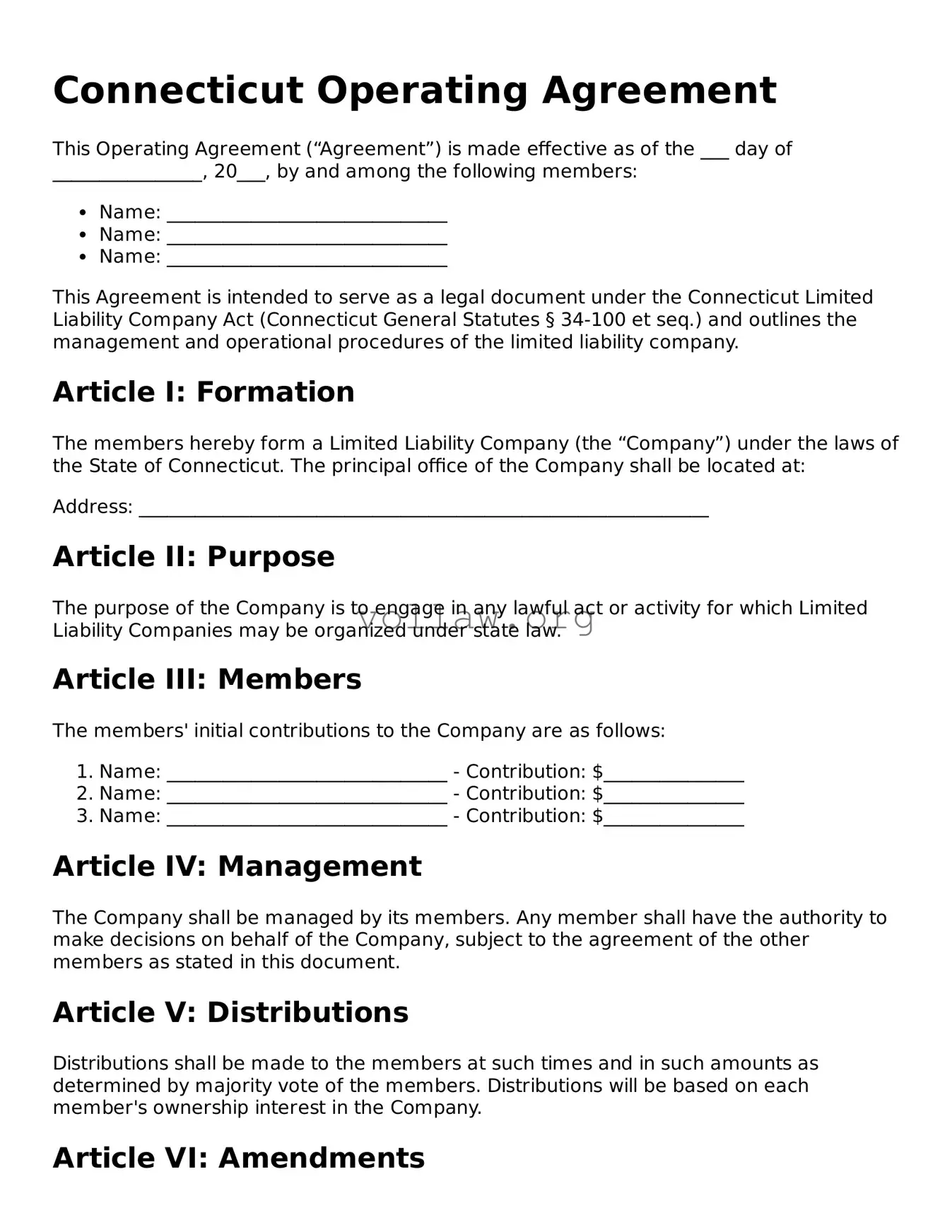
While Connecticut law does not strictly require an LLC to file an Operating Agreement with the state, it is a critical internal document for any multi-member LLC. For single-member LLCs, it reinforces the "corporate veil" that protects personal assets.
Ownership Structure and Buy-Sell Provisions The Operating Agreement should clearly outline the percentage of ownership held by each member and the distribution of profits and losses. It should also include "Buy-Sell" provisions that dictate what happens if a member wants to leave the company, becomes incapacitated, or passes away.
Operational Governance and Voting Rights This section defines how major decisions are made. It specifies whether a simple majority or a unanimous vote is required for actions such as taking out business loans, amending the Operating Agreement, or dissolving the company.
Phase 5: Federal and State Tax Compliance
Once the state approves your LLC, you must integrate your business into the federal and state tax systems.
Employer Identification Number (EIN)
Most LLCs must obtain an EIN from the IRS. Think of this as a Social Security number for your business. It is required for opening a business bank account, hiring employees, and filing federal tax returns. You can apply for an EIN for free on the IRS website immediately after receiving your approved Certificate of Organization.
Connecticut Department of Revenue Services (DRS)
In 2026, Connecticut requires most LLCs to register with the DRS for state-level taxes. This is handled through the "myconneCT" portal. Depending on your business activities, you may need to register for:
- Sales and Use Tax: If you sell tangible goods or certain services.
- Pass-Through Entity (PET) Tax: Connecticut has a mandatory PET tax for LLCs taxed as partnerships or S-Corps. This tax is levied at the entity level, but members receive a corresponding credit on their personal state income tax returns.
- Unemployment Insurance Tax: If you plan to hire employees.
Phase 6: Maintaining Ongoing Compliance
Creating the LLC is only the first step. To keep the entity in "Good Standing" and protect your limited liability status, you must adhere to annual requirements.
The Annual Report
Every Connecticut LLC must file an Annual Report with the Secretary of the State each year.
- Deadline: Between January 1st and May 1st.
- Fee: $80 (as of 2026).
- Content: Updates to the business address, registered agent, or management team.
- Penalty: Failure to file can lead to "Administrative Dissolution," where the state revokes your legal right to conduct business.
Local Licenses and Permits
Depending on your city or town (e.g., Bridgeport, Danbury, or Greenwich), you may need local zoning permits, health department approvals, or professional licenses. Always check with the Town Clerk’s office in the municipality where your principal office is located.
Comparing LLCs to Other Connecticut Business Structures
Choosing the right entity type depends on your capital needs, tax strategy, and risk tolerance. In 2026, the LLC remains the most popular choice for small to mid-sized Connecticut businesses.
| Feature | LLC | Sole Proprietorship | C-Corporation |
|---|---|---|---|
| Liability Protection | Full Personal Asset Protection | No Protection | Full Personal Asset Protection |
| Taxation | Pass-through or PET Tax | Personal Income Tax | Double Taxation (Corp + Individual) |
| Management | Flexible (Members or Managers) | Single Owner | Rigid (Board of Directors) |
| Annual Fees | $80 Annual Report | None | $435+ (Report + Franchise Tax) |
| Setup Cost | $120 | $0 - $20 (Trade Name) | $250+ |
Troubleshooting Common Formation Issues
Even with the streamlined 2026 Business One-Stop portal, errors can delay your formation. Common mistakes include:
- Non-Distinguishable Names: If your name is too similar to an existing business (e.g., "CT Logistics LLC" vs "Connecticut Logistics LLC"), the SOTS will reject the filing.
- Missing Registered Agent Signature: The agent must explicitly consent to the appointment. If you are using a third-party service, ensure they have provided the electronic authorization code.
- Incorrect NAICS Codes: Using a code that does not match your business description can trigger unwanted audits or licensing inquiries from the Department of Consumer Protection.
- Failure to Register with DRS: Many owners forget that the Secretary of the State and the Department of Revenue Services are separate. Forming the LLC does not automatically register you for state taxes.
Frequently Asked Questions
How long does it take to create a CT LLC in 2026? If you use the online Business One-Stop portal, standard processing typically takes 3 to 5 business days. For urgent needs, Connecticut offers 24-hour expedited service for an additional $50 fee, allowing you to receive your digital Certificate of Organization by the next business day.
Do I need an attorney to form an LLC in Connecticut? No, you are not legally required to hire an attorney to file a Certificate of Organization. However, if your LLC has multiple members, complex management tiers, or significant capital investment, consulting with a Connecticut business attorney to draft a customized Operating Agreement is highly recommended to prevent future disputes.
What is the "Business One-Stop" portal? The Business One-Stop is Connecticut's centralized digital platform launched to consolidate filings for the Secretary of the State, the Department of Revenue Services, and the Department of Labor. It serves as the primary interface for starting, managing, and growing a business in the state as of 2026.
Can I use a P.O. Box as my business address in CT? You may use a P.O. Box for your mailing address, but the SOTS requires a physical street address for the "Principal Office Address." Similarly, your Registered Agent must have a physical Connecticut street address where they can be reached during standard business hours.
What happens if I forget to file my CT LLC Annual Report? If you miss the May 1st deadline, your LLC will fall into "Lapsed" status. If the report remains unfiled for an extended period, the Secretary of the State will issue a notice of intent to administratively dissolve your business. This results in the loss of your liability protection and the potential loss of your business name to another registrant.
Final Recommendations for New CT Business Owners
To ensure a successful launch in 2026, treat the formation process as a multi-stage project rather than a single filing. Start by verifying your name availability and securing a professional registered agent if you value privacy. Immediately following state approval, secure your EIN and register with the Department of Revenue Services via myconneCT to ensure you are compliant with Connecticut's unique Pass-Through Entity Tax requirements. By maintaining a strict calendar for your Annual Report filings and keeping your Operating Agreement updated, you will protect your assets and provide a solid legal foundation for your enterprise's growth.
Image Gallery