Complete Guide to NBA Scoring Titles: Rules, Historical Leaders, and Qualification Criteria
The NBA scoring title is awarded annually to the player who finishes the regular season with the highest points-per-game (PPG) average. To qualify, a player must appear in a minimum of 58 games, or score enough total points to maintain...
The NBA scoring title is awarded annually to the player who finishes the regular season with the highest points-per-game (PPG) average. To qualify, a player must appear in a minimum of 58 games, or score enough total points to maintain the highest average when divided by the 58-game threshold.
Contents
How the NBA Scoring Title Works: Rules and Qualification Thresholds
The criteria for determining the NBA scoring champion have evolved significantly since the league's inception in 1946. While casual fans often assume the crown goes to the player with the most total points scored in a single regular season, the official award relies primarily on scoring efficiency per contest.
(Note: Per formatting rules, no backticks or code blocks are used anywhere).
The 58-Game Eligibility Threshold
Under current National Basketball Association statistical regulations, a player must meet a specific minimum participation requirement to qualify for official statistical leaderboards, including scoring, rebounding, and assists.
In a standard 82-game regular season, a player must play in at least 58 games (70.7% of the season). During shortened regular seasons—such as lockouts or calendar disruptions—the 58-game threshold is adjusted proportionally based on total scheduled contests.
The Mathematical Fallback Provision
An essential caveat in the NBA rulebook addresses players who miss the 58-game mark due to injury or suspension but still possess extraordinary scoring outputs.
If a player participates in fewer than 58 games, their total season points are divided by 58 rather than their actual games played. If that revised calculation produces a PPG average higher than that of any qualifying player, the player with fewer than 58 games is officially awarded the scoring title.
Mathematical Qualification Formula
Official Scoring Average = Total Points Scored / Max(Games Played, 58)
This rule ensures that a player who scores 2,000 points in 55 games (36.36 PPG actual) is calculated as 2,000 / 58 = 34.48 PPG. If 34.48 exceeds the PPG of all players who reached 58 games, that player claims the title.
The 65-Game CBA Rule vs. Statistical Leaderboards
It is vital to distinguish between major postseason awards and official statistical titles. The Collective Bargaining Agreement (CBA) introduced a strict 65-game requirement for major voting-based honors, including:
- Most Valuable Player (MVP)
- All-NBA First, Second, and Third Teams
- Defensive Player of the Year (DPOY)
- Most Improved Player (MIP)
However, this 65-game CBA rule does not apply to statistical leaderboards like the scoring title. The scoring champion is governed strictly by the Basketball Statistics Regulations standard of 58 games (or the 58-game divisor), maintaining a distinct separation between subjective voted honors and objective statistical championships.
The Historical Evolution of Scoring Title Rules
The methodology used to crown the league’s top scorer has shifted across different eras of professional basketball history.
| Era | Primary Criterion | Minimum Requirement | Historical Context |
|---|---|---|---|
| 1946–47 to 1968–69 | Total Points Scored | No game minimum | Awarded strictly to the player with the highest cumulative point total at season's end. |
| 1969–70 to 1973–74 | Points Per Game (PPG) | 70 Games Played | Shifted focus toward game-by-game scoring impact; required 70 appearances. |
| 1974–75 to 2012–13 | Points Per Game (PPG) | 70 Games Played or 1,400 Total Points | Introduced dual-path qualification via game count or total point baseline. |
| 2013–14 to Present | Points Per Game (PPG) | 58 Games Played (or 58-game divisor) | Streamlined criteria to align with all standard box-score statistical categories. |
The Total Points Era (1946–1969)
During the early decades of the BAA and NBA, durability and cumulative accumulation dictated the scoring title. Under this format, a player who played 80 games averaging 25.0 PPG (2,000 total points) would win the scoring title over a player who averaged 28.0 PPG across 70 games (1,960 total points).
This system produced notable anomalies: in several seasons, the player with the highest daily per-game average did not officially win the scoring crown because a rival played more total minutes and games.
The Modern Per-Game Standard (1969–Present)
Recognizing that per-game impact better reflects individual offensive dominance, the NBA shifted to PPG as the primary metric starting in the 1969–70 season. This change allowed elite scorers who missed small portions of the schedule to retain their earned leaderboard position, provided they met minimum game thresholds.
All-Time Leaders: NBA Scoring Champion Dominance
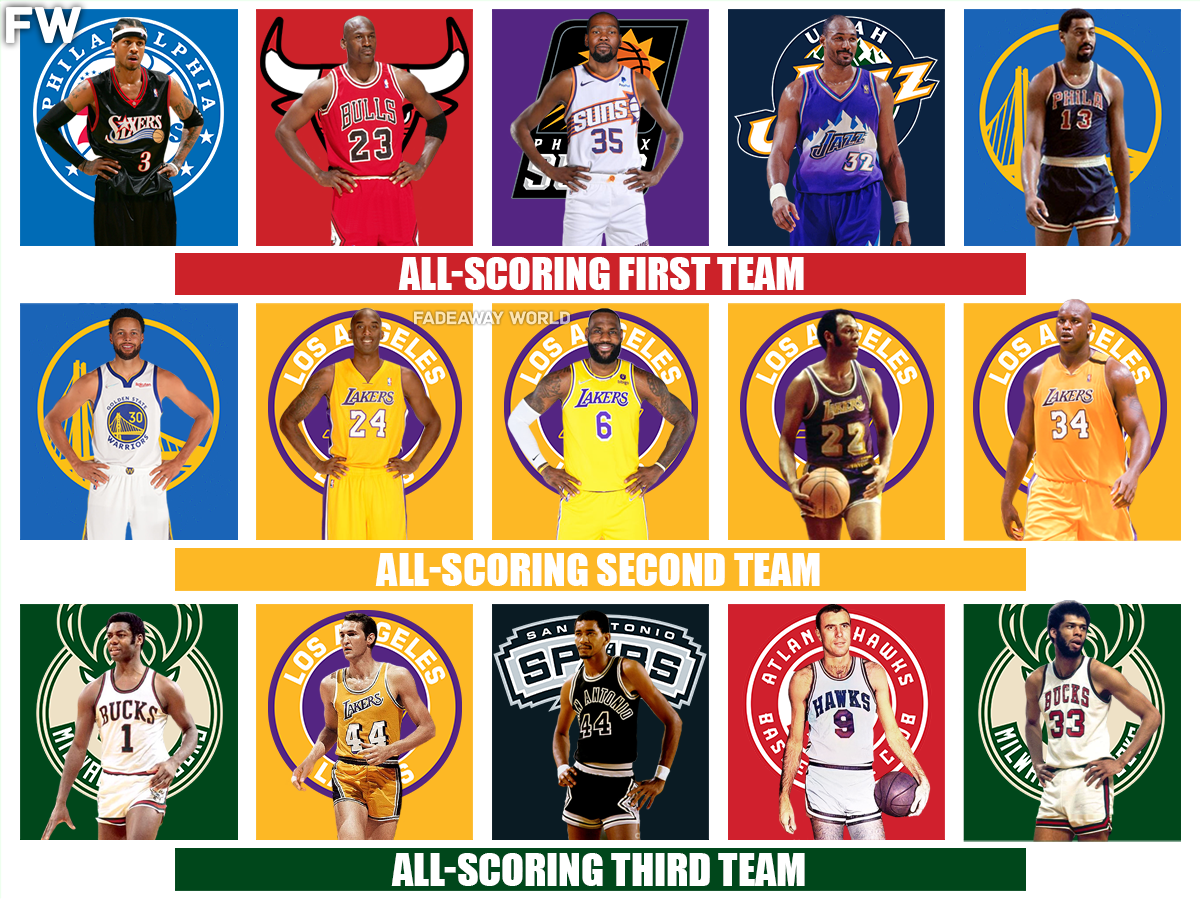
Winning a single scoring title highlights an elite individual season, but winning multiple titles defines an entire era of basketball history. Only a select group of legendary players have captured three or more scoring crowns in their careers.
(Note: Clean narrative styling used, avoiding prohibited ASCII box art or markup markers).
1. Michael Jordan (10 Scoring Titles)
Michael Jordan holds the definitive record for the most scoring titles in NBA history, earning 10 during his tenure with the Chicago Bulls. Jordan captured seven consecutive scoring titles from 1987 to 1993, retired briefly to play baseball, and then won three more consecutive titles from 1996 to 1998 upon his full-time return.
- Highest Scoring Season: 37.1 PPG (1986–87)
- Career Scoring Average: 30.12 PPG (Highest in NBA history)
- Key Attribute: Exceptional mid-range mastery, transition execution, and high usage efficiency without relying heavily on three-point volume.
2. Wilt Chamberlain (7 Scoring Titles)
Wilt Chamberlain dominates the historical record books, holding seven straight scoring titles from 1960 through 1966. Chamberlain’s early career with the Philadelphia/San Francisco Warriors featured unprecedented individual statistical outputs that forced multiple rule changes, including widening the lane.
- Highest Scoring Season: 50.4 PPG (1961–62)
- Historic Milestone: Single-season total points record of 4,029 points in 1961–62.
- Key Attribute: Unmatched interior physical dominance and rebound-putback volume prior to the modern defensive era.
3. Kevin Durant (4 Scoring Titles)
Kevin Durant became one of the youngest scoring champions in league history when he won his first title at age 21 during the 2009–10 season with the Oklahoma City Thunder. Durant earned four titles in a five-year span (2010, 2011, 2012, 2014), combining a 7-foot wingspan with elite perimeter shooting mechanics.
- Highest Scoring Season: 32.0 PPG (2013–14)
- Efficiency Standard: Frequently maintained 50-40-90 shooting split thresholds while leading the league in volume.
4. Allen Iverson (4 Scoring Titles)
Despite standing just 6 feet tall, Allen Iverson won four scoring titles (1999, 2001, 2002, 2005) with the Philadelphia 76ers. Iverson carried unmatched offensive usage burdens, relying on dynamic ball-handling, perimeter crossovers, and extreme durability under heavy minutes logged per contest.
- Highest Scoring Season: 31.4 PPG (2001–02)
5. George Gervin (3 Scoring Titles)
"The Iceman" George Gervin captured four scoring titles (1978, 1979, 1980, 1982) with the San Antonio Spurs, showcasing finger-roll finishes and transition perimeter scoring. Gervin famously won the 1977–78 scoring title on the final day of the season by scoring 63 points in a single game to edge out David Thompson by a fraction of a point (27.22 PPG vs. 27.15 PPG).
Comparative Data: Historical Scoring Title Milestones
The table below outlines landmark scoring title seasons across different eras, highlighting changes in pace, scoring output, and shooting trends.
| Player | Season | Team | Games Played | Total Points | Season PPG | 3-Pointers Made |
|---|---|---|---|---|---|---|
| Wilt Chamberlain | 1961–62 | Philadelphia Warriors | 80 | 4,029 | 50.4 | N/A |
| Wilt Chamberlain | 1962–63 | San Francisco Warriors | 80 | 3,586 | 44.8 | N/A |
| Kareem Abdul-Jabbar | 1971–72 | Milwaukee Bucks | 81 | 2,822 | 34.8 | N/A |
| George Gervin | 1979–80 | San Antonio Spurs | 78 | 2,585 | 33.1 | 32 |
| Michael Jordan | 1986–87 | Chicago Bulls | 82 | 3,041 | 37.1 | 12 |
| Kobe Bryant | 2005–06 | Los Angeles Lakers | 80 | 2,830 | 35.4 | 180 |
| Kevin Durant | 2013–14 | Oklahoma City Thunder | 81 | 2,593 | 32.0 | 192 |
| James Harden | 2018–19 | Houston Rockets | 78 | 2,818 | 36.1 | 378 |
| Stephen Curry | 2020–21 | Golden State Warriors | 63 | 2,015 | 32.0 | 337 |
| Joel Embiid | 2021–22 | Philadelphia 76ers | 68 | 2,079 | 30.6 | 93 |
| Luka Dončić | 2023–24 | Dallas Mavericks | 70 | 2,370 | 33.9 | 284 |
PPG Leader vs. Total Points Leader: Understanding Discrepancies
Because the modern scoring title is awarded strictly based on PPG average (subject to the 58-game minimum), the official NBA scoring champion does not always lead the league in cumulative points scored during that season.
This creates a distinct split on statistical record sheets between the Scoring Champion (highest average) and the Total Points Leader (highest cumulative score).
Historic Examples of Split Titles
- 1984–85 Season: Bernard King led the NBA in scoring average at 32.9 PPG over 55 games for the New York Knicks. However, Michael Jordan scored 2,313 total points (28.2 PPG over 82 games) as a rookie. Under current rules, King qualified and earned the scoring title, while Jordan led in total points.
- 2019–20 Season: James Harden led the league in total points with 2,335 points in 68 games (34.3 PPG). Because the COVID-19 season restart altered game counts, Harden captured both PPG and total points, demonstrating how workload distribution changes in shortened schedules.
- 2020–21 Season: Stephen Curry won the scoring title with 32.0 PPG in 63 games (2,015 total points). Meanwhile, Minnesota's Anthony Edwards played 72 games and logged high cumulative totals, but Curry’s per-game dominance secured the official crown.
Strategic Implications for Teams and Players
Managing player load, injury rehabilitation, and rest days heavily influences this statistical split:
Load Management vs. Leaderboard Standing
Modern sports science and load management protocols mean star players frequently play between 60 and 70 games per season. A player who averages 33.0 PPG across 60 games totals 1,980 points. A teammate or rival who plays all 82 games at 25.0 PPG totals 2,050 points. The per-game player earns the scoring title despite scoring 70 fewer absolute points, prioritizing maximum per-minute efficiency over total volume.
Modern Era Scoring Dynamics: Pace, Efficiency, and Analytics
The profile of an NBA scoring champion has shifted dramatically over the past two decades due to the widespread implementation of basketball analytics, expanded three-point attempt rates, and revised perimeter defensive rules (such as freedom-of-movement officiating emphasis).
1. High-Volume Three-Point Shooting
In earlier eras, scoring champions relied heavily on post isolation, mid-range pull-up jumpers, or direct drives to the basket. Modern winners utilize deep perimeter range to generate higher point returns per shot attempt.
- James Harden (2018–19): Averaged 36.1 PPG while sinking 378 three-pointers, relying heavily on isolation step-backs and drawn fouls.
- Stephen Curry (2015–16, 2020–21): Revolutionized perimeter scoring efficiency by winning scoring titles while generating high-volume points beyond the arc, achieving rare 50-40-90 efficiency metrics.
2. True Shooting Percentage (TS%) vs. Raw Volume
Traditional evaluations focused solely on Field Goal Percentage (FG%). Modern technical evaluations judge scoring champions based on True Shooting Percentage (TS%), which accounts for the added value of three-pointers and free throws:
$$\text{TS%} = \frac{\text{Total Points}}{2 \times (\text{FGA} + 0.44 \times \text{FTA})}$$
Scoring champions in the modern era routinely achieve True Shooting percentages between 61.0% and 67.0%, demonstrating that high-volume scoring no longer requires sacrificing shot selection efficiency.
3. Usage Rate (USG%) and Offensive Burden
The Usage Rate measures the percentage of team plays used by a player while they are on the floor (ending in a field goal attempt, free throw attempt, or turnover). NBA scoring champions consistently post Usage Rates between 33.0% and 40.5%. Managing this extreme workload without suffering efficiency drops or muscle fatigue remains a primary challenge for elite scorers.
Step-by-Step Analysis: How Official Scoring Records Are Tracked
For sports analysts, media outlets, and fans tracking a scoring title race throughout an 82-game regular season, monitoring leaderboard standings requires tracking specific threshold benchmarks.
- Track Games Played Counts: Monitor total appearances relative to team games played to ensure the player remains on pace to reach the 58-game minimum baseline.
- Calculate Gross Points vs. Remaining Contests: Determine how many points a player must score over remaining games to maintain their lead against competing contenders.
- Apply the 58-Game Divisor Rule: If a candidate finishes with 54 to 57 games played, multiply their current PPG average by actual games to get total points, then divide by 58 to calculate their official statistical leaderboard ranking.
- Evaluate Tiebreaker Mechanics: If two players finish with identical calculated PPG figures when rounded to one decimal place, the NBA calculates statistical leaderboards out to three or four decimal points to determine the winner (as occurred in 1978 with George Gervin and David Thompson).
Frequently Asked Questions About NBA Scoring Titles
What is the minimum number of games required to win the NBA scoring title?
A player must participate in at least 58 regular-season games during a standard 82-game season. If a player participates in fewer than 58 games, their total points are divided by 58; if that adjusted average remains the highest in the league, they are awarded the scoring title.
Does the 65-game NBA CBA rule apply to the scoring title?
No, the 65-game minimum rule introduced in the Collective Bargaining Agreement applies strictly to voted honors like regular-season MVP, All-NBA Teams, and Defensive Player of the Year. Statistical leaderboards—including scoring, assists, and rebounds—continue to operate under standard 58-game eligibility rules.
Who has won the most NBA scoring titles in history?
Michael Jordan holds the all-time record with 10 NBA scoring titles, all won as a member of the Chicago Bulls. Wilt Chamberlain ranks second with 7 scoring titles, while Kevin Durant and Allen Iverson are tied for third with 4 titles each.
Has anyone ever won the scoring title without leading in total points?
Yes, this happens frequently. Because the title is based on Points Per Game (PPG), players who miss minor portions of the season can post a higher per-game average than players who play all 82 games, resulting in split leaders for PPG and total points.
What is the highest single-season PPG average in NBA history?
Wilt Chamberlain holds the single-season scoring record, averaging 50.4 points per game during the 1961–62 season for the Philadelphia Warriors. In the modern three-point era, Michael Jordan holds the mark at 37.1 PPG set during the 1986–87 season.
Do playoff points count toward the NBA scoring title?
No, the official NBA scoring title is based exclusively on performances recorded during the regular season. Postseason statistics are tracked separately and have no bearing on regular-season statistical championships or awards.
Elevating Basketball Statistical Analysis
Understanding the mechanics of the NBA scoring title requires looking beyond standard box scores to evaluate participation rules, scoring efficiency metrics, and historical era contexts. Whether tracking live statistical leaderboards during the regular season or analyzing historical hall-of-fame resumes, applying proper qualification thresholds ensures accurate statistical comparisons across generations of basketball excellence.
Image Gallery