Understanding Louisiana Workers Compensation Insurance Rates
Louisiana workers compensation insurance rates are determined by a combination of state-specific regulations, industry classifications, payroll sizes, and employer loss histories, with premiums calculated per $100 of employer payroll b...
Louisiana workers compensation insurance rates are determined by a combination of state-specific regulations, industry classifications, payroll sizes, and employer loss histories, with premiums calculated per $100 of employer payroll based on job hazard levels.
Contents
Navigating the landscape of workers compensation insurance in Louisiana requires a firm grasp of how statutory regulations, industry classifications, and historical loss data interact to shape business expenses. For employers operating within the state, coverage is generally mandatory for businesses with one or more employees, with few exemptions. Understanding the mechanics behind premium calculations helps organizations budget accurately, implement effective workplace safety protocols, and utilize risk management strategies to lower costs over time.
Operating a business in Louisiana exposes employers to specific legal frameworks overseen by the Louisiana Workforce Commission (LWC) and the Louisiana Department of Insurance (LDI). Because workers compensation operates as a no-fault system designed to provide medical care and wage replacement to injured workers while protecting employers from civil tort liability, insurance pricing directly reflects the financial exposure associated with different occupations. Analyzing these rates involves examining how advisory organizations, insurance carriers, and state regulators collaborate to establish baseline costs and modify them for individual businesses.
The Regulatory Framework of Louisiana Workers Compensation
The Louisiana workers compensation system is governed by Title 23 of the Louisiana Revised Statutes. The Office of Workers' Compensation Administration (OWCA), a subset of the Louisiana Workforce Commission, administers claims, resolves disputes, and oversees compliance across the state. Unlike standard commercial liability policies, workers compensation insurance provides statutory benefits that are heavily regulated regarding medical fee schedules, permanent partial disability awards, and temporary total disability calculations.
Insurance companies operating in the state must file their rating plans, forms, and manuals with the Louisiana Department of Insurance. While carriers use advisory rates established by rating bureaus as a foundational starting point, they maintain the legal flexibility to apply deviations, schedule credits, and premium discounts based on their underwriting guidelines. Understanding this regulatory environment is essential because state statutes dictate minimum benefit levels, which in turn directly influence the underlying actuarial cost of providing coverage.
Employers must verify compliance mandates carefully. In Louisiana, sole proprietors, partners, and corporate officers may sometimes elect to be included or excluded from coverage depending on their corporate structure and ownership percentage, but any statutory employee requires immediate coverage from day one of operations. Failure to maintain mandatory workers compensation insurance can result in severe civil penalties, stop-work orders, and potential criminal liability for business owners.
How Workers Compensation Premiums Are Calculated
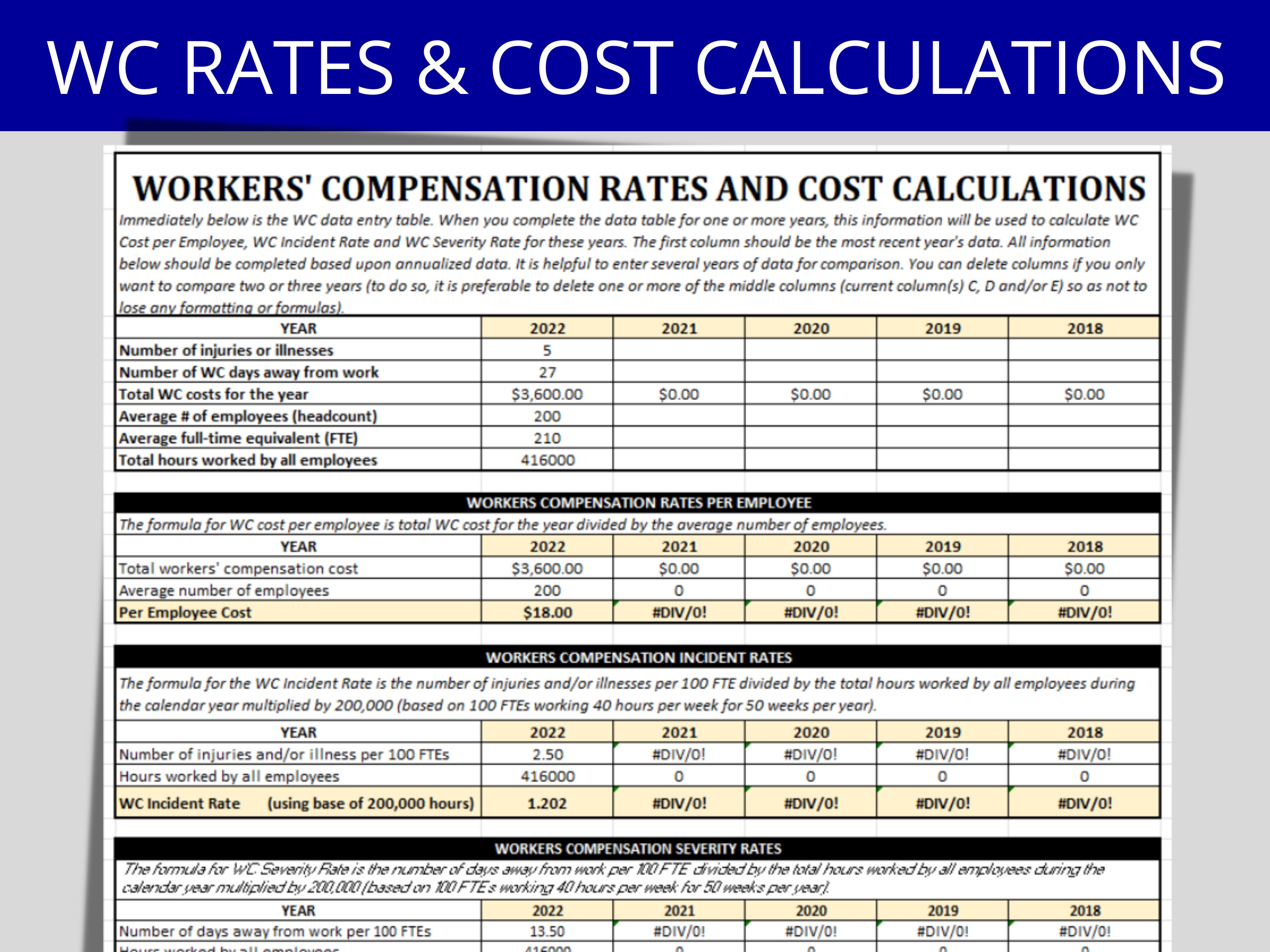
The fundamental formula for calculating a workers compensation premium relies on three primary variables: the employer's payroll, the classification code of the employees, and the Experience Modification Rate (EMR). Insurance underwriters evaluate these components to produce a final manual premium, which is then adjusted for premium discounts, expense constants, and scheduled credits or debits.
- Core Workers Compensation Formula:
- (Payroll / $100) × (Classification Rate) = Manual Premium
- Manual Premium × Experience Modification Rate (EMR) = Adjusted Premium
- Adjusted Premium + Expense Constants - Credits = Final Cost
Payroll is evaluated per $100 units. If an employer has a specific class code with a rate of $2.00 per $100 of payroll and total annual payroll for that class is $500,000, the manual premium calculation is 5,000 (representing $500,000 divided by 100) multiplied by $2.00, yielding a baseline manual premium of $10,000 before modifications.
Classification Codes and Hazard Groups
Every job duty within a business is assigned a specific classification code managed by organizations such as the National Council on Compensation Insurance (NCCI). These codes group workers by the similarity of their occupational hazards. For example, clerical office workers carry significantly lower risk profiles and lower classification rates than structural steel erectors or commercial roofing contractors.
Insurance auditors review payroll records annually to ensure employees are properly categorized. Misclassifying workers—such as reporting high-risk construction labor under low-risk clerical codes—can result in severe audit adjustments, retroactive premium charges, and potential allegations of premium fraud. Employers must maintain detailed payroll records segregated by job duties to ensure accurate rate application.
The Role of the Experience Modification Rate (EMR)
The Experience Modification Rate, commonly referred to as the "mod rate," acts as a multiplier applied to an employer's manual premium based on their historical loss record relative to the average employer in the same industry.
- EMR of 1.00: Represents the industry average. The employer pays the standard manual premium without adjustments.
- EMR Below 1.00: Indicates a safer-than-average loss history with fewer or less severe claims. This rewards the employer with a premium discount.
- EMR Above 1.00: Reflects a worse-than-average loss history. This acts as a debit modifier, increasing the total annual premium cost.
Only businesses that meet a specific state-designated premium threshold qualify for an experience modification rating. Smaller businesses typically operate with an EMR of 1.00 until their payroll and premium volume reach the eligibility threshold set by statistical rating bureaus.
Comparative Overview of Louisiana Rating Factors
Evaluating how different operational elements affect overall insurance expenses clarifies why two businesses with identical payroll totals can experience vastly different premium statements.
| Rating Factor | Description | Impact on Premium |
|---|---|---|
| Classification Code | Categorizes employees by occupational risk and historical injury frequency. | Direct baseline cost driver; higher hazard equals higher rate per $100 payroll. |
| Payroll Volume | Total gross remuneration paid to covered employees, divided into $100 units. | Multiplier applied to the classification rate to determine manual premium. |
| Experience Modification Rate (EMR) | Historical comparison of actual losses versus expected losses for the business size. | Percentage multiplier that increases or decreases the manual premium. |
| Schedule Rating Credits | Underwriter evaluation of workplace safety programs, management commitment, and premises safety. | Percentage discount or surcharge applied based on carrier underwriting discretion. |
| Premium Discounts | Sliding-scale reductions applied to larger total premium amounts to account for administrative efficiencies. | Reduces final premium cost as total premium volume increases. |
Factors Driving Louisiana Workers Compensation Costs
Insurance pricing is dynamic and responds to broader macroeconomic and legal trends within the state. Several distinct elements influence whether Louisiana rates trend upward or downward over time.
Medical Cost Inflation and Litigation
Medical expenses represent a substantial portion of workers compensation payouts. The cost of hospital stays, surgical procedures, prescription medications, and physical therapy directly impacts carrier loss ratios. Furthermore, the legal environment surrounding dispute resolution plays a critical role. When claims involve prolonged litigation regarding compensability, permanent disability ratings, or utilization review disputes, administrative and legal expenses drive up overall system costs, which eventually translates to upward pressure on advisory rates.
Occupational Mix and Industry Concentration
Louisiana's economic landscape features heavy concentrations of maritime, energy, petrochemical, construction, and manufacturing industries. Many of these sectors involve high-hazard operations. Because the statewide rate level is an aggregate reflection of all claims across all industries, high-hazard sectors carry a heavy weight in actuarial calculations. Employers in low-risk office or retail environments often benefit from lower baseline rates, but their rates remain tied to the statutory health and solvency of the broader insurance pool.
Strategies for Managing and Reducing Workers Compensation Expenses
Employers seeking to control their workers compensation expenditures must take a proactive, structured approach to risk management, safety compliance, and claims administration.
Implementing Comprehensive Safety Programs
Establishing a formal, written safety program demonstrates to insurance underwriters that an organization prioritizes loss prevention. Key components include:
- Conducting regular, documented safety meetings and hazard assessments.
- Providing appropriate personal protective equipment (PPE) and ensuring proper usage.
- Training new hires thoroughly on job-specific safety protocols and equipment handling.
- Enforcing strict reporting procedures for near-misses and minor injuries.
Effective Claims Management and Return-to-Work Programs
When an injury does occur, swift action minimizes long-term cost escalation. Employers should maintain a designated medical provider network approved by their insurance carrier, ensure injured workers receive prompt medical attention, and maintain open communication with the injured employee throughout recovery.
Implementing a formal return-to-work program—often featuring temporary modified-duty or light-duty assignments—significantly reduces indemnity (wage replacement) costs. Keeping an employee engaged in productive, medically approved tasks within their physical restrictions helps control claim duration and prevents unnecessary spikes in the employer's experience modification rate.
Frequently Asked Questions
Is workers compensation insurance mandatory for all employers in Louisiana?
Yes, Louisiana law generally requires any business with one or more employees to carry workers compensation insurance. This mandate applies to full-time, part-time, and seasonal workers. Sole proprietors and corporate officers may have specific options to exempt themselves under strict statutory guidelines, but any standard employee must be covered.
How does an employer find their specific industry classification codes?
Classification codes are assigned based on the primary operations of the business and the specific duties of the workers. Employers can review their policy declaration pages, consult with their licensed insurance agent or broker, or reference classification guidelines provided by the National Council on Compensation Insurance (NCCI) or the Louisiana Department of Insurance.
What happens if a Louisiana business operates without workers compensation coverage?
Operating without mandatory workers compensation insurance in Louisiana carries severe consequences. The Louisiana Workforce Commission can issue stop-work orders, assess heavy civil penalties and fines, and hold business owners personally liable for any workplace injuries that occur while uninsured. Additionally, injured employees retain the right to sue the uninsured employer directly in civil court without the protections of the statutory no-fault system.
Can an employer negotiate their workers compensation rates?
While advisory base rates are filed with the state and cannot be altered arbitrarily by individual agents, insurance carriers compete for business by offering schedule rating credits, safety tier discounts, and dividend plans. Employers can improve their negotiating position by maintaining a clean loss history, implementing robust safety programs, and presenting thorough risk management documentation to underwriters.
How long do claims stay on an employer's experience modification calculation?
Loss history used to calculate an Experience Modification Rate typically examines the three most recent policy years, excluding the most immediate active year. Because claims remain visible in the formula for multiple years, prompt claims closure and active loss control yield long-term compounding benefits for the business's EMR.
What steps should an employer take immediately following a workplace injury?
First, ensure the employee receives immediate and appropriate medical care. Second, report the injury to the insurance carrier and the Louisiana Workforce Commission as required by statutory deadlines. Third, investigate the root cause of the incident to implement corrective measures that prevent recurrence, and coordinate with the medical provider regarding safe return-to-work options.
Next Actions for Business Owners
Business owners and financial managers seeking to optimize their workers compensation strategy should begin by reviewing their current policy declaration pages to verify that employee classification codes and payroll figures are accurate. Request a copy of the current experience modification worksheet from the rating bureau or insurance carrier to audit past claims for accuracy and closure status. Finally, consult with an independent commercial insurance broker specializing in Louisiana commercial markets to evaluate alternative rating plans, safety group programs, and underwriting credits available to control long-term premium costs.
Image Gallery