Florida Mugshots Search: Legal Frameworks, Public Records Access, and Official 2026 Guidelines
Navigating a Florida mugshots search requires an understanding of the state's uniquely broad public records laws, combined with modern privacy regulations and commercial database practices. Because public access policies evolve continu...
Navigating a Florida mugshots search requires an understanding of the state's uniquely broad public records laws, combined with modern privacy regulations and commercial database practices. Because public access policies evolve continuously, conducting a search in 2026 involves balancing Florida's historic government transparency traditions against new federal and state protections regarding consumer data privacy, expungements, and commercial exploitation.
Contents
Understanding Florida Public Records and the Sunshine Law
Florida has long operated under some of the most transparent public record statutes in the United States, anchored by Article I, Section 24 of the Florida Constitution and Chapter 119 of the Florida Statutes, commonly known as the Sunshine Law.
Under these statutes, arrest records, booking photographs, and police reports generated by law enforcement agencies are generally considered public property. Anyone can request these records without needing to state a purpose. However, the operational reality of obtaining a Florida mugshot in 2026 has shifted significantly due to digital privacy laws, commercial data broker regulations, and statutory amendments designed to protect individuals who were never convicted or who successfully sealed their records.
Statutory Exceptions and Exemptions
While the Sunshine Law provides broad access, specific exemptions prevent the immediate or total release of certain booking photographs and arrest details. Law enforcement agencies in Florida withhold records in the following scenarios:
- Juvenile Records: Arrests and mugshots of minors (under 18) are strictly confidential under Florida law, except in cases where a juvenile is tried as an adult for a serious felony offense.
- Active Criminal Investigations: Release of booking photos or evidentiary logs may be delayed if the disclosure would jeopardize an ongoing criminal investigation or compromise undercover operations.
- Undercover Personnel and Informants: Law enforcement officers working undercover, as well as registered confidential informants, are exempt from public mugshot disclosures.
- Victim Identification Protection: If a booking photo inadvertently reveals the identity of a protected victim—such as in cases of domestic violence, sexual assault, or human trafficking—agencies blur or withhold the image.
Official Methods for Conducting a Florida Mugshots Search
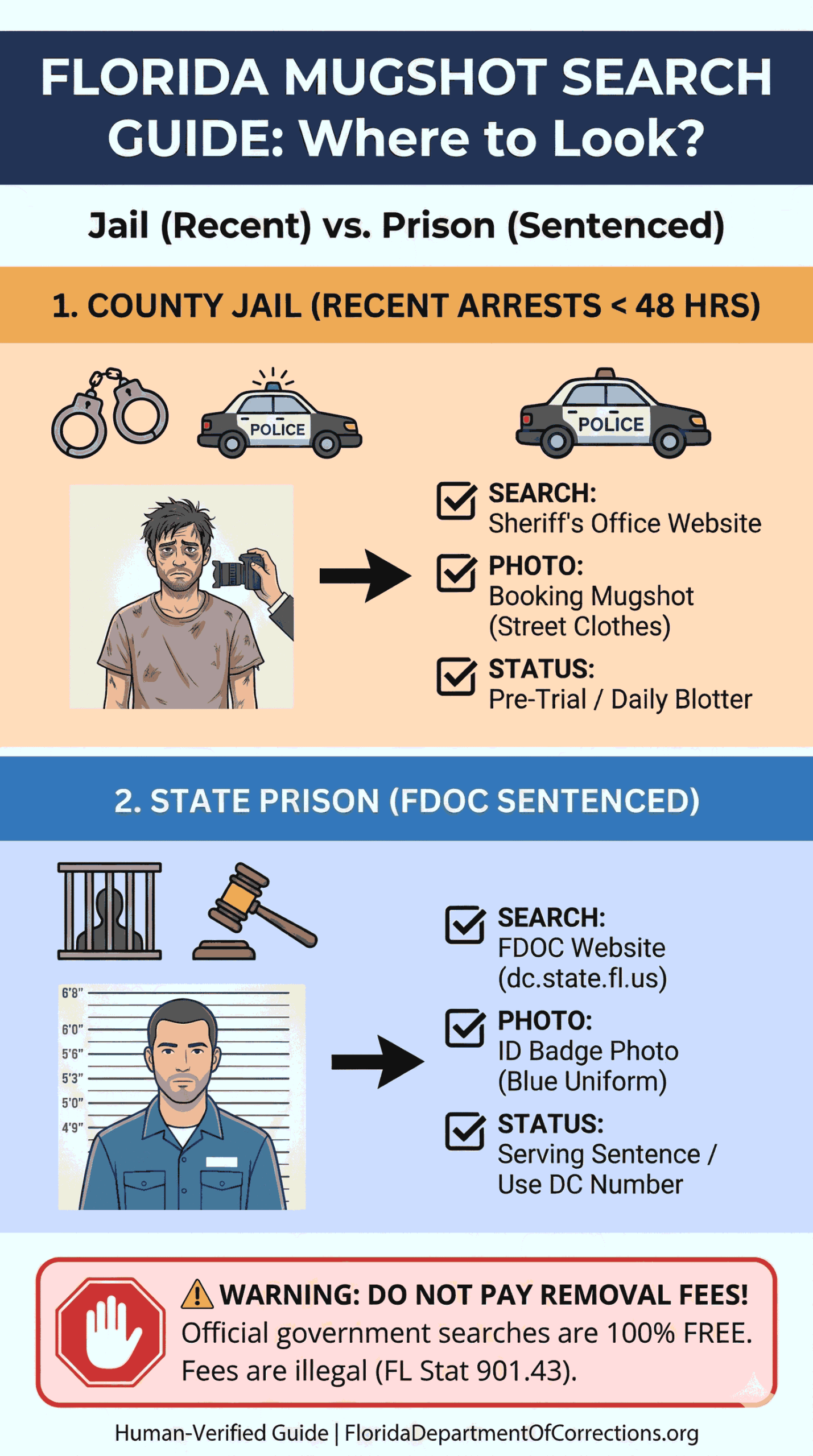
When seeking verified, up-to-date arrest data in Florida, relying on official government channels is critical to ensure accuracy and avoid predatory third-party websites. Because Florida does not maintain a single, centralized statewide mugshot database for all municipal and county arrests, searches must typically be conducted at the county level or through the Florida Department of Law Enforcement (FDLE).
1. County Sheriff Office Inmate Queries
Because local county jails handle initial bookings, the most direct method to locate a recent mugshot is through the specific County Sheriff Office where the arrest took place. Major jurisdictions like Miami-Dade, Broward, Hillsborough, and Orange counties maintain active online jail lookup portals.
County Portal Requirements: To use a county inmate search tool effectively, you generally need the individual's full legal name and date of birth, or the specific booking number assigned during intake. Most county portals refresh their rosters multiple times daily, providing direct access to booking charges, bond amounts, and current custody status alongside the mugshot.
2. Florida Department of Law Enforcement (FDLE) Public Criminal History
For broader state-level criminal history checks, the FDLE provides the Computerized Criminal History (CCH) system. While the CCH system provides official disposition records, convictions, and court outcomes, it does not function as a casual photo gallery. Obtaining official records through FDLE requires navigating a formal public records request process or utilizing their online paid instant search tool.
Commercial Mugshot Sites Versus Official Government Portals
The digital landscape surrounding Florida mugshots is populated by numerous third-party aggregation websites. Understanding the operational differences between official government repositories and commercial data scrapers is essential for personal privacy and data accuracy.
| Feature / Dimension | Official County Sheriff Portals | State FDLE Repositories | Commercial Third-Party Sites |
|---|---|---|---|
| Data Freshness | Real-time or updated hourly directly from booking logs. | Updated as court dispositions and state filings are processed. | Variable; often scraped and archived indefinitely. |
| Cost | Free public access for basic inmate lookups. | Nominal fees for certified statewide background checks. | Free viewing, but high fees charged for mugshot removal. |
| Legal Compliance | Strictly bound by Florida public records and sealing laws. | Adheres strictly to statutory privacy and expungement orders. | Frequently slow to update or comply with removal mandates. |
| Data Accuracy | High; managed directly by arresting law enforcement agencies. | High; reflects official court-reported dispositions. | Low to Moderate; prone to outdated or mismatched records. |
Florida Legislation Governing Commercial Mugshot Removal
In response to predatory data brokers charging individuals hundreds or thousands of dollars to remove booking photos—even when charges were dropped or dismissed—the Florida legislature enacted stringent regulations.
Under Florida Statutes Section 817.5681, commercial entities that publish mugshots online are legally prohibited from charging a fee or compensation to remove, correct, or modify a booking photograph. If a commercial website fails to remove a mugshot within ten days of receiving a written request accompanied by proof that the underlying charges were dismissed, dropped, or resulted in an acquittal, the publisher becomes civilly liable for damages, attorney fees, and statutory penalties.
Steps to Remove a Mugshot from Third-Party Sites
If your booking photo appears on a commercial aggregation site following a dismissed or dropped case, follow this structured workflow:
- Obtain Official Documentation: Secure a certified copy of the disposition from the Clerk of Court proving that the charges were dropped, nolle prossed, or resulted in a "not guilty" verdict.
- Identify the Publisher: Locate the administrative contact, compliance email, or physical mailing address listed on the commercial website hosting the image.
- Draft a Formal Removal Notice: Send a written demand via certified mail or official electronic submission. Include your full name, date of birth, date of arrest, the specific URL where the mugshot appears, and attach the official court disposition document.
- Invoke Florida Statute 817.5681: Explicitly cite Florida law in your correspondence, noting the mandatory ten-day compliance window and potential legal liability for non-compliance.
- File a Complaint: If the site fails to remove the content, file a formal complaint with the Florida Office of the Attorney General and consult a legal professional regarding civil remedies.
Sealing and Expungement in Florida
The most permanent method to remove a mugshot from public view and official search indexes is through the legal process of sealing or expunging a criminal record via the FDLE and the local court system.
- Sealing: Hides a criminal record from public view, though certain government entities, law enforcement agencies, and specialized employers can still access it. Sealing is typically available for cases where adjudication was withheld.
- Expungement: Physically destroys or legally obliterates the record across participating agencies. After an expungement is granted, you may legally deny or fail to acknowledge the arrest in most circumstances.
To qualify for sealing or expungement in Florida, applicants must first apply for and receive a Certificate of Eligibility from the FDLE. Once issued, a petition must be filed with the circuit court in the county where the charges originated.
Frequently Asked Questions About Florida Mugshots Search
Are all Florida mugshots available to the public online?
While law enforcement agencies capture and store booking photos as public records, not all mugshots are instantly published online, and juveniles or exempt individuals are strictly shielded. Furthermore, many county sheriff offices automatically purge or restrict older booking photos from their public portals after a set retention period.
Can I legally remove my mugshot from a commercial website in Florida?
Yes, under Florida law, commercial mugshot publishers cannot demand payment to remove booking photos. If your charges were dismissed, dropped, or resulted in an acquittal, you can legally require them to remove the image within ten days at no cost.
How do I find a mugshot if I only know the person's name?
You can search individual county jail inmate lookup databases using the person's first and last name. However, because common names yield numerous results, having a middle initial, date of birth, or approximate booking date is necessary to confirm the correct identity.
Does the FDLE provide a free online mugshot gallery?
No. The Florida Department of Law Enforcement provides formal criminal history background check tools and statutory record services, but it does not host a casual searchable photo gallery of arrested individuals.
What is the difference between a county inmate search and an FDLE background check?
A county inmate search provides immediate, local booking details, custody status, and mugshots for individuals currently or recently held in that specific county's jail. An FDLE background check covers statewide criminal history, formal court dispositions, and convictions over a broader timeline.
Securing Official Records and Ensuring Compliance
When executing a Florida mugshots search, always prioritize official county sheriff websites and verified state repositories to ensure data accuracy, legal safety, and respect for statutory privacy boundaries. If you are dealing with outdated or wrongfully published commercial listings, leverage your rights under Florida state law to demand immediate removal and consult qualified legal counsel for record sealing or expungement options.
Image Gallery