The Complete Guide to The Lord of the Rings Movie Release Dates
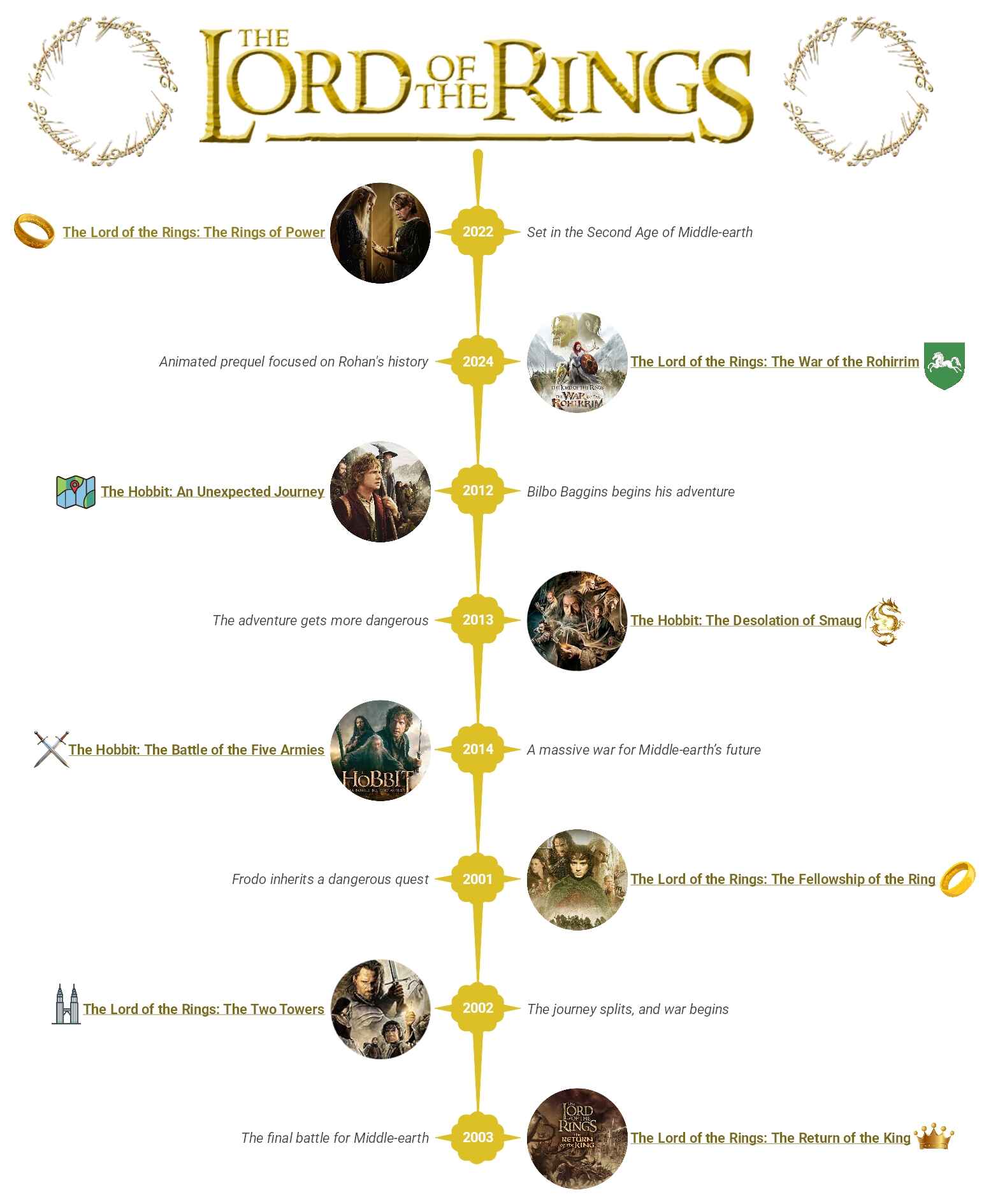
The original theatrical release dates for Peter Jackson’s The Lord of the Rings trilogy span three consecutive December debuts: The Fellowship of the Ring released on December 19, 2001, The Two Towers on December 18, 2002, and The Retu...
The original theatrical release dates for Peter Jackson’s The Lord of the Rings trilogy span three consecutive December debuts: The Fellowship of the Ring released on December 19, 2001, The Two Towers on December 18, 2002, and The Return of the King on December 17, 2003. This timeline expanded with extended home media editions, HD remasters, The Hobbit prequels, and modern feature film revivals.
Contents
The Original Lord of the Rings Trilogy: Theatrical Release Dates (2001–2003)
Director Peter Jackson accomplished an unprecedented feat in cinema history by filming all three installments of The Lord of the Rings simultaneously across New Zealand. Production ran for over 438 days of principal photography between October 1999 and December 2000, followed by annual pick-up shoots through 2003. New Line Cinema opted for an annual holiday release strategy, establishing mid-December as the definitive window for epic fantasy blockbusters.
- The Fellowship of the Ring (Dec 19, 2001)
- Extended DVD Edition (Nov 12, 2002)
- The Two Towers (Dec 18, 2002)
- Extended DVD Edition (Nov 18, 2003)
- The Return of the King (Dec 17, 2003)
- Extended DVD Edition (Dec 14, 2004)
The Fellowship of the Ring
- World Premiere: December 10, 2001 (Odeon Leicester Square, London)
- North American & Wide Release: December 19, 2001
The Lord of the Rings: The Fellowship of the Ring introduced global audiences to J.R.R. Tolkien’s Middle-earth on a grand cinematic scale. Arriving in North American theaters on Wednesday, December 19, 2001, the film carried high expectations due to the vast fandom of the original 1954 novels and a substantial production budget of approximately $93 million for the first chapter.
The theatrical cut ran for 178 minutes, grossing over $880 million worldwide. The mid-December release window proved ideal, taking advantage of the extended holiday viewing period and launching an award-season push that culminated in 13 Academy Award nominations and four wins.
The Two Towers
- World Premiere: December 5, 2002 (Ziegfeld Theatre, New York City)
- North American & Wide Release: December 18, 2002
Following the critical and commercial triumph of the first film, The Lord of the Rings: The Two Towers made its North American theatrical debut on December 18, 2002. The second installment carried a theatrical runtime of 179 minutes, focusing on the split storylines of the broken Fellowship and the massive siege of Helm’s Deep.
By retaining the same mid-December Wednesday opening slot as its predecessor, New Line Cinema capitalized on holiday theater traffic. The Two Towers surpassed the original at the global box office, earning more than $947 million and winning two Academy Awards.
The Return of the King
- World Premiere: December 1, 2003 (Embassy Theatre, Wellington, New Zealand)
- North American & Wide Release: December 17, 2003
The trilogy concluded with The Lord of the Rings: The Return of the King, which premiered internationally in Wellington, New Zealand—the production hub of the series—before opening in wide North American release on December 17, 2003.
Running 201 minutes in theaters, the film represented an extraordinary box office event, grossing over $1.14 billion globally. At the 76th Academy Awards in March 2004, The Return of the King won all 11 awards for which it was nominated, tying historical records for the most Oscars won by a single film alongside Ben-Hur and Titanic.
Extended Edition Release Timeline: DVD, Blu-ray, and 4K Remasters
For many fans, the theatrical release dates tell only half the story. Jackson and his editorial team crafted expanded cuts featuring restored scenes, additional score compositions by Howard Shore, and expanded character arcs. These extended editions established their own distinct physical media release schedule.
| 2002–2004 | 2010–2011 | 2020–2021 |
|---|---|---|
| Extended Edition DVDs | HD Blu-ray Discs | 4K Ultra HD Remasters |
| 4-Disc Boxed Sets | 1080p Transfers | HDR10 / Dolby Vision |
The DVD Era (2002–2004)
Rather than simply re-releasing the theatrical cut on home media, New Line Home Entertainment issued two separate physical releases for each film: a theatrical DVD release in late summer, followed by an elaborate 4-disc Special Extended DVD Edition in November or December of the following year.
- The Fellowship of the Ring (Extended Edition): Released on November 12, 2002 (adding 30 minutes of footage, bringing total runtime to 208 minutes).
- The Two Towers (Extended Edition): Released on November 18, 2003 (adding 44 minutes of footage, bringing total runtime to 223 minutes).
- The Return of the King (Extended Edition): Released on December 14, 2004 (adding 51 minutes of footage, bringing total runtime to 251 minutes).
These box sets included brand-new commentary tracks from the cast and crew, alongside multi-part documentary featurets detailing Tolkien's lore, costume design, weapons forging, visual effects by Wētā Digital, and musical score composition.
High-Definition Blu-ray Releases (2010–2011)
The transition to High-Definition physical media split the home audience across two distinct dates:
- Theatrical Cuts Blu-ray: April 6, 2010
- Extended Edition Blu-ray Box Set: June 28, 2011
The delayed release of the Extended Editions on Blu-ray caused considerable discussion among home theater enthusiasts. When the 15-disc set debuted in June 2011, it offered 1080p high-definition transfers split across two Blu-ray discs per film to preserve high bitrates, accompanied by the original DVD bonus features.
4K Ultra HD Remasters (2020–2021)
In late 2020, Warner Bros. Home Entertainment released remastered 4K Ultra HD editions overseen directly by Peter Jackson.
- 4K Ultra HD Trilogy Set (Theatrical & Extended): Released on December 1, 2020
- Middle-earth Ultimate Collector’s Edition 4K: Released on October 26, 2021
The 4K releases utilized dynamic range scanning (HDR10 and Dolby Vision) and remastered Dolby Atmos audio tracks, standardizing color grading across both The Lord of the Rings and The Hobbit film series.
The Hobbit Trilogy: Prequel Release Dates (2012–2014)
Nearly a decade after The Return of the King swept the Academy Awards, Peter Jackson returned to Middle-earth to adapt J.R.R. Tolkien’s 1937 novel The Hobbit. Originally planned as a two-film adaptation directed by Guillermo del Toro, the project expanded into a three-part feature trilogy under Jackson’s direction.
Warner Bros. maintained the holiday release calendar that proved successful during the original trilogy, releasing each chapter in mid-December across consecutive years.
| Dec 14, 2012 | Dec 13, 2013 | Dec 17, 2014 |
|---|---|---|
| An Unexpected Journey | The Desolation of Smaug | The Battle of the Five Armies |
The Hobbit: An Unexpected Journey
- World Premiere: November 28, 2012 (Embassy Theatre, Wellington)
- North American Release: December 14, 2012
An Unexpected Journey debuted in North America on December 14, 2012. The film introduced high-frame-rate (HFR) projection to mainstream cinemas, showing select screenings at 48 frames per second alongside standard 24 fps presentations. It grossed over $1.017 billion worldwide.
The Hobbit: The Desolation of Smaug
- World Premiere: December 2, 2013 (Dolby Theatre, Los Angeles)
- North American Release: December 13, 2013
The second chapter arrived in theaters on December 13, 2013, continuing Bilbo Baggins’ quest toward the Lonely Mountain. The film grossed $959 million globally during its theatrical run.
The Hobbit: The Battle of the Five Armies
- World Premiere: December 1, 2014 (Odeon Leicester Square, London)
- North American Release: December 17, 2014
Originally subtitled There and Back Again, the final installment was retitled The Battle of the Five Armies prior to its release on December 17, 2014. The film concluded the cinematic prequel storyline, grossing $962 million worldwide.
Modern Middle-earth Feature Films
Middle-earth returned to theatrical release schedules with animated and live-action expansions produced by Warner Bros. Pictures and New Line Cinema.
The Lord of the Rings: The War of the Rohirrim
- Theatrical Release Date: December 13, 2024
Directed by veteran anime filmmaker Kenji Kamiyama (Ghost in the Shell: Stand Alone Complex), The Lord of the Rings: The War of the Rohirrim is an original animated feature film. Set roughly 183 years before the events of The Fellowship of the Ring, the story explores the life and reign of Helm Hammerhand, the legendary King of Rohan who built Helm's Deep.
The film received a nationwide theatrical release on December 13, 2024, continuing the franchise's long-standing tradition of mid-December cinematic releases.
The Lord of the Rings: The Hunt for Gollum
- Target Release Window: 2026
Announced by Warner Bros. Discovery, The Lord of the Rings: The Hunt for Gollum is a live-action feature film directed by Andy Serkis, who also reprises his role as Smeagol/Gollum. Peter Jackson, along with co-writers Fran Walsh and Philippa Boyens, returned to produce and oversee story development.
The film focuses on unexamined events occurring during the early timeline of The Fellowship of the Ring, specifically the effort to locate Gollum before Sauron's forces extract information regarding the One Ring.
Summary Table of All Middle-earth Feature Releases
The following table provides a complete comparative overview of theatrical release dates, extended media debuts, total running times, and premiere locations across the entire theatrical franchise history.
| Film Title | Distribution Category | Initial Premiere Date | North American Release | Extended Edition Release | Theatrical / Extended Runtime |
|---|---|---|---|---|---|
| The Fellowship of the Ring | Original Trilogy | Dec 10, 2001 (London) | Dec 19, 2001 | Nov 12, 2002 | 178 min / 208 min |
| The Two Towers | Original Trilogy | Dec 5, 2002 (NYC) | Dec 18, 2002 | Nov 18, 2003 | 179 min / 223 min |
| The Return of the King | Original Trilogy | Dec 1, 2003 (Wellington) | Dec 17, 2003 | Dec 14, 2004 | 201 min / 251 min |
| An Unexpected Journey | The Hobbit Prequel | Nov 28, 2012 (Wellington) | Dec 14, 2012 | Nov 5, 2013 | 169 min / 182 min |
| The Desolation of Smaug | The Hobbit Prequel | Dec 2, 2013 (Los Angeles) | Dec 13, 2013 | Nov 4, 2014 | 161 min / 186 min |
| The Battle of the Five Armies | The Hobbit Prequel | Dec 1, 2014 (London) | Dec 17, 2014 | Nov 17, 2015 | 144 min / 164 min |
| The War of the Rohirrim | Animated Feature | Dec 13, 2024 (US) | Dec 13, 2024 | N/A | 134 min |
| The Hunt for Gollum | Feature Film | Target 2026 | Target 2026 | TBD | TBD |
Chronological Order vs. Release Order Viewing Schedules
Understanding release dates helps viewers choose between two primary viewing methods when organizing a marathon of the Middle-earth film catalog.
Option A: Release Order (Recommended for First-Time Viewers)
- [2001-2003] LOTR Trilogy
- [2012-2014] The Hobbit Trilogy
- [2024+] Expanded Films
Option B: Chronological Story Order
- [2024] War of Rohirrim
- [2012-2014] The Hobbit
- [2026] Hunt for Gollum
- [2001-2003] LOTR
1. The Release Order Strategy
Watching the films by original release date remains the most common entry point for new audiences:
- The Fellowship of the Ring (2001)
- The Two Towers (2002)
- The Return of the King (2003)
- The Hobbit: An Unexpected Journey (2012)
- The Hobbit: The Desolation of Smaug (2013)
- The Hobbit: The Battle of the Five Armies (2014)
- The Lord of the Rings: The War of the Rohirrim (2024)
Why Choose Release Order:
- The Hobbit trilogy was filmed with visual and narrative callbacks that assume familiarity with Jackson’s Lord of the Rings films.
- Special effects technology, soundtrack themes, and cinematography evolve naturally across production years.
2. The In-Universe Chronological Strategy
For viewers who want to experience narrative events as they occur in Middle-earth history:
- The Lord of the Rings: The War of the Rohirrim (Set ~2758 of the Third Age)
- The Hobbit: An Unexpected Journey (Set 2941 of the Third Age)
- The Hobbit: The Desolation of Smaug (Set 2941 of the Third Age)
- The Hobbit: The Battle of the Five Armies (Set 2941 of the Third Age)
- The Lord of the Rings: The Hunt for Gollum (Set between 3001 and 3018 of the Third Age)
- The Lord of the Rings: The Fellowship of the Ring (Set 3001 to 3019 of the Third Age)
- The Lord of the Rings: The Two Towers (Set 3019 of the Third Age)
- The Lord of the Rings: The Return of the King (Set 3019 of the Third Age)
Frequently Asked Questions
What day of the week did the original Lord of the Rings movies premiere?
All three films in Peter Jackson's original trilogy opened on a Wednesday in North America during mid-December (December 19, 2001; December 18, 2002; and December 17, 2003). Opening mid-week allowed studios to build strong word-of-mouth momentum heading directly into the Christmas holiday weekend.
Why were all the Lord of the Rings movies released in December?
New Line Cinema strategically chose December release dates for several reasons:
- It leveraged the high-traffic holiday moviegoing season when audiences spent time with family.
- It positioned the films at the height of the film industry's awards consideration window, directly leading into Golden Globe and Academy Award voting periods.
- It created a reliable annual tradition for moviegoers across three consecutive years.
How long after the theatrical releases did the Extended Editions debut?
The Extended Editions typically arrived on DVD roughly 11 to 12 months after each film’s theatrical debut. For example, The Fellowship of the Ring debuted in theaters in December 2001, while its Special Extended DVD Edition was released on November 12, 2002. This window allowed the studio to issue a standard home video cut in late summer before releasing the expanded cut ahead of the next theatrical installment.
What is the total running time of all Lord of the Rings films combined?
The total running time varies based on the version selected:
- Theatrical Cuts (Trilogy): 536 minutes (8 hours, 56 minutes)
- Extended Cuts (Trilogy): 682 minutes (11 hours, 22 minutes)
- Combined Six-Film Middle-earth Marathon (Extended LOTR + Extended Hobbit): 1,218 minutes (20 hours, 18 minutes)
Are new Lord of the Rings movies planned after 2024?
Yes. Following the December 2024 animated release of The Lord of the Rings: The War of the Rohirrim, Warner Bros. and New Line Cinema announced live-action projects, beginning with Andy Serkis's directed feature The Lord of the Rings: The Hunt for Gollum, which targeted a 2026 theatrical window.
Next Steps for Fans and Collectors
To build or update a Middle-earth home media collection, consider these guidelines:
- Verify Format Compatibility: If purchasing physical home media, ensure your display setup supports HDR10/Dolby Vision to get the full visual benefits of the remastered 4K Ultra HD sets released in 2020.
- Select the Right Cut: Choose theatrical versions for casual viewing or first-time audiences to maintain faster pacing. Select Extended Cuts when planning comprehensive marathon sessions.
- Check Official Announcement Outlets: For upcoming theatrical dates beyond current production schedules, monitor press releases from Warner Bros. Pictures and official trade announcements via New Line Cinema.
Image Gallery