UFC Lightweight Champion: Division History, Title Lineage, and Technical Analysis
The UFC Lightweight Champion holds the undisputed title in the 155-pound (70.3 kg) weight class, universally recognized as the most talent-dense and competitive division in Mixed Martial Arts (MMA). Dagestani grappling specialist Islam...
The UFC Lightweight Champion holds the undisputed title in the 155-pound (70.3 kg) weight class, universally recognized as the most talent-dense and competitive division in Mixed Martial Arts (MMA). Dagestani grappling specialist Islam Makhachev has held the title since defeating Charles Oliveira at UFC 280 in October 2022, continuing a legacy defined by elite wrestling, suffocating top control, and evolving striking.
Contents
Current UFC Lightweight Champion Status and Division Overview
The 155-pound division represents the sweet spot of combat sports physical dynamics. Athletes in this weight class combine the explosive speed and fluid movement of featherweights with the single-strike knockout power of welterweights.
Islam Makhachev's championship reign exemplifies the modern standard required to hold gold at 155 pounds. Training out of Abdulmanap Nurmagomedov’s system in Dagestan alongside former undefeated champion Khabib Nurmagomedov, Makhachev seamlessly blends World Combat Sambo championship grappling with polished, economical kickboxing.
Note: Championship bouts strictly enforce the 155.0-pound upper limit. Unlike non-title fights, which permit a 1-pound allowance (up to 156.0 lbs), title contenders must hit the exact weight target during the official morning weigh-in window.
To maintain championship status in this division, an athlete must navigate a grueling gauntlet of elite contenders. The division routinely features former titleholders, world-class Brazilian Jiu-Jitsu black belts, NCAA Division I All-American wrestlers, and high-volume Muay Thai striking specialists.
The Historical Lineage of the UFC Lightweight Championship
The 155-pound championship title has undergone several distinct eras since its inception. From early dynamic brawlers to modern multi-disciplinary tacticians, the belt's lineage reflects the overall technical maturation of MMA.
The Foundation and Early Era (2001–2008)
- Jens Pulver (2001–2002): Crowned the inaugural champion at UFC 31 after defeating Caol Uno. Pulver defended the title against B.J. Penn before vacating due to a contract dispute.
- Sean Sherk (2006–2007): Re-established the division after a prolonged hiatus, defeating Kenny Florian at UFC 64 using relentless takedowns and ground-and-pound.
- B.J. Penn (2008–2010): Considered one of the greatest lightweight fighters in history, "The Prodigy" dominated the division with legendary defenses against Joe Stevenson, Sean Sherk, and Diego Sanchez, establishing high standards for defensive wrestling and elite BJJ.
The Grinding Era and Kinetic Striking (2010–2016)
- Frankie Edgar (2010–2012): Shocked the combat world by dethroning Penn at UFC 112. Edgar's reign was characterized by footwork, boxing volume, heart, and iconic title defenses against Gray Maynard.
- Benson Henderson (2012–2013): Utilized massive lower-body strength, dynamic leg kicks, and scramble defense to record three consecutive title defenses against Frankie Edgar, Nate Diaz, and Gilbert Melendez.
- Anthony Pettis (2013–2015): Captured the belt with an armbar victory over Henderson, ushering in an era of flashy, highly accurate striking and dynamic off-the-back submissions.
- Rafael dos Anjos (2015–2016): Neutralized Pettis with relentless pressure, aggressive stance shifts, and dominant pressure grappling to claim the throne.
The Global Mainstream and Sambo Dominance (2016–Present)
- Eddie Alvarez (2016): Stopped dos Anjos with first-round strikes to claim the championship at UFC Fight Night 90.
- Conor McGregor (2016–2018): Made combat sports history at UFC 205 by knocking out Alvarez to become the first simultaneous two-division champion in UFC history (Featherweight and Lightweight).
- Khabib Nurmagomedov (2018–2020): Established one of the most dominant championship runs in sports history. Nurmagomedov retired undefeated at 29-0 after defending the belt against Conor McGregor, Dustin Poirier, and Justin Gaethje via dominant stoppages.
- Charles Oliveira (2021–2022): Set UFC records for most submission finishes and finishes overall, capturing the vacant belt against Michael Chandler and defending against Dustin Poirier.
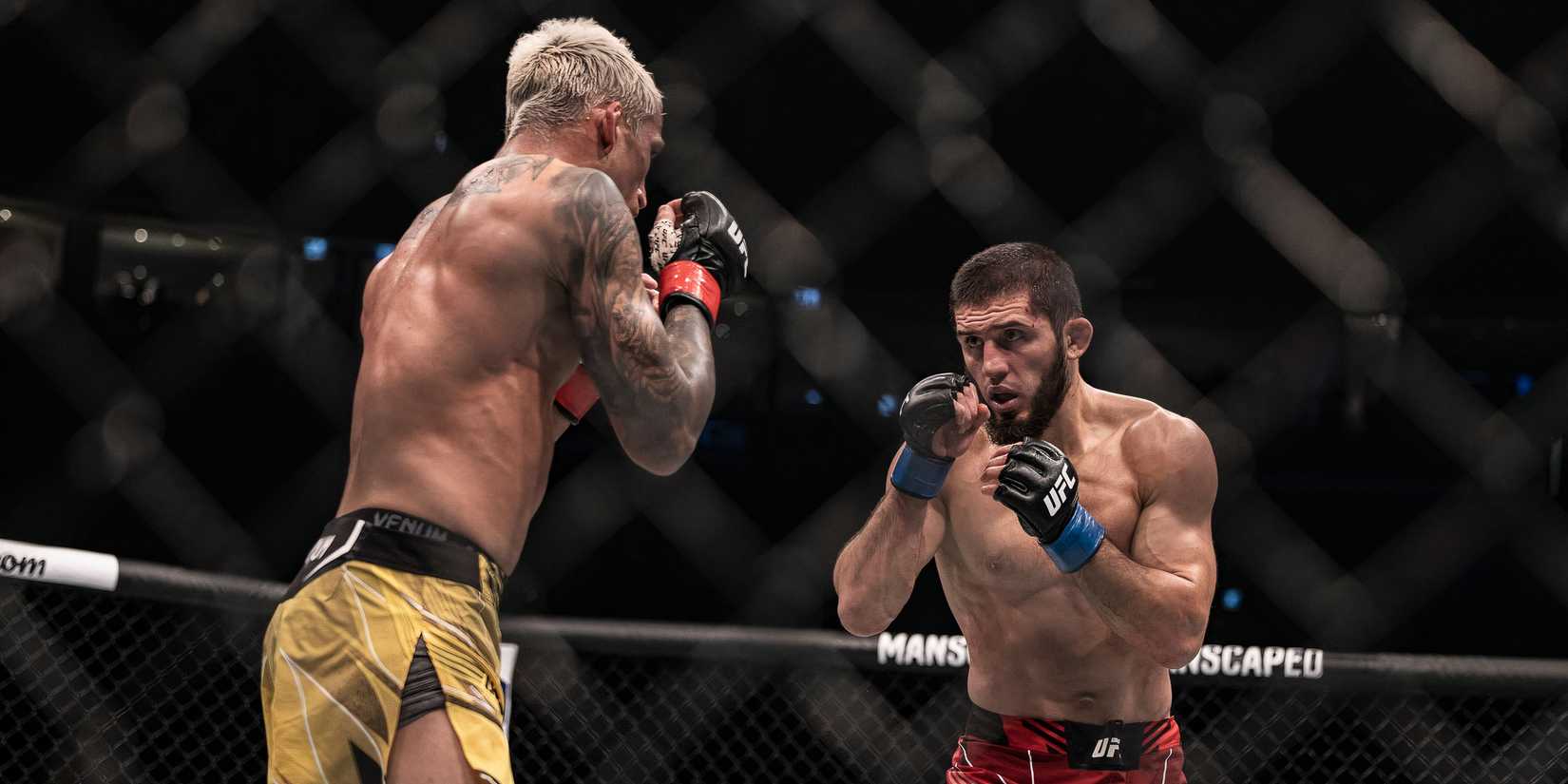
- Islam Makhachev (2022–Present): Submitted Oliveira at UFC 280, solidifying Dagestani Sambo as the preeminent championship base style while adding high-level striking defenses against elite challengers.
Division Metrics and Historic Championship Records
The lightweight division holds some of the most competitive statistical benchmarks in the Ultimate Fighting Championship. Below is a comparative breakdown of key metrics among historic 155-pound titleholders.
| Champion Name | Title Reign Period | Successful Defenses | Primary Base Style | Signature Finishing Method |
|---|---|---|---|---|
| B.J. Penn | 2008 – 2010 | 3 Defenses | Brazilian Jiu-Jitsu / Boxing | Rear-Naked Choke / TKO |
| Frankie Edgar | 2010 – 2012 | 3 Defenses | NCAA Division I Wrestling / Boxing | Decision / KO (Punches) |
| Benson Henderson | 2012 – 2013 | 3 Defenses | Taekwondo / Wrestling | Unanimous Decision |
| Khabib Nurmagomedov | 2018 – 2020 | 3 Defenses | Combat Sambo / Freestyle Wrestling | Rear-Naked Choke / Triangle |
| Charles Oliveira | 2021 – 2022 | 1 Defense | Brazilian Jiu-Jitsu / Muay Thai | Rear-Naked Choke / Guillotine |
| Islam Makhachev | 2022 – Present | 3 Defenses | Combat Sambo / Judo | Arm-Triangle Choke / Head Kick |
Record Context: The record for most consecutive title defenses in the UFC Lightweight Division stands at 3 defenses, shared jointly by B.J. Penn, Frankie Edgar, Benson Henderson, Khabib Nurmagomedov, and Islam Makhachev. This shared ceiling underscores the incredible difficulty of maintaining long-term championship dominance at 155 pounds.
Technical and Stylistic Evolution of 155-Pound Champions
Winning and holding the UFC Lightweight Championship requires solving complex stylistic equations. Over the past two decades, championship-level tactics have shifted from single-discipline dominance to integrated hybrid systems.
Evolutionary Timeline: 1. Pure Wrestling/BJJ (2001-2008) -> Heavy top control and basic boxing hooks. 2. Volume Striking & Scramble Defense (2010-2015) -> High cardio pace, angles, wall-walks. 3. Pressure Counter-Striking (2016-2018) -> Distance manipulation, precise left-hand counters. 4. Chain Wrestling & Wrist Control (2018-2020) -> Mat returns, Dagestani handcuff, wall squeezing. 5. Integrated Sambo-Kickboxing (2022-2026) -> Checking kicks, trip takedowns, submissions from top positions.
1. The Dagestani Grappling Blueprint
Under the late coach Abdulmanap Nurmagomedov, Dagestani fighters developed an elite system specifically designed for the octagonal cage. Champions like Khabib and Makhachev rely on:
- Cage Walking and Wall Drives: Forcing opponents against the fence to restrict lateral movement and break stance balance.
- The "Dagestani Handcuff": Pinning an opponent's wrist behind their back while controlling their posture on the mat, preventing wall-walks or guard retention.
- Trip Mechanics (Trip and Foot Sweep): Utilizing Judoka sweeps (O-Uchi Gari, Harai Goshi) from upper-body clinches rather than wasting energy on single-leg shoot attempts from long range.
2. High-Volume Muay Thai and Submission Threat
Counter-balancing the wrestling heavyweights are dynamic strikers like Charles Oliveira. This style emphasizes front push-kicks (teeps) to dictate range, heavy knee strikes in the clinch, and an immediate willingness to jump or pull guard because of absolute confidence in ground submission skills.
3. Footwork, Pace, and Oxygen Management
Because lightweight fighters process oxygen rapidly compared to heavyweights, championship 5-round fights (25 minutes) run at a furious pace. Champions like Frankie Edgar demonstrated that lateral footwork, constant level changes, and metabolic conditioning can break opponents who rely solely on single-shot power.
Path to the Gold: Weight Limits, Championship Rules, and Governance
Every UFC Lightweight Championship contest operates under strict administrative and regulatory protocols enforced by athletic commissions (such as the Nevada State Athletic Commission or foreign sanctioning bodies) adhering to the Association of Boxing Commissions Unified Rules of MMA.
Championship Match Specifications: - Division Weight Limit: 155.0 lbs (0.0 lb allowance) - Duration: 5 Rounds (5 minutes per round, 1 minute rest period) - Scoring System: 10-Point Must System (Judged on Effective Striking/Grappling) - Equipment: 4 oz approved gloves, mouthguard, cup/protective gear
Weight Cut Protocols and Biological Impact
Athletes targeting the 155-pound mark often walk around at 175 to 190 pounds outside of training camp. The process of making weight involves two phases:
- Camp Phase: Gradual body-fat reduction over 8–12 weeks through controlled caloric deficit and targeted metabolic conditioning.
- Water Cut Phase: Acute dehydration during fight week involving sodium manipulation, water loading, and sweat induction (saunas, hot baths, sweat suits) to shed 10–15 pounds of water weight within 48 hours.
If a fighter misses the 155.0-pound mark for a championship bout:
- They become ineligible to win the championship belt.
- If the reigning champion misses weight, the title is immediately vacated upon step onto the scale, though the bout may proceed as a non-title catchweight fight.
- A percentage of the missing fighter’s purse (typically 20% to 30%) is forfeited directly to their opponent.
Frequently Asked Questions About the UFC Lightweight Championship
Who has the most title defenses in UFC Lightweight history?
The record for the most successful consecutive lightweight title defenses is three, held jointly by B.J. Penn, Frankie Edgar, Benson Henderson, Khabib Nurmagomedov, and Islam Makhachev.
What is the exact weight limit for a UFC Lightweight title fight?
The exact weight limit for a championship fight in the lightweight division is 155.0 pounds (70.3 kg). Unlike non-title fights, there is no 1-pound grace allowance permitted during official weigh-ins.
Who was the first UFC Lightweight Champion?
Jens Pulver was the inaugural UFC Lightweight Champion. He won the title on May 4, 2001, at UFC 31 by defeating Caol Uno via a five-round unanimous decision.
Why is the 155-pound division widely considered the hardest in MMA?
The lightweight division has the highest concentration of active fighters globally. This vast talent pool combines ideal human physical traits—blending speed, cardio, leverage, and knockout power—creating an exceptionally tough road to earning and keeping a ranking.
Has any lightweight champion won titles in other UFC weight classes?
Yes. Conor McGregor won the Featherweight (145 lbs) belt before capturing the Lightweight (155 lbs) title. Additionally, B.J. Penn won the Welterweight (170 lbs) title before becoming the Lightweight Champion.
Tactical Outlook: Evolving Requirements for Future Champions
To achieve long-term success at 155 pounds, prospective champions must continually adapt to the division's evolving technical demands. The gap between top-5 contenders and the championship belt often comes down to minute technical details:
- Anti-Wrestling Striking: Developing short uppercuts and knee strikes to intercept low-altitude shoots without exposing the body to mat returns.
- Calf Kick Defense: Utilizing proper shin checks and switching stances quickly to prevent damage to the peroneal nerve from low calf kicks.
- Mat Recovery: Mastering wall-walks and hip-scapes under heavy pressure to limit time spent flattened out on the canvas.
As the 155-pound division advances, the UFC Lightweight Champion remains the benchmark for elite multi-disciplinary combat performance in modern sports.
Image Gallery