Why Limited Pay Whole Life Beats a Single Premium Pre-Pay Policy
Limited pay whole life insurance outclasses single premium and pre-paid policies by maximizing cash value growth while avoiding the severe tax penalties associated with Modified Endowment Contracts (MEC). By spreading premium payments...
Limited pay whole life insurance outclasses single premium and pre-paid policies by maximizing cash value growth while avoiding the severe tax penalties associated with Modified Endowment Contracts (MEC). By spreading premium payments over a defined multi-year period, limited pay policies preserve tax-free policy loans, eliminate tax drag on deposited funds, and maintain maximum liquidity.
Contents
Disclaimer: Life insurance product rules, tax laws, and internal revenue codes (such as IRC Sections 7702 and 7702A) are subject to change and varied state regulations. This guide provides technical educational analysis and does not constitute formal legal, accounting, or financial planning advice.
Understanding Policy Structures: Limited Pay vs. Single Premium & Pre-Pay
To evaluate why one permanent life insurance strategy outperforms another, you must first understand how each contract handles cash funding, growth mechanics, and federal tax treatment.
- Premium Funding Strategies
- Limited Pay Whole Life
- Paid over 7-20 yrs
- Maintains Non-MEC
- Tax-Free Loans
- Single Premium Whole Life
- Lump sum upfront
- Triggers MEC Rules
- LIFO Tax + 10% Penalty
- Pre-Pay (PDA) Account
- Lump sum in escrow
- Taxable PDA Interest
- Gradual Policy Pay
- Limited Pay Whole Life
Limited Pay Whole Life Insurance
A limited pay whole life policy requires premium payments for a specified, finite period—such as 7 years (7-pay), 10 years (10-pay), 20 years (20-pay), or until a specific age (e.g., Pay-to-65). Once the contractual payment window closes, the policy is fully paid up. No further out-of-pocket premiums are ever required, yet the policy remains active for the insured's entire lifetime, continuing to accumulate guaranteed cash value and non-guaranteed policy dividends.
Single Premium Whole Life (SPWL)
A single premium whole life policy is funded with a single lump-sum payment at contract inception. The single payment fully funds the policy's death benefit and initial cash value. While this creates immediate paid-up status and generates early cash accumulation, funding a life insurance policy all at once changes its federal tax classification under U.S. law.
Pre-Pay Policies (Premium Deposit Accounts)
A pre-pay policy (often utilizing a Premium Deposit Account or PDA) is an arrangement where a policyholder deposits a lump sum of money into a special interest-bearing escrow account managed by the insurance company. The insurer automatically withdraws funds from this deposit account each year to pay the annual limited-pay premiums over a designated period (e.g., 5 to 10 years). While intended to mimic a single lump-sum outlay, the underlying mechanics differ significantly from a true single premium contract.
The MEC Problem: How Single Premium Destroys Tax-Free Liquidity
The primary reason limited pay whole life insurance superiorly serves wealth-building and liquidity goals lies in federal tax classification.
Under the U.S. Internal Revenue Code (IRC) Section 7702A, any life insurance contract entered into after June 21, 1988, is subject to the 7-Pay Test. This test determines whether the cumulative amount of premiums paid into the policy at any time during the first seven contract years exceeds the sum of the net level premiums that would have been needed to provide paid-up future benefits after seven annual payments.
- IRS 7-Pay Test Comparison
- Single Premium Policy
- 100% Funded Year 1
- Fails 7-Pay Test
- Classed as a MEC
- Taxed on LIFO basis
- 10% penalty < 59½
- Limited Pay Policy (e.g., 10-Pay)
- Funded over 7+ Years
- Passes 7-Pay Test
- Classed as Non-MEC
- Tax-free loans
- Tax-free FIFO access
- Single Premium Policy
Why Single Premium Policies Automatically Become MECs
Because a single premium policy is 100% funded in Year 1, it mathematically fails the 7-Pay Test on day one. As a result, the IRS permanently classifies the contract as a Modified Endowment Contract (MEC).
While a MEC retains a income-tax-free death benefit for beneficiaries, it loses the unique tax advantages that make life insurance cash value an effective liquid asset:
- LIFO Taxation: Withdrawals and policy loans from a MEC are treated on a Last-In, First-Out (LIFO) basis. This means any growth or earnings in the policy are deemed to come out first and are fully taxable as ordinary income.
- 10% Tax Penalty: If the policyholder accesses cash value via loan or withdrawal before reaching age 59½, the taxable portion is hit with an additional 10% federal penalty tax (similar to an early traditional IRA distribution).
- Collateral Restrictions: Using a MEC policy as collateral for third-party financing can trigger immediate taxable events.
How Limited Pay Preserves Non-MEC Advantage
In contrast, a properly designed limited pay whole life policy (such as a 7-pay or 10-pay structure) distributes premium contributions across the 7-pay window or longer. Because the annual premium stays within the statutory limits set by Section 7702A, the contract retains its Non-MEC status.
Under non-MEC status, policyholders enjoy core tax privileges governed by IRC Section 72(e):
- Tax-Free FIFO Withdrawals: Withdrawals of cash value up to the total cost basis (the total premiums paid) are received tax-free on a First-In, First-Out (FIFO) basis.
- Tax-Free Policy Loans: Policy loans taken against the cash value are not considered taxable distributions, regardless of whether the policy has accrued substantial gain or whether the owner is under age 59½.
- Unrestricted Access: Cash value can be borrowed and repaid on the policyholder's own schedule without triggering income tax or IRS early-withdrawal penalties.
For individuals utilizing strategies like the Infinite Banking Concept (IBC), cash flow management, or real estate opportunities, keeping non-MEC status via a limited pay contract is mandatory.
Taxation of Cash Growth: Pre-Pay Deposit Accounts vs. Limited Pay Accumulation
To avoid the MEC tax trap of a single premium policy, some buyers consider a pre-pay strategy using a Premium Deposit Account (PDA). In this setup, the buyer transfers a large lump sum to the insurer up front, and the insurer pays out annual limited-pay premiums over 5 to 10 years. However, this approach introduces a secondary tax inefficiency known as tax drag.
- Lump Sum Deposit
- Premium Deposit Account (Escrow)
- Earns Annual Interest
- Taxable as Ordinary Income (1099-INT Issued Yearly)
- Annual Transfer to Life Policy
- Earns Annual Interest
The PDA Tax Drag Problem
Funds held within a Premium Deposit Account are not yet inside the life insurance policy contract. Instead, they reside in a side deposit account that yields a fixed interest rate. Under IRS rules:
- The interest earned within the PDA is taxable to the contract holder as ordinary income in the year it is credited.
- The insurance carrier issues a Form 1099-INT annually for the interest growth inside the deposit account.
- The annual tax liability reduces the net compounding yield of the funds waiting to enter the policy.
Furthermore, if the policyholder decides to surrender the arrangement early or needs to withdraw money from the pre-pay deposit account before it transfers into the life insurance policy, carriers often apply withdrawal penalties, interest rate adjustments, or surrender charges on the unapplied funds.
The Pure Limited Pay Cash Growth Advantage
With a direct limited pay whole life structure—or one where annual contributions are scheduled directly from the owner's broader cash flow—every dollar entering the policy immediately goes to work inside the tax-advantaged life insurance umbrella.
- Immediate Tax Deferred Compounding: Cash value growth inside a whole life policy compounds free of current-year income taxes. No 1099-INT forms are generated.
- Paid-Up Additions (PUA) Efficiency: When limited pay policies are structured with a high ratio of Paid-Up Additions riders (where extra funds purchase micro-units of paid-up whole life insurance), cash value builds rapidly from Year 1 without triggering PDA interest taxes.
- Dividend Compounding: Reinvested policy dividends purchase additional paid-up life insurance, expanding both the cash value and the overall death benefit tax-free.
Comparison Matrix: Limited Pay vs. Single Premium vs. Pre-Pay Policy
The following matrix compares the essential financial and operational differences among these three funding methods.
| Feature / Dimension | Limited Pay Whole Life (e.g., 10-Pay) | Single Premium Whole Life (SPWL) | Pre-Pay Policy (PDA Escrow Setup) |
|---|---|---|---|
| IRS Tax Classification | Non-MEC (if structured within 7-pay rules) | MEC (Modified Endowment Contract) | Non-MEC (premiums enter policy annually) |
| Policy Loan Taxation | Tax-Free (IRC Section 72e) | Taxable (LIFO basis on earnings) | Tax-Free (once inside the policy) |
| Pre-59½ IRS Penalty | 0% on policy loans/basis | 10% tax penalty on gains withdrawn | 0% on policy loans/basis |
| Side Account Taxation | N/A (funds reside in cash flow or policy) | N/A (all cash enters in Year 1) | Taxable annually (1099-INT on deposit interest) |
| Early Cash Value Liquidity | High (especially with PUA riders) | Moderate to High (restricted by MEC tax rules) | Moderate (PDA funds subject to carrier lock-up) |
| Maximum Premium Flexibility | High (can adjust PUA portion year-to-year) | None (single transaction) | Low (locked into deposit account schedule) |
| Death Benefit Efficiency | High long-term compounding | Static to slow-growing benefit | Moderate long-term compounding |
| Ideal Primary Use Case | Cash accumulation, banking, tax-free income | Wealth transfer, death benefit protection | Funding future premiums from windfalls |
Liquidity, Flexibility, and Cash Value Growth Mechanics
Beyond tax considerations, limited pay whole life insurance outpaces single premium and pre-pay arrangements in operational flexibility and cash compounding efficiency.
- Compulsory vs. Optional Flexibility (Limited Pay)
- Total Annual Limited-Pay Outlay
- Base Premium (Contractual Obligation)
- PUA Rider (Flexible/Optional)
- Total Annual Limited-Pay Outlay
Early Cash Value Accumulation via PUA Riders
Modern limited pay policies can be engineered using a combination of base whole life insurance and a Paid-Up Additions (PUA) rider.
- Base Premium: Pays for the foundational death benefit guarantees and insurance overhead costs.
- PUA Rider: Directs cash almost entirely into immediate cash value, generating paid-up life insurance with high liquidity from the very first policy year.
Because limited pay policies stretch funding across several years, policyholders can design a contract with a low base premium requirement and a high, flexible PUA capacity. If financial circumstances change in any given year, the policyholder can drop or reduce the optional PUA contributions while maintaining the baseline policy in good standing.
A single premium policy offers zero funding flexibility after purchase. A pre-pay PDA account locks up the full lump sum under rigid contract terms, restricting real-time capital reallocation.
Compounding Dividends and Guaranteed Growth
Mutual insurance carriers pay dividends to participating whole life policyholders. In a limited pay policy, dividends are typically directed to purchase additional paid-up insurance additions.
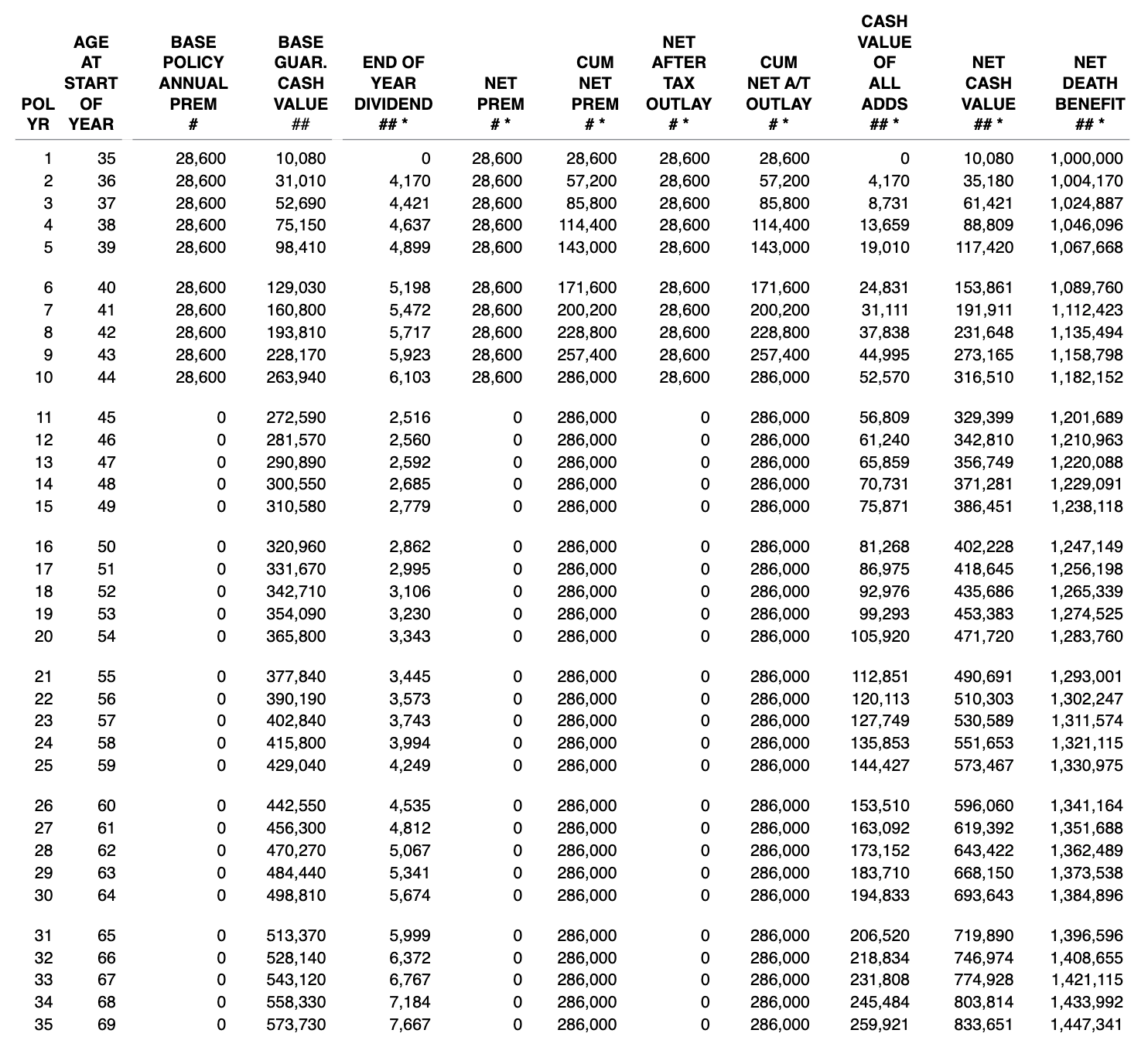
Because the underlying policy becomes fully paid up after the limited pay period ends (e.g., after 10 or 20 years), the owner never owes another dollar out-of-pocket. However, the existing pool of cash value continues to receive guaranteed growth plus non-guaranteed dividends every year for life.
Because the policy retains non-MEC status, this compounding cash value can be borrowed against tax-free at age 40, 60, or 80 to fund business ventures, real estate investments, or retirement income—an advantage unavailable with a single premium MEC policy.
When Might a Single Premium or Pre-Pay Make Sense?
While limited pay whole life insurance is the superior vehicle for cash accumulation, liquidity, and active wealth building, there are niche scenarios where alternative structures serve a specific purpose.
Estate Planning and Pure Wealth Transfer
If an individual’s primary goal is to transfer a fixed lump sum of wealth to heirs tax-free upon death, and they have zero intention of ever accessing or borrowing the policy cash value during their lifetime, a Single Premium Whole Life policy can work.
- The contract immediately converts a cash lump sum into a larger, guaranteed, income-tax-free death benefit.
- Because the policyholder will never take loans or withdrawals, the MEC tax penalties on lifetime distributions become irrelevant.
Substandard Health or Advanced Age
For older individuals or those with severe health impairments who cannot qualify for multi-year underwriting commitments, a single premium policy or simplified-issue SPWL contract can lock in immediate coverage without ongoing payment obligations.
Automated Windfall Management
If a real estate investor or business owner receives a sudden, massive lump-sum payout (e.g., from a business sale) and wants to automate a 7-pay policy without managing annual transfers, a Premium Deposit Account can serve as a convenience mechanism. However, even in this scenario, structuring the underlying contract as a 7-pay or 10-pay non-MEC limited pay policy remains critical. The minor tax drag on the side deposit account is generally preferable to destroying lifetime cash liquidity with a single premium MEC.
How to Structure a Limited Pay Whole Life Policy for Maximum Efficiency
To maximize the benefits of a limited pay whole life policy over single premium or pre-pay alternatives, structure the policy with an experienced mutual insurance professional.
- Optimal Limited Pay Structure
- 10-Pay Non-MEC Policy Blend
- 10-30% Base Whole Life
- Guaranteed Foundation
- Long-Term Dividends
- 70-90% PUA Rider Blend
- High Early Cash Value
- Maximal Tax Efficiency
- 10-30% Base Whole Life
- 10-Pay Non-MEC Policy Blend
1. Select the Right Pay Period
- 7-Pay / 10-Pay Policies: Best for rapid cash accumulation, short funding windows, and individuals looking to optimize early liquidity.
- Pay-to-65 / 20-Pay Policies: Best for spreading out cash commitments over a career, creating lower annual required outlays while maintaining high long-term death benefit growth.
2. Optimize the Base-to-PUA Ratio
Request a illustration that blends the contract using a low base premium (10% to 30%) and a high PUA rider allocation (70% to 90%). This design:
- Minimizes insurance agent commissions.
- Maximizes initial cash value access (often 85%–90%+ of Year 1 premiums are immediately available as liquid cash value).
- Keeps cumulative premiums strictly below the IRS 7-pay limit to protect non-MEC status.
3. Choose a Participating Mutual Carrier
Ensure the policy is issued by a major mutual insurance company (owned by policyholders rather than public shareholders) with a proven history of paying annual dividends for over 100 consecutive years. Dividend performance is essential for accelerating the cash value growth of a limited pay contract.
Frequently Asked Questions
Why does a single premium whole life policy fail the 7-Pay Test?
A single premium whole life policy pays 100% of the lifetime premium upfront in a single installment. Under IRC Section 7702A, the IRS limits the amount of capital that can be deposited into a life insurance contract during its first seven years relative to its death benefit. Funding the policy in one lump sum exceeds these statutory limits, causing it to fail the 7-Pay Test and automatically classified as a Modified Endowment Contract (MEC).
Can I turn a limited pay whole life policy into a MEC by accident?
Yes. If you pay extra cash into the policy through Paid-Up Additions (PUA) riders that exceed the IRS 7-pay annual threshold, or if you reduce the policy's face amount (death benefit) during the first seven years, the contract can trigger MEC status. Top-tier mutual life insurance companies monitor these limits automatically and notify you before accepting payments that would violate 7-pay rules.
How does interest earned in a Premium Deposit Account (PDA) get taxed?
Interest earned on funds held within a Premium Deposit Account is considered taxable ordinary income in the year it is credited. The insurance company issues a Form 1099-INT to the policyholder annually. This creates a minor tax drag on unapplied deposit funds before they are transferred into the life insurance policy.
Are policy loans from a limited pay whole life policy taxable?
No. As long as the limited pay policy maintains its non-MEC status and remains active (does not lapse with an outstanding loan balance exceeding cost basis), policy loans are treated as tax-free distributions under IRC Section 72(e), regardless of the policyholder's age.
Is a 10-pay policy better than a single premium policy for Infinite Banking (IBC)?
Yes. Strategies like the Infinite Banking Concept rely entirely on taking tax-free policy loans against cash value to finance external assets or investments. Because a single premium policy is a MEC, loans are subject to income taxes and potential 10% penalties. A 10-pay policy maintains non-MEC status, preserving tax-free borrowing privileges.
Final Recommendation and Action Steps
Choosing between policy structures comes down to protecting your capital's flexibility and tax status. While single premium policies offer simplicity, they permanently sacrifice tax-free policy access by triggering MEC classification. Pre-pay accounts attempt to bypass this limitation, but introduce annual tax drag on side-account interest and rigid administrative rules.
To execute an optimal policy design:
- Work with an independent specialist: Request customized illustrations from top mutual carriers focusing on non-MEC 7-pay or 10-pay whole life contracts.
- Blend with PUA riders: Require a high Paid-Up Additions allocation to ensure early cash liquidity while maintaining a low baseline premium commitment.
- Verify non-MEC headroom: Confirm that your planned contribution schedule leaves safety margin below the statutory 7-pay limit set by IRC Section 7702A.
By utilizing a properly structured limited pay whole life policy, you secure long-term guaranteed compounding, lifetime death benefit protection, and tax-free access to your cash value whenever opportunity calls.
Image Gallery