Why the History of the FFA Creed Matters for Agricultural Education and Leadership
The history of the FFA Creed matters because it reflects the evolving values, technology, and scope of American agriculture while serving as a foundational leadership guide for generations of students. Written during the dawn of modern...
The history of the FFA Creed matters because it reflects the evolving values, technology, and scope of American agriculture while serving as a foundational leadership guide for generations of students. Written during the dawn of modern vocational education, the Creed anchors youth leadership in ethics, hard work, stewardship, and community, adapting across decades to remain relevant to a diverse agricultural industry.
Contents
Understanding how and why the FFA Creed was created—and how it was subsequently revised—provides vital context for agricultural educators, students, industry leaders, and policy advocates. The Creed is not merely a piece of text to be memorized for competitions; it is a historical document that outlines the philosophical shifts of career and technical education (CTE) in the United States.
The Origins of the FFA Creed: E.M. Tiffany and the Birth of a Movement
The National FFA Organization (originally Future Farmers of America) was established in 1928 to prepare young men for careers in agriculture. During this pivotal period in American education, vocational training was expanding rapidly following the passage of the Smith-Hughes National Vocational Education Act of 1917. As rural youth organized into local and state agricultural clubs, the need arose for a unifying statement of purpose and ideals.
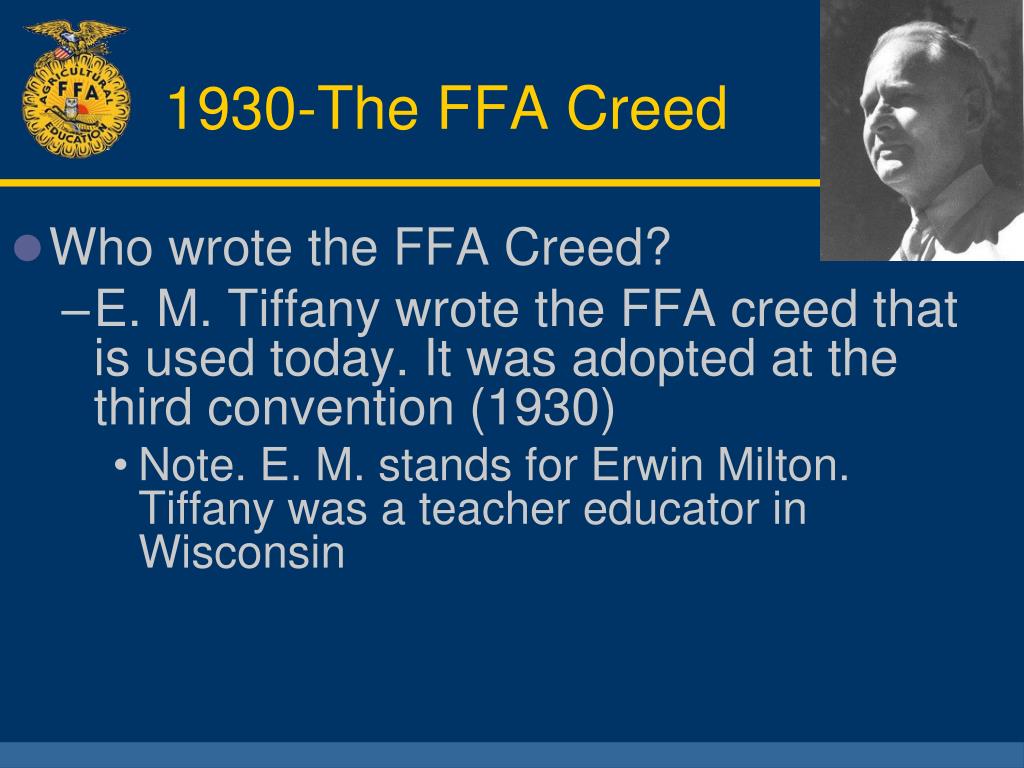
In 1928, Erwin Milton Tiffany (E.M. Tiffany), a professor of agricultural education at the University of Wisconsin–Madison, authored a five-paragraph statement that articulated the core beliefs of agricultural youth. Tiffany designed the text to capture the dignities, challenges, and high aspirations of life connected to the land. Each of the five paragraphs begins with the powerful declaration, "I believe."
The national organization officially adopted the Creed at the 3rd National FFA Convention in Kansas City, Missouri, in 1930. At the time of its adoption, rural America was facing severe economic strains brought on by agricultural depression and the early days of the Great Depression. Tiffany’s text resonated deeply because it offered hope, rooted in personal agency, technological progress, and ethical stewardship.
The Five-Paragraph Structure
The FFA Creed is structured around five core pillars:
- Faith in the future of agriculture: Acknowledging the tradition of farm life while committing to technological and scientific advancement.
- Pride in agricultural living: Recognizing that honest work in agriculture yields essential sustenance and personal satisfaction.
- Leadership and respect: Committing to self-reliance, leadership, and mutual respect among producers and community members.
- Stewardship and fairness: Balancing personal profit with ethical dealings and public service.
- Inspiring trust and national strength: Asserting that agricultural leadership contributes directly to the stability and prosperity of the nation.
Historical Revisions: How the Creed Evolved Over Time
A common misconception is that the FFA Creed has remained entirely unchanged since 1928. In reality, the delegates of the National FFA Convention have formally revised the text twice—at the 38th National FFA Convention in 1965 and the 63rd National FFA Convention in 1990. These revisions demonstrate that while the core ethics of agriculture remain stable, the scope, language, and membership of agricultural education must evolve alongside society.
- 1928: E.M. Tiffany drafts the Creed
- 1930: Adopted at 3rd National Convention
- 1965: First Revision (38th Convention)
- Reflected modernization of agricultural practices
- 1990: Second Revision (63rd Convention)
- Shifted "farm" to "agriculture"
- Adopted gender-neutral, inclusive language
The 1965 Revision: Modernizing Technical Scope
By the mid-1960s, post-World War II technology had revolutionized American food production. Mechanization, hybrid seed technology, synthetic fertilizers, and computerized management altered how farms operated. The 1965 revision updated specific phrases to reflect modern efficiency and technological progress rather than reliance solely on manual labor.
The 1990 Revision: Inclusivity and Industry Expansion
The 1990 revision marked a transformative milestone in FFA history. The organization had officially opened its national membership to female students in 1969, and by 1988, the delegate body voted to change the organization's official name from "Future Farmers of America" to the "National FFA Organization." This shift acknowledged that agriculture encompasses agribusiness, agronomy, veterinary science, food safety, engineering, and environmental management—not just production farming.
During the 63rd Convention in 1990, delegates updated the Creed to reflect this broader definition:
- Expanding Scope: The word "farm" or "farming" was replaced in key sections with "agriculture" or "agricultural industry," opening the Creed’s identity to urban, suburban, and non-traditional students.
- Gender Neutrality: Gender-specific terms (such as "his") were replaced with inclusive language, affirming that leadership in agriculture belongs equally to all members regardless of gender.
Key Revisions in the FFA Creed
The following table summarizes the structural evolution of the FFA Creed across its three distinct historical eras:
| Era / Event | Primary Objective | Key Textual Changes | Impact on Agricultural Education |
|---|---|---|---|
| 1930 Adoption (3rd Convention) | Establish a baseline national identity for rural vocational youth | Original text by E.M. Tiffany emphasizing rural life and farm work | Unified local agricultural clubs into a national movement with shared moral values. |
| 1965 Revision (38th Convention) | Align text with post-war agricultural modernization | Updated phrases around agricultural efficiency, labor, and technology | Recognized that science and industrial management were central to modern food systems. |
| 1990 Revision (63rd Convention) | Refine language for diversity, equity, and broad industry scope | Replaced "farm" with "agriculture"; removed gendered pronouns | Welcomed non-traditional, urban, and female students into career and technical leadership. |
Why Understanding the History of the FFA Creed Matters Today
Studying the history of the FFA Creed yields practical insights for educators, students, and leaders across career and technical fields. Rather than treating the text as an static historical artifact, analyzing its development provides three distinct educational advantages.
1. It Proves Agriculture Is an Evolving Industry
Many students enter agricultural education believing the field is restricted to traditional row-crop farming or livestock production. The history of the Creed proves that the industry has continuously broadened its identity. Tracking how the text transitioned from "farming" to "agriscience, technology, and natural resources" helps students recognize that career pathways in agriculture include policy, robotics, biochemistry, supply chain logistics, and environmental stewardship.
2. It Demonstrates the Power of Inclusive Leadership
The 1990 revisions highlight how national organizations can adapt to serve diverse student demographics without compromising their fundamental principles. By understanding why gender-inclusive language and broader industry definitions were integrated, students learn that true leadership requires removing barriers to entry and recognizing the contributions of every practitioner.
3. It Teaches Public Speaking through Critical Analysis
The FFA Creed Speaking Career Development Event (CDE) is one of the premier competitive events for middle and early high school members (typically grades 7–9). Students are required to recite the Creed from memory and answer complex questions from a panel of judges regarding its meaning.
When students understand the historical background of E.M. Tiffany’s writing and the context behind the 1965 and 1990 revisions, their answers demonstrate depth, original thought, and historical awareness rather than simple memorization.
Creed Memorization + Historical Context = Superior Performance in Creed Speaking CDEs
Practical Application: Teaching and Deconstructing the Creed
For agricultural educators and FFA advisors, teaching the Creed's history can transform classroom engagement. Instead of assigning simple recitation drills, instructors can implement structured historical analysis.
Step 1: Comparative Text Analysis
Provide students with copies of the 1930 original text alongside the current official version. Direct them to highlight words that were replaced, added, or removed.
Step 2: Contextual Inquiry
Prompt students to research what was occurring in American society during 1928, 1965, and 1990:
- What economic conditions shaped E.M. Tiffany's worldview in 1928?
- How did the Civil Rights Movement and the admission of women to FFA in 1969 influence the 1990 delegate vote?
- How did mechanical and technological innovations between 1930 and 1965 change the physical reality of farm labor?
Step 3: Modern Reinterpretation
Ask students to explain how specific phrases apply to contemporary challenges, such as global food security, climate resilience, water conservation, and agricultural technology. For example, when evaluating the phrase "in the promise of better days through better ways," students can discuss autonomous farming machinery, indoor vertical farming, or gene-editing technology.
Frequently Asked Questions
Who wrote the original FFA Creed, and when was it created?
Erwin Milton Tiffany (E.M. Tiffany), a professor of agricultural education at the University of Wisconsin–Madison, wrote the original Creed in 1928. It was officially adopted by the National FFA Organization at its 3rd National Convention in 1930.
How many times has the FFA Creed been revised?
The FFA Creed has been revised twice by voting delegates at the National FFA Convention: first at the 38th Convention in 1965, and again at the 63rd Convention in 1990.
Why was the wording changed from "farm" to "agriculture" in 1990?
The delegates changed the text to reflect the changing scope of the industry. Agriculture encompasses science, business, engineering, natural resources, and processing—not just traditional production farming. Changing the term ensured the Creed resonated with suburban, urban, and non-farming students.
What is the FFA Creed Speaking Career Development Event (CDE)?
The FFA Creed Speaking CDE is a competitive public speaking event designed for FFA members in 7th, 8th, and 9th grades. Contestants memorize and recite the FFA Creed and answer three questions posed by judges to test their understanding of its principles, history, and real-world application.
Where can I find official historical records of National FFA Conventions?
Official proceedings, historical records, and archived documents regarding convention votes and Creed revisions are maintained by the National FFA Organization and accessible through the National FFA Historical Archives.
Next Steps for Educators and Students
To put the history of the FFA Creed into practice:
- Download Official Archives: Review the historical documentation of convention proceedings provided by state FFA associations or the National FFA Organization.
- Integrate Comparative Lesson Plans: Incorporate the 1930 vs. 1990 comparative exercise into early career-exploration units for agricultural education courses.
- Prepare CDE Competitors with History: When training students for the Creed Speaking contest, devote specific practice sessions to historical background questions, ensuring students can articulate why revisions occurred.
Image Gallery