How Memorization Techniques Help Students Succeed in Academic Environments
Memorization techniques serve as the cognitive foundation for academic success by transforming raw information into durable, retrievable knowledge. By employing evidence-based strategies like spaced repetition, active recall, and mnemo...
Memorization techniques serve as the cognitive foundation for academic success by transforming raw information into durable, retrievable knowledge. By employing evidence-based strategies like spaced repetition, active recall, and mnemonic devices, students can bypass the limitations of rote learning, reduce cognitive load during high-stakes testing, and build the long-term conceptual frameworks necessary for mastery across complex subjects.
Contents
The Science of Cognitive Encoding
Academic success is rarely a matter of raw intelligence; it is a matter of efficient information management. The brain naturally prioritizes information that it perceives as "meaningful" or "frequently accessed." Memorization techniques are, at their core, methods to signal to the brain that specific data—whether it be historical dates, mathematical formulas, or scientific nomenclature—is worthy of long-term storage rather than ephemeral discard.
When students rely on passive review, such as re-reading textbooks or highlighting passages, they often fall victim to the "illusion of competence." This occurs when the familiarity of the text is mistaken for actual mastery. Conversely, deliberate memorization techniques force the brain to engage in deeper cognitive processing. This process, often referred to as "elaborative rehearsal," connects new information to existing neural pathways, making the data easier to stabilize in long-term memory.
Core Techniques for Effective Retention
To move beyond basic memorization, students should adopt a multi-faceted approach. No single technique is universally effective; rather, the combination of these methods creates a robust system for academic advancement.
1. Active Recall
Active recall involves testing oneself rather than simply reviewing study materials. Instead of looking at a flashcard and reading the answer immediately, a student should force themselves to articulate the information from memory. This process of retrieval strengthens the neural connection associated with that piece of information. Research in educational psychology consistently shows that the act of struggling to retrieve information is exactly what makes the memory stronger for future use.
2. Spaced Repetition Systems (SRS)
The "forgetting curve," first proposed by Hermann Ebbinghaus, illustrates how quickly information is lost if it is not revisited at optimal intervals. Spaced repetition counteracts this by scheduling reviews at increasingly long intervals. As a student becomes more proficient with a specific fact, the interval between reviews increases. In 2026, many students utilize digital software platforms that automate this scheduling, ensuring they spend their study time only on the information they are most likely to forget.
3. Mnemonic Devices and Method of Loci
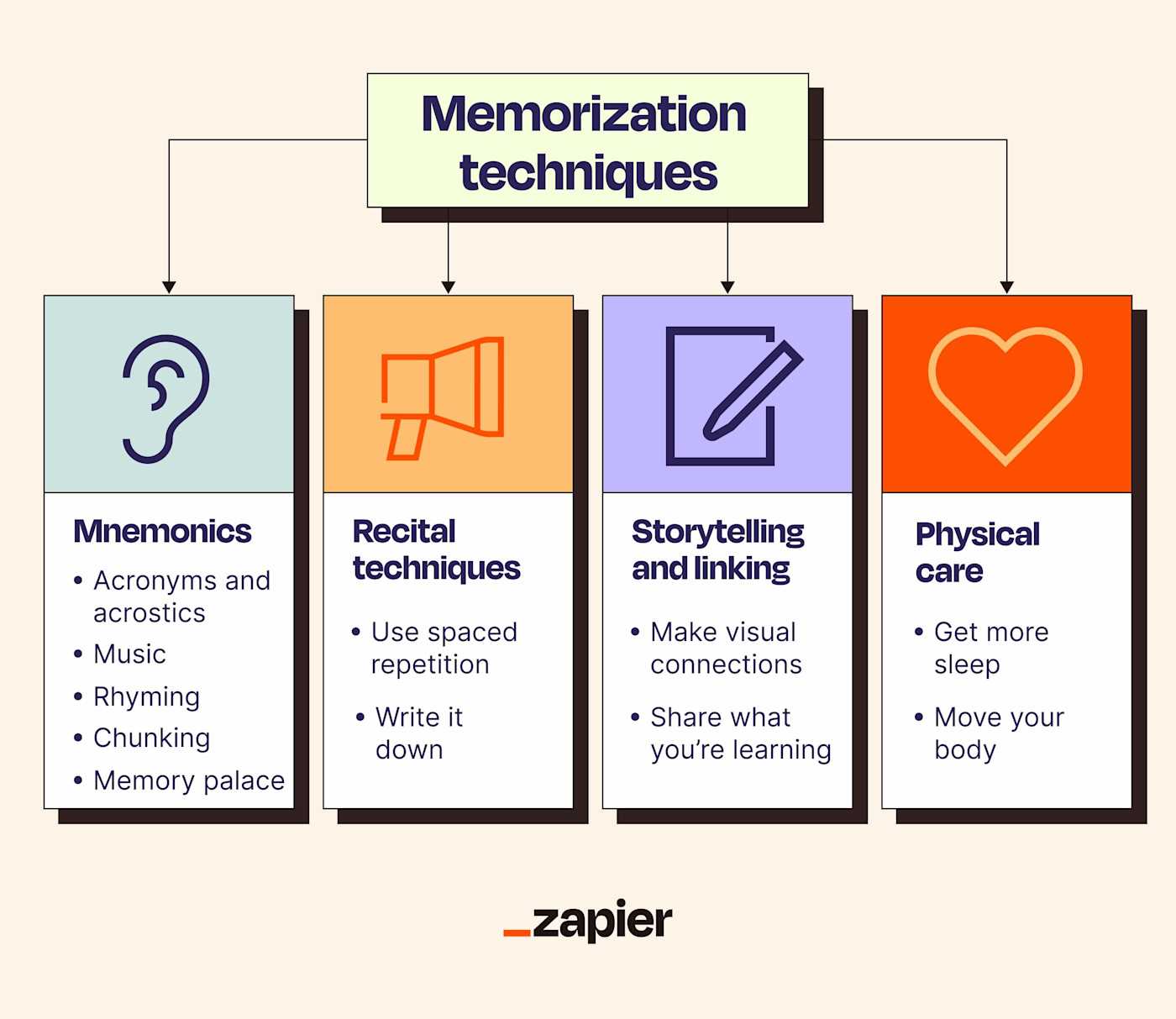
Mnemonics are memory aids that associate complex data with easier-to-remember patterns. The "Method of Loci," or memory palace, is a sophisticated version of this where students visualize a familiar physical space and "place" pieces of information along a path. When they need to recall the information during an exam, they mentally walk through the room, picking up the items as they go. This taps into the brain’s highly evolved spatial memory, which is often far more reliable than abstract verbal memory.
Comparing Memorization Strategies
| Technique | Primary Benefit | Ideal Use Case |
|---|---|---|
| Active Recall | Strengthens neural pathways | Concept definitions, complex processes |
| Spaced Repetition | Prevents the forgetting curve | Vocabulary, language learning, dates |
| Method of Loci | Enhances serial recall | Lists, sequential steps, long speeches |
| Chunking | Reduces cognitive load | Phone numbers, sequences, formulas |
| Interleaving | Promotes deep learning | Mixed-topic exams, problem-solving |
Bridging Memorization and Conceptual Mastery
A common critique of "memorization" is that it is the antithesis of "understanding." This is a false dichotomy. In practice, memorization provides the building blocks for critical thinking. For instance, a student cannot analyze the complexities of a geopolitical event if they have not memorized the names of the involved nations, the chronologies of the treaties, or the definitions of the governing ideologies.
By automating the retrieval of foundational facts, students free up their working memory to perform higher-order tasks such as synthesis, evaluation, and creative application. When the "basics" become second nature, the student’s mind is no longer occupied with remembering the terminology, allowing them to focus entirely on the broader argument or the underlying logical structure of the curriculum.
Managing Cognitive Load and Avoiding Burnout
Memorization is mentally taxing. Effective students recognize that their brain is a biological organ with physical limits. Attempting to cram large volumes of information into a single session—"massed practice"—leads to diminishing returns and rapid fatigue.
By integrating these techniques into a consistent, daily study schedule, students maintain a manageable "cognitive load." This prevents the stress associated with last-minute preparation and fosters a sense of autonomy. Furthermore, when students successfully master a difficult topic through these techniques, they develop a sense of "academic self-efficacy." This confidence is a significant predictor of continued success, as students who believe they have the tools to learn any subject are more likely to persist through challenging academic hurdles.
Troubleshooting Common Challenges
Students often feel discouraged when they struggle to remember specific types of information. It is important to note that memory is context-dependent. If a technique is failing, it is usually because the student is attempting to force information into their memory without sufficient "hooking."
- The "meaningless" data problem: If the information lacks inherent logic, such as a long string of technical codes, use "acronyms" or "acrostics" to create artificial structure.
- The "distraction" factor: Memorization requires high-intensity focus. Attempting to memorize while multitasking is scientifically inefficient. If focus is a barrier, break study sessions into 25-minute blocks (often called the Pomodoro Technique) to ensure the brain is fully engaged during the retrieval process.
- Verification: If you are unsure if you have memorized something, test it in a different environment or a different context. If you can only explain the concept while looking at your notes, you have not yet achieved true memorization.
Frequently Asked Questions
Is memorization still relevant in the age of generative AI? Yes. While digital tools can store information, they cannot replace the internal cognitive network required for rapid problem-solving. True expertise requires immediate access to a "database" of knowledge in your own mind, which allows for spontaneous innovation and critical analysis during discussions or examinations.
How long should a typical memorization session last? For most students, 20 to 45 minutes of intense, active study is the optimal duration. Anything longer than this without a break usually results in a decrease in the quality of encoding. Use the remaining time in your study period to switch to a different subject or to perform non-cognitive tasks to allow the brain to consolidate the information.
What is the best way to memorize complex scientific formulas? Do not try to memorize the formula by rote. Instead, memorize the derivation. If you understand the logical steps of how a formula is built, you do not need to memorize the final string of characters; you can reconstruct the formula whenever you need it.
Can these techniques be applied to humanities subjects? Absolutely. In history or literature, the "facts" are dates, themes, and character motivations. Using active recall to test your understanding of why a character made a specific choice—rather than just memorizing the choice itself—is an effective way to master the material while also deepening your analytical capabilities.
Next Steps for Students
To begin, identify one specific course or subject that you currently find overwhelming. Instead of re-reading your notes, create a set of questions based on your learning objectives. Spend the next week applying active recall to these questions, and use a simple tracking system to monitor which facts you struggle to retain. By isolating the information you find difficult and subjecting it to spaced repetition, you will likely see a measurable improvement in your confidence and your exam results within 14 days.
Image Gallery