Understanding the Zillow Zestimate: A Comprehensive Guide to Home Valuations in 2026
The Zillow Zestimate is a sophisticated, computer-generated tool that provides an estimated market value for millions of homes across the United States. Utilizing a proprietary formula that incorporates public records, user-submitted d...
The Zillow Zestimate is a sophisticated, computer-generated tool that provides an estimated market value for millions of homes across the United States. Utilizing a proprietary formula that incorporates public records, user-submitted data, and advanced machine learning models, the Zestimate serves as a preliminary research point for buyers, sellers, and homeowners. It is designed to offer a snapshot of a property’s potential worth in the current 2026 market, though it is not a substitute for a professional appraisal or a comparative market analysis (CMA) provided by a licensed real estate agent.
Contents
Understanding the Zestimate requires a deep dive into the technology behind the number, the factors that influence its fluctuations, and the critical distinctions between a digital estimate and a physical appraisal. As the real estate landscape continues to evolve in 2026, Zillow’s algorithm has become increasingly nuanced, integrating hyper-local economic indicators and high-resolution visual data to refine its accuracy.
The Evolution and Technology of the Zestimate Algorithm
By 2026, the Zestimate has moved far beyond the simple statistical regression models of its early years. Today, it functions as a highly integrated neural network. The algorithm processes billions of data points daily to determine the value of more than 100 million homes.
Machine Learning and Neural Networks
Zillow’s current valuation engine uses a distributed computing framework that allows it to "learn" from historical sales data. In 2026, the model places a higher emphasis on neural networks, which can identify complex patterns that traditional models might miss. For instance, the system can now better account for "seasonal premiums" or the specific impact of a new school district boundary change faster than ever before.
Computer Vision Integration
One of the most significant advancements in the Zestimate’s accuracy involves computer vision. When homeowners or agents upload photos to Zillow, the algorithm analyzes these images to assess the quality of the interior. It can distinguish between a kitchen with dated laminate countertops and one featuring high-end quartz or marble. This "visual intelligence" allows the Zestimate to adjust values based on the apparent condition and finish of the home, narrowing the gap between a digital estimate and an on-site inspection.
Key Data Sources Powering the Valuation
The Zestimate does not exist in a vacuum; it is the product of diverse and massive datasets. To understand your home's valuation, you must understand the "ingredients" Zillow uses:
- Public Records: This remains the bedrock of the Zestimate. Zillow pulls data from county tax assessor offices, including prior sale prices, property tax assessments, and deed transfers.
- Multiple Listing Service (MLS) Data: For homes currently on the market, Zillow has access to real-time data including list price, days on market, and price drops.
- User-Submitted Updates: Homeowners have the power to "claim" their home on Zillow. By updating facts—such as a finished basement, a new roof, or an additional bathroom—owners provide the algorithm with data that may not yet be reflected in public records.
- Market Signals: In 2026, the algorithm tracks macro-economic trends, such as local inventory levels, mortgage rate fluctuations, and even proximity to new transit hubs or major employment centers.
Accuracy Rates: On-Market vs. Off-Market
A common point of confusion is why a Zestimate might seem remarkably accurate for one home but wildly "off" for another. The answer usually lies in the property's listing status.
On-Market Accuracy
When a home is listed for sale, the Zestimate becomes significantly more precise. This is because the algorithm can leverage the listing price and the immediate reaction of the market. According to Zillow’s own data, the median error rate for on-market homes is frequently below 2%. This means half of the Zestimates are within 2% of the final selling price.
Off-Market Accuracy
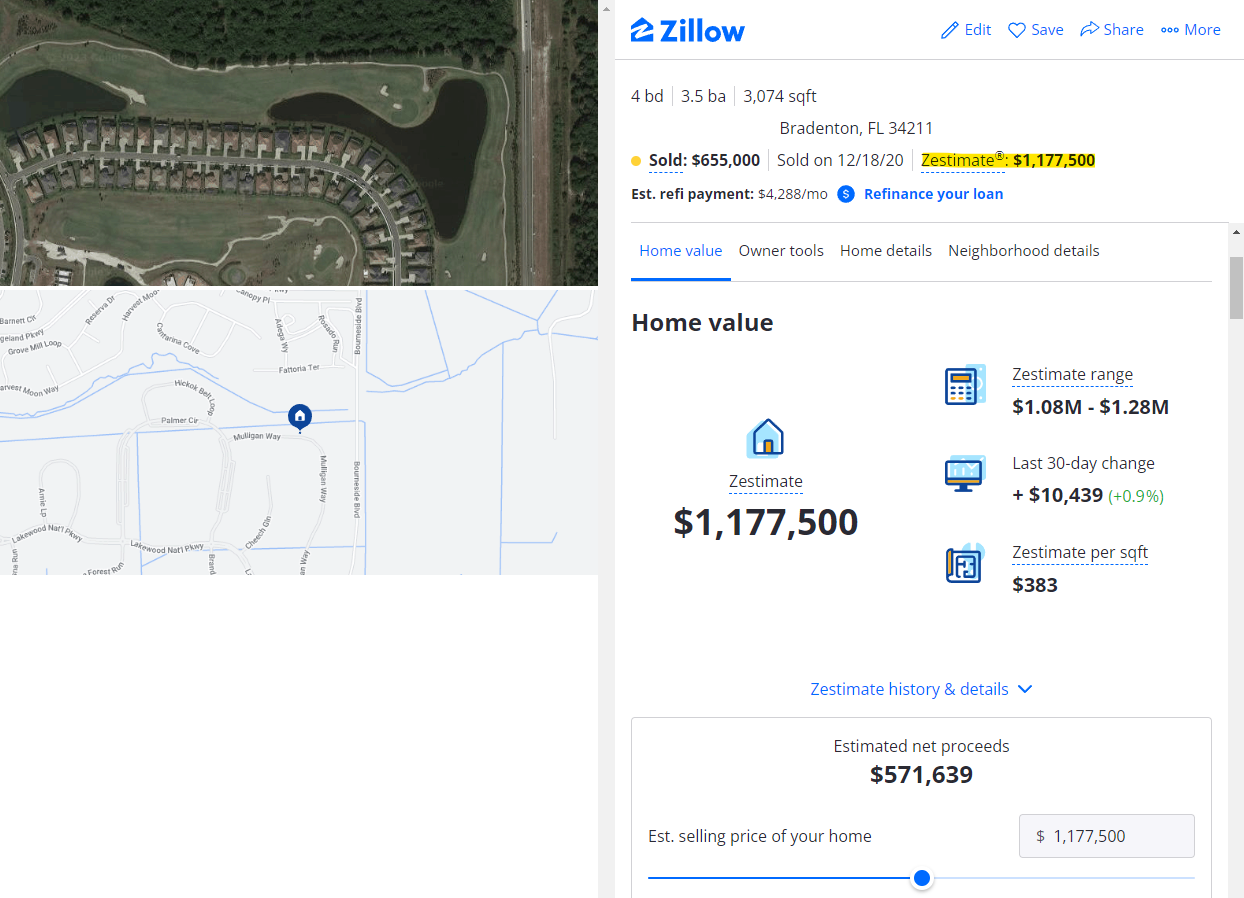
For homes not currently for sale, the median error rate is typically higher—often ranging between 6% and 8%. Without a recent listing or a "price discovery" process, the algorithm must rely more heavily on older public records and "comps" (comparable sales) in the neighborhood. If a neighbor’s home sold for a low price due to a divorce or a quick cash sale, it might inadvertently pull down your off-market Zestimate until more data points normalize the average.
Zestimate vs. Appraisal vs. CMA: Key Differences
It is a common mistake to use the terms "valuation," "estimate," and "appraisal" interchangeably. In 2026, the distinctions are more important than ever for financial planning.
| Feature | Zillow Zestimate | Professional Appraisal | Comparative Market Analysis (CMA) |
|---|---|---|---|
| Primary Goal | Instant market snapshot | Official value for lending | Strategic pricing for sale |
| Data Source | Algorithm & Public Records | Physical Inspection & Comps | Local Agent Expertise & MLS |
| Cost | Free | $400 - $800+ | Usually Free (from an agent) |
| Legality | Not for mortgage lending | Required for most loans | For marketing/listing only |
| Inspection | None (Digital only) | Comprehensive interior/exterior | Walk-through by agent |
Why the Zestimate Isn't an Appraisal
A professional appraiser, licensed by the state, performs a physical walkthrough of the property. They check for structural integrity, code violations, and specific upgrades that a satellite image or a tax record cannot capture. Banks and mortgage lenders require a professional appraisal to justify the loan amount. A Zestimate is a useful tool for a homeowner to track their equity, but it cannot be used to secure a mortgage or a home equity line of credit (HELOC).
How to Improve the Accuracy of Your Home’s Estimate
If you believe your Zestimate is too low (or even too high), you are not powerless. Zillow provides tools for homeowners to refine the data.
Claim Your Home
The first step is to "Claim Your Home" on the Zillow platform. This verifies you as the owner and gives you access to the property's "edit" dashboard. Once verified, you can ensure that the basic facts—square footage, number of bedrooms, and lot size—are correct. Errors in these fundamental fields are the leading cause of inaccurate Zestimates.
Update Home Facts and Features
The algorithm reacts to specific "value-add" features. In 2026, make sure to check boxes for:
- Energy-efficient upgrades: Solar panels, smart thermostats, and EV charging stations.
- Recent Renovations: Mentioning a kitchen remodel or a bathroom update.
- Amenities: Features like a pool, a finished garage, or a high-end security system.
Market Context and "Comps"
While you cannot manually change the Zestimate number, updating your home's facts often triggers a recalculation. If the algorithm sees that your home has 2,500 square feet instead of the 2,000 listed in old tax records, the Zestimate will likely adjust upward to match similar-sized homes in your area.
Common Pitfalls and Misconceptions
Despite its sophistication, the Zestimate has limitations that users must acknowledge to avoid financial frustration.
The "Lag" Factor
Public records are not updated instantly. When a home sells, it can take weeks or even months for the county to record the deed and for Zillow’s crawlers to ingest that data. During periods of rapid price appreciation or depreciation, the Zestimate may lag behind the actual "street" price of homes.
Neighborhood Anomalies
Algorithms struggle with "outlier" properties. If your home is the only mid-century modern house in a neighborhood of Victorian-style homes, or if your lot is twice the size of your neighbors’, the Zestimate may struggle to find appropriate comparisons. This "homogeneity bias" means the Zestimate is most accurate in subdivisions where homes are relatively similar.
The "Listing Effect"
Sometimes, the act of listing a home for a specific price causes the Zestimate to jump or drop to align with the list price. This is not necessarily the algorithm "cheating"; rather, it is the model incorporating the most recent, expert-vetted data point available: the price an owner and their agent believe the market will bear.
Practical Advice for Homeowners and Buyers in 2026
If you are looking at a Zestimate today, use it as one of several data points. For buyers, the Zestimate can help identify if a home is priced significantly above the neighborhood average, signaling a need for deeper investigation. For sellers, it provides a "first impression" that most potential buyers will see, making it vital to ensure the property facts are accurate before hitting the market.
Professional Limitation: This guide provides general information regarding digital home valuations. Real estate markets are subject to local laws and economic volatility. Always consult with a licensed real estate professional or a certified appraiser for valuations intended for legal, tax, or lending purposes. For official guidelines on property appraisals, visit the Appraisal Institute.
Frequently Asked Questions
Can I hide my Zestimate from the public?
While you cannot easily "delete" a Zestimate from Zillow’s database because it is based on public records, you can sometimes "hide" the property's listing if it is not for sale. However, the valuation itself is considered a public-interest data point. If you find the Zestimate is causing issues, the best course of action is to update the home facts to ensure it is as accurate as possible.
Why did my Zestimate drop suddenly when no changes were made?
Zestimates fluctuate based on the market, not just your specific home. If a nearby home similar to yours sold for a "distress price" (like a foreclosure or a short sale), the algorithm might interpret that as a decline in the overall neighborhood value. Additionally, if local inventory increases significantly, the reduced scarcity can lead the model to lower its valuation.
Is the Zestimate used for calculating property taxes?
No. Local municipalities use their own assessment models to determine property taxes. While both may use similar public records, the tax assessor’s value is often a percentage of market value and follows a different legal schedule. Your Zestimate has no direct impact on your tax bill.
How often does Zillow update the Zestimate?
Zillow updates its valuations for most homes daily. However, the most significant shifts occur when new sales data is processed from the county or when a homeowner updates their property profile. If you have just updated your home facts, it may take 24 to 48 hours for the new Zestimate to reflect those changes.
Does Zillow's algorithm account for school rankings?
Yes. By 2026, the Zestimate algorithm heavily weights "location-based desirability," which includes proximity to highly-rated schools. Since school ratings are often a primary driver for buyer demand, the algorithm sees the correlation between school boundaries and higher sales prices, incorporating that into the final estimate.
Image Gallery