Gang Signs with Hands: Identification, Origins, and Public Safety Risks
Gang signs with hands—often referred to as "stacking," "throwing up," or "flashing" signs—are physical gestures used by street gangs to communicate affiliation, declare territory, issue commands, and challenge rivals. Originating as ta...
Gang signs with hands—often referred to as "stacking," "throwing up," or "flashing" signs—are physical gestures used by street gangs to communicate affiliation, declare territory, issue commands, and challenge rivals. Originating as tactical, nonverbal signaling systems, these gestures are analyzed by criminologists and law enforcement to assess street dynamics, track conflicts, and evaluate community threat levels.
Contents
Street gangs use nonverbal kinesics to circumvent verbal monitoring by rival factions and correctional officers. While popular media often caricatures these movements, real-world gang hand gestures carry high-stakes consequences within illicit subcultures. Misinterpreting, casually mimicking, or displaying these physical codes in public environments creates genuine safety hazards. Understanding the origins, mechanics, and legal ramifications of hand signs provides vital context for educators, community workers, and public safety personnel.
The Semiotics and Mechanics of Hand Signs
In criminology and sociology, gang hand signs fall under nonverbal semiotics—structured systems of symbolic communication using fingers, wrists, and palms. These physical displays are rarely random. They follow specific syntactic rules developed over decades within individual criminal organizations.
The Mechanics of Stacking and Flashing
Gang gestures typically rely on three physical methods of communication:
- Static Posturing (Flashing): A single, sustained hand shape held in place to signal identity or warn an approaching party. This is common when entering contested territory or marking physical presence in photos or surveillance frames.
- Sequential Motion (Stacking): A rapid, fluid sequence of distinct hand shapes performed in quick succession. Much like digital alphanumeric code, stacking spells out specific sets, geographic zip codes, deceased members' initials, or violent intent against a rival.
- Inversion and Degradation ("Cracking" or "Dropping"): Inverting, breaking, or bending a rival gang's established hand sign downward. In street subculture, physically twisting or dropping an opponent's symbol represents a direct, often lethal insult intended to provoke an immediate physical altercation.
Alphanumeric Transliteration
The majority of street-level hand signs translate standard Roman letters or Arabic numerals into finger configurations. Gang sets frequently encode:
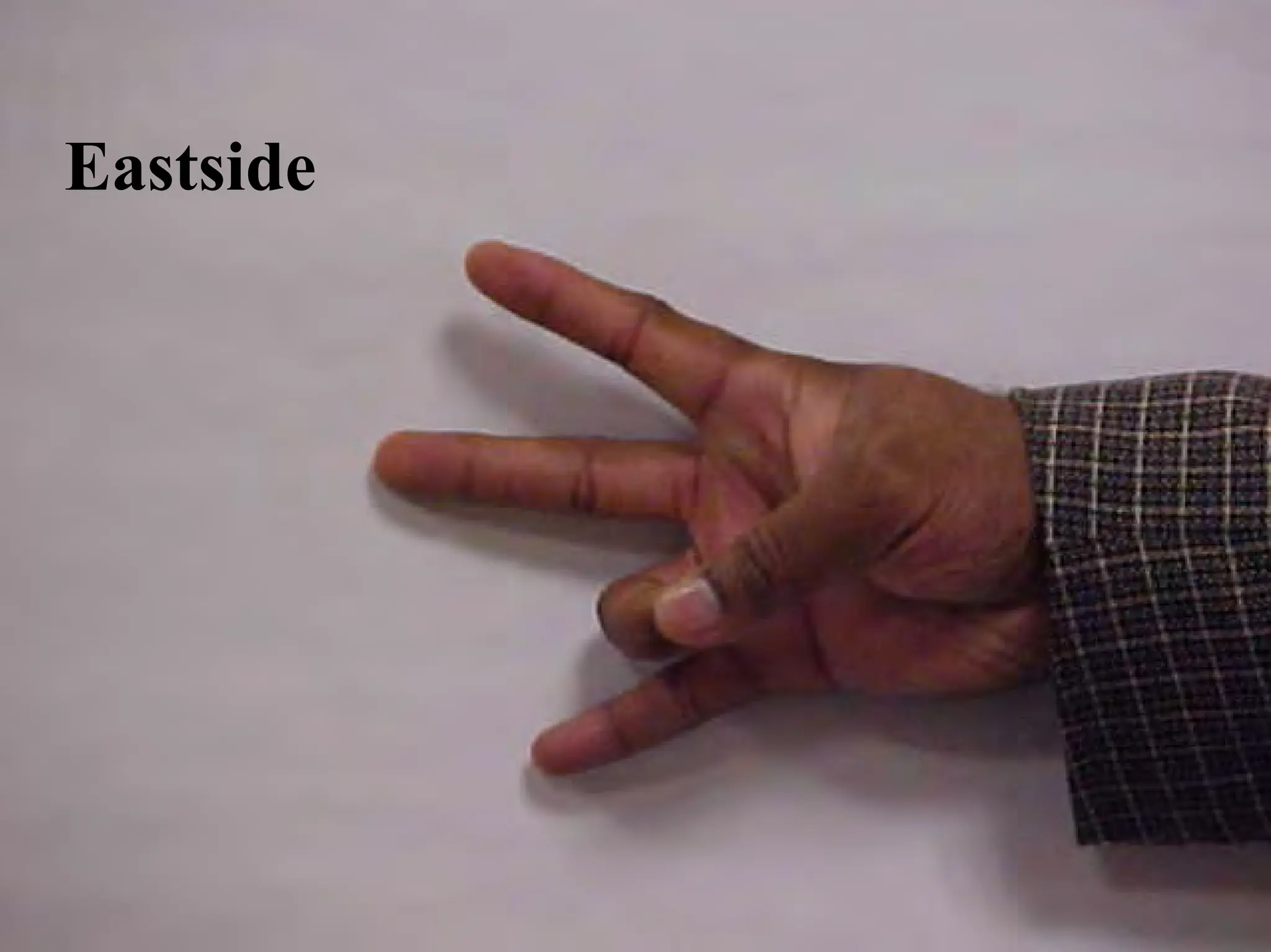
- Initialisms: The first letters of the neighborhood street, gang name, or faction (e.g., forming an "E" and an "S" with separate hands to indicate "East Side").
- Area Codes and Streets: Numbers representing local territory, such as forming digits representing 18th Street or specific area codes like 213, 312, or 713.
- Alliance Geometry: Geometric motifs aligned with broader coalitions, such as five-pointed stars or pitchfork configurations.
Major Gang Alliances and Historical Sign Typologies
While thousands of hyper-local neighborhood sets exist across North America, most contemporary street hand signs trace their roots to the major historic coalitions of Chicago, Southern California, and the Northeast.
| NOTE: The following taxonomy is an educational summary of prominent historic alliances analyzed by law enforcement. |
|---|
(Correction: Rule forbids ASCII boxes; formatting directly into clear analytical text and standard Markdown tables below).
Analytical Framework of Gang Kinesics Criminological analysis distinguishes between national umbrella confederations and hyper-local hybrid sets. While national alliances established the base semiotic alphabets in the late twentieth century, modern municipal street groups frequently adapt or invert these signs to fit local feuds, rendering context and geography critical in professional threat assessment.
Chicago Coalitions: Folk Nation and People Nation
Emerging from the Illinois correctional systems during the 1970s, the Folk Nation and People Nation established rigid, opposing visual typologies:
- Folk Nation: Characterized primarily by the upward six-pointed star and the upward three-pronged pitchfork. Member sets—such as the Gangster Disciples—traditionally position signs toward the right side of the body.
- People Nation: Characterized by the five-pointed star and three-pointed crowns. Affiliated groups—such as the Latin Kings and Vice Lords—traditionally align their symbols to the left side of the body. Displays that drop or break the five-pointed crown are explicit provocations directed at People Nation affiliates.
West Coast Coalitions: Crips, Bloods, Sureños, and Norteños
The rivalries originating in Los Angeles and California's state prison systems created distinct, globally recognized physical gestures:
- Crips: Sets typically form variations of the letter "C" using curved fingers and thumbs. Advanced stacking incorporates physical letters denoting specific avenues or cross-streets, such as 60th Street, 83rd Street, or specific geographic regions (e.g., Compton, Long Beach).
- Bloods: Affiliates use complex single- or two-handed configurations to spell the word "BLOOD" or isolate the letter "B." Fingers are contorted to form the loops of the letter "B" using the index finger and thumb, with remaining digits extended or bent to construct adjacent letters.
- Sureños (Sur 13): Southern California Latino street gangs aligned with the Mexican Mafia (La Eme) frequently incorporate the number 13 into their hand signs. This is achieved through three fingers on one hand and one on the other, or a single hand signaling a "1" followed by a "3".
- Norteños (Nuestra Familia): Northern California factions align with the number 14 (representing the letter "N," the 14th letter of the alphabet). Hand gestures feature four extended fingers or combinations indicating the Roman numeral XIV.
Structural Comparison of Gang Coalition Sign Typologies
The following comparative table details the primary structural classifications recognized in forensic gang intelligence and academic criminology.
| Coalition / Organization | Primary Geographic Roots | Core Symbolism Represented | Common Hand Configuration | Adversarial Degradation Signs |
|---|---|---|---|---|
| Folk Nation (e.g., Gangster Disciples) | Chicago, IL / Midwest | Six-Point Star, Upward Pitchfork | Extended thumb, index, and pinky upright forming a fork | Pitchforks angled or pointed toward the ground |
| People Nation (e.g., Latin Kings, Vice Lords) | Chicago, IL / Midwest | Five-Point Star, Three-Point Crown | Three extended fingers (thumb tucked) representing a crown | Dropped crowns; inverted three-finger displays |
| Crips Sets | Los Angeles, CA / National | The letter "C", Local street numerals | Curled thumb and fingers forming an open circle or "C" | Bent fingers simulating a broken "C" or crossed fingers |
| Bloods Sets | Los Angeles, CA / National | The letter "B", The word "BLOOD" | Interlocking index and thumbs forming double loops | Inverted "B" configurations; downward-facing hooks |
| Sureños (Sur 13) | Southern California / Southwest | The number 13, The letter "M" | One hand showing index finger; other showing three digits | Crossing fingers to break the 13; inverted "S" gestures |
| Norteños (Nuestra Familia) | Northern California / Pacific West | The number 14, The letter "N" | Four fingers extended upward on one hand; single finger on other | Dropping four fingers; breaking Roman numeral shapes |
| Mara Salvatrucha (MS-13) | El Salvador / Central America / US | Devil Horns ("La Garra"), Number 13 | Extended index and pinky pointing downward or upward | Inverting "La Garra" toward the ground in mockery |
Public Safety Hazards and the Risks of Civilian Mimicry
One of the most pressing concerns surrounding gang signs is the hazard they present to civilians who mimic these gestures without understanding their operational context. Pop-culture exposure through music videos, social media trends, and streaming platforms has normalized gestures that carry severe, violent implications on the street.
The Problem of Mistaken Identity
In gang-dense jurisdictions, flashing a hand sign is interpreted as an immediate declaration of active combatant status. Members are socially and operationally conditioned to treat an unknown individual making these signs as an existential threat or an encroaching rival.
Critical Safety Consideration Street-level confrontations occur in fractions of a second. If an individual jokingly or inadvertently displays an adversarial gesture toward an active set, gang members do not stop to verify whether the gesture was ironic, theatrical, or naive. The action is routinely met with sudden, severe violence.
Digital Fingerprinting and Social Media Screening
In contemporary employment screening, military enlistment, and school disciplinary procedures, photographic evidence of hand signs creates irreversible professional damage:
- Academic and Extracurricular Expulsion: Zero-tolerance policies in secondary schools and athletic associations treat the flashing of signs in school photographs or campus grounds as actionable disruption or intimidation.
- Employment Background Checks: Corporate HR investigators and risk management teams screen public digital footprints. Photos displaying recognized criminal kinesics frequently result in immediate disqualification or termination.
- Law Enforcement Gang Databases: Depending on municipal regulations, appearing in photographs with documented gang members while displaying affiliated hand gestures serves as primary criterion points for inclusion in local or state intelligence databases.
Distinguishing Cultural Gestures from Active Criminal Signs
A significant challenge for educators, security personnel, and parents is separating criminal hand displays from benign cultural, athletic, or religious gestures. Many gang signs deliberately co-opt pre-existing everyday body language.
Overlapping Visual Indicators
Several non-criminal gestures bear visual similarities to street identifiers:
- The "Hook 'em Horns" and Heavy Metal Horns: Extending the index and pinky fingers while holding down the middle and ring fingers with the thumb is a celebrated collegiate sports tradition (University of Texas) and a staple of rock and metal concerts. However, when inverted or positioned at specific angles in urban environments, this exact shape mimics the "devil horns" identifier of MS-13 or Mara 18.
- The "Peace" Sign (V-Sign): Two extended fingers in a "V" shape universally represent peace or victory. In specific metropolitan neighborhoods, holding a V-sign sideways or rotating the palm inward can signify the Vicelords or 22nd Street factions.
- The "OK" Gesture: Touching the thumb and index finger into a circle while extending three fingers has historically meant agreement. In recent years, it has been co-opted both as an online trolling symbol and as a signifier for specific regional sets representing the letter "O" or the number "3".
- Athletic Three-Point Celebrations: Professional basketball players frequently celebrate successful three-point shots by holding up three fingers, tapping their temple, or flashing downward three-finger signs. Adolescents often emulate these athletic heroes, inadvertently flashing gestures that resemble East Coast and Midwest pitchfork or crown variations.
Contextual Evaluation Matrix
When analyzing whether a gesture represents criminal behavior or harmless cultural expression, trained analysts evaluate four environmental indicators:
- Context and Environment: Is the sign occurring at an organized athletic event, a music performance, or in a physical area contested by rival street groups?
- Accompanying Body Language: Gang displays are typically paired with an aggressive posture, squaring of the shoulders, specific spatial positioning (e.g., throwing to the left or right side), or verbal slogans ("banging on wax").
- Apparel and Color Blocking: Hand signs flashed in conjunction with monochromatic bandanas, specific athletic jerseys bearing symbolic numerical codes, or altered brand logos signal organized intent.
- Targeting: Is the gesture directed intentionally across a street, toward a passing vehicle, or into an online livestream to insult a known adversary? Targeted displays indicate active street involvement rather than casual emulation.
Legal and Forensic Analysis: Hand Signs in the Courtroom
Within the American legal system, hand signs are not merely street communications; they serve as critical evidentiary elements in criminal prosecutions, sentence enhancements, and gang injunctions.
Expert Witness Testimony and Admissibility
Under Federal Rule of Evidence 702 and corresponding state evidentiary standards, prosecutors frequently call certified gang intelligence officers to provide expert witness testimony regarding the meaning of hand signs captured on camera.
Evidentiary Function in Prosecutions Hand gestures captured on surveillance footage, social media posts, or smartphone videos are introduced as direct evidence of premeditation, criminal motivation, and structural conspiracy. The ability of an expert to translate a rapid sequence of stacking demonstrates to a jury that a defendant acted under the direction or for the benefit of a criminal enterprise.
Statutory Sentence Enhancements
Many states utilize specific statutory enhancements designed to elevate penalties for crimes committed to advance criminal street gangs (such as the California STEP Act, or Street Terrorism Enforcement and Prevention Act):
- Establishing Active Membership: While an individual may claim to have severed ties with a street group, recent social media images flashing the group's signs demonstrate ongoing active participation.
- Proving Specific Intent: If an assault or homicide occurs following an argument, defense counsel may argue the incident was an impulsive personal dispute. If surveillance footage shows the perpetrator stacking or flashing a set sign immediately prior to the weapon discharge, prosecutors can prove the act was committed for the benefit of, at the direction of, or in association with a criminal street gang.
- Civil Gang Injunctions: Municipalities have historically used civil injunctions to ban known gang members from gathering within designated "safety zones." In these legal zones, making specific gestures in public view constitutes a direct violation of the injunction, leading to immediate arrest and misdemeanor charges.
Practical Guidance for Parents, Educators, and Youth Mentors
When youth begin adopting street gestures, immediate punitive intervention can backfire if the underlying driver is simply cultural curiosity or peer pressure. Public safety experts recommend a measured, structured approach:
1. Document Before Reacting
Before confronting a young person, document the exact images, gestures, and contexts where the signs appear. Note if the gestures are paired with specific colors, localized slang, or sudden behavioral shifts (e.g., academic decline, unexplained curfews, or defensive reactions when asked about new associates).
2. Differentiate Between Fascination and Affiliation
Young people frequently adopt mannerisms seen on digital platforms like TikTok, YouTube, or music streams without realizing the real-world violence linked to them. Have an objective conversation focusing on physical safety rather than moral condemnation:
- Explain that rival sets do not distinguish between "ironic mimicry" and "active recruitment."
- Show how digital algorithms push dangerous subcultures for engagement without conveying the life-or-death realities on the street.
- Emphasize the long-term impact that public digital photographs displaying hand signs have on athletic recruitment, military service eligibility, and college admissions.
3. Connect with Objective Community Resources
If the gestures are accompanied by active territorial changes, visible paraphernalia, or fear of walking certain neighborhood blocks, seek guidance from trained, non-punitive intervention specialists. School counselors, local youth diversion programs, and specialized community-based violence interruption organizations possess direct, localized insight into current street tensions and can provide safe exits for youth at risk of recruitment.
Frequently Asked Questions
What does "stacking" gang signs mean?
Stacking is the act of performing a rapid, fluid series of hand movements that spell out letters, numbers, or specific symbols in quick succession. Unlike a single static hand sign, stacking typically communicates complex identifiers, such as a member's exact neighborhood set, alliance, street number, and hostility toward specific rivals.
Can someone be arrested solely for flashing a gang sign?
In the United States, displaying a hand sign is generally protected speech under the First Amendment and is not illegal on its own. However, flashing signs can lead to arrest if it constitutes fighting words, an immediate physical threat, a violation of a civil gang injunction in a designated safety zone, or a breach of probation or parole terms that ban displaying gang insignia.
Why do gangs invert or throw signs upside down?
Inverting a rival gang's hand sign—often called "cracking," "dropping," or "dissing"—is an intentional insult designed to show disrespect toward that group. Dropping an opponent's sign is considered an aggressive provocation that frequently sparks retaliatory physical violence or shootings.
How do law enforcement agencies decode complex hand signs?
Law enforcement agencies decode signs using specialized gang intelligence units that analyze local street history, cross-reference state and federal intelligence databases, and monitor jailhouse communications. Gang experts also study surveillance video, recorded jail visits, and social media interactions to track how local signs evolve.
What should an ordinary person do if someone flashes a gang sign at them?
If an individual flashes a gang sign at you, remain calm, do not react, and avoid making prolonged eye contact or returning any gestures. De-escalate the situation by quietly and quickly exiting the area to a secure, public space, and notify local security or law enforcement if you believe there is an immediate threat to public safety.
Educational and Community Safety Resources
Understanding the complex nonverbal landscape of street culture is vital for preserving public safety and protecting vulnerable populations from preventable harm. If you are an educator, parent, or community leader seeking to implement comprehensive prevention programs, consult localized resources from municipal youth diversion initiatives and recognized public safety education boards. Proactive education, grounded in objective awareness rather than sensationalism, remains the most effective tool for mitigating the spread of youth involvement in organized street crime.
Image Gallery