What the Burning Man Flood Revealed: Infrastructure, Resilience, and Logistics
The 2023 Burning Man flood, caused by unexpected heavy rainfall on the Black Rock Desert, revealed critical vulnerabilities in the event's logistical infrastructure, specifically regarding the "leave no trace" ethos, mass-exit protocol...
The 2023 Burning Man flood, caused by unexpected heavy rainfall on the Black Rock Desert, revealed critical vulnerabilities in the event's logistical infrastructure, specifically regarding the "leave no trace" ethos, mass-exit protocols, and the dependency on unimproved lakebed surfaces for large-scale temporary human habitation.
Contents
The Environmental Context of Black Rock City
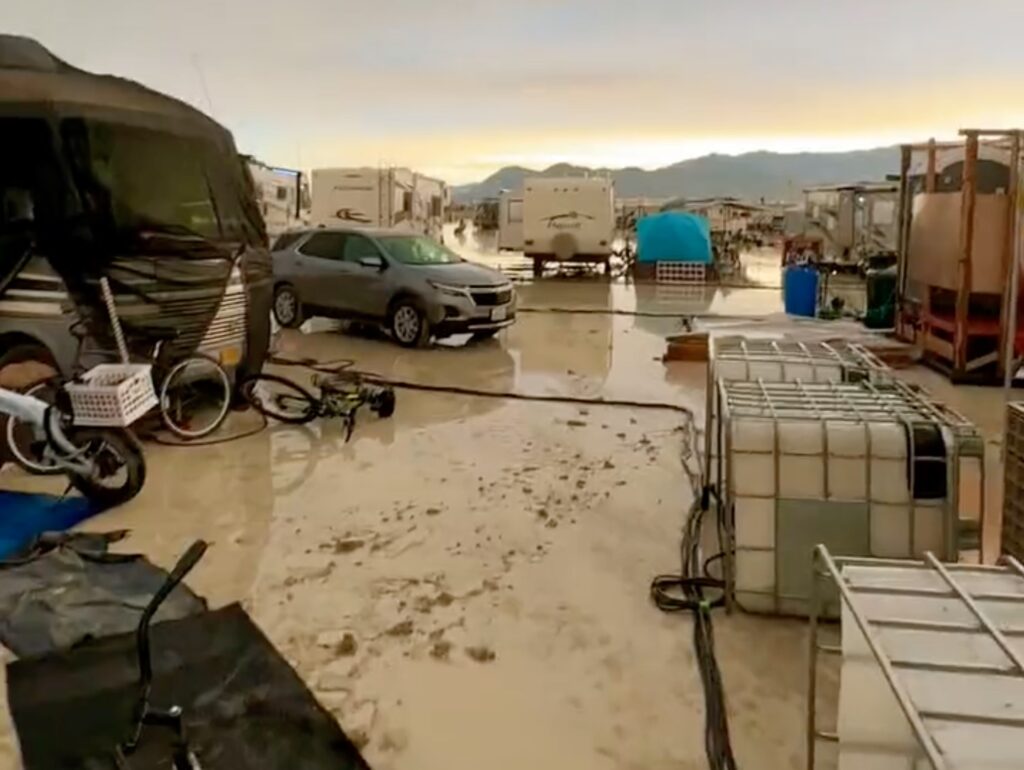
Burning Man is held annually on the Black Rock Desert, an ancient lakebed known as a playa. Under dry conditions, the playa provides a hard, crack-free surface perfect for temporary infrastructure. However, the geology of the Black Rock Desert is composed of alkaline clay—a substance that, when saturated with water, turns into a thick, viscous mud. This mud is not merely slippery; it is notoriously adhesive, often referred to by participants as "playa mud" or "gumbo." It builds up rapidly on boots, tires, and bicycle wheels, effectively immobilizing anything attempting to traverse the surface.
When remnants of Tropical Storm Hilary and subsequent unseasonable moisture hit the area in September 2023, the desert floor could not absorb the volume of water. The resulting saturation rendered the temporary city essentially inaccessible by conventional motor vehicles, transforming the logistical plan from a controlled exit into an emergency shelter-in-place scenario.
Logistical Vulnerabilities: The "Exit" Problem
The primary reveal of the 2023 event was the fragility of the "Exodus" process. Burning Man relies on a single, primary ingress/egress road that spans the desert floor. During typical operation, this road is managed with high precision to avoid traffic jams. Once the mud rendered this road impassable, the organization faced a logistical gridlock.
The flood highlighted a systemic dependency: the event assumes a static, dry, and predictable climate. Because the city is built on federal land managed by the Bureau of Land Management (BLM), the organization is restricted in how much permanent or heavy infrastructure it can deploy to improve road durability. The event revealed that when the "leave no trace" requirement is combined with extreme weather, the ability to evacuate tens of thousands of people becomes functionally impossible without massive equipment that the organizers are generally prohibited from installing permanently.
Impact on "Leave No Trace" and Waste Management
A core tenet of Burning Man is the "Leave No Trace" (LNT) policy. Participants are expected to manage their own waste and ensure that every item brought onto the playa is removed. The flood created a massive, unforeseen challenge for this policy. As the mud made movement difficult, many participants abandoned items—including bicycles, camping gear, and trash—in a desperate attempt to walk out or wait for conditions to improve.
This mass abandonment created a secondary ecological crisis. The organization had to pivot from facilitating an arts event to conducting a massive site cleanup under adverse conditions. This revealed that the LNT ethos, while effective during stable weather, relies heavily on the physical capacity of individuals to carry their refuse to the exit. When personal mobility is stripped away, the waste management system shifts from an individual responsibility to a collective, industrial-scale recovery operation.
Comparative Analysis of Site Resilience
To understand the challenges faced, it is helpful to look at how different components of the city held up under the extreme saturation compared to standard operating conditions.
| Component | Standard Dry Condition Performance | Flood Condition Performance | Recovery Strategy |
|---|---|---|---|
| Playa Roadway | High-speed, high-volume capacity | Zero-speed; adhesive mud trap | Aerial support and heavy towing |
| Camping Gear | Designed for wind and heat | High risk of saturation and collapse | Increased reliance on elevated structures |
| Sanitation | Regular, scheduled servicing | Interrupted access for vacuum trucks | Emergency protocols and voluntary limits |
| Mass Exodus | Optimized for steady flow | Complete standstill; shelter-in-place | Phased exit once surface dries |
Safety Protocols and Emergency Communication
The flooding event provided a live-stress test for the communication channels within Black Rock City. With thousands of people stranded, the organizers had to transition from event-hosting to emergency-management messaging.
One of the most significant revelations was the necessity of robust, decentralized communication. Because cellular service is limited on the playa, participants are accustomed to intermittent connectivity. However, when the weather shifted, the demand for verified information spiked. The organization used radio broadcasts and direct-to-camp communication to manage expectations, yet many participants were left relying on social media rumors. This highlighted a gap: when the physical environment shuts down, the digital infrastructure is not always sufficient to prevent panic or misinformation.
The Role of Federal Land Management
Burning Man operates under a Special Recreation Permit issued by the Bureau of Land Management (BLM). The 2023 flood underscored the tension between the event's scale and the government's mandate to preserve the desert landscape. Any attempt to "harden" the playa to prevent future flood-related closures would involve significant environmental impact assessments and potential permanent alterations to the site. The flood served as a case study for both regulators and organizers regarding the limits of temporary events on sensitive, undeveloped public lands.
Planning for Climate Uncertainty: Expert Guidance
For organizers of large-scale outdoor events, the 2023 flood serves as a blueprint for risk mitigation.
- Strategic Staging: Always maintain an emergency stockpile of food and water in excess of the projected participant duration to account for unexpected extended stays.
- Mobility Redundancy: Relying on standard vehicles is insufficient in extreme weather. Specialized equipment—such as 4x4 vehicles with high-clearance or heavy-duty recovery gear—is essential for critical infrastructure maintenance.
- Communication Infrastructure: Develop a redundant, non-cellular internal communication system that reaches all camps, ensuring the organization can provide guidance even when the internet is unavailable.
- Human-Centric Design: Design camp layouts to discourage the accumulation of waste in high-traffic zones, allowing for easier site cleanup if forced to abandon positions quickly.
Frequently Asked Questions
Why was the Burning Man site so impassable during the flood? The playa is made of alkaline clay, which loses all structural integrity when wet. It forms a deep, suction-like mud that clogs vehicle tires and makes walking nearly impossible, effectively locking any vehicle in place until the moisture evaporates.
Were there long-term environmental damages revealed by the flood? The primary concern was the potential for chemical contamination or debris burial. However, the event's cleanup crews, supported by federal oversight, worked to remove abandoned gear and impacted soil to ensure the site was restored to BLM standards.
Does the BLM now require new permits based on the 2023 incident? Permitting remains a complex, ongoing process. The event continues to operate under federal oversight, with discussions regarding climate-resilient protocols becoming a more prominent part of the planning stages for future years.
What should individual campers learn from the 2023 flood? Individual resilience is key. Campers should always prepare for "worst-case" scenarios, including extreme weather. This includes bringing extra water, dry shelter options, and a "go-bag" that can be easily transported if walking becomes necessary.
How does the event handle waste if vehicles cannot exit? When waste collection trucks cannot reach the site, the organization implements emergency trash protocols, encouraging participants to consolidate waste at central nodes where it can be removed once the ground dries sufficiently for heavy vehicle traffic.
Next Actions for Participants
If you are planning to attend large-scale, off-grid events in arid environments, your primary task is to review your "Self-Reliance Plan." Research the specific soil type and weather patterns of the event site. Invest in high-quality, all-terrain footwear and ensure that your shelter—be it a tent or a modular structure—is designed to withstand high winds and potential pooling water. By treating "worst-case" weather as a predictable possibility rather than a surprise, you contribute to the safety and collective resilience of the entire community.
Image Gallery