Leo Horoscope Dates: Exact Calendar Ranges, Decans, and Astronomical Shifts
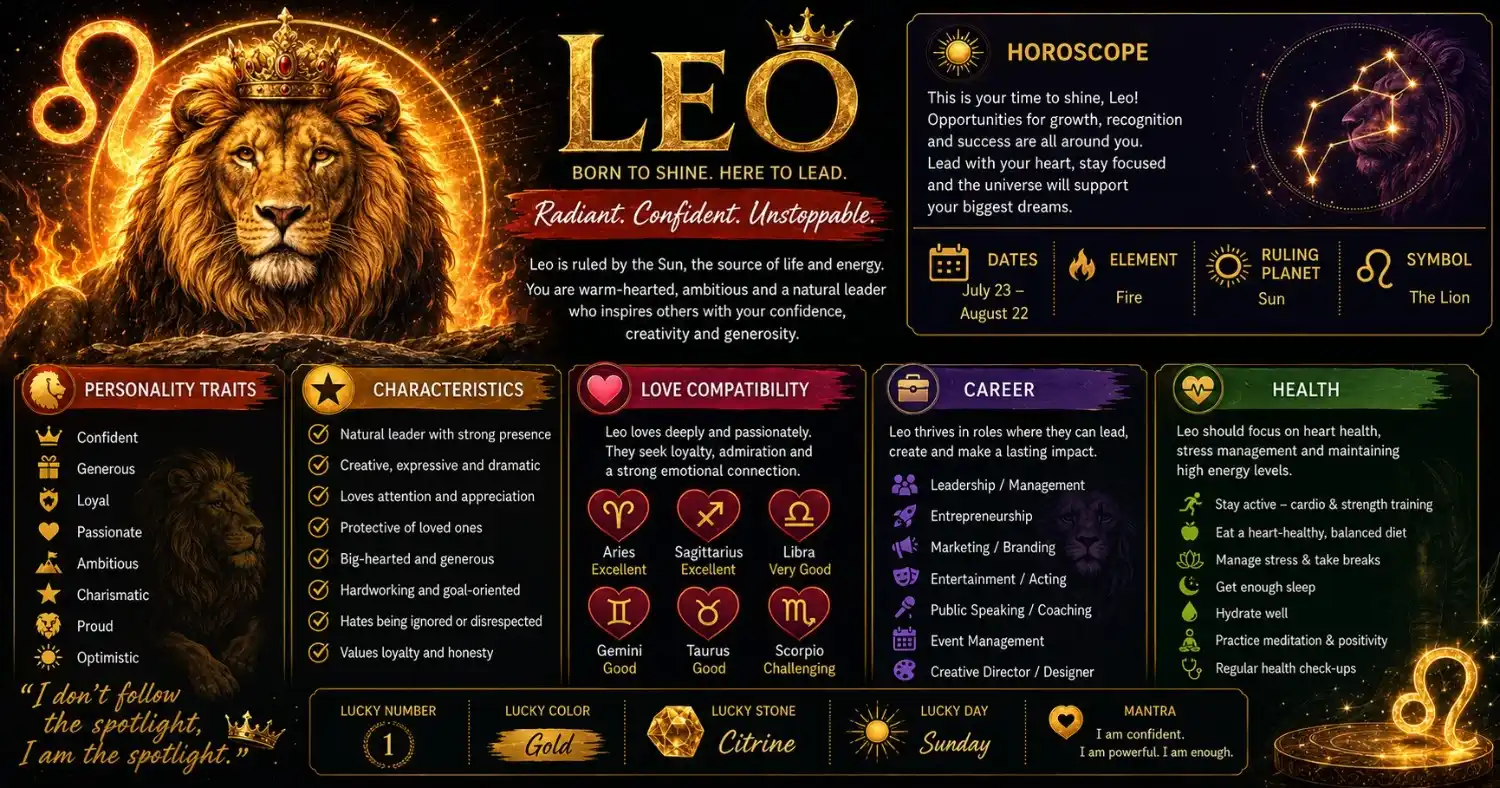
In standard Western tropical astrology, Leo horoscope dates run from July 23 through August 22. Anyone born within this calendar span has their natal Sun positioned in the sign of the Lion, the fixed fire sign ruled by the Sun. Precise...
In standard Western tropical astrology, Leo horoscope dates run from July 23 through August 22. Anyone born within this calendar span has their natal Sun positioned in the sign of the Lion, the fixed fire sign ruled by the Sun. Precise ingress and egress times fluctuate by up to a day depending on leap years and geographic time zones.
Contents
Western, Vedic, and Astronomical: The Three Leo Date Systems
The question of which dates belong to Leo depends on whether you follow Western tropical astrology, Eastern sidereal (Vedic) astrology, or observational astronomy. While Western media almost universally publishes tropical dates, these three systems calculate the position of the Sun along the ecliptic plane using distinct celestial reference points.
Tropical Astrology (July 23 – August 22)
Western astrology relies on the tropical zodiac, an artificial spatial construct anchored to the Northern Hemisphere's seasons rather than fixed physical constellations. The zodiac begins at 0° Aries on the vernal equinox. Because the tropical system divides the 360-degree ecliptic into twelve equal 30-degree segments, the Sun enters the sign of Leo at precisely 120° ecliptic longitude and exits at 150° longitude.
Under this system, the Leo solar season begins every year around July 22 or July 23 and concludes between August 22 and August 23. It represents midsummer in the Northern Hemisphere, mirroring the sign's solar, radiant, and expressive archetypes.
Sidereal / Vedic Astrology (August 16 – September 16)
Sidereal astrology, practiced primarily in India as Jyotish (Vedic astrology), aligns the zodiac signs with the observable physical star constellations. Because Earth undergoes axial precession—a slow, 25,772-year wobble known as the precession of the equinoxes—the tropical zodiac shifts backward against the background stars by approximately one degree every 71.6 years.
Vedic astrology accounts for this shift using a corrective offset known as an Ayanamsa (most commonly the Lahiri Ayanamsa). Consequently, the Sun does not enter the sidereal sign of Leo (Simha) until approximately August 16 or 17, remaining there until September 16 or 17. Individuals who identify as Leos in the Western tradition frequently discover they are Cancer Suns in Vedic calculations.
Astronomical Constellation Boundaries (August 10 – September 15)
In 1930, the International Astronomical Union (IAU) formally codified the boundaries of the 88 modern constellations to give astronomers precise regional maps of the night sky. Unlike astrological systems, which assign uniform 30-degree sectors to every sign, physical constellations vary dramatically in shape and span.
The physical constellation of Leo spans roughly 35.8 degrees along the ecliptic. From an observational standpoint, the Sun travels in front of the actual stars of Leo from approximately August 10 until September 15.
| System | Standard Calendar Dates | Celestial Reference Anchor | Segment Size | Primary Application |
|---|---|---|---|---|
| Western (Tropical) | July 23 – August 22 | Vernal Equinox (0° Aries seasonal anchor) | Fixed 30° | Modern Western horoscopes and psychological astrology |
| Vedic (Sidereal) | August 16 – September 16 | Observable star groups adjusted via Ayanamsa | Fixed 30° | Jyotish, traditional Indian horoscopes, karmic charting |
| Astronomical (IAU) | August 10 – September 15 | Physical stellar boundaries codified in 1930 | Variable (35.8°) | Observational astrophysics and celestial navigation |
The Mechanics of Ingress: Why Leo Start and End Dates Fluctuate
A common source of confusion among those born on July 22, July 23, August 22, or August 23 is that different publications assign these boundary days to different signs. These variations are not printing errors; they stem from the mathematical divergence between our civil calendar and solar physics.
A standard calendar year spans 365 days, whereas a leap year contains 366 days. However, the tropical solar year—the precise interval required for Earth to complete one orbit relative to the vernal equinox—lasts approximately 365.24219 days (365 days, 5 hours, 48 minutes, and 45 seconds).
Because our calendar year does not match the solar cycle perfectly, the exact moment the Sun crosses 120° ecliptic longitude shifts forward by roughly six hours each year until a leap year resets the count.
Geographic location introduces a second layer of variation:
- Universal Time Coordinated (UTC): Ephemeris tables track planetary positions using UTC. If the Sun enters Leo at 11:30 PM UTC on July 22, an individual born at that exact instant in London or New York is born under a Leo Sun.
- Local Time Discrepancies: For someone born at that identical absolute moment in Tokyo, Japan (UTC+9), the local clock reads 8:30 AM on July 23.
- Leap Year Influence: In the year immediately following a leap year, the Sun’s ingress into Leo occurs earlier in the calendar day than it does in the fourth year of a leap-year cycle.
Determining Your Boundary Sign
If your birthday falls on July 22, July 23, August 22, or August 23, never rely on a generic date table. Cast a precise natal chart using your exact birth hour, minute, and birth city. Modern ephemeris software calculates the Sun's degree down to the arcsecond, removing all ambiguity.
The Three Decans of Leo: Dates, Degrees, and Planetary Rulers
In classical Hellenistic and modern Western astrology, each 30-degree zodiac sign divides into three equal subdivisions of 10 degrees, known as decans or decanates. Each decan spans roughly ten calendar days and imparts a distinct sub-influence governed by a planetary co-ruler belonging to the same element (Fire: Leo, Sagittarius, Aries).
Understanding decans explains why people born in late July often exhibit temperamental differences from those born in mid-August.
Decan 1: 0°00' to 9°59' Leo (July 23 – August 1)
- Planetary Ruler: The Sun
- Sub-Ruler: The Sun
- Key Attributes: Unfiltered vitality, magnetism, dramatic presence, leadership
The first decan represents Leo in its purest, most concentrated manifestation. Because the Sun functions as both the sign ruler and the decan ruler, individuals born in this window express classical solar qualities with little dilution. They display pronounced confidence, creative stamina, and a natural instinct to command attention. Their primary developmental challenge involves managing ego rigidity and avoiding excessive pride when external validation is withheld.
Decan 2: 10°00' to 19°59' Leo (August 2 – August 12)
- Planetary Ruler: The Sun
- Sub-Ruler: Jupiter (Ruler of Sagittarius)
- Key Attributes: Philosophical breadth, optimism, generosity, intellectual curiosity
The second decan is infused with the jovial, expansive energy of Jupiter, the planetary ruler of the secondary fire sign, Sagittarius. Leos born in this range temper their dramatic flair with a desire for exploration, higher learning, and ideological pursuits. They often exhibit a sharp sense of humor, affinity for travel, and an instinctive optimism. While passionate, they tend to be less authoritarian than First Decan natives, though they must guard against overextension and dogmatic overconfidence.
Decan 3: 20°00' to 29°59' Leo (August 13 – August 22)
- Planetary Ruler: The Sun
- Sub-Ruler: Mars (Ruler of Aries)
- Key Attributes: Strategic drive, physical energy, fierce ambition, incisive focus
The third decan incorporates the dynamic, competitive force of Mars, ruler of Aries. Leos born in this sector possess intense drive, decisiveness, and an urge toward tangible accomplishment. Their solar desire to shine is paired with a direct, martial approach to problem-solving. These natives often gravitate toward competitive athletics, business leadership, or executive execution. They must remain conscious of impatience and impulsive anger when projects or individuals do not move at their preferred speed.
| Decan | Degree Range | Approximate Dates | Primary Ruler | Sub-Ruler | Core Temperament |
|---|---|---|---|---|---|
| First Decan | 0°00' – 9°59' | July 23 – August 1 | The Sun | The Sun | Radiant, theatrical, authoritative, sovereign |
| Second Decan | 10°00' – 19°59' | August 2 – August 12 | The Sun | Jupiter | Expansive, idealistic, philosophical, generous |
| Third Decan | 20°00' – 29°59' | August 13 – August 22 | The Sun | Mars | Direct, ambitious, competitive, assertive |
Navigating the Cusps: Cancer-Leo and Leo-Virgo Transitions
Pop astrology frequently refers to "cusp dates"—transitional intervals where an individual is presumed to hold the traits of two adjoining signs simultaneously. In technical astrological practice, however, a planet can occupy only one zodiacal sign at any fraction of a second. At 29°59'59" Cancer, the Sun is in Cancer; one arcsecond later, at 0°00'00" Leo, it is entirely in Leo.
Despite this technical distinction, individuals born within roughly three to four days of an ingress or egress frequently experience psychological transitions between the signs' archetypes. This occurs because Mercury and Venus—planets that never travel far from the Sun—frequently sit in the adjacent sign.
The Cancer-Leo Cusp: July 19 to July 25
Known traditionally as the "Cusp of Oscillation," this period bridges cardinal water (Cancer) and fixed fire (Leo). Individuals born during this late-July passage balance Cancer's intuitive, protective, and emotionally private nature with Leo's expressive, public, and confident orientation.
When balanced, these natives possess exceptional emotional intelligence paired with magnetic charisma. When unbalanced, they oscillate between hyper-sensitive withdrawal and demanding public affirmation.
The Leo-Virgo Cusp: August 19 to August 25
Known as the "Cusp of Exposure," this window connects fixed fire (Leo) with mutable earth (Virgo). People born along this late-August border combine the grand vision, dignity, and performance of Leo with the analytical precision, pragmatism, and duty of Virgo.
This structural blend often produces effective organizational leaders, editors, producers, and designers. The primary internal friction arises between Leo's desire to act grandly on intuition and Virgo's insistence on scrutinizing every detail for flaws before proceeding.
Modality, Element, and Rulership Framework
To understand why the dates of Leo hold specific significance within astrology, one must examine the foundational structural components that define the sign:
Element: Fire (Intuitive, Vital, Dynamic) Modality: Fixed (Sustained, Resolute, Stabilizing) Polarity: Yang / Masculine (Extroverted, Active) Domicile Ruler: The Sun (Identity, Vital Force, Ego) Exaltation: Neptune (Traditional) / None (Modern standard) Detriment: Saturn (Structure, Restriction, Distance) Fall: Uranus (Disruption, Eccentricity)
The Fixed Fire Dynamic
Astrology groups signs by four elements (Fire, Earth, Air, Water) and three modalities (Cardinal, Fixed, Mutable).
- Fire Element: Imparts passion, intuition, executive courage, and high physical vitality.
- Fixed Modality: Occurs in the heart of a season. It consolidates, stabilizes, and resists change.
While Aries is cardinal fire (the initiating spark) and Sagittarius is mutable fire (the spreading, shifting flame), Leo is fixed fire. It corresponds to the sustained heat of a blazing hearth or the steady, unwavering radiance of a star.
This mechanical combination accounts for the core psychological characteristics of those born within the Leo dates: loyalty, consistency, stubbornness, artistic persistence, and a preference for predictable authority over disruptive unpredictability.
The Solitary Rulership of the Sun
In traditional astrology, every classical planet rules two signs, with two exceptions: the Moon rules only Cancer, and the Sun rules only Leo.
Because the Sun represents the center of the solar system, individuals born under the Leo window naturally view their existence through the lens of individual agency, creative self-expression, and sovereign purpose. The Sun never moves retrograde; similarly, Leo energy is characterized by direct, forward-moving focus.
Compatibility Patterns Across the Zodiac Calendar
Solar compatibility evaluates how the elemental and modal properties of Leo interact with the Sun positions of other birth periods. While a complete synastry analysis requires comparing entire natal charts, the Sun's date relationships form the baseline geometry (aspects) between signs.
High Synergy: Fire and Air Signs
Leo forms harmonious aspects with the remaining Fire signs and complementary Air signs:
- Aries (March 21 – April 19): Trine aspect (120°). Aries provides pioneering initiative that excites Leo, while Leo provides the sustained follow-through that Aries often abandons.
- Sagittarius (November 22 – December 21): Trine aspect (120°). Sagittarius expands Leo’s intellectual and philosophical horizons, creating a shared optimism grounded in creative exploration.
- Gemini (May 21 – June 20): Sextile aspect (60°). Gemini’s wit and curiosity feed Leo’s need for engaged social dialogue and intellectual play.
- Libra (September 23 – October 22): Sextile aspect (60°). Libra’s aesthetic refinement and diplomatic instincts complement Leo’s flair for presentation, forming a socially cohesive pair.
The Polarity Axis: Aquarius (January 20 – February 18)
Aquarius sits directly opposite Leo on the zodiac wheel (180° opposition). This creates an axis of identity: Leo represents personal sovereignty, individual performance, and the heart, while Aquarius governs collective movements, objective logic, and the group mind.
Relationships between those born during these two windows contain immediate chemical polarity. They either achieve powerful mutual balance or experience an ideological clash between personal ego (Leo) and detached egalitarianism (Aquarius).
Dynamic Friction: Fixed Sign Squares
- Taurus (April 20 – May 20): Square aspect (90°). Both are fixed signs. Taurus prioritizes material security, physical comfort, and deliberate pacing, whereas Leo requires visible appreciation, expressive output, and drama. Stalemate over practical vs. creative priorities is common.
- Scorpio (October 23 – November 21): Square aspect (90°). Both possess immense psychological willpower. Scorpio works behind the scenes through subtext, emotional depth, and privacy; Leo operates openly through radiance, straightforward pride, and public visibility. Power struggles can emerge unless deep mutual respect is established.
Frequently Asked Questions
What are the exact dates for the Leo horoscope?
In Western (tropical) astrology, the dates for Leo are July 23 through August 22. Anyone born during this period has their natal Sun in Leo.
The exact hour of transition between Cancer and Leo or Leo and Virgo varies slightly from year to year depending on leap year cycles and time zone offsets. If your birthday is on July 22, July 23, August 22, or August 23, consult an accurate birth chart calculated with your time and place of birth to confirm your Sun sign.
Can your sign be Leo if you were born on July 22?
Yes, you can be a Leo if you were born on July 22, depending on your precise birth year, time, and location.
Because the solar year is roughly 365.24 days long, the moment the Sun reaches 120° ecliptic longitude shifts by roughly six hours every year. In certain leap-year cycles and Western time zones, the Sun enters Leo late in the day on July 22 rather than July 23.
Why do some sources state Leo starts on August 16?
Sources citing August 16 are using the sidereal (Vedic) zodiac or observational astronomy, rather than the Western tropical system.
Sidereal astrology tracks the Sun’s physical alignment against the actual constellations, compensating for the precession of the equinoxes. In the sidereal system, the Sun passes through the constellation of Leo from approximately August 16 to September 16.
What is the difference between a July Leo and an August Leo?
The behavioral differences between July and August Leos are largely explained by astrological decans and Mercury/Venus placements.
July Leos fall into the First Decan, co-ruled by the Sun, producing a traditional, bold, and expressive solar character. August Leos belong to the Second Decan (co-ruled by Jupiter) or Third Decan (co-ruled by Mars), introducing philosophical, expansive, competitive, and action-oriented personality layers.
Is the Leo-Virgo cusp a real zodiac sign?
Astrologically, the Leo-Virgo cusp is not an independent sign. Every planet resides at a definitive degree within a single sign at any given second.
A person born on August 22 or 23 has their Sun either in the final degrees of Leo or the first degree of Virgo. However, because neighboring planets like Mercury and Venus often reside in adjacent signs, individuals born during this window frequently express a blend of Leo's confidence and Virgo's analytical precision.
Verifying Your Exact Sun Degree
Knowing your general horoscope dates provides a starting point, but accurate astrological analysis requires identifying the precise degree of your natal Sun. If your birth falls on an ingress boundary or you want to determine which decan governs your chart, cast your natal chart using your exact time of birth and geographic coordinates. This ensures complete astronomical accuracy and reveals the planetary placements that make your solar expression distinct.
Image Gallery