Why 6-Inch Seamless Gutters Save You Money and Protect Your Home
Six-inch seamless gutters save money by preventing expensive water-related structural damage, reducing the frequency of maintenance, and eliminating the leaks associated with sectional joints. Their larger capacity handles high-volume...
Six-inch seamless gutters save money by preventing expensive water-related structural damage, reducing the frequency of maintenance, and eliminating the leaks associated with sectional joints. Their larger capacity handles high-volume rainfall more efficiently than standard 5-inch systems, effectively mitigating the risk of foundation erosion, basement flooding, and fascia board rot that leads to costly repairs.
Contents
The Engineering Advantage of 6-Inch Systems
The primary difference between standard 5-inch gutters and 6-inch seamless gutters lies in both the physical width of the trough and the manufacturing process. Most residential properties were historically fitted with 5-inch K-style gutters. However, as extreme weather patterns and higher-intensity rainfall events become more common, the 5-inch capacity often reaches a breaking point, resulting in overflow.
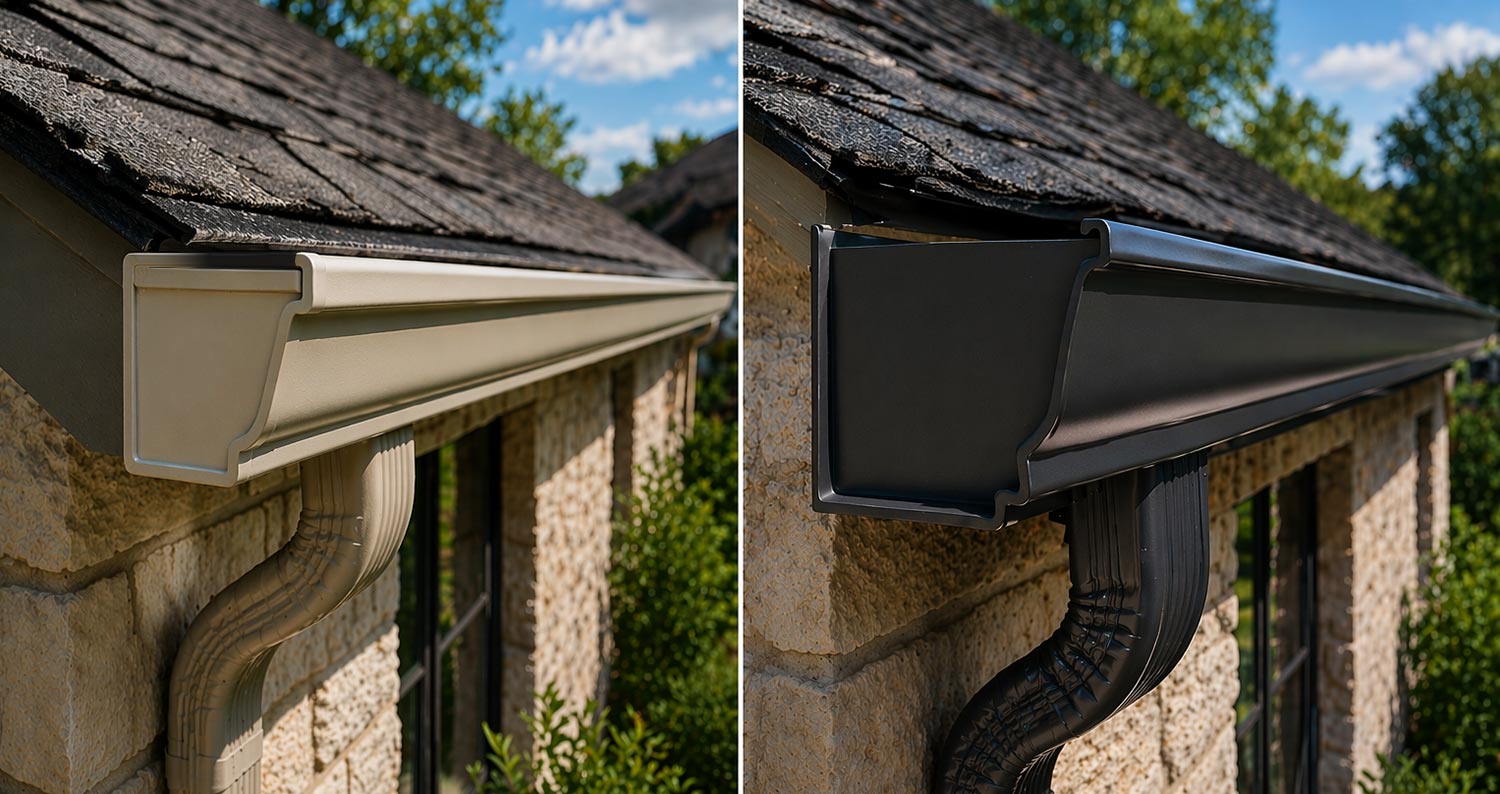
Seamless gutters are manufactured on-site using a portable roll-forming machine. This allows the contractor to create a single, continuous piece of aluminum, copper, or steel that spans the length of your roofline. Because there are no seams—except at the corners—the most common failure point in a gutter system is removed. When you combine this seamless design with the increased depth and width of a 6-inch profile, you gain significantly more water-carrying volume, which prevents the "spill-over" effect that damages your home’s perimeter.
Mitigating Foundation and Structural Costs
The most significant financial drain associated with poor drainage is foundation damage. When gutters overflow, the water falls directly against the base of your home rather than being diverted away through downspouts. Over time, this saturation leads to soil expansion and contraction, which can cause cracking in concrete foundations.
Repairing a compromised foundation is one of the most expensive home maintenance projects a homeowner can face, often costing tens of thousands of dollars. By installing 6-inch seamless gutters, you ensure that even during heavy downpours, the water is captured and channeled into the downspouts rather than pooling at the foundation. This proactive investment is essentially an insurance policy for your home's structural integrity.
Reduced Maintenance and Repair Expenses
Traditional sectional gutters rely on dozens of joints and connectors. These segments are typically held together by sealants or rivets that degrade under the stress of thermal expansion and contraction. As seasons change, metal expands in the heat and shrinks in the cold, eventually causing those seals to crack and leak.
These leaks are not just a nuisance; they are a direct cause of wood rot. When water drips from a seam, it often runs behind the gutter and saturates the fascia boards (the trim directly behind the gutter). Rotting fascia boards eventually require a complete tear-off and replacement, which involves removing the gutters, replacing the wood, and reinstalling the system. By choosing a 6-inch seamless system, you eliminate these seams, thereby eliminating the leak points that lead to wood decay and recurring maintenance bills.
Comparing 5-Inch and 6-Inch Gutter Systems
| Feature | 5-Inch Sectional Gutters | 6-Inch Seamless Gutters |
|---|---|---|
| Material Integrity | High risk of seam failure | Continuous, no mid-section seams |
| Water Capacity | Standard | Approx. 40% more volume |
| Overflow Risk | High during heavy rain | Very low |
| Maintenance | Frequent sealing/caulking | Minimal inspection required |
| Long-term Value | Lower due to recurring repairs | Higher due to structural protection |
Why Volume Matters: Handling Modern Rainfall
Many homeowners assume that if their current 5-inch gutters worked in the past, they are sufficient today. However, technical standards for roof drainage have evolved. A 6-inch gutter does not just offer 20% more width; it offers approximately 40% more water-holding capacity than a 5-inch system due to the increased depth and trough geometry.
If you have a metal roof or a roof with a steep pitch, water accelerates as it descends, often overshooting smaller gutters entirely. The wider 6-inch profile acts as a "catch-all," ensuring that the high-velocity water is contained. By avoiding the common issue of overshoot and overflow, you protect your landscaping, walkways, and siding from the erosion caused by uncontrolled water runoff.
Financial Considerations and Return on Investment
While the upfront installation cost of 6-inch seamless gutters is higher than purchasing and installing standard sectional gutters from a home improvement store, the long-term value is undeniable.
- Labor Savings: Seamless gutters require professional installation with specialized equipment. This ensures a custom fit that DIY sectional kits cannot replicate.
- Longevity: A properly installed seamless system can last 20 to 30 years with routine cleaning. Sectional systems often begin to leak within 5 to 7 years.
- Protection of Assets: Avoiding a single instance of siding replacement or foundation waterproofing pays for the cost difference between the two systems many times over.
When evaluating quotes, always ensure the estimate includes the transition to 3x4-inch downspouts, which are usually paired with 6-inch gutters to maximize flow. Using 2x3-inch downspouts with 6-inch gutters creates a bottleneck that limits the effectiveness of the system.
Common Mistakes to Avoid
- Undersizing Downspouts: Never pair a high-capacity 6-inch gutter with undersized downspouts. The drainage potential of the system is only as good as its narrowest point.
- Ignoring Slope (Pitch): Gutters must be installed with a slight downward slope toward the downspouts. Without this, water will pool, causing the gutters to sag and eventually fail.
- DIY Installation Attempt: Roll-forming machines are not available for home use. Attempting to "seam" your own gutters creates instant weak points, defeating the primary benefit of the seamless design.
Frequently Asked Questions
Are 6-inch gutters overkill for a small house? Not necessarily. The choice depends more on your roof pitch and local rainfall intensity than the square footage of the home. If you have a steep roof, water travels faster, and a 6-inch gutter is often necessary to prevent overshoot, regardless of the home's size.
Can I install seamless gutters myself? No. Seamless gutters must be fabricated on-site by a professional using a gutter machine. The segments are custom-cut to the exact length of your rooflines, which is physically impossible to achieve with store-bought sections.
Do 6-inch gutters look too bulky on my home? The visual difference between 5-inch and 6-inch gutters is minimal from the ground. Most modern home designs accommodate the larger profile easily, and the improved performance often outweighs the minor difference in aesthetic profile.
How often should I clean my seamless gutters? Even seamless gutters need to be cleaned at least twice a year to remove debris. If you have trees overhanging your roof, consider installing high-quality gutter guards to prevent clogs, which can lead to standing water and added weight on the brackets.
Does insurance cover damage caused by leaking gutters? Generally, insurance covers sudden, accidental damage (like a storm ripping a gutter down). It rarely covers "gradual" damage, such as wood rot or foundation cracking resulting from a leaking gutter that was ignored for years. Proactive maintenance is your responsibility as a homeowner.
Next Steps for Homeowners
To determine if your home requires a 6-inch upgrade, observe your gutters during the next heavy rainstorm. If you see water pouring over the sides or if you notice staining on the fascia boards behind the gutter, your current system is failing. Contact a local, reputable gutter contractor to perform an assessment. Request an estimate specifically for a 6-inch seamless system, ensuring the quote includes the necessary transition to 3x4-inch downspouts to ensure the system functions at its peak capacity.
Image Gallery