Mastering the 15 Required AP Government Supreme Court Cases for 2026
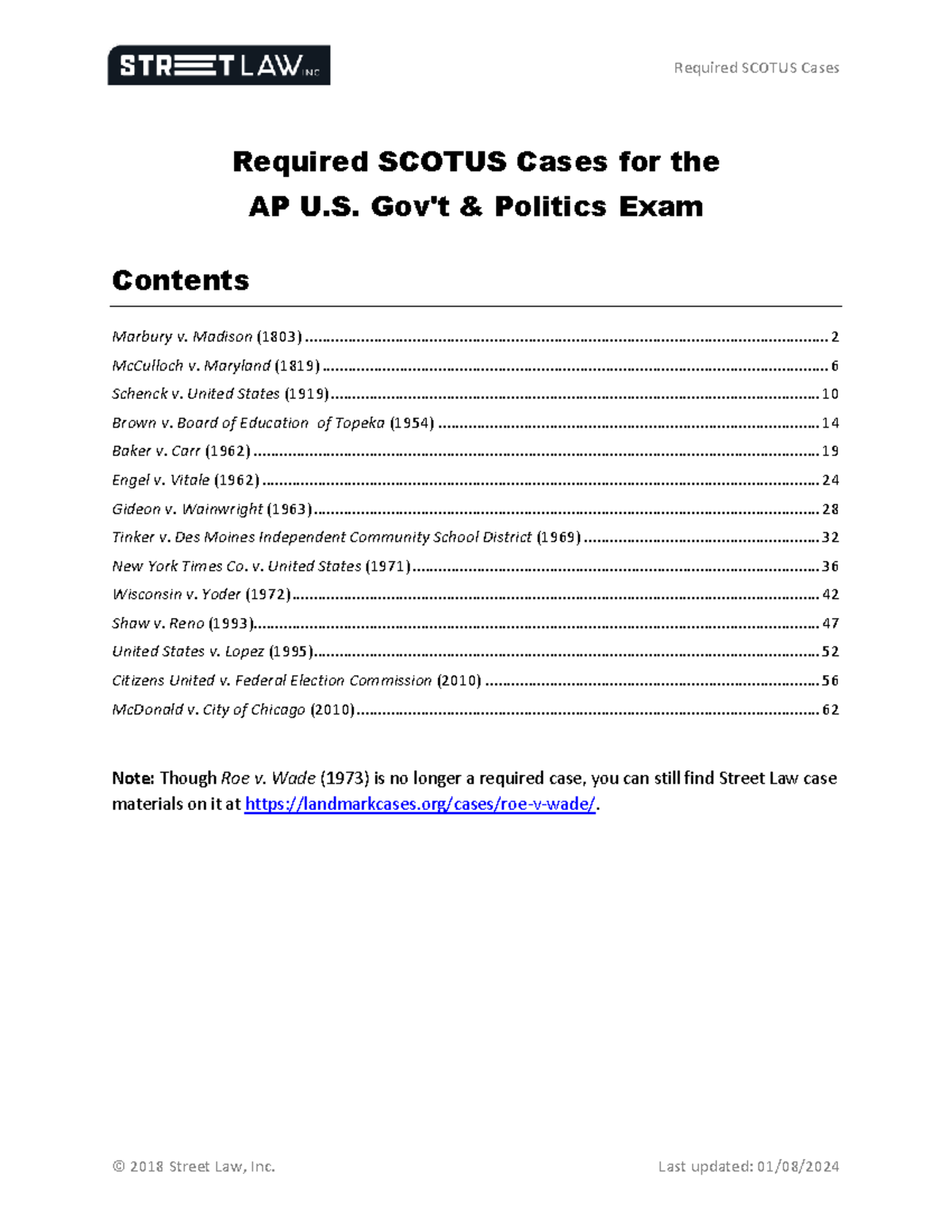
To succeed in AP United States Government and Politics, students must master 15 specific landmark Supreme Court cases required by the College Board. These cases establish the legal frameworks for federalism, civil liberties, civil righ...
To succeed in AP United States Government and Politics, students must master 15 specific landmark Supreme Court cases required by the College Board. These cases establish the legal frameworks for federalism, civil liberties, civil rights, and institutional power. Mastery involves understanding the facts, constitutional provisions, holdings, and lasting impacts of each case to excel in the SCOTUS Comparison Free Response Question (FRQ).
Contents
Success on the AP Gov exam in 2026 requires more than just memorizing names; it requires a deep dive into the constitutional reasoning that the Supreme Court used to reach its decisions. The 15 required cases are the "building blocks" of American jurisprudence. In the current 2025-2026 academic cycle, the College Board continues to emphasize the application of these precedents to new, hypothetical scenarios in the FRQ #3.
Federalism and the Balance of Power
The relationship between the federal government and state governments is a foundational theme in the AP curriculum. Two specific cases define the boundaries of the "Necessary and Proper" clause and the "Commerce Clause," illustrating the tug-of-war between centralized authority and states' rights.
McCulloch v. Maryland (1819)
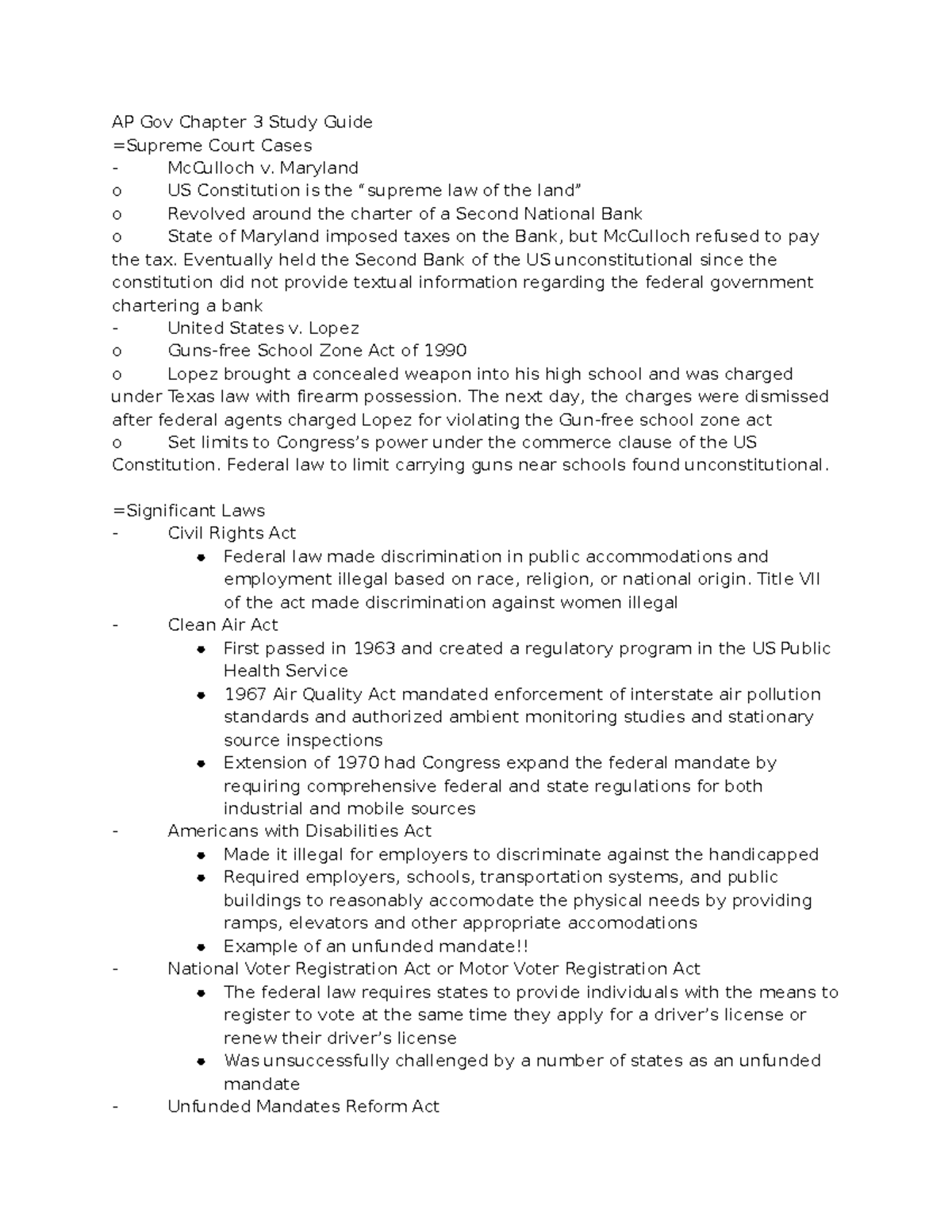
The central issue in McCulloch was whether Congress had the authority to charter a national bank and whether a state (Maryland) could tax that bank. The Court ruled unanimously that under the Necessary and Proper Clause (Article I, Section 8), Congress possessed "implied powers" to create a bank to carry out its expressed fiscal duties. Furthermore, the Court established that the Supremacy Clause (Article VI) prevented states from taxing federal entities.
United States v. Lopez (1995)
This case marked a significant shift toward "devolution" or returning power to the states. Alfonzo Lopez was charged with violating the federal Gun-Free School Zones Act of 1990. The government argued that gun violence in schools affected interstate commerce. However, the Court ruled that the possession of a gun in a local school zone is not an economic activity that has a substantial effect on interstate commerce. This limited the reach of the Commerce Clause for the first time in sixty years.
The First Amendment: Freedom of Religion
The First Amendment contains two distinct clauses regarding religion: the Establishment Clause and the Free Exercise Clause. The required cases highlight the delicate balance between government neutrality and individual religious practice.
Engel v. Vitale (1962)
In this landmark case, the Court addressed whether a state-authored, non-denominational prayer recited in public schools violated the Establishment Clause. The Court ruled 6-1 that even though the prayer was voluntary and non-denominational, the "official" nature of the prayer constituted a government endorsement of religion, which is prohibited by the First Amendment.
Wisconsin v. Yoder (1972)
Focusing on the Free Exercise Clause, Yoder involved Amish parents who refused to send their children to high school, citing religious beliefs. The state of Wisconsin argued that its interest in an educated citizenry outweighed the parents' religious freedom. The Court disagreed, ruling that the individual's interest in the free exercise of religion outweighed the State's interest in compelling school attendance beyond the eighth grade.
The First Amendment: Freedom of Expression and Press
Free speech is not absolute, but the Supreme Court has set a very high bar for government interference, particularly concerning political speech and "prior restraint."
Schenck v. United States (1919)
During World War I, Charles Schenck distributed leaflets urging men to resist the draft. He was convicted under the Espionage Act. The Court upheld the conviction, establishing the "clear and present danger" test. Justice Oliver Wendell Holmes famously noted that the First Amendment does not protect speech that creates a clear and present danger of a significant evil that Congress has the power to prevent.
Tinker v. Des Moines Independent Community School District (1969)
This case defined the limits of speech within public schools. Students wore black armbands to protest the Vietnam War and were suspended. The Court ruled in favor of the students, stating that students do not "shed their constitutional rights to freedom of speech or expression at the schoolhouse gate." The Court held that for a school to suppress speech, it must prove that the conduct would "materially and substantially interfere" with the operation of the school.
New York Times Co. v. United States (1971)
Known as the "Pentagon Papers Case," this addressed the concept of "prior restraint" (government action that prohibits speech or other expression before it can take place). The Nixon administration attempted to prevent the New York Times from publishing classified documents regarding the Vietnam War. The Court ruled that the government carries a "heavy burden" to justify prior restraint and failed to meet it in this case, as publication did not pose an immediate threat to national security.
Selective Incorporation and the Due Process Clause
The 14th Amendment’s Due Process Clause has been used by the Court to apply the Bill of Rights to the states, a process known as "selective incorporation."
Gideon v. Wainwright (1963)
Clarence Earl Gideon was charged with a felony in Florida and requested a lawyer, but the state refused, claiming it only provided counsel in capital (death penalty) cases. The Court ruled unanimously that the Sixth Amendment's right to counsel is a fundamental right essential to a fair trial and is applicable to the states through the Due Process Clause of the 14th Amendment.
Roe v. Wade (1973)
Roe addressed whether the Constitution protects a woman's right to an abortion. The Court ruled that the 14th Amendment's "right to privacy" (first established in Griswold v. Connecticut) was broad enough to encompass a woman's decision to have an abortion. While the 2022 Dobbs decision overturned Roe, it remains a required case for the 2026 AP exam to understand the historical evolution of substantive due process and the right to privacy.
McDonald v. Chicago (2010)
Following the decision in D.C. v. Heller (which applied the 2nd Amendment to federal enclaves), the Court in McDonald addressed whether the 2nd Amendment applies to the states. The Court ruled that the right to keep and bear arms for self-defense is "fundamental" and "deeply rooted in this Nation's history," thereby incorporating the 2nd Amendment to the states via the 14th Amendment.
Civil Rights and the Equal Protection Clause
The struggle for equality is represented by cases that challenge segregation and the systematic exclusion of minority groups from public life.
Brown v. Board of Education (1954)
This is arguably the most important civil rights case in U.S. history. Overturning the "separate but equal" doctrine established in Plessy v. Ferguson (1896), the Court ruled that racial segregation in public schools is inherently unequal and violates the Equal Protection Clause of the 14th Amendment. This decision laid the legal groundwork for the modern Civil Rights Movement.
Representation, Districting, and Campaign Finance
These cases examine how the democratic process is structured, focusing on "one person, one vote," gerrymandering, and the role of money in politics.
Baker v. Carr (1961)
Prior to this case, the Court viewed legislative districting as a "political question" that the judiciary should not touch. However, Charles Baker challenged Tennessee's failure to redraw districts despite massive population shifts. The Court ruled that redistricting challenges are "justiciable," meaning courts can hear them. This established the "one person, one vote" principle, requiring districts to be roughly equal in population.
Shaw v. Reno (1993)
This case dealt with racial gerrymandering. North Carolina created a bizarrely shaped majority-minority district to comply with the Voting Rights Act. The Court ruled that while the goal was to help minorities, the district was so irrationally shaped that it could only be viewed as an effort to segregate voters based on race, which violated the Equal Protection Clause.
Citizens United v. Federal Election Commission (2010)
In a controversial 5-4 decision, the Court ruled that the First Amendment prohibits the government from restricting independent expenditures by corporations and unions for political communications. The Court held that corporate funding of independent political broadcasts in candidate elections cannot be limited, leading to the rise of "Super PACs."
Judicial Review and the Power of the Court
The very power of the Supreme Court to act as the final arbiter of the Constitution was not explicitly stated in the Constitution itself.
Marbury v. Madison (1803)
In the final days of John Adams' presidency, he appointed several "midnight judges," but their commissions were not delivered. William Marbury sued James Madison to compel delivery. Chief Justice John Marshall ruled that while Marbury was entitled to his commission, the law allowing him to sue directly in the Supreme Court (the Judiciary Act of 1789) was unconstitutional. This established the principle of Judicial Review, the power of the Court to declare laws of Congress unconstitutional.
Summary Table of Required SCOTUS Cases
| Case Name | Year | Constitutional Provision | Key Principle/Impact |
|---|---|---|---|
| Marbury v. Madison | 1803 | Article III (Judicial Power) | Established Judicial Review. |
| McCulloch v. Maryland | 1819 | Necessary & Proper; Supremacy Clause | Established implied powers and federal supremacy. |
| Schenck v. U.S. | 1919 | 1st Amendment (Speech) | Established "Clear and Present Danger" test. |
| Brown v. Board of Ed. | 1954 | 14th Amendment (Equal Protection) | Declared "separate but equal" unconstitutional. |
| Baker v. Carr | 1961 | 14th Amendment (Equal Protection) | "One person, one vote"; redistricting is justiciable. |
| Engel v. Vitale | 1962 | 1st Amendment (Establishment Clause) | No school-led prayer in public schools. |
| Gideon v. Wainwright | 1963 | 6th Amendment (Right to Counsel) | Incorporated right to counsel to the states. |
| Tinker v. Des Moines | 1969 | 1st Amendment (Symbolic Speech) | Protected student speech unless "disruptive." |
| NYT v. United States | 1971 | 1st Amendment (Freedom of Press) | Heavy presumption against "prior restraint." |
| Wisconsin v. Yoder | 1972 | 1st Amendment (Free Exercise) | Individual religious practice outweighs state school laws. |
| Roe v. Wade | 1973 | 14th Amendment (Due Process/Privacy) | Established right to abortion (later overturned in 2022). |
| Shaw v. Reno | 1993 | 14th Amendment (Equal Protection) | No racial gerrymandering solely based on race. |
| U.S. v. Lopez | 1995 | Article I (Commerce Clause) | Limited federal power; gun possession is not commerce. |
| McDonald v. Chicago | 2010 | 2nd Amendment; 14th Amendment | Incorporated the right to bear arms to the states. |
| Citizens United v. FEC | 2010 | 1st Amendment (Free Speech) | Corporate/union spending on elections is protected. |
Frequently Asked Questions
Which case is most likely to appear on the 2026 AP Gov FRQ #3?
While any case can appear, the College Board frequently uses cases involving the 1st Amendment, the 14th Amendment, and Federalism. Students should be prepared to compare a required case (like Wisconsin v. Yoder) to a non-required case provided in the exam prompt. The key is identifying the specific constitutional clause that links the two cases.
How does the overturning of Roe v. Wade affect the 2026 exam?
For the 2026 exam, you must still know Roe v. Wade as a required case. You should understand its original holding (protecting abortion rights under the right to privacy) and how it used the 14th Amendment. However, you should also be aware of Dobbs v. Jackson (2022), which returned the authority to regulate abortion to the states, as this reflects the current legal reality you may need to discuss in an Argument Essay.
What is the difference between the Establishment Clause and the Free Exercise Clause?
The Establishment Clause (Engel v. Vitale) prevents the government from setting up an official religion or favoring one religion over another. The Free Exercise Clause (Wisconsin v. Yoder) protects an individual's right to practice their religion as they see fit, provided it doesn't violate "compelling" government interests.
Why is Marbury v. Madison considered the most important case?
Without Marbury v. Madison, the Supreme Court would have no power to strike down unconstitutional laws. It established the judiciary as a co-equal branch of government with the power of judicial review, ensuring that the Constitution remains the supreme law of the land.
What is selective incorporation?
Selective incorporation is the legal doctrine that ensures states cannot enact laws that take away the constitutional rights of American citizens that are enshrined in the Bill of Rights. Cases like Gideon v. Wainwright and McDonald v. Chicago are prime examples where the Court used the 14th Amendment's Due Process Clause to "incorporate" federal rights at the state level.
To achieve a 5 on the AP Government exam, focus on the "Constitutional Question" for each case. Ask yourself: "What part of the Constitution was the Court interpreting?" Once you master the link between the facts and the specific clause, you will be able to tackle any comparison or application question the 2026 exam presents.
Image Gallery