Why the Right Security Controls for Cloud Services Matter
Selecting and implementing the right security controls for cloud services is the primary defense against data breaches, regulatory non-compliance, and operational downtime. These controls ensure that sensitive data remains protected wi...
Selecting and implementing the right security controls for cloud services is the primary defense against data breaches, regulatory non-compliance, and operational downtime. These controls ensure that sensitive data remains protected within the shared responsibility model, allowing organizations to mitigate risks specific to distributed environments while maintaining the high availability and scalability that cloud computing provides.
Contents
As we navigate 2026, the cloud has evolved from a mere storage and hosting solution into the backbone of global enterprise operations, integrating sophisticated artificial intelligence (AI) and machine learning (ML) workflows. However, this complexity introduces new attack vectors. The difference between "generic security" and the "right security controls" is the difference between a vulnerable perimeter and a resilient, zero-trust architecture. Understanding why these specific safeguards matter is essential for any modern organization.
The Foundation: The Shared Responsibility Model in 2026
To understand why specific controls matter, one must first grasp the Shared Responsibility Model. This framework, utilized by major providers like Amazon Web Services (AWS), Microsoft Azure, and Google Cloud Platform (GCP), dictates who is responsible for which aspect of security. In 2026, this model has become more nuanced with the rise of serverless computing and managed AI services.
The cloud service provider (CSP) is generally responsible for the security of the cloud—the physical hardware, data centers, and the global infrastructure. The customer, however, is responsible for security in the cloud. This includes data classification, identity and access management (IAM), and the configuration of the operating systems and applications.
Without the right security controls, a customer may leave a "door" unlocked in an otherwise secure facility. For instance, while a CSP ensures the physical server is not stolen, the customer must ensure that an S3 bucket or a Blob storage container is not accidentally set to "public." The right controls provide the automated oversight necessary to prevent these human errors, which remain the leading cause of cloud-related breaches.
Mitigating the Financial and Reputational Risks
The financial implications of inadequate cloud security have reached record highs. By 2026, the average cost of a data breach for enterprises using poorly configured cloud environments has surged, driven by higher discovery costs and more aggressive ransomware tactics.
Direct Costs of Data Breaches
When security controls are insufficient, attackers can move laterally through a network. The right controls, such as micro-segmentation, limit this movement, ensuring that a single compromised credential does not lead to a total system takeover. The cost of a breach involves more than just the ransom or the lost data; it includes forensic investigations, legal fees, notification costs, and the implementation of new security measures under extreme pressure.
Reputational Damage and Trust
In a competitive market, trust is a primary currency. Customers and partners expect their data to be handled with the highest level of integrity. A significant breach caused by the absence of fundamental controls—like lack of multi-factor authentication (MFA) or unencrypted databases—can lead to a permanent loss of customer confidence. In the cloud era, migrating to a competitor is easier than ever, making the "right" security a key component of customer retention.
Regulatory Compliance and Legal Necessity
The regulatory landscape in 2026 is stricter than ever before. With the full implementation of updated global frameworks and the maturation of AI-specific regulations, organizations are held to rigorous standards regarding data sovereignty and privacy.
The right security controls matter because they provide the "audit trail" required to prove compliance. Controls such as automated logging and monitoring are not just technical requirements; they are legal safeguards. Under frameworks like GDPR, HIPAA, or the Digital Operational Resilience Act (DORA), organizations must demonstrate that they have taken "appropriate technical and organizational measures" to protect data.
Failure to implement specific controls—such as encryption for data at rest or strict access logs—can result in fines that scale with global turnover. Furthermore, in 2026, many insurance providers refuse to pay out on cybersecurity claims if the organization cannot prove that "standard" controls were active at the time of the incident.
Addressing the Modern Threat Landscape: AI and Automation
By 2026, cyber-adversaries are utilizing AI to scan for vulnerabilities at a pace that manual security teams cannot match. The right security controls now include AI-driven defense mechanisms that can identify and block anomalous behavior in real-time.
Identity as the New Perimeter
In the past, security was focused on the network perimeter (firewalls). In the cloud, the perimeter is Identity. The right controls in 2026 focus heavily on Identity and Access Management (IAM). This includes:
- Just-in-Time (JIT) Access: Providing users with the minimum permissions needed for the shortest duration possible.
- Phishing-Resistant MFA: Moving beyond SMS-based codes to hardware keys or biometric-linked passkeys.
- Conditional Access: Evaluating the risk of a login attempt based on location, device health, and time of day before granting access.
Without these specific controls, a stolen password becomes a "skeleton key" to the entire cloud infrastructure.
Technical Specifications: Comparing Essential Cloud Security Controls
The following table outlines key security control categories and why they are vital for cloud services in the current environment.
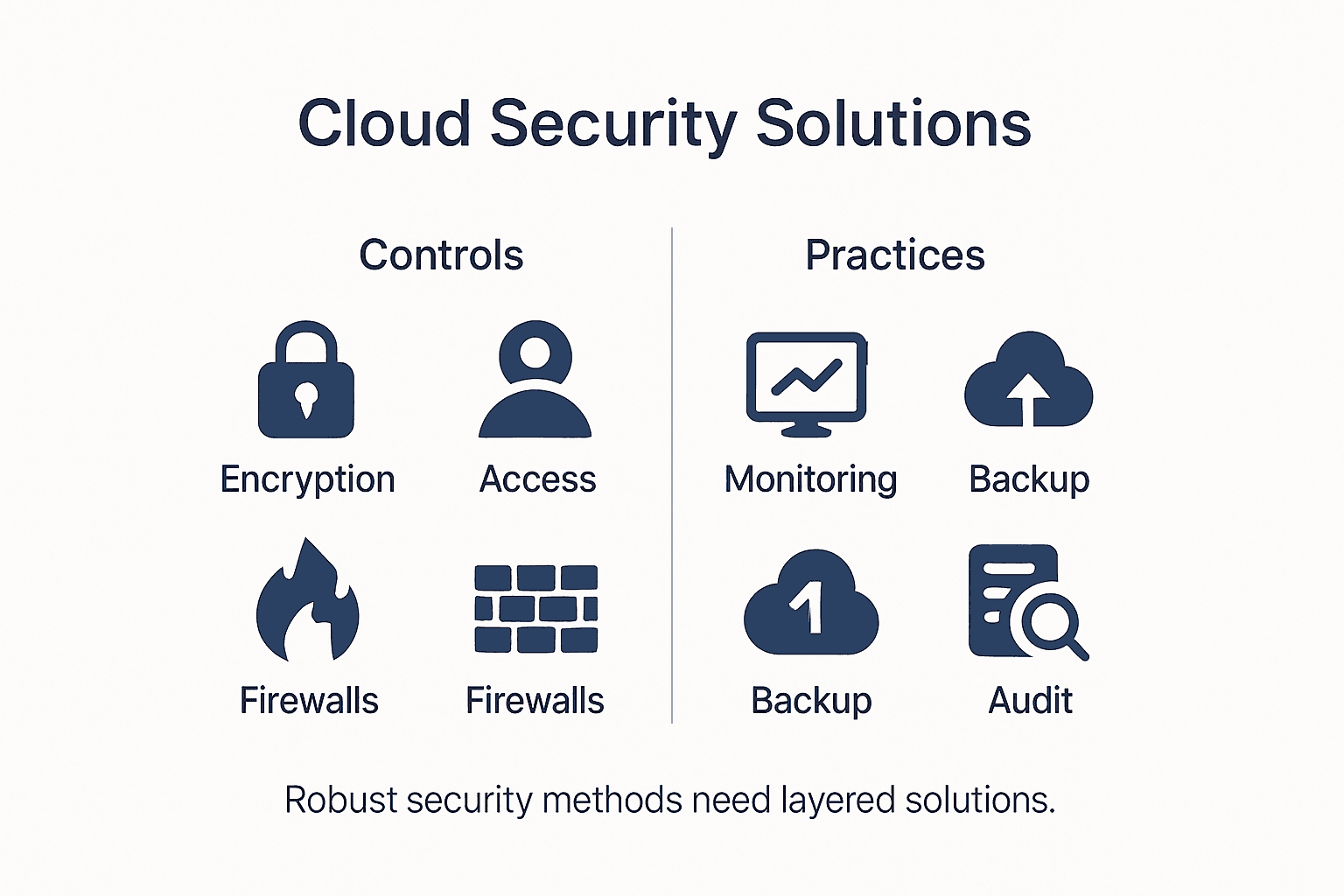
| Control Category | Primary Function | Business Impact | Why It Matters in 2026 |
|---|---|---|---|
| IAM (Identity & Access Management) | Governs who can access which resources and under what conditions. | Reduces risk of unauthorized access and lateral movement. | Credentials are the #1 target for AI-driven brute-force attacks. |
| CSPM (Cloud Security Posture Management) | Automatically identifies and remediates misconfigurations. | Prevents data leaks caused by human error or "drift." | Complex multi-cloud environments are too large for manual auditing. |
| Data Encryption (AES-256/Quantum-Safe) | Protects data at rest and in transit from being read by unauthorized parties. | Ensures data remains useless if stolen; meets compliance. | Preparing for "store now, decrypt later" threats from future quantum tech. |
| WAF & DDoS Protection | Filters malicious web traffic and mitigates denial-of-service attacks. | Maintains service availability and protects against web exploits. | Botnets have become more sophisticated, requiring automated edge defense. |
| SIEM / SOAR | Aggregates logs and automates responses to security incidents. | Minimizes "mean time to respond" (MTTR) during an active breach. | Human analysts cannot keep up with the volume of cloud telemetry data. |
Operational Resilience and Business Continuity
Cloud services are often chosen for their uptime, but that uptime is only as good as the security protecting it. The "right" security controls include robust backup and disaster recovery (DR) protocols that are "air-gapped" or immutable.
In 2026, ransomware often targets the cloud backups first. If your security controls do not include immutable backups—backups that cannot be changed or deleted for a set period—your organization remains vulnerable to total data loss. By implementing the right integrity controls, you ensure that even in the event of a successful breach, the business can be restored to a functional state within hours rather than weeks.
Furthermore, configuration management (Infrastructure as Code or IaC) allows for the rapid redeployment of secure environments. If a segment of your cloud is compromised, the right controls allow you to "kill" the affected environment and spin up a clean, verified version instantly, maintaining business continuity.
Common Mistakes in Control Selection
It is a common error to assume that more controls are always better. In reality, "security friction" can lead to employees bypassing controls to get their work done.
- Over-Privileging: Giving developers "Admin" rights to avoid ticket delays. This is a high-risk practice that the right IAM controls (like PIM/PAM) resolve.
- Neglecting Egress Filtering: Organizations often focus on what comes in but ignore what goes out. The right controls monitor outbound traffic to prevent "data exfiltration" to known malicious IPs.
- Ignoring Shadow IT: Employees using unapproved cloud services (SaaS) creates a blind spot. The right controls include Cloud Access Security Brokers (CASB) to gain visibility into all cloud usage across the enterprise.
Frequently Asked Questions
What is the most important security control for a small business using cloud services?
The single most important control is Multi-Factor Authentication (MFA), specifically phishing-resistant MFA. Most cloud breaches start with compromised credentials. By requiring a second form of verification that cannot be easily intercepted, you eliminate the vast majority of automated attacks.
Why is "Cloud Posture Management" (CSPM) emphasized so much?
CSPM matters because cloud environments change constantly. Developers spin up new instances, and settings can "drift" from the secure baseline. CSPM tools act as a continuous auditor, flagging if a storage bucket becomes public or if a port is opened accidentally, which prevents the most common cause of cloud data leaks.
How does encryption at rest differ from encryption in transit?
Encryption in transit protects data as it travels over the internet or between servers (using protocols like TLS 1.3). Encryption at rest protects the data while it is stored on a disk (using AES-256). Both are necessary; without both, data is vulnerable either while being moved or if the physical storage media or virtual disk is accessed.
Do I need different security controls for different cloud providers (AWS vs. Azure)?
While the underlying principles of the controls remain the same, the implementation varies by provider. The "right" approach in 2026 often involves using a third-party security layer or a "cross-cloud" management platform to ensure consistent security policies are applied regardless of which cloud provider is being used.
Does using a cloud provider mean I don't need my own security team?
No. While the provider handles the "heavy lifting" of physical security and hardware maintenance, your internal team or a managed service provider (MSP) is still required to configure the security controls, manage identities, and respond to alerts generated by your specific workloads.
Practical Recommendations for 2026
To ensure your cloud environment is adequately protected, start by performing a comprehensive risk assessment tailored to your specific cloud usage. Do not rely on "default" settings; these are often designed for ease of use rather than maximum security.
Identify your most sensitive data—"the crown jewels"—and apply the most stringent controls there first. Implement a Zero Trust architecture where no user or device is trusted by default, even if they are inside the network. Finally, automate your security posture. In the fast-moving cloud landscape of 2026, manual security is no longer sufficient; use automated tools for configuration monitoring, threat detection, and incident response to stay ahead of modern threats.
Image Gallery