How Bundling Auto and Home Insurance Saves You Money in 2026
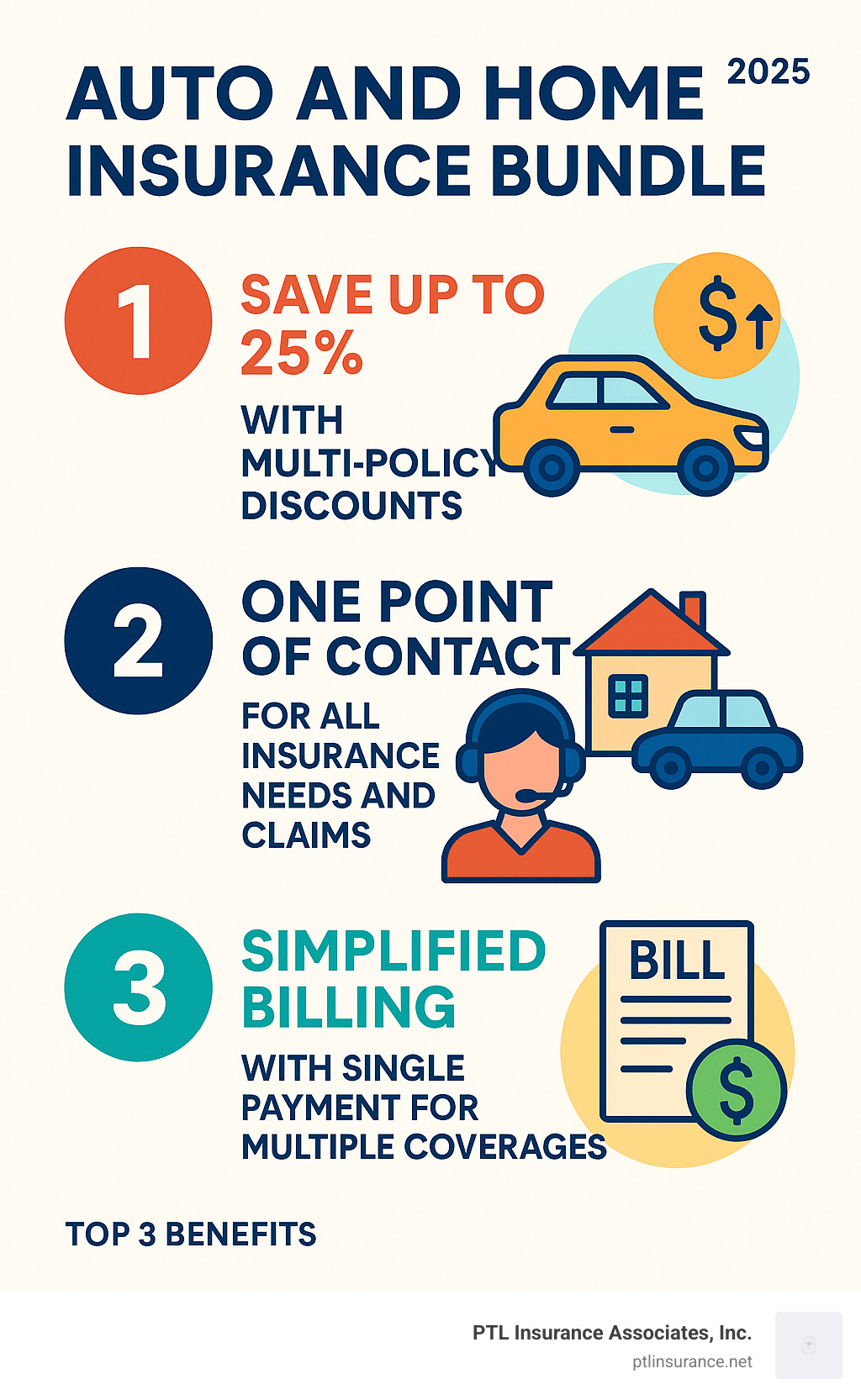
Bundling auto and home insurance—frequently referred to by carriers as a multi-policy discount—saves you money by reducing your total annual premium by an average of 15% to 25%. Insurance companies offer these significant price reducti...
Bundling auto and home insurance—frequently referred to by carriers as a multi-policy discount—saves you money by reducing your total annual premium by an average of 15% to 25%. Insurance companies offer these significant price reductions to increase customer retention and lower their administrative overhead, as managing multiple policies under one account is more cost-effective for the insurer.
Contents
The practice of "bundling" has become a cornerstone of personal finance management in 2026. As the insurance market continues to adjust to evolving climate risks and vehicle technology costs, combining your primary insurance needs remains the most effective way for the average consumer to lower their fixed monthly expenses. However, understanding the mechanics of these discounts is essential to ensure you are not sacrificing coverage quality for a lower price tag.
The Economic Logic Behind the Multi-Policy Discount
Insurance carriers are fundamentally in the business of risk management and customer lifetime value. From the insurer's perspective, a client who holds both a homeowners policy and an auto policy is statistically less likely to "churn" or switch to a competitor. In 2026, the cost of acquiring a new customer is significantly higher than the cost of retaining an existing one. By offering a bundle discount, the carrier effectively shares a portion of that saved acquisition cost with the policyholder.
Furthermore, there is an actuarial component to bundling. Data suggests that individuals who bundle multiple policies tend to be more "insurance-stable." These policyholders often exhibit lower claim frequencies across their entire portfolio compared to those who shop for separate policies strictly based on the lowest individual price. This perceived lower risk allows carriers to apply "tier-based" pricing that rewards the consolidated account holder.
Administrative and Operational Efficiency
When you bundle, you typically deal with a single billing system, one mobile app, and one point of contact for customer service. For the insurance company, this reduces the "per-policy" operational cost. Instead of processing two separate payments or managing two different sets of renewal notices, the digital infrastructure handles them as a unified unit. These efficiencies are passed down through the premium structure, often showing up as a line-item credit on both the auto and the home declarations pages.
Realizing the Savings: Percentage Breakdown by Coverage
The amount you save through bundling is not a flat dollar amount; it is usually a percentage applied to the base premium of each policy. In 2026, the specific savings can vary significantly depending on the state's regulatory environment and the carrier's appetite for specific risks.
- Auto Insurance Savings: Most carriers apply a 10% to 15% discount on the auto portion of the bundle. This is particularly valuable in 2026 as the cost of repairing modern electric vehicles and cars equipped with advanced driver-assistance systems (ADAS) has kept base premiums high.
- Homeowners Insurance Savings: The discount on the home policy is often more substantial, ranging from 15% to 25%. Because home insurance premiums are generally higher than auto premiums (especially in catastrophe-prone areas), this percentage represents the largest portion of the total dollar savings.
- Combined Impact: For a household paying $2,000 for home insurance and $1,500 for auto insurance annually, a 20% bundle discount could result in $700 in annual savings.
The Impact of Modern Risk Factors
In 2026, many carriers have integrated telematics (usage-based insurance) into their bundles. By agreeing to share driving data through a mobile app or a vehicle's embedded system, policyholders can often stack an additional "safe driver" discount on top of their existing bundle discount. This "stacked" approach can lead to total savings exceeding 30% for high-qualified individuals.
Key Benefits Beyond the Premium Discount
While the financial reduction is the primary driver for bundling, there are several secondary benefits that improve the policyholder experience and financial security.
The Single Deductible Benefit
One of the most valuable, yet often overlooked, features offered by some carriers in a bundle is the "single deductible." If a single event—such as a severe windstorm or a garage fire—damages both your home and your car, a bundled policy may allow you to pay only one deductible rather than one for each policy. Given that home deductibles in 2026 often start at $1,000 to $2,500, avoiding a second $500 or $1,000 auto deductible provides immediate liquidity during a crisis.
Simplified Claims and Management
Managing insurance through a single portal reduces the likelihood of coverage gaps. When a single agent or company oversees both your property and your liability, they can more easily identify if your limits are consistent across policies. For example, if you increase your auto liability limits to protect your assets, a bundled agent will likely recommend a matching increase (or an umbrella policy) to ensure your home is equally protected.
When Bundling Might Not Be the Cheapest Option
It is a common misconception that bundling is always the cheapest route. There are specific scenarios where "unbundling" or "splitting" your insurance may result in lower total costs.
- High-Risk Drivers: If one member of the household has a recent DUI or multiple at-fault accidents, a standard carrier that offers a great home insurance rate might charge an exorbitant premium for the auto portion—even with the bundle discount. In this case, it may be cheaper to keep the home with the standard carrier and move the auto to a non-standard or "high-risk" specialty insurer.
- Unique Property Risks: Homeowners in high-risk wildfire or hurricane zones may find that only a few specialty carriers will cover their property. These specialty carriers often do not offer competitive auto insurance. In these instances, the "best of breed" approach—buying the best possible home policy and a separate, affordable auto policy—frequently beats the bundled price of a carrier that is trying to overcharge for the high-risk element.
- The "Teaser Rate" Trap: Some carriers offer deep "new business" bundle discounts that gradually erode over three to five years. It is vital to review your renewal notices in 2026 to ensure the discount remains competitive relative to the current market.
Comparison of Major Carrier Bundling Features (2026)
| Carrier Type | Typical Bundle Discount | Key Advantage | Single Deductible Available? |
|---|---|---|---|
| National Captive (e.g., State Farm, Allstate) | 15% – 25% | Local agent support and high policy stability. | Often (varies by state) |
| Direct Writer (e.g., GEICO, Progressive) | 10% – 20% | Superior digital tools and fast online quoting. | Less common |
| Mutual Insurers (e.g., Liberty Mutual, Amica) | 15% – 22% | Dividend potential for policyholders. | Sometimes |
| Specialty/High-Net-Worth (e.g., Chubb, PURE) | 10% – 15% | High liability limits and agreed-value coverage. | Usually Yes |
Note: Discounts and features are subject to state-specific regulations and individual underwriting approval.
Step-by-Step Guide to Bundling Your Insurance
If you are currently insured with two different companies, follow these steps to consolidate and save.
1. Gather Your Current Declarations Pages
You cannot compare "apples to apples" without knowing your current coverage limits, deductibles, and endorsements. Ensure you have the "Dec Page" for both your home and auto policies.
2. Request a "Bundled" Quote from Both Existing Carriers
Start with the companies you already know. Ask your current auto insurer for a home quote, and vice versa. This is often the path of least resistance and allows you to see if your current companies are competitive in the other's "lane."
3. Consult an Independent Insurance Agent
Independent agents represent multiple carriers. They can run your profile through several bundling scenarios—some with large national brands and others with regional carriers that might offer niche discounts. According to the Insurance Information Institute, comparing at least three quotes is the only way to ensure market-rate accuracy.
4. Evaluate the Total Cost, Not Just the Discount
Ignore the "20% off" marketing for a moment and look at the bottom-line annual total. If Company A gives you a 25% discount but has higher base rates, it may still be more expensive than Company B, which offers only a 10% discount but has lower base rates.
5. Check for Compatibility with Umbrella Insurance
If you have significant assets, you should consider an Umbrella Policy. Most carriers require you to have both your home and auto insurance with them before they will issue an umbrella policy. Bundling is often a prerequisite for this critical layer of liability protection.
Financial and Professional Advice Limitation
This article provides general information about insurance bundling and is not a substitute for professional financial or legal advice. Insurance regulations vary significantly by jurisdiction. Always consult with a licensed insurance agent or financial advisor in your specific state or province to discuss your individual coverage needs and eligibility for discounts.
Frequently Asked Questions
Does bundling auto and home insurance affect my credit score?
No, the act of bundling does not affect your credit score. However, most insurance carriers use an "insurance-based credit score" to determine your base premiums. When you apply for a new bundle quote, the insurer will perform a "soft pull" of your credit history, which does not impact your credit rating but allows them to calculate your risk tier accurately.
Can I bundle if I rent my home instead of owning it?
Yes. "Bundling" is not limited to homeowners. Most carriers offer a "Multi-Policy Discount" for combining auto insurance with renters insurance or condo insurance. While the dollar savings on the renters policy may be smaller (since renters insurance is generally inexpensive), the discount applied to the auto policy can still be substantial.
Is it hard to switch if my home insurance is paid through escrow?
Switching is relatively straightforward, even with an escrow account. Once you secure a new bundled policy, you must notify your mortgage servicer of the change. Your new agent will typically send the new policy's "Evidence of Insurance" to the lender. If there is a refund from your old home policy, it will be mailed to you directly, and you should typically deposit it back into your escrow account to avoid a future shortage.
Will I lose my "loyalty discount" if I switch to a bundle with a new company?
While you may lose a specific longevity or loyalty discount with your current carrier, the "new business" bundle discount at a different company is almost always larger than a standard loyalty credit. In 2026, the market rewards shoppers more than it rewards long-term tenure, making it financially beneficial to compare rates every two to three years.
Can I bundle more than just home and auto?
Most carriers allow you to add "pylons" to your bundle. This can include motorcycle insurance, boat insurance, RV insurance, or even life insurance. Each additional policy typically increases the discount percentage or adds another layer of "multi-policy" credit to the primary auto and home accounts.
Practical Recommendation
The most effective way to save money in 2026 is to review your bundled insurance policies annually. Set a calendar reminder for 45 days before your auto policy renewal. Use this time to request a "re-quote" from your current agent and at least one competitor. If your rates have increased by more than 5% without a corresponding claim or change in your risk profile, it is likely time to switch carriers to recapture the full benefit of a bundle discount.
Image Gallery