Orca Security Cloud-Based Financial Compliance Software: A Comprehensive Operational Guide
Orca Security provides agentless cloud security and compliance posture management that financial institutions use to continuously map, monitor, and audit cloud-native infrastructures. Financial institutions operating in cloud environme...
Orca Security provides agentless cloud security and compliance posture management that financial institutions use to continuously map, monitor, and audit cloud-native infrastructures.
Contents
Financial institutions operating in cloud environments face a complex matrix of regulatory mandates, security threats, and strict reporting deadlines. As banks, fintech startups, and asset management firms migrate critical workloads to platforms like Amazon Web Services (AWS), Microsoft Azure, and Google Cloud Platform (GCP), securing these environments becomes inseparable from regulatory adherence. Traditional compliance monitoring tools often rely on resource-heavy agents, require extensive manual configuration, and create significant performance overhead. Orca Security approaches this challenge through its patented SideScanning technology, delivering cloud security posture management (CSPM) and compliance solutions designed to assess multi-cloud estates without installing individual virtual machine agents.
Understanding Cloud-Based Financial Compliance
Cloud-based financial compliance refers to the automated processes, software tools, and continuous auditing mechanisms that financial organizations use to prove adherence to industry regulations and statutory frameworks within cloud environments. Unlike traditional on-premises infrastructures where physical hardware and localized networks dictate audit boundaries, cloud environments are dynamic, ephemeral, and distributed.
Financial entities must comply with a mosaic of rigorous frameworks, including the Payment Card Industry Data Security Standard (PCI DSS), the Health Insurance Portability and Accountability Act (HIPAA) where applicable, the Gramm-Leach-Bliley Act (GLBA), SOC 2 Type II, and European regulations such as the Digital Operational Resilience Act (DORA). These frameworks require strict access controls, data encryption at rest and in transit, vulnerability management, and immutable audit logs.
Cloud-based compliance software automates the gathering of evidence, maps cloud resource configurations directly to regulatory controls, and flags misconfigurations before they manifest as audit failures or security breaches. The primary operational objective is moving away from periodic, manual point-in-time audits toward a state of continuous compliance assurance.
Core Architecture: How Orca Security Operates
The foundational differentiator of Orca Security's platform is its agentless architecture, powered by SideScanning technology. Understanding how this architecture functions is essential for risk and compliance officers evaluating its suitability for financial workloads.
The Limitation of Traditional Agents
Historically, cloud security tools required deploying software agents onto every virtual machine, container, or host. In financial environments, this creates several operational friction points:
- Performance impact on high-throughput transaction processing systems.
- Administrative overhead of maintaining agent software lifecycles.
- Coverage gaps caused by newly spun-up instances or forgotten assets.
- Potential security vulnerabilities introduced by agents running with elevated permissions.
The SideScanning Mechanism
Orca Security bypasses the need for individual instance agents by reading the block storage (snapshots and disk volumes) of cloud assets out-of-band. By taking read-only snapshots of cloud storage and analyzing them externally, Orca builds a comprehensive inventory of the entire cloud estate.
This approach examines operating systems, application code, configurations, secrets, and identity and access management (IAM) permissions without consuming CPU cycles on production servers or interfering with sensitive financial transactions. For compliance teams, this means complete visibility across the environment, including shadow IT and ephemeral serverless functions, without administrative friction.
Financial Compliance Frameworks Supported by Orca Security
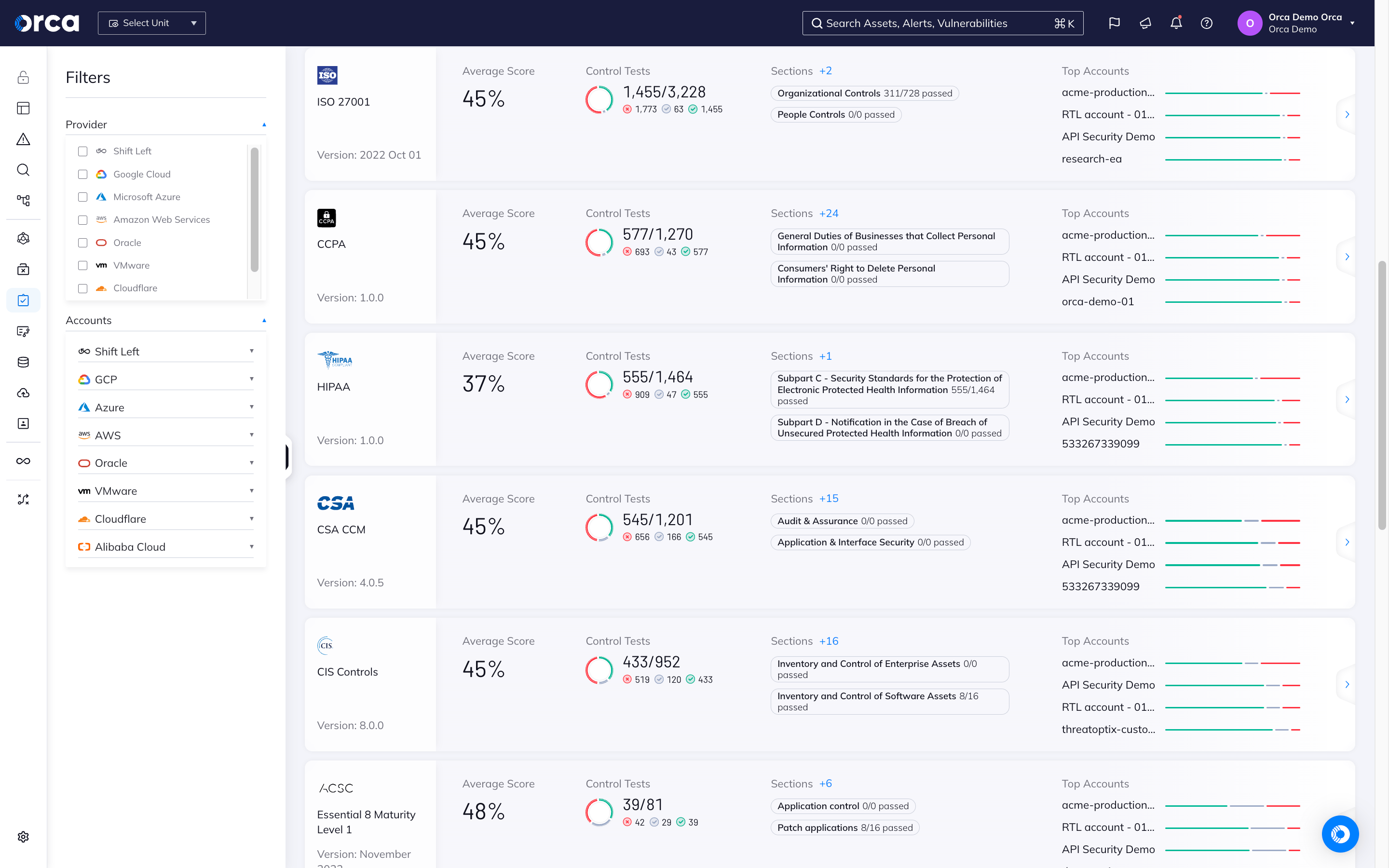
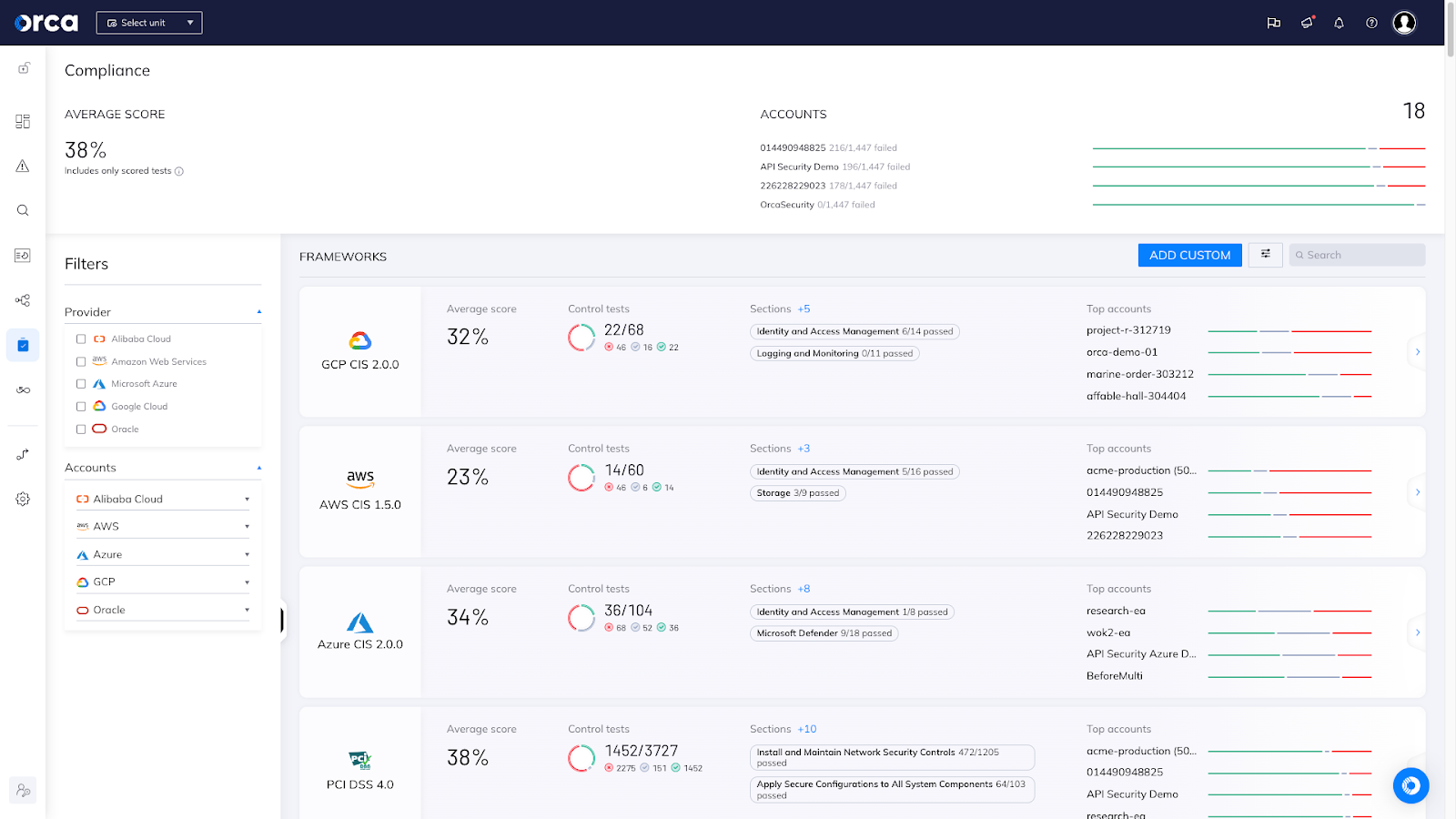
Financial institutions are legally obligated to maintain rigorous controls over customer data and transactional integrity. Orca Security maps its scanning engine against major compliance frameworks, translating technical cloud configurations into audit-ready reporting.
PCI DSS (Payment Card Industry Data Security Standard)
For organizations processing credit card transactions, PCI DSS compliance is non-negotiable. Orca continuously assesses cardholder data environments (CDE) for unencrypted data, overly permissive network exposure, missing patches, and weak authentication mechanisms. The platform maps findings directly to PCI DSS requirements, significantly reducing the time required to compile annual Reports on Compliance (RoC) or Self-Assessment Questionnaires (SAQ).
SOC 2 Type II
SOC 2 compliance evaluates an organization’s information systems relative to security, availability, processing integrity, confidentiality, and privacy. Orca provides continuous monitoring for the Security and Availability Trust Services Criteria. By automating evidence collection for configuration management, access controls, and vulnerability remediation, the platform helps organizations demonstrate operational maturity to enterprise clients and auditors.
GLBA (Gramm-Leach-Bliley Act)
The GLBA mandates that financial institutions protect consumer financial privacy and safeguard sensitive data. Orca’s data discovery engine identifies where Personally Identifiable Information (PII) and non-public personal information (NPI) reside within cloud storage buckets, databases, and volumes, alerting compliance officers to unauthorized exposure or inadequate encryption.
Key Features for Financial Cloud Environments
Securing financial cloud workloads requires specialized capabilities that extend beyond basic asset discovery. Orca Security integrates several key modules tailored to meet these demanding operational requirements.
Cloud Security Posture Management (CSPM)
CSPM capabilities continuously evaluate multi-cloud configurations against industry benchmarks, Center for Internet Security (CIS) benchmarks, and custom organizational policies. In a financial setting, CSPM detects misconfigured storage buckets, open database ports, and non-compliant encryption keys, providing prioritized remediation guidance.
Cloud Workload Protection Platform (CWPP)
While SideScanning handles passive inspection, the CWPP component identifies runtime risks, OS vulnerabilities, malware, and compromised credentials. Financial applications often rely on complex microservices architectures; Orca correlates workload vulnerabilities with network accessibility and data sensitivity to determine actual exploitability.
Cloud Infrastructure Entitlement Management (CIEM)
Identity and access management is a primary vector for cloud security breaches. Orca’s CIEM engine analyzes IAM policies, roles, and user permissions across AWS, Azure, and GCP. It detects excessive privileges, dormant accounts, and toxic permission combinations, helping financial institutions enforce the principle of least privilege required by regulatory auditors.
Shift-Left Security and Infrastructure as Code (IaC) Scanning
Compliance begins before code reaches production. Orca integrates into developer pipelines and CI/CD tools to scan Infrastructure as Code templates (such as Terraform, AWS CloudFormation, and Kubernetes manifests). This prevents non-compliant configurations from being deployed into live financial production environments.
Comparison of Financial Cloud Compliance Approaches
Evaluating compliance tooling requires balancing depth of visibility against operational drag. The table below compares agentless CSPM approaches with traditional agent-based solutions and manual auditing methods.
| Evaluation Metric | Agentless CSPM (Orca Security) | Traditional Agent-Based Tools | Manual Auditing & Point-in-Time Scans |
|---|---|---|---|
| Deployment Speed | Minutes (API integration) | Weeks/Months (agent rollout) | N/A (Documentation driven) |
| Performance Overhead | Zero production impact | Low to moderate CPU/Memory drain | None, but highly disruptive to staff |
| Coverage Completeness | 100% of cloud estate (including shadow IT) | Subject to agent installation gaps | Prone to human error and blind spots |
| Audit Readiness | Continuous, real-time dashboards | Periodic scans requiring manual collation | Historical snapshots valid only at audit date |
| Maintenance Burden | Minimal (cloud-native management) | High (agent updates, version conflicts) | Extremely high (resource-intensive) |
Implementation Prerequisites and Operational Workflow
Deploying a cloud-native compliance platform in a financial institution demands a structured approach to ensure proper authorization, least-privilege access, and alignment with internal governance policies.
1. Cloud Provider Integration
The initial technical step involves connecting Orca Security to the organization's cloud service providers (AWS, Azure, GCP). This is typically achieved by deploying read-only cross-account roles or service principals with strictly scoped permissions. Because Orca does not require administrative write access for its core scanning functions, security architects can provision access with minimal institutional risk.
2. Baseline Configuration and Policy Selection
Once connected, compliance officers select the regulatory frameworks relevant to their operational footprint (e.g., PCI DSS v4.0, SOC 2, ISO 27001). The platform ingests cloud metadata and establishes a baseline inventory of all assets, identities, data stores, and network pathways.
3. Alert Triage and Risk Prioritization
Financial cloud environments often generate thousands of low-level security alerts. Orca uses its proprietary Risk Graph technology to contextualize alerts. Instead of treating every unpatched vulnerability equally, the platform highlights vulnerabilities that are actively exposed to the internet, contain sensitive financial data, and possess administrative privileges. This allows compliance and security teams to focus on critical risk vectors first.
4. Remediation and Continuous Reporting
Remediation workflows can be integrated into existing enterprise ticketing systems such as Jira, ServiceNow, or automated via webhook triggers to developer channels. Continuous compliance dashboards generate reports formatted specifically for internal risk committees, board members, and external regulatory auditors.
Operational Limitations and Considerations
While agentless cloud compliance software offers significant advantages, risk officers must evaluate certain operational realities before adoption:
- Snapshot Limitations: Because SideScanning relies on disk snapshots, organizations must account for cloud provider API rate limits and snapshot creation windows, particularly in massive enterprise environments with petabytes of data.
- Deep Runtime Monitoring: While SideScanning excels at static configuration, vulnerability, and asset discovery, certain real-time behavioral monitoring use cases may still benefit from lightweight runtime agents or network telemetry tools.
- Organizational Culture: Adopting automated compliance tooling requires cross-functional alignment between security, compliance, development, and finance teams to ensure that automated remediation policies do not disrupt ongoing software delivery pipelines.
Frequently Asked Questions
Does Orca Security replace traditional SIEM and log management tools?
No. Orca focuses on cloud security posture management, vulnerability assessment, and compliance posture. It complements Security Information and Event Management (SIEM) systems like Splunk or Microsoft Sentinel by providing rich asset and configuration context, but it does not ingest operational runtime event logs for real-time threat hunting in the same manner.
How does Orca Security handle data privacy regulations like GDPR?
Orca’s SideScanning technology reads metadata and disk structures to identify the presence and location of sensitive data (such as PII or financial records) without unnecessarily extracting or storing the underlying regulated customer data outside the customer’s secure cloud perimeter, aligning with data minimization principles.
Can Orca Security audit multi-cloud financial architectures?
Yes. Financial institutions frequently utilize multi-cloud strategies to prevent vendor lock-in and maintain operational resilience. Orca provides a unified dashboard and compliance engine spanning AWS, Microsoft Azure, Google Cloud Platform, and Kubernetes environments.
What is the typical timeframe for initial deployment?
Initial connection and baseline asset discovery typically occur within hours of granting read-only access permissions to the platform. Generating comprehensive compliance posture reports depends on the size of the cloud estate but generally takes less than 24 hours.
Conclusion and Next Actions
Securing cloud-based financial infrastructure requires moving beyond periodic manual checks and resource-heavy agent software. Orca Security’s agentless, SideScanning approach offers financial institutions continuous visibility, automated regulatory mapping, and context-aware risk prioritization without compromising system performance.
Organizations evaluating this software should begin by defining their specific regulatory requirements, inventorying their multi-cloud footprint, and scheduling a targeted proof-of-concept (PoC) to validate platform integration within a non-production cloud environment.
Image Gallery