The History of Manchester United Goalkeepers: From Legend to Modern Sweeper
The history of Manchester United goalkeepers spans over a century of iconic figures who defined distinct eras of English and European football. From early pioneers like Harry Moger and Munich hero Harry Gregg to legendary champions Pet...
The history of Manchester United goalkeepers spans over a century of iconic figures who defined distinct eras of English and European football. From early pioneers like Harry Moger and Munich hero Harry Gregg to legendary champions Peter Schmeichel, Edwin van der Sar, and David de Gea, the position has evolved from traditional shot-stopping to modern, ball-playing sweeper-keepers.
Contents
Early Foundations: Pre-War Era to the Busby Babes
The role of the goalkeeper at Manchester United was established during the club's formative years at Bank Street and Old Trafford. Long before modern tactical systems prioritized distribution, early goalkeepers were judged entirely on positional resilience, aerial bravery, and shot-stopping under physical pressure from opposition forwards.
Harry Moger and the First Golden Age
Harry Moger was Manchester United's first truly dominant goalkeeper. Joining the club in 1903 from Southampton, Moger made 266 appearances during a transformative period under manager Ernest Mangnall. Standing over six feet tall—a rare physical stature for custodians in the Edwardian era—Moger possessed an exceptional aerial reach that neutralized opposition crossing tactics.
Moger anchored the defense during Manchester United’s inaugural golden age, securing the club's first League Championship in the 1907–08 season, followed by an FA Cup victory in 1909 and a second League title in 1910–11. His composure under pressure established an early benchmark for future Old Trafford goalkeepers.
Harry Gregg and the Courage of Munich
Few players embody the spirit of Manchester United more profoundly than Harry Gregg. Signed from Doncaster Rovers in December 1957 for £23,500—then a world-record fee for a goalkeeper—Gregg quickly demonstrated why Sir Matt Busby prioritized his signature. Gregg possessed aggressive aerial command, elite reflexes, and an authoritative presence that stabilized Busby's young squad.
Just three months into his Manchester United career, tragedy struck during the Munich air disaster on February 6, 1958. Demonstrating heroic bravery, Gregg escaped the wreckage of the aircraft and returned to rescue teammates Bobby Charlton and Dennis Viollet, infant passenger Vesna Lukić, and her pregnant mother.
Despite the emotional and physical trauma of Munich, Gregg returned to the pitch just 13 days later against Sheffield Wednesday. Later that year, he was named the best goalkeeper of the 1958 FIFA World Cup in Sweden. Though injuries limited his overall silverware, Gregg’s courage and shot-stopping ability remain monumental pillars in the club's history.
The European Pioneers: Alex Stepney and the 1968 Triumph
Following the Munich air disaster, Sir Matt Busby set out to rebuild a squad capable of conquering Europe. A critical piece of that rebuild arrived in May 1966, when Manchester United signed Alex Stepney from Chelsea for a record fee of £55,000.
Stepney immediately made the number one shirt his own, providing the positional discipline and rapid reaction saves required to stabilize Busby’s attacking side. In his debut season (1966–67), Stepney helped United secure the First Division title, earning qualification for the European Cup.
Key Milestone: 1968 European Cup Final Match: Manchester United 4-1 Benfica (AET) Location: Wembley Stadium, London Stepney's Crucial Save: Point-blank late save against Eusébio at 1-1
The pinnacle of Stepney’s career came on May 29, 1968, in the European Cup Final against Benfica at Wembley Stadium. With the match tied at 1–1 late in regulation time, Portuguese legend Eusébio broke free from the defense. Stepney stood tall, reading the striker's body language and catching Eusébio's thunderous point-blank shot, prompting the legendary forward to applaud Stepney's reflexes. United went on to win 4–1 after extra time, becoming the first English club to lift the European Cup.
Stepney went on to play 539 games for Manchester United over twelve years, placing him among the club's highest appearance makers. Notably, he was also a designated penalty taker during the 1973–74 season, scoring two goals and demonstrating a level of composure with his feet that was decades ahead of its time.
The Golden Standard: Peter Schmeichel and the 1990s Dominance
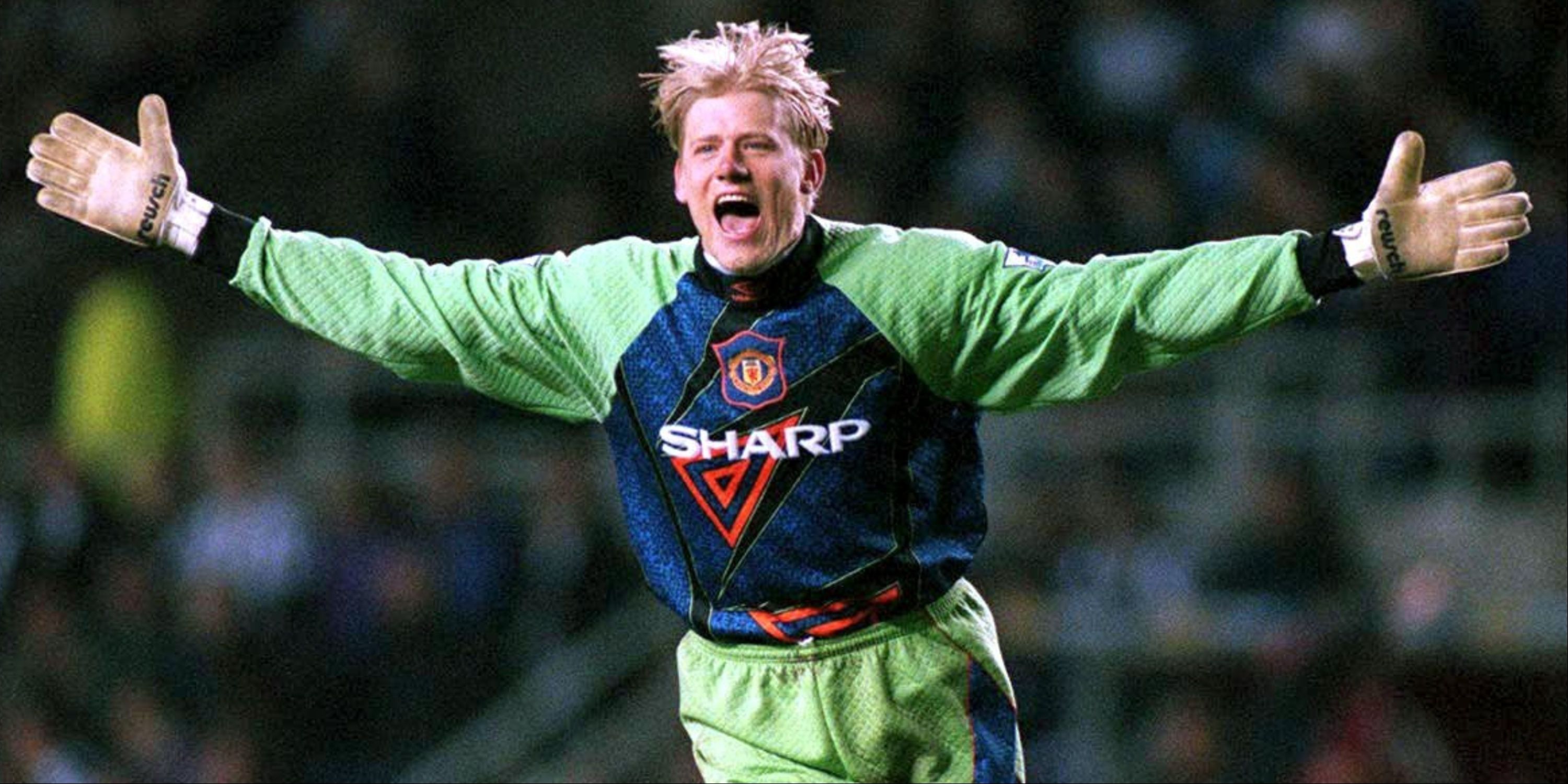
When Sir Alex Ferguson set out to end Manchester United's 26-year league title drought in the early 1990s, he prioritized a goalkeeper capable of intimidating opposition attackers and commanding the entire penalty box. In August 1991, Ferguson signed Danish goalkeeper Peter Schmeichel from Brøndby for £505,000—a transaction Ferguson later described as the "bargain of the century."
Schmeichel redefined modern goalkeeping through physical stature, handball-inspired star-jump saves, and vocal leadership. He operated as an extra defender, regularly rushing off his line to sweep up long balls and smothering one-on-one breakaways with unyielding aggression.
Peter Schmeichel's Manchester United Legacy (1991–1999)
- 398 Total Appearances
- 180 Clean Sheets (45.2% Shutout Rate)
- 5 Premier League Titles (1993, 1994, 1996, 1997, 1999)
- 3 FA Cups (1994, 1996, 1999)
- 1 UEFA Champions League (1999 Treble Captain)
Beyond shot-stopping, Schmeichel revolutionized transition play. Utilizing a powerful overhead throw, he could launch accurate counter-attacks past the halfway line, instantly setting loose wide players like Ryan Giggs and Andrei Kanchelskis.
Schmeichel’s final match for Manchester United was the historic 1999 UEFA Champions League Final against Bayern Munich in Barcelona. Captaining the side in the absence of Roy Keane, Schmeichel lifted the trophy as United completed an unprecedented Treble of the Premier League, FA Cup, and Champions League, establishing him as one of the greatest goalkeepers in football history.
The Transition Wilderness (1999–2005)
Following Peter Schmeichel's departure in 1999, Manchester United entered a turbulent six-year period searching for a worthy successor. Sir Alex Ferguson rotated through multiple international custodians, illustrating how difficult it was to manage the unique pressure of playing in goal at Old Trafford.
- Mark Bosnich: Returning for a second spell at the club in 1999, the Australian played a key role in the 1999–2000 Premier League title win, but consistency and fitness issues shortened his tenure.
- Massimo Taibi: Signed from Venezia in 1999, the Italian made just four appearances, remembered primarily for a high-profile error against Southampton.
- Fabien Barthez: The World Cup and European Championship winner arrived from Monaco in 2000 for £7.8 million. Barthez brought flair, eccentric sweeping, and spectacular reflexes, winning Premier League titles in 2001 and 2003. However, high-risk decision-making ultimately led to his replacement.
- Tim Howard & Roy Carroll: Howard showed initial promise after joining from MetroStars in 2003, winning the PFA Team of the Year award in his debut season, but shared duties with Carroll as neither fully secured the long-term starting role.
Calm and Control: The Edwin van der Sar Era (2005–2011)
The wilderness period ended in June 2005 when Ferguson signed veteran Dutch goalkeeper Edwin van der Sar from Fulham for an estimated £2 million. Van der Sar brought an aura of calm authority, exceptional positional intelligence, and fluid distribution that perfectly complimented a formidable central defensive partnership of Rio Ferdinand and Nemanja Vidić.
Unlike Schmeichel’s aggressive style, Van der Sar relied on elite anticipation, minimizing the need for dramatic saves by preventing dangerous situations before they developed. He was also an early pioneer of modern distribution, comfortable using both feet to build attacks from the back.
- [ Ferdinand ]
- [ Vidić ]
- [ Edwin van der Sar ]
- (1,311 Minutes Without Conceding - 2008/09)
During the 2008–09 season, Van der Sar set a world league record by going 1,311 consecutive minutes without conceding a goal in the Premier League, spanning 14 consecutive clean sheets.
Van der Sar's defining moment occurred on May 21, 2008, in the UEFA Champions League Final in Moscow against Chelsea. In a dramatic penalty shootout, Van der Sar saved Nicolas Anelka's decisive spot-kick to secure Manchester United's third European Cup. By the time he retired in 2011 at age 40, he had won four Premier League titles and reached three Champions League finals with the club.
Shot-Stopping Brilliance: The David de Gea Era (2011–2023)
Replacing Van der Sar presented a similar challenge to replacing Schmeichel. In June 2011, Ferguson invested in 20-year-old Spanish goalkeeper David de Gea, signing him from Atlético Madrid for approximately £18.9 million—a British record fee for a goalkeeper at the time.
De Gea faced an intense adaptation period, struggling initially with the aerial physicality of Premier League set-pieces. However, through focused physical development and revolutionary foot-save techniques, De Gea transformed into the premier shot-stopper of his generation.
David de Gea's Manchester United Milestone Summary
- 545 Total Appearances (Most by any GK in club history)
- 190 Clean Sheets (Surpassed Peter Schmeichel's record of 180)
- 4x Sir Matt Busby Player of the Year (2014, 2015, 2016, 2018)
- 2x Premier League Golden Glove (2017–18, 2022–23)
- Major Honors: Premier League (2013), FA Cup (2016), Europa League (2017)
During the post-Ferguson transition period in the mid-2010s, De Gea stood as Manchester United's most consistent performer. He became the first player in history to win the Sir Matt Busby Player of the Year award in three consecutive seasons (2014–2016), later adding a fourth in 2018. His performance against Tottenham Hotspur in January 2019—making 11 saves in a single half—remains a masterclass in modern shot-stopping.
De Gea concluded his twelve-year spell at Old Trafford in 2023 having broken two major long-standing club records: total appearances by a goalkeeper (545) and total clean sheets (190).
Tactical Shift: André Onana and the Modern Era
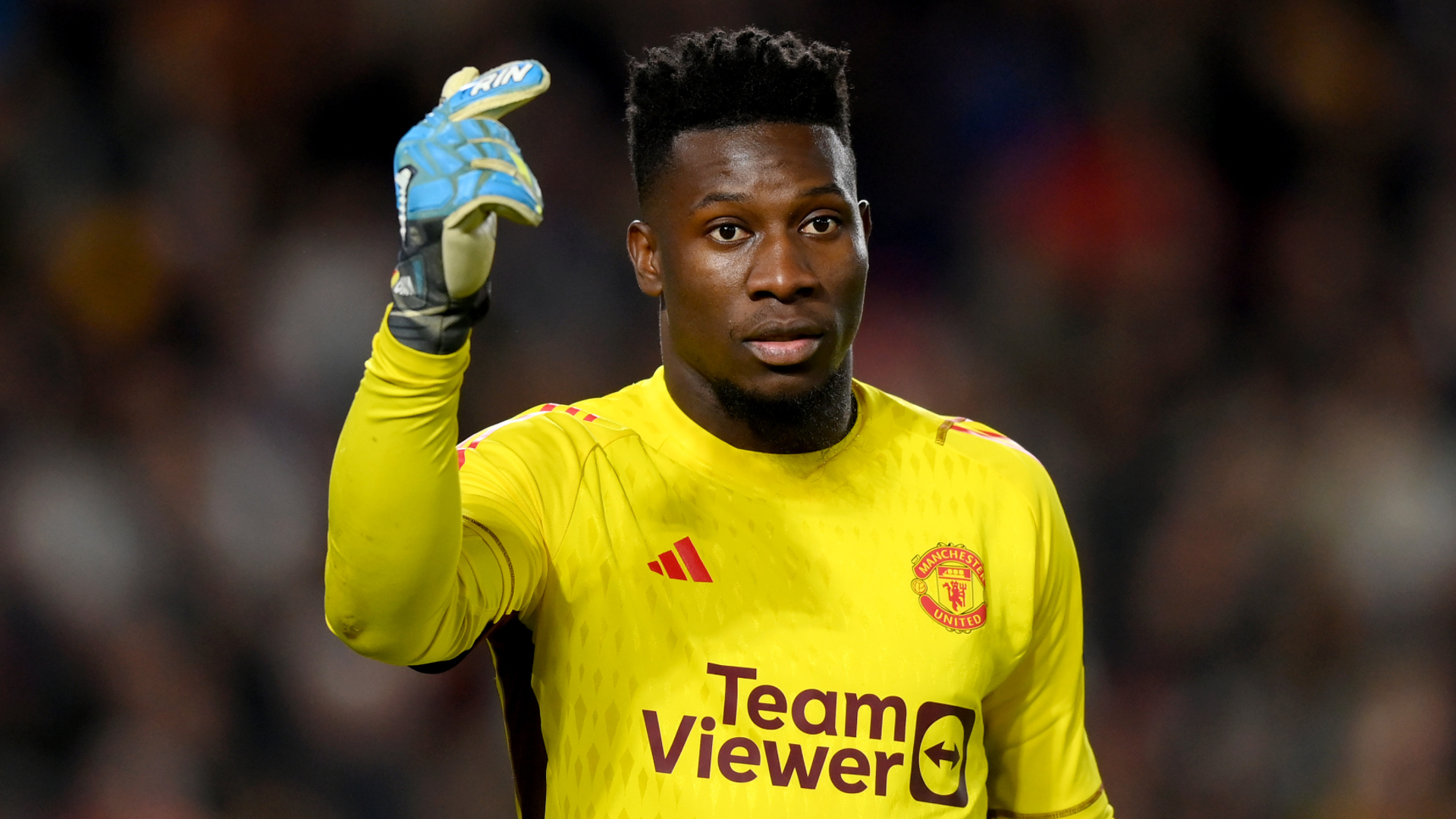
In July 2023, Manchester United signaled a fundamental tactical shift by signing Cameroonian goalkeeper André Onana from Inter Milan for £47.2 million. This move marked the end of the traditional line-keeper era at Old Trafford and ushered in the requirement for a complete sweeping playmaker.
Onana was recruited specifically for his ability to act as an eleven-man passing option in build-up play. Operating high up the pitch, Onana's comfort under pressure, long-range passing accuracy, and willingness to step out of his penalty box allow the defensive line to push higher up the pitch, aligning with modern European tactical standards. Alongside squad rotation options like Altay Bayındır, Manchester United's modern goalkeeping union reflects the tactical shift toward ball manipulation, press-resistance, and sweeping range.
Comparative Analysis of Legendary Goalkeepers
The following table compares the careers, statistics, and tactical characteristics of Manchester United’s primary starting goalkeepers across key eras:
| Goalkeeper | Era / Active Years | Appearances | Clean Sheets | Major Honors | Primary Goalkeeping Style |
|---|---|---|---|---|---|
| Harry Moger | 1903–1912 | 266 | ~85 | 2 League Titles, 1 FA Cup | Aerial dominance, positional command |
| Harry Gregg | 1957–1966 | 247 | 48 | 1958 World Cup Best GK | Aggressive rushing, bravery, aerial claim |
| Alex Stepney | 1966–1978 | 539 | 175 | 1 European Cup, 1 First Division, 1 FA Cup | Positional intelligence, reactive saves |
| Peter Schmeichel | 1991–1999 | 398 | 180 | 5 Premier Leagues, 1 Champions League, 3 FA Cups | Star-jump saves, intimidation, counter-throwing |
| Fabien Barthez | 2000–2004 | 139 | 50 | 2 Premier Leagues | Sweeper-keeper, high-risk distribution |
| Edwin van der Sar | 2005–2011 | 266 | 135 | 4 Premier Leagues, 1 Champions League, 1 Club World Cup | Positional reading, calm composure, two-footed passing |
| David de Gea | 2011–2023 | 545 | 190 | 1 Premier League, 1 Europa League, 1 FA Cup, 2 League Cups | Elite line reactions, foot saves, shot-stopping |
| André Onana | 2023–Present | — | — | 1 FA Cup (2024) | Press-resistant build-up, deep playmaker, sweeper |
Frequently Asked Questions
Who has kept the most clean sheets in Manchester United history?
David de Gea holds the record for the most clean sheets in Manchester United history with 190 clean sheets in 545 appearances. He officially broke Peter Schmeichel’s previous record of 180 clean sheets during the Carabao Cup Final victory against Newcastle United in February 2023.
Who was Manchester United's goalkeeper during the 1999 Treble season?
Peter Schmeichel was the primary goalkeeper during the 1998–99 Treble season. He captained the team in his final appearance for the club during the 2–1 victory against Bayern Munich in the UEFA Champions League Final in Barcelona. Raimond van der Gouw served as his primary deputy throughout that campaign.
What is the consecutive clean sheet record for a Manchester United goalkeeper?
Edwin van der Sar holds the record for consecutive clean sheets. During the 2008–09 Premier League season, Van der Sar went 1,311 minutes without conceding a goal, spanning 14 consecutive league matches. This remains an English top-flight football record.
Has a Manchester United goalkeeper ever scored a goal?
Yes. Alex Stepney scored two goals for Manchester United, both from penalty kicks during the 1973–74 First Division season. Additionally, Peter Schmeichel scored six goals during his professional career, including one for Manchester United against Rotherham United in a 1995 UEFA Cup tie.
Why did Manchester United transition from David de Gea to André Onana in 2023?
The transition was driven by tactical evolution. While David de Gea was an elite conventional shot-stopper, manager Erik ten Hag required a goalkeeper capable of high press-resistance, sweeping outside the penalty area, and distributing short passes to bypass opposition presses. André Onana was signed from Inter Milan to fulfill this modern build-up role.
Modern Legacy and Next Actions
The evolution of Manchester United goalkeepers mirrors the broader tactical history of football itself. From the physical resilience of Harry Moger and Harry Gregg to the command of Alex Stepney, Peter Schmeichel, and Edwin van der Sar, the position has always demanded unique strength of character. As the club continues to develop its modern tactical identity with swept play and deep build-up distribution, the fundamental requirement remains unchanged: commanding the box at Old Trafford requires elite technical skill and mental fortitude.
For fans and analysts looking to explore Manchester United history further:
- Review Museum Archives: Visit the Manchester United Museum at Old Trafford to view historical goalkeeping memorabilia, including Harry Gregg's World Cup awards and Peter Schmeichel's 1999 match kits.
- Analyze Match Footage: Compare the defensive positioning of the 2007–09 Ferdinand-Vidić-Van der Sar triangle against modern pressing structures to understand the evolution of positional play.
Image Gallery