Guide to Car and Auto Insurance Bundles: How Multi-Policy Discounts Work
A car and auto insurance bundle—commonly referred to in the insurance industry as a multi-policy or multi-vehicle discount—combines personal auto coverage with another insurance policy, such as homeowners, renters, condo, or an additio...
A car and auto insurance bundle—commonly referred to in the insurance industry as a multi-policy or multi-vehicle discount—combines personal auto coverage with another insurance policy, such as homeowners, renters, condo, or an additional vehicle policy, under a single insurance provider. Bundling typically reduces combined premium rates by 5% to 25%, while streamlining billing and policy management into a single account.
Contents
Understanding Auto Insurance Bundles: Multi-Policy vs. Multi-Vehicle
While the terms "car insurance" and "auto insurance" describe the exact same financial protection product, the phrase "car and auto insurance bundle" generally refers to two distinct discount structures offered by property and casualty insurers: multi-policy bundling and multi-vehicle bundling.
Understanding how these structures operate helps policyholders evaluate whether consolidating policies delivers real cost savings or simply masks underlying rate increases.
- Consolidated Auto Insurance
- Multi-Policy Bundles
- Auto + Homeowners
- Auto + Renters / Condo
- Auto + Umbrella Liability
- Auto + Life / Property
- Multi-Vehicle Bundles
- 2+ Personal Vehicles
- Auto + Motorcycle / RV
- Auto + Boat / Personal Watercraft
- Multi-Policy Bundles
Multi-Policy Bundling
Multi-policy bundling occurs when an insurer provides coverage for your vehicle alongside a non-auto policy. The most common multi-policy combinations include:
- Auto and Homeowners Insurance: The most lucrative bundle in the personal lines market. Insurers frequently offer their highest percentage discounts on this pairing because homeowners present lower statistically aggregated risk profiles and tend to maintain longer policy tenure.
- Auto and Renters Insurance: Designed for tenants who do not own personal real estate. While total dollar savings are lower due to the low baseline cost of renters coverage, the percentage discount applied to the auto policy often offsets a substantial portion of the renters premium.
- Auto and Condo Insurance: Similar to homeowners bundling, this pairing covers personal property and interior structural elements (HO-6 policies) alongside bodily injury and property damage auto liability.
- Auto and Life or Umbrella Insurance: Excess liability (umbrella) policies often require underlying auto liability limits of at least $250,000/$500,000. Bundling umbrella or term life policies with auto coverage unlocks cross-product pricing breaks across the entire portfolio.
Multi-Vehicle Bundling
Multi-vehicle bundling applies when two or more personal vehicles—such as sedans, trucks, SUVs, motorcycles, or recreational vehicles (RVs)—are listed under a single auto policy or linked household accounts.
Insurers calculate multi-vehicle discounts based on the assumption that household members cannot drive every vehicle simultaneously, lowering total road risk per vehicle insured.
How Much Can You Save by Bundling Vehicle Insurance?
Discount structures vary significantly across carriers, geographical regions, and risk profiles. The primary financial benefit of bundling stems from reduced administrative overhead and customer acquisition costs for the insurer, a portion of which is returned to the policyholder as a premium reduction.
According to baseline industry data tracked by the Insurance Information Institute, multi-policy bundling can yield overall savings ranging from 5% to over 20%. Premium reductions apply differently across separate policy components:
- Home and Auto Bundles: Average savings generally range from 15% to 25% on the homeowners premium, and 5% to 15% on the auto premium.
- Renters and Auto Bundles: Savings typically range from 5% to 10% on the auto portion, while the renters discount may range from 10% to 15%.
- Multi-Car Discounts: Adding a second or third vehicle to an auto policy usually reduces the collision and comprehensive coverage rates on each additional vehicle by 10% to 25%.
| Policy Bundle Type | Estimated Auto Discount | Estimated Companion Discount |
|---|---|---|
| Auto + Homeowners | 5% – 15% | 15% – 25% |
| Auto + Renters | 5% – 10% | 10% – 15% |
| Auto + Condo (HO-6) | 5% – 12% | 10% – 20% |
| Multi-Vehicle (2+ Cars) | 10% – 25% (per vehicle) | N/A |
| Auto + Umbrella Liability | 5% – 10% | 5% – 10% |
Premium Mechanics: Where the Discount Is Applied
Insurance companies do not apply bundle discounts as a flat lump sum. Instead, they apply percentage reductions to specific line items on the insurance declarations page.
For example, an insurer might apply a 10% multi-policy discount to the bodily injury liability, property damage liability, comprehensive, and collision sub-totals of your car insurance premium.
Understanding this distinction is critical: if your auto premium is $1,800 per year and your renters premium is $200 per year, a 10% discount on the auto premium saves $180, which effectively covers 90% of the cost of the renters policy.
Key Benefits and Hidden Drawbacks of Bundled Policies
While bundling is widely promoted, it is not universally beneficial for every driver or property owner. Analyzing both the advantages and trade-offs prevents policyholders from overpaying due to convenience bias.
Advantages of Bundling
- Single-Deductible Options: Some national carriers offer a single-deductible feature when a single event damages multiple covered assets. For example, if a severe hail storm or garage fire damages both your house and your car parked in the driveway, an insurer offering single-deductible benefits will charge only the higher of the two policy deductibles rather than requiring separate out-of-pocket payments for both claims.
- Simplified Account Management: Managing renewals, payments, policy updates, and claims through a unified digital portal reduces billing confusion and minimizes the risk of policy lapses.
- Enhanced Retention and Non-Renewal Protection: Insurance companies are historically less inclined to issue non-renewal notices after a single fault claim or weather event to customers who hold multiple high-value policies with the firm.
Potential Drawbacks and Pitfalls
- "Price Creep" and Legacy Rates: Insurers understand that customers with bundled policies face higher friction when changing providers. Consequently, carriers may incrementally raise auto premiums over consecutive renewal terms—a practice known as price optimization—relying on the convenience of bundling to deter policyholders from shopping around.
- Affiliate Underwriting Surcharges: Some major auto insurance brands do not underwrite home or renters coverage directly. Instead, they bundle your car policy with a third-party affiliate partner. In these scenarios, management is split across two separate underwriting entities, reducing operational simplicity and potentially diluting customer support quality.
- Uncompetitive Single-Line Pricing: A carrier may offer a stellar multi-policy discount, but if their base auto insurance rate is 40% above market average for your demographic, the net cost will remain higher than purchasing split policies from separate specialty insurers.
Comparing Top Auto Insurance Bundled Providers
The following breakdown outlines the bundling characteristics, discount structures, and feature availability across major national property and casualty carriers in 2026.
| Insurance Carrier | Typical Home + Auto Discount | Multi-Car Discount Availability | Single-Deductible Feature Offered? | Primary Advantage |
|---|---|---|---|---|
| State Farm | Up to 20% – 25% | Yes | Select States / Endorsements | Strong agent network and high home-auto pairing savings |
| Allstate | Up to 25% | Yes | Yes (Claim Satisfaction Guarantee) | Robust policy customization and combined billing features |
| Progressive | Average 7% (Auto) / 12% (Home) | Yes | Optional (Single-Deductible Claim) | Flexible digital quote management and name-your-price options |
| GEICO | Varies (Home underwritten via affiliates) | Yes | Rare (Partner-dependent) | Strong standalone auto rates with third-party home options |
| Liberty Mutual | Up to 10% – 20% | Yes | Optional Package Add-on | Vehicle replacement guarantees and custom coverage options |
| Nationwide | Up to 20% | Yes | Yes (On select combined packages) | Single-deductible coverage for combined home/auto losses |
Note: Discount levels, underwriting guidelines, and policy terms are regulated at the state level by insurance commissioners and vary based on personal risk profiles, location, and loss history.
Step-by-Step: How to Shop, Compare, and Switch to a Bundled Policy
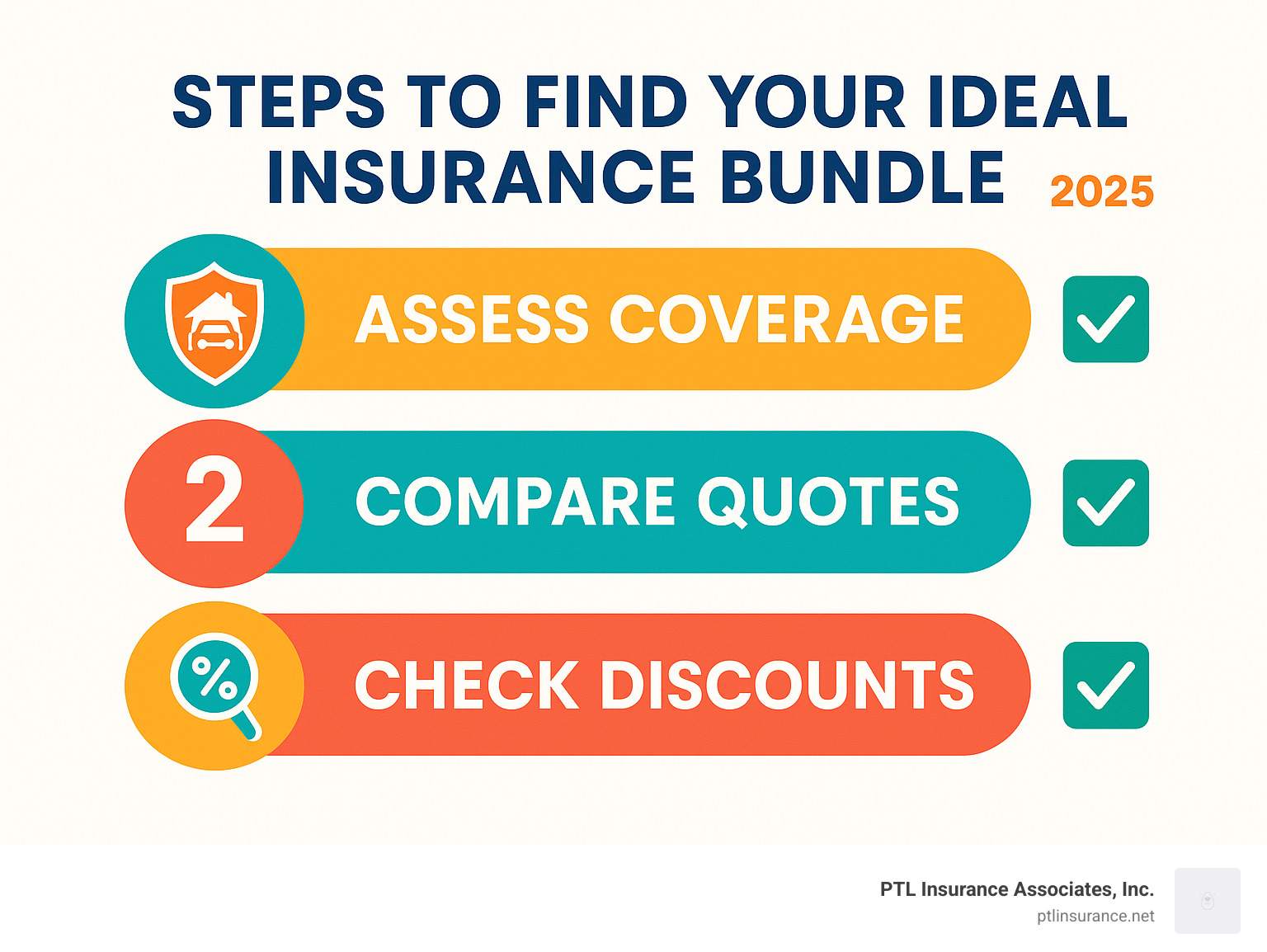
Optimizing an auto insurance bundle requires deliberate evaluation of policy declarations pages, endorsement terms, and competitive benchmarks. Follow these procedural steps to secure maximum financial protection at the lowest net cost.
- Step 1: Audit Current Declarations Pages
- Check coverage limits, deductibles, endorsements, and current premiums
- Step 2: Request Itemized Quotes from Independent Carriers & Agents
- Ensure side-by-side limit comparisons, e.g., $100k/$300k liability
- Step 3: Evaluate Base Rates vs. Net Bundled Pricing
- Verify total combined premium across all policies, not just percentage discounts
- Step 4: Check Underwriting Entities & Deductible Terms
- Determine if home coverage is direct or third-party affiliate
- Step 5: Bind New Bundle & Formally Cancel Old Policies
- Set start date first to eliminate gaps; submit written cancellation notices
Step 1: Audit Your Existing Declarations Pages
Before requesting quotes, pull the Declarations Page (Dec Page) for every current policy (auto, home, renters). Note the exact coverage parameters:
- Bodily Injury Liability Limits (e.g., $100,000/$300,000 per person/accident)
- Property Damage Liability Limit (e.g., $100,000)
- Comprehensive and Collision Deductibles (e.g., $500 or $1,000)
- Uninsured/Underinsured Motorist Coverage
- Property Dwelling Coverage (Limit A) and Personal Property Limits (Limit C)
Step 2: Obtain Quotes Based on Matching Limits
When requesting quotes from carriers or independent brokers, ensure every quote matches your existing liability limits and deductibles. Comparing a high-deductible bundled quote against a low-deductible standalone policy distorts financial comparison.
Step 3: Calculate the Total Net Premium
Do not focus strictly on advertised percentage savings. Calculate the combined annualized cost of all standalone policies versus the combined annualized cost of the proposed bundle:
$$\text{Net Annual Savings} = (\text{Standalone Auto} + \text{Standalone Home}) - (\text{Bundled Auto} + \text{Bundled Home})$$
If Company A charges $1,200 for auto and $800 for home (Total: $2,000), but offers a 10% bundle discount ($1,800 net), it remains more expensive than Company B, which offers unbundled policies at $900 for auto and $700 for home (Total: $1,600 net).
Step 4: Verify Underwriting Entities
If purchasing a bundle through an online aggregator or direct insurer, clarify whether the auto insurer underwrites the homeowners policy directly or partners with an outside agency (e.g., Homesite, Foremost, or Homesite Insurance Group).
Direct underwriting provides unified claims handling, whereas affiliate partnerships may result in separate customer service channels, distinct billing dates, and independent rate hikes.
Step 5: Transition Without Coverage Gaps
Once you select a bundled policy:
- Establish the official effective start date for the new bundled policies.
- Formally submit written cancellation requests to your old insurance carriers effective on or after the new policy start date. Never leave a 24-hour gap in auto liability coverage, as state motor vehicle departments track lapses automatically, which can result in license suspension or re-registration fines.
- If your homeowners insurance is paid through an escrow account, notify your mortgage lender immediately with the new policy declarations page and insurance binder so they can update escrow disbursements.
When Bundling Vehicle Insurance Does Not Make Sense
Bundling is not an absolute financial solution. In several common insurance scenarios, unbundling coverage across separate specialized carriers delivers superior value or necessary protection:
- High-Risk Drivers (SR-22 or Major Infractions): Drivers with recent DUI convictions, reckless driving charges, or multiple at-fault accidents are classified as non-standard risks. Mainstream carriers that offer high bundling discounts on home insurance may refuse auto coverage outright or charge punitive auto premiums. In such cases, securing auto coverage through a specialized non-standard insurer while placing home insurance with a standard carrier yields lower combined costs.
- High-Value or Coastal Real Estate: Properties located in areas vulnerable to wild fires, hurricanes, or coastal flooding may require specialty property coverage from surplus lines carriers. A standard national auto insurer may decline to write the property portion or issue severe windstorm exclusions, negating any potential bundling advantage.
- Unique Classic Car or Commercial Vehicle Needs: Classic cars, modified off-road vehicles, or commercial vehicles require specialized agreed-value policies. Bundling standard personal auto policies with non-standard vehicle assets often results in inadequate valuation clauses during total-loss claims.
Frequently Asked Questions
Can I bundle car insurance if the vehicles have different owners?
Yes, provided the registered owners reside in the same physical household and share a primary address. Insurers permit multi-car bundling for immediate family members, domestic partners, or relatives living under one roof. However, non-related roommates owning separate vehicles typically must maintain distinct auto policies unless both are listed as named insureds or regular drivers on a joint policy.
Does bundling auto insurance lock in my rates permanently?
No. Insurance policies operate on six-month or twelve-month terms. Insurers retain the right to adjust baseline rates at renewal based on state filings, regional inflation, personal claim events, or moving violations. The bundling percentage discount remains applied, but it reduces a higher base rate if universal price increases take effect.
What happens to my bundle if I cancel one of the policies mid-term?
If you cancel one policy within a bundle—such as selling a home or switching your auto coverage to another company—the carrier removes the multi-policy discount from the remaining policy. The remaining policy's premium will adjust upward on a pro-rata basis for the duration of the term.
Is an auto and renters bundle worth it if I don't own valuable possessions?
Yes. Renters insurance provides critical personal liability protection (typically $100,000 to $300,000) that shields your future earnings if a visitor is injured inside your rental unit. Because renters policies are relatively inexpensive (often $15 to $20 per month), applying a multi-policy discount to your auto premium frequently offsets most or all of the annual cost of the renters policy.
How does a single deductible work in a bundled auto and home claim?
If a single loss event—such as a fallen tree branch, garage collapse, or house fire—damages both your dwelling and your insured vehicle, a carrier offering a single-deductible endorsement waives the lower deductible. You pay only the higher deductible (usually the homeowners deductible), and the insurer covers losses across both assets up to policy limits.
Strategic Recommendation
To ensure your car and auto insurance bundle delivers actual cost savings without compromising coverage depth, re-evaluate your policy terms every two years.
Start by obtaining clear copies of your current declarations pages, then request side-by-side quotes from both direct national carriers and an independent insurance agent who has access to regional insurers.
Focus your final decision on total net portfolio cost, liability adequacy ($100,000/$300,000 minimum liability recommended), and the financial stability rating of the underlying underwriting entities as measured by independent agencies such as A.M. Best.
Image Gallery