How to Complete SEC Registration Online: A Comprehensive Guide to ESPARC (2026)
To complete SEC registration online, you must use the Electronic Simplified Processing of Applications for Registration of Companies (ESPARC) portal. The process involves creating an account, verifying your proposed corporate name, inp...
To complete SEC registration online, you must use the Electronic Simplified Processing of Applications for Registration of Companies (ESPARC) portal. The process involves creating an account, verifying your proposed corporate name, inputting company details (such as directors and capital structure), uploading required documents, and paying the registration fees through the integrated eSPAYSEC system.
Contents
While the term "SEC registration" can refer to the U.S. Securities and Exchange Commission's EDGAR system for filing periodic reports or registering securities, it most commonly refers to the foundational process of legally incorporating a business entity through the Philippines SEC. This guide focuses on the latter—the comprehensive online registration of new corporations and partnerships—which has become a fully digital standard as of 2026.
Understanding the SEC ESPARC Ecosystem
In 2026, the SEC has streamlined the "Doing Business" landscape by integrating several subsystems into a single user journey. Before you begin, it is essential to understand that online registration is no longer just a digital "submission" of paper forms; it is a live data-entry process that validates your information against national databases in real-time.
The ESPARC system handles the primary application. It is supported by eSPAYSEC, the online payment portal that accepts credit cards, digital wallets, and bank transfers, and the SEC CheckApp, which allows for mobile monitoring of your application status. The goal of this digital shift is to reduce the "Ease of Doing Business" friction, allowing a domestic corporation to be registered in as little as one to three business days, provided all requirements are met.
The Role of the Central Business Portal (CBP)
The SEC registration process is now frequently initiated through the Central Business Portal, which serves as a unified platform for various government agencies. When you complete your SEC registration online, the system often triggers the automatic issuance of a Taxpayer Identification Number (TIN) from the Bureau of Internal Revenue (BIR) and registration numbers for social agencies like SSS, PhilHealth, and Pag-IBIG.
Prerequisites for Online Registration
Preparation is the most critical phase of SEC registration. If you enter the portal without the necessary data points, the session may time out, or you may face "Name Rejection," which requires starting over.
1. Business Name Requirements
You must have at least three alternative names for your corporation. The SEC strictly enforces naming guidelines:
- Distinguishability: The name must not be identical or confusingly similar to an existing registered name.
- Suffixes: It must include appropriate suffixes like "Inc.," "Corp.," "OPC," or "LLP."
- Restricted Terms: Words like "Bank," "Trust," "Insurance," or "University" require special clearance from secondary regulators (e.g., the Bangko Sentral ng Pilipinas).
2. Identifying the Corporate Structure
Decide whether you are forming a Stock Corporation, a Non-Stock Corporation, or a One Person Corporation (OPC). Under the Revised Corporation Code, a standard corporation no longer requires a minimum of five incorporators; even a single natural person can form an OPC. However, you must identify your:
- Incorporators: The persons (natural or juridical) who originally formed the corporation.
- Directors/Trustees: The governing body of the corporation.
- Nominee and Alternate Nominee: Specifically required for OPCs to ensure business continuity in the event of the single stockholder's death or incapacity.
3. Financial and Capitalization Data
You must define your Authorized Capital Stock (ACS), which is the maximum amount of share capital the corporation is allowed to issue. From this, you must determine the Subscribed Capital (the portion of ACS taken by stockholders) and the Paid-up Capital (the portion actually paid into the corporation). While the 2019 Revised Corporation Code removed the general 25% subscription/payment requirement for most corporations, specific industries (like retail trade with foreign equity) still maintain strict minimum capital requirements.
Step-by-Step Guide to the Online Application
Once you have your data prepared, follow these steps to navigate the ESPARC portal.
Step 1: Account Creation and System Login
Visit the SEC ESPARC portal and create an account. You will need a valid email address that you monitor regularly, as all Notices of Deficiency or Certificates of Registration will be sent here. In 2026, many users use a Philippine National Public Key Infrastructure (PNPKI) digital signature to verify their identity at the login stage.
Step 2: Name Verification and Reservation
This is the most common point of failure. Enter your proposed name in the system. The portal will run an automated check against the SEC database. If the name is available, the system will "reserve" it for a specific period (usually 30 days) for a small fee. If it is rejected, the system will provide a reason, such as "reserved keyword" or "phonetic similarity."
Step 3: Application Type and Company Information
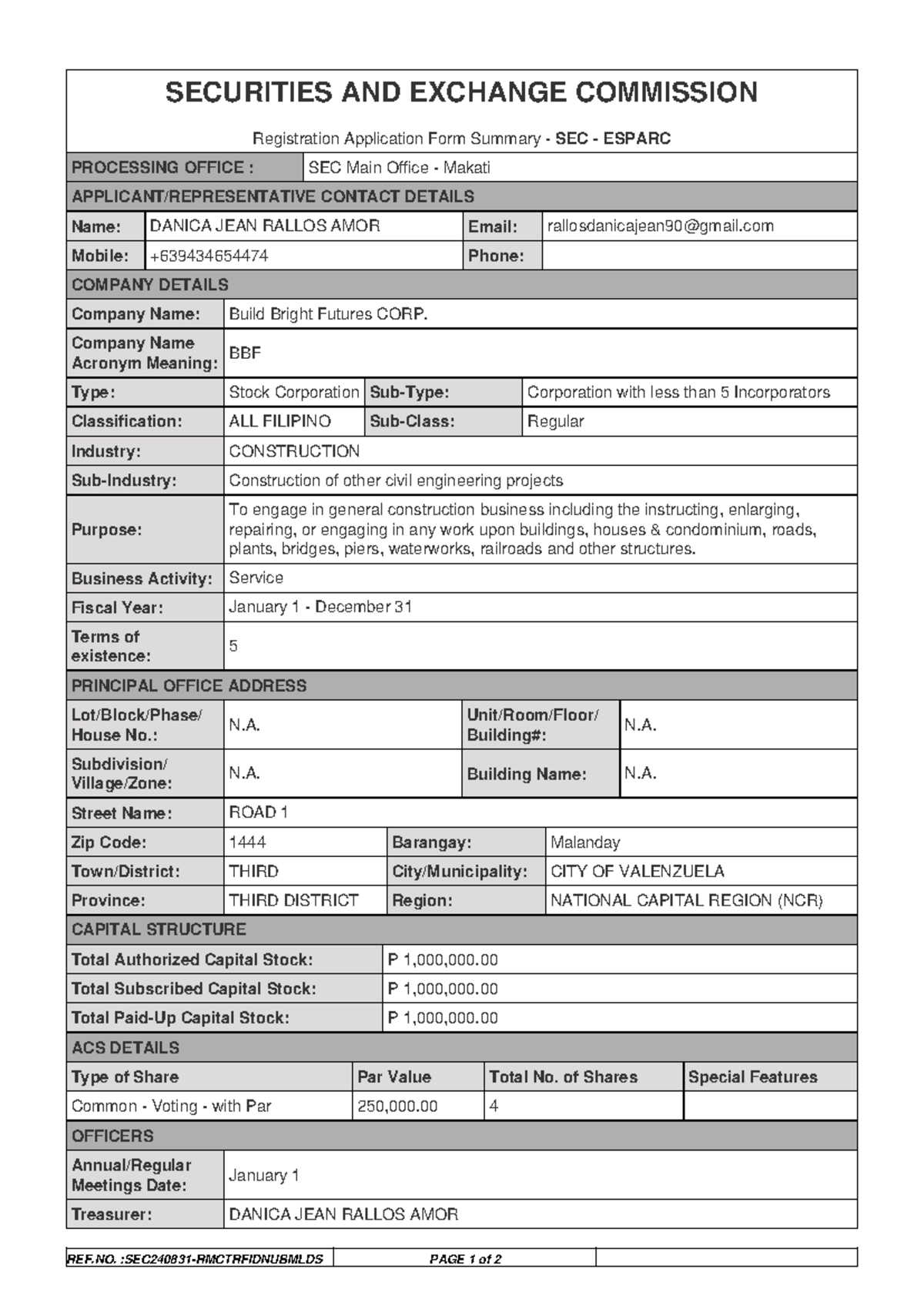
Select the type of entity you are registering. You will be prompted to fill out digital forms that represent the Articles of Incorporation and Bylaws.
- Purpose Clause: Clearly state the primary and secondary purposes of the business. Be specific; a vague purpose can lead to delays during the manual review phase.
- Principal Office Address: Provide the complete address. In 2026, the SEC requires a physical address; P.O. boxes are generally not sufficient for the "Principal Office."
Step 4: Capitalization and Stockholders
Enter the breakdown of shares. You must specify the par value of the shares (e.g., 1.00 PHP per share) and the distribution among the incorporators. The system will automatically calculate the totals to ensure they match your Authorized Capital Stock declaration.
Step 5: Uploading Supporting Documents
Depending on your entity type, you may need to upload PDF copies of:
- Treasurer’s Affidavit: Certifying that the capital has been received.
- Affidavit of Undertaking to Change Name: A standard document agreeing to change the name if another entity has a prior right to it.
- Endorsements: If you are a specialized entity (e.g., a pawnshop or a school), you must upload the endorsement from the relevant government agency.
Step 6: Review and Digital Signing
Review the generated "Summary of Application." In 2026, the SEC emphasizes the use of Electronic Signatures. The ESPARC system allows for the digital signing of the Articles of Incorporation and Bylaws. If you choose not to use digital signatures, you may be required to print, notarize, and physically upload the scanned documents, which significantly slows down the process.
Costs and Payment via eSPAYSEC
The cost of SEC registration is not a flat fee; it is largely based on your Authorized Capital Stock. Below is a breakdown of the typical costs associated with online registration in 2026.
| Fee Type | Description | Estimated Amount (PHP) |
|---|---|---|
| Filing Fee (Stock) | Based on Authorized Capital Stock (ACS) | 1/5 of 1% of ACS (Min. 2,000) |
| Filing Fee (Non-Stock) | Flat rate for non-profit entities | 1,000 |
| Name Reservation | Per 30 days of reservation | 100 |
| Legal Research Fee (LRF) | Mandatory fee for legal funds | 1% of Filing Fee (Min. 10) |
| Bylaws Fee | Flat rate for the corporate bylaws | 1,000 |
| Oversight/Registration | Integrated BIR and initial filing costs | Varies by entity size |
Payments are handled via eSPAYSEC. You can pay using:
- Digital Wallets: GCash, Maya, and other accredited providers.
- Credit/Debit Cards: Visa, Mastercard, and JCB.
- Online Banking: Real-time settlement via Landbank or other commercial banks.
- Over-the-Counter: Selected partner outlets, though this requires a printed Payment Assessment Form (PAF).
Post-Registration Requirements
Receiving your Digital Certificate of Incorporation is a major milestone, but it does not mean your business is fully compliant. There are several "Next Actions" required within specific timeframes.
1. Registration of Stock and Transfer Book (STB)
Within 30 days of incorporation, you must register your Stock and Transfer Book (for stock corporations) or Membership Book (for non-stock) with the SEC. This can now be done through the SEC’s online portal for corporate book registration.
2. General Information Sheet (GIS)
You are required to file an annual GIS within 30 days of your annual stockholders' meeting. Failure to do so can lead to your corporation being placed under "Delinquent" status.
3. BIR and LGU Compliance
While the SEC gives you a legal "personality," you still need a Business Permit from the Local Government Unit (LGU) where your office is located and a Certificate of Registration (Form 2303) from the BIR to legally print invoices and pay taxes.
Common Pitfalls and Troubleshooting
- Inconsistent Data: The most common cause of rejection is a mismatch between the data entered in the portal and the data in the uploaded PDF documents. Ensure names are spelled identically in all sections.
- Payment Expiration: Once a Payment Assessment Form (PAF) is generated, it usually has a strict expiration date (often 48-72 hours). If you miss this window, you may need to re-trigger the assessment or restart the application.
- Pop-up Blockers: The ESPARC and eSPAYSEC portals use pop-up windows for payment gateways and document previews. Ensure your browser allows pop-ups for the
sec.gov.phdomain. - Browser Compatibility: As of 2026, the portal is optimized for Chromium-based browsers (Chrome, Edge) and Firefox. Using older versions of Safari or Internet Explorer may result in form submission errors.
FAQ
Can a foreigner register a company online with the SEC?
Yes, foreigners can be incorporators and stockholders, but the online system will require their Passport numbers and Alien Certificate of Registration (ACR) if they are residents. Be aware of "Negative List" restrictions that limit foreign ownership in specific industries like mass media (0%) or advertising (30%).
How long does the online SEC registration process take?
If using the ESPARC "Fast Track" for corporations with standard bylaws, the process can be completed in 24 hours. For applications requiring manual review (customized bylaws or specialized industries), it typically takes 5 to 10 business days.
Is a physical appearance at the SEC office still required in 2026?
Generally, no. The SEC has moved to a "Digital First" policy. The Certificate of Incorporation is issued digitally with a QR code for verification. However, the SEC reserves the right to require the submission of original notarized documents if they suspect fraud or inconsistent data.
What is the difference between ESPARC and the old CRS?
The Company Registration System (CRS) was the predecessor to ESPARC. ESPARC is faster, more user-friendly, and integrates real-time name validation and automated payment assessment, which the older system lacked.
Can I change my business type after registration?
Changing from a Stock Corporation to an OPC (or vice versa) is possible but requires a formal Amendment of the Articles of Incorporation. This is a separate online process that involves filing an application for amendment and paying the corresponding fees.
Practical Recommendation
Before starting your online SEC registration, conduct a thorough search for your proposed business name on the SEC Company Search tool. This prevents the frustration of multiple rejections in the ESPARC portal. Additionally, ensure you have a stable internet connection and digital copies of your valid IDs ready. If your business involves foreign equity or specialized regulations, consulting with a legal professional or a registered corporate secretary is highly advised to ensure your "Primary Purpose" clause is legally sound and compliant with the 2026 regulatory framework.
Image Gallery