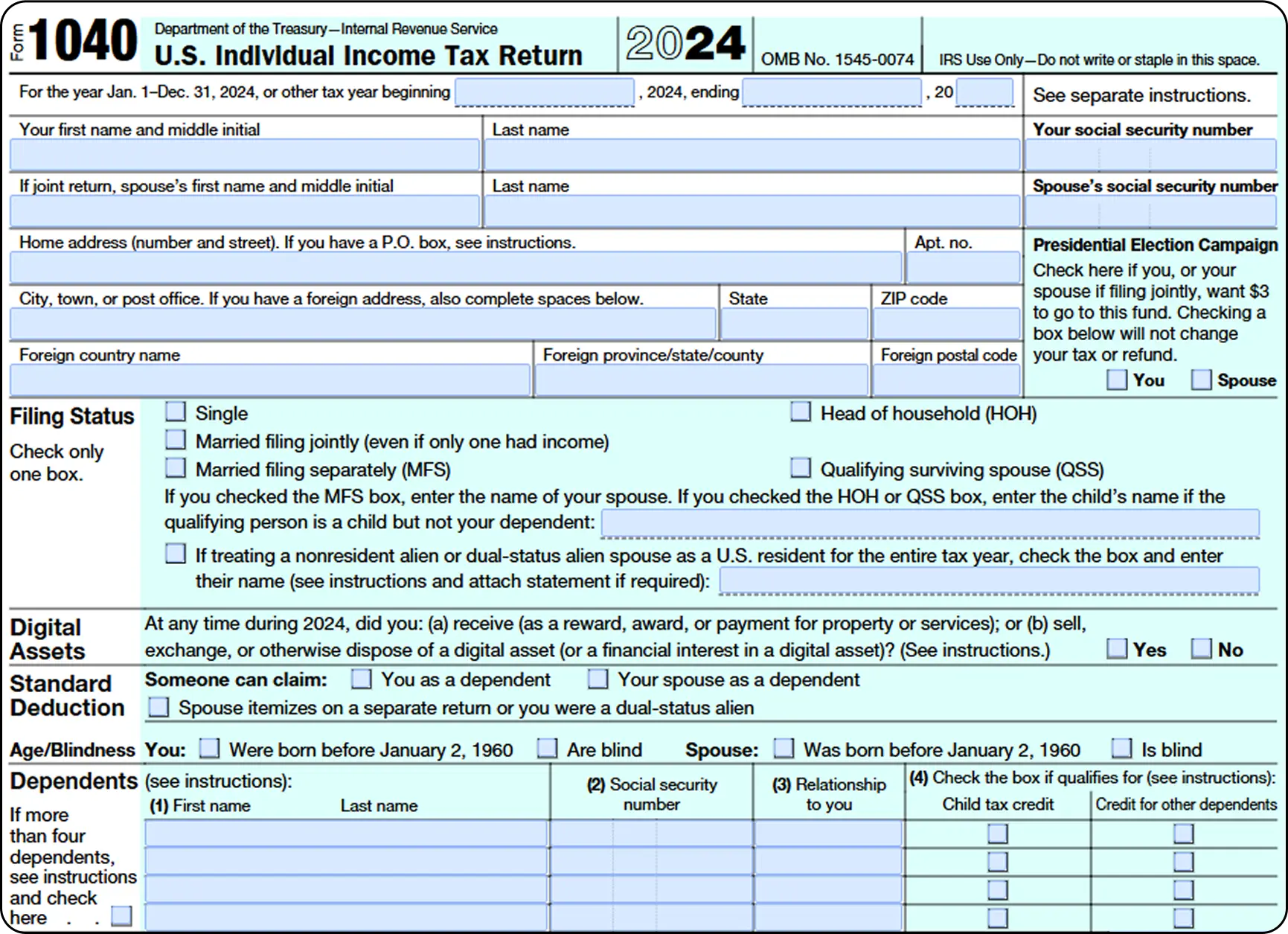
IRS Form 1040 Instructions for 2026: Comprehensive Filing Guide and Tax Year Updates
IRS Form 1040 instructions for the 2026 filing season provide the mandatory framework for reporting individual income, claiming credits, and calculating federal tax liability for the 2025 tax year. These guidelines incorporate updated...
IRS Form 1040 instructions for the 2026 filing season provide the mandatory framework for reporting individual income, claiming credits, and calculating federal tax liability for the 2025 tax year. These guidelines incorporate updated inflation-adjusted standard deductions, revised tax brackets, and critical reporting requirements for digital assets and energy-efficient home improvement credits.
Contents
Understanding the 2026 Filing Season Framework
As we navigate the 2026 tax season, taxpayers must distinguish between the 2025 tax year (the period for which you are currently filing) and the 2026 tax year (the period for which you are currently performing tax planning). The instructions released by the Internal Revenue Service this year are the most technically complex in a decade due to the looming sunset of several Tax Cuts and Jobs Act (TCJA) provisions scheduled for the end of December 2026.
For the 2026 filing season, the IRS has fully integrated the Direct File system across all 50 states, allowing eligible taxpayers to file their 1040 forms directly with the government at no cost. This shift, combined with the increased processing power of the IRS’s modernized back-end systems, has led to faster refund cycles, provided the return is free of errors and submitted electronically.
Key Deadlines for 2026
The standard tax deadline for 2026 falls on Wednesday, April 15, 2026. Taxpayers requesting an extension using Form 4868 will have until October 15, 2026, to file their finalized returns, though it is critical to remember that an extension to file is not an extension to pay any taxes owed.
2025 Tax Year Brackets and Standard Deductions (Filed in 2026)
To accurately complete your 1040 form in 2026, you must apply the correct standard deduction and identify your marginal tax rate based on your 2025 earnings. The following table outlines the foundational figures required for your calculations.
| Filing Status | 2025 Standard Deduction (Filed 2026) | 2025 Tax Brackets (Examples) |
|---|---|---|
| Single | $15,000 | 10% on income up to $11,925; 12% over $11,925 |
| Married Filing Jointly | $30,000 | 10% on income up to $23,850; 12% over $23,850 |
| Head of Household | $22,500 | 10% on income up to $17,000; 12% over $17,000 |
| Married Filing Separately | $15,000 | 10% on income up to $11,925; 12% over $11,925 |
| Qualifying Surviving Spouse | $30,000 | 10% on income up to $23,850; 12% over $23,850 |
Technical Note on Inflation Adjustments
The 2025 tax year saw a significant upward adjustment in standard deductions to account for persistent inflationary pressures. This ensures that a larger portion of taxpayer income remains non-taxable. When following the 2026 instructions, ensure you are not using the lower 2024 figures, which will result in an overpayment of tax.
Step-by-Step Guide to Completing Form 1040 in 2026
The 2026 instructions follow a modular approach, directing taxpayers to various schedules depending on the complexity of their financial situation.
1. Personal Information and Filing Status
The top of Form 1040 requires your name, address, and Social Security Number (SSN). You must select one of the five filing statuses. This choice is critical as it determines your standard deduction and tax rate. If you are a senior citizen (age 65 or older), the IRS recommends using Form 1040-SR, which features larger print and a specialized standard deduction table for seniors.
2. The Digital Asset Question
The 2026 instructions maintain a prominent "Digital Asset" question on the first page. You must check "Yes" if, at any time during 2025, you received (as a reward, award, or payment for property or services) or sold, exchanged, or otherwise disposed of a digital asset or a financial interest in a digital asset. This includes cryptocurrency, stablecoins, and certain non-fungible tokens (NFTs).
3. Reporting Gross Income
Lines 1 through 9 aggregate your total income. This includes:
- Wages and Salaries: Reported on Form W-2.
- Tax-Exempt and Taxable Interest: Reported on Form 1099-INT.
- Dividends: Reported on Form 1099-DIV.
- IRA and Pension Distributions: Reported on Form 1099-R.
- Social Security Benefits: Reported on Form SSA-1099.
4. Adjustments to Income (Schedule 1)
To arrive at your Adjusted Gross Income (AGI) on Line 11, you may subtract specific "above-the-line" deductions. Common adjustments in 2026 include educator expenses (up to $300), student loan interest deductions, and contributions to a traditional IRA or Health Savings Account (HSA).
Standard vs. Itemized Deductions: The 2026 Decision
After calculating your AGI, you must decide whether to take the standard deduction or itemize your deductions on Schedule A. In 2026, approximately 90% of taxpayers find the standard deduction more beneficial due to the high thresholds set by current tax law.
When to Itemize on Schedule A
You should itemize if your total allowable expenses exceed the standard deduction amounts listed in the table above. Allowable itemized deductions include:
- State and Local Taxes (SALT): Still capped at $10,000 for the 2025 tax year.
- Mortgage Interest: Generally deductible on debt up to $750,000 for homes purchased after 2017.
- Charitable Contributions: Subject to specific AGI limitations (usually 60% for cash).
- Medical and Dental Expenses: Only the portion that exceeds 7.5% of your AGI.
Comparison of Deduction Strategies
Standard Deduction Pros Simplifies the filing process significantly and requires no record-keeping for specific expenses. It provides a guaranteed reduction of taxable income regardless of actual spending.
Itemized Deduction Pros Potentially offers a much larger tax break for individuals with high mortgage interest, significant medical bills, or large charitable gifts. It is essential for high-net-worth individuals or those living in high-tax states where SALT and mortgage interest often exceed $15,000 or $30,000.
Non-Refundable and Refundable Credits for 2026
Credits are more valuable than deductions because they reduce your tax liability dollar-for-dollar. The 2026 instructions highlight several key credits available for the 2025 tax year.
Child Tax Credit (CTC)
For the 2025 tax year, the CTC remains at $2,000 per qualifying child under age 17. The refundable portion, known as the Additional Child Tax Credit (ACTC), is capped and subject to earned income requirements. Ensure you complete Schedule 8812 to claim this credit.
Energy Efficiency Credits
Under the Inflation Reduction Act provisions active in 2026, taxpayers can claim significant credits for residential energy improvements. The Energy Efficient Home Improvement Credit (Section 25C) allows for a credit of up to 30% of the cost of eligible improvements, such as heat pumps, biomass stoves, and insulation, generally capped at $1,200 annually (with higher limits for specific equipment).
Earned Income Tax Credit (EITC)
The EITC is a major refundable credit for low-to-moderate-income working individuals and couples, particularly those with children. The maximum credit amounts have been adjusted for 2026 to reflect the higher cost of living.
Technical Requirements for Electronic Filing
The IRS now mandates that most professional tax preparers file electronically. For individuals, the 2026 instructions strongly encourage the use of electronic filing (e-file) to minimize processing delays.
- Authentication: You must provide your prior-year AGI or a self-selected PIN to sign your return electronically.
- Direct Deposit: To receive a refund in 2026, the IRS requires a valid Routing Transit Number (RTN) and Account Number. Refunds via direct deposit are typically issued within 21 days.
- Identity Protection PIN (IP PIN): If you were a victim of identity theft, you must enter your 6-digit IP PIN provided by the IRS to prevent fraudulent filings in your name.
Planning for the 2026 Sunset: Looking Toward 2027
A unique aspect of the IRS 1040 instructions for 2026 is the inclusion of warnings regarding the 2027 tax year. Many provisions of the 2017 Tax Cuts and Jobs Act are scheduled to expire on December 31, 2025. This means that while you are filing your 2025 return in 2026, the taxes you are currently accruing throughout 2026 may be subject to different rules if Congress does not act.
- Standard Deduction Reduction: If the sunset occurs, standard deductions will nearly be cut in half starting in the 2026 tax year (affecting the 2027 filing).
- Tax Rate Increases: Individual tax brackets are scheduled to revert to higher 2017 levels (e.g., the 12% bracket may return to 15%, and the 37% top rate may return to 39.6%).
- SALT Cap Expiration: The $10,000 cap on state and local tax deductions is scheduled to expire, which may favor itemizers in 2026 and beyond.
- Exemption Changes: The personal exemption, currently at $0, may be reinstated.
Common Mistakes to Avoid in 2026
Data from the IRS highlights several recurring errors that taxpayers should avoid when following the 1040 instructions.
- Incorrect SSNs: Ensure all Social Security Numbers for dependents match the Social Security Administration's records exactly.
- Filing Status Errors: Choosing "Single" when you qualify as "Head of Household" can cost you thousands in standard deduction differences.
- Math Errors: Even with software, manual overrides can lead to calculation mistakes on Line 24 (Total Tax) or Line 33 (Total Payments).
- Unsigned Forms: Paper-filed returns that lack a physical signature are treated as if they were never filed.
FAQs for 2026 IRS 1040 Filing
What is the standard deduction for 2026?
For the 2025 tax year filed in 2026, the standard deduction is $15,000 for Single filers and $30,000 for Married Filing Jointly. For the 2026 tax year (planning for next year), these figures are adjusted further for inflation but are subject to the TCJA sunset provisions at the end of the year.
While the 2025 numbers are finalized, taxpayers should monitor legislative updates throughout 2026, as the "tax cliff" at year-end could drastically change the deduction landscape for the following filing season.
Can I file my 1040 for free in 2026?
Yes, the IRS Direct File program is now available nationwide in 2026 for taxpayers with relatively straightforward tax situations. Additionally, the IRS Free File program remains available for taxpayers with an AGI below a certain threshold (typically around $79,000).
Direct File is a significant development for 2026, allowing users to bypass third-party software and file directly with the IRS. It supports W-2 income, Social Security, and unemployment income, along with standard deductions and common credits like the CTC and EITC.
How do I report cryptocurrency on my 2026 tax return?
You must answer the digital asset question on page 1 of Form 1040 and report any capital gains or losses on Schedule D and Form 8949. If you received crypto as payment for services, it must be reported as ordinary income on Line 1.
The IRS has increased its enforcement of digital asset reporting in 2026. Using blockchain forensic tools, the agency can now more easily match exchange-reported data (via Form 1099-DA) with individual tax returns.
Is the Child Tax Credit refundable in 2026?
Yes, the Child Tax Credit is partially refundable for the 2025 tax year (filed in 2026) through the Additional Child Tax Credit (ACTC). You must have earned income of at least $2,500 to qualify for the refundable portion.
The maximum refund amount per child is subject to inflation indexing. To claim it, you must complete Schedule 8812 and ensure that your qualifying child has a valid Social Security Number issued before the due date of the return.
What should I do if I cannot pay my taxes by April 15, 2026?
You should still file your return or an extension by the deadline to avoid the failure-to-file penalty, which is much higher than the failure-to-pay penalty. Afterward, you can apply for an IRS Online Payment Agreement.
The IRS offers short-term extensions of 180 days or long-term installment agreements. In 2026, these applications can be completed entirely online through the IRS taxpayer portal, often providing immediate approval for those who owe $50,000 or less in combined tax, interest, and penalties.
Final Recommendations for 2026 Taxpayers
To ensure a seamless filing experience in 2026, gather all 2025 documentation—including W-2s, 1099s, and receipts for energy-efficient upgrades—before starting the 1040 form. Given the technical shifts in tax law and the expansion of digital filing options, using the IRS Direct File system or updated tax software is highly recommended to catch inflation-adjusted credits you might otherwise miss. If your financial situation involves complex business income or foreign assets, consulting a Certified Public Accountant (CPA) is advisable to navigate the nuances of the 2026 tax landscape.
Image Gallery