How to Get SR-22 Insurance in Washington State: A Step-by-Step Guide
To get SR-22 insurance in Washington State, contact a state-licensed auto insurance provider and request an SR-22 Certificate of Financial Responsibility filing. Your insurer will submit the document electronically to the Washington De...
To get SR-22 insurance in Washington State, contact a state-licensed auto insurance provider and request an SR-22 Certificate of Financial Responsibility filing. Your insurer will submit the document electronically to the Washington Department of Licensing (DOL). Once filed and approved, pay any required state reinstatement fees to legally restore your driving privileges.
Contents
What Is an SR-22 in Washington State?
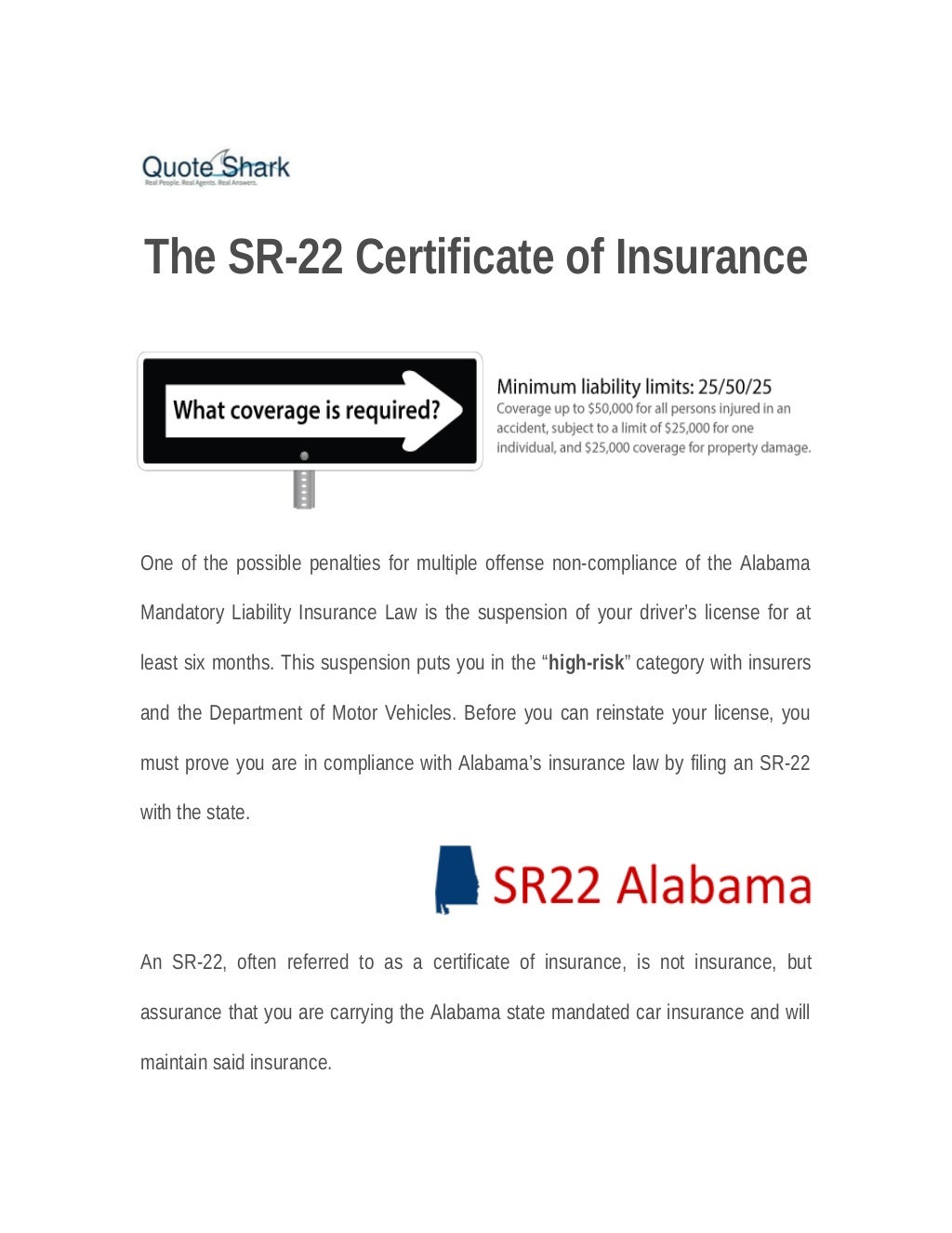
An SR-22 is not an actual insurance policy. Instead, it is an official legal endorsement—a Certificate of Financial Responsibility—attached to an existing or new auto insurance policy. When an insurance company issues an SR-22 on your behalf, it serves as state-verified proof that you maintain at least the minimum mandatory liability coverage required under Washington law.
Under the Washington Financial Responsibility Law (RCW 46.29), the Washington Department of Licensing (DOL) mandates an SR-22 filing for drivers deemed high-risk due to specific traffic violations or legal judgments. The document acts as an automated monitoring system: if your policy lapses, cancels, or experiences a coverage gap, your insurer is legally obligated to file an SR-26 form directly with the Washington DOL, triggering an immediate suspension of your driver's license.
Washington State Minimum Liability Limits
To qualify for an SR-22 filing in Washington, your auto policy must meet or exceed the state's statutory liability requirements:
- $25,000 for bodily injury or death of one person in an accident.
- $50,000 total for bodily injury or death of two or more people in an accident.
- $10,000 for property damage per accident.
These coverage limits are frequently abbreviated as 25/50/10. While these represent the bare legal minimums necessary to satisfy an SR-22 mandate, purchasing higher liability limits is strongly recommended if you hold significant personal assets.
Common Reasons the Washington DOL Requires an SR-22
The Washington DOL orders an SR-22 mandate following administrative actions, court convictions, or failure to demonstrate financial accountability. The primary triggers include:
- DUI or Physical Control Convictions: Operating a motor vehicle under the influence of alcohol or drugs (RCW 46.61.502) or being in physical control of a vehicle while impaired.
- Driving While License Suspended (DWLS): Convictions for driving on a suspended or revoked license, particularly DWLS 2nd or 1st degree.
- Reckless Driving or Negligent Driving (1st Degree): High-severity moving violations that carry administrative license suspensions.
- Uninsured Vehicle Accidents: Being involved in an accident causing bodily injury or property damage exceeding $1,000 while driving without valid insurance liability coverage.
- Habitual Traffic Offender (HTO) Status: Accumulating multiple major traffic violations within a five-year window.
- Unsatisfied Court Judgments: Failing to pay court-ordered civil damages resulting from a motor vehicle collision.
How to Get SR-22 Insurance in Washington: Step-by-Step
Navigating driver's license reinstatement in Washington requires completing specific administrative steps in precise sequence.
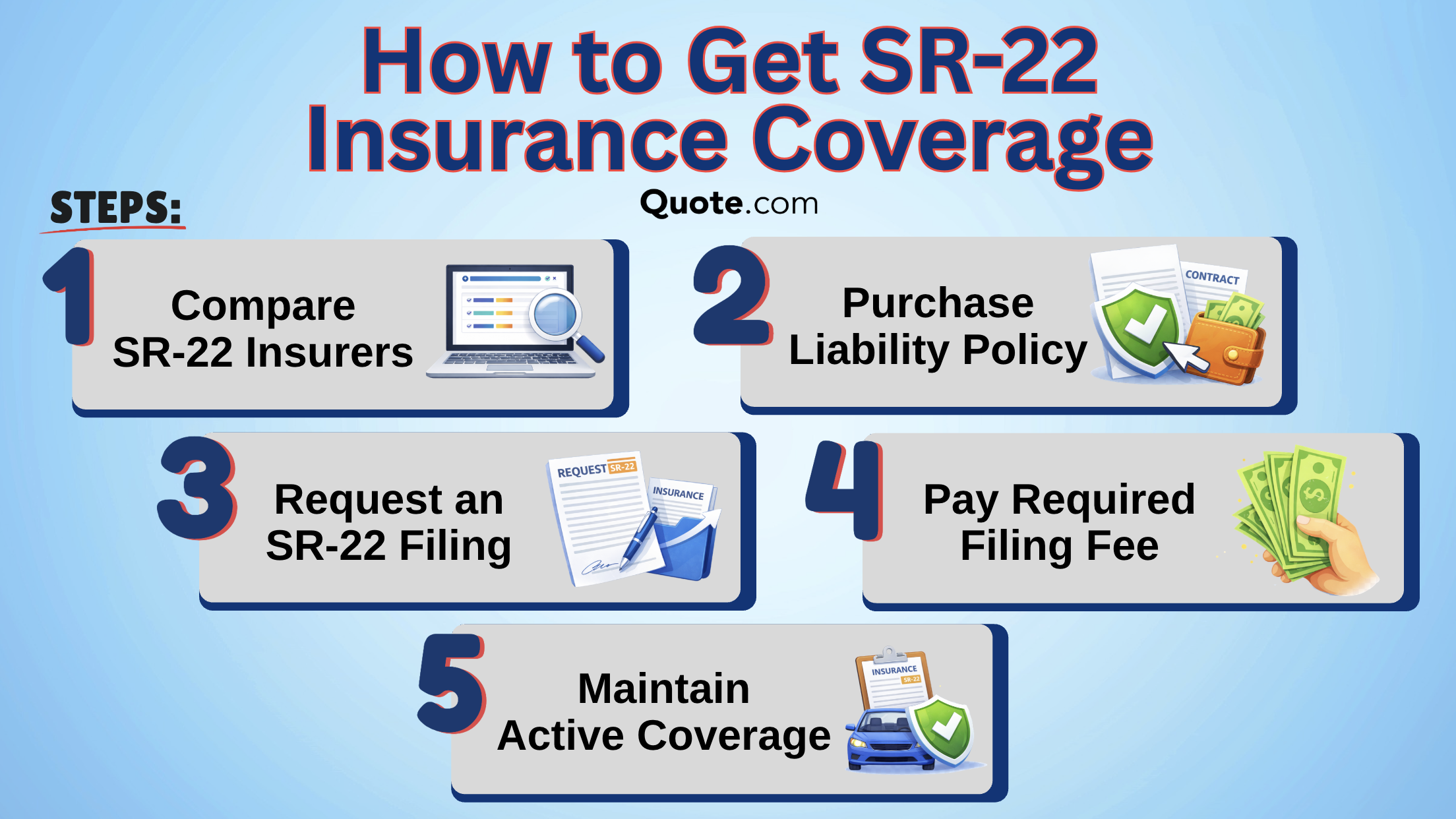
- Step 1: Check your license status with the WA DOL
- Step 2: Determine your coverage type (Owner, Non-Owner, Broad)
- Step 3: Shop quotes and select a licensed WA insurer
- Step 4: Pay filing fees & authorize electronic DOL filing
- Step 5: Pay WA DOL reinstatement fees and verify compliance
Step 1: Review Your Official Washington DOL Requirements
Before shopping for coverage, access your official driving record via the Washington Department of Licensing License eXpress portal. Obtain your suspension order or driving record abstract. This document details:
- The exact effective date of your suspension or revocation.
- The required duration of your SR-22 requirement (typically 36 consecutive months).
- Any outstanding administrative fees or secondary reinstatement conditions, such as installing an Ignition Interlock Device (IID).
Step 2: Choose the Correct Type of SR-22 Policy
Washington permits drivers to satisfy financial responsibility obligations through three distinct policy structures depending on vehicle ownership:
- Owner’s SR-22 Policy: Designed for individuals who own a registered vehicle. The SR-22 endorsement covers the named driver while operating their specified vehicle(s).
- Non-Owner SR-22 Policy: Intended for drivers who do not own a vehicle, live in a household without registered vehicles, but require a valid driver's license for employment or personal mobility. This policy provides secondary liability coverage when driving borrowed, rented, or non-owned cars.
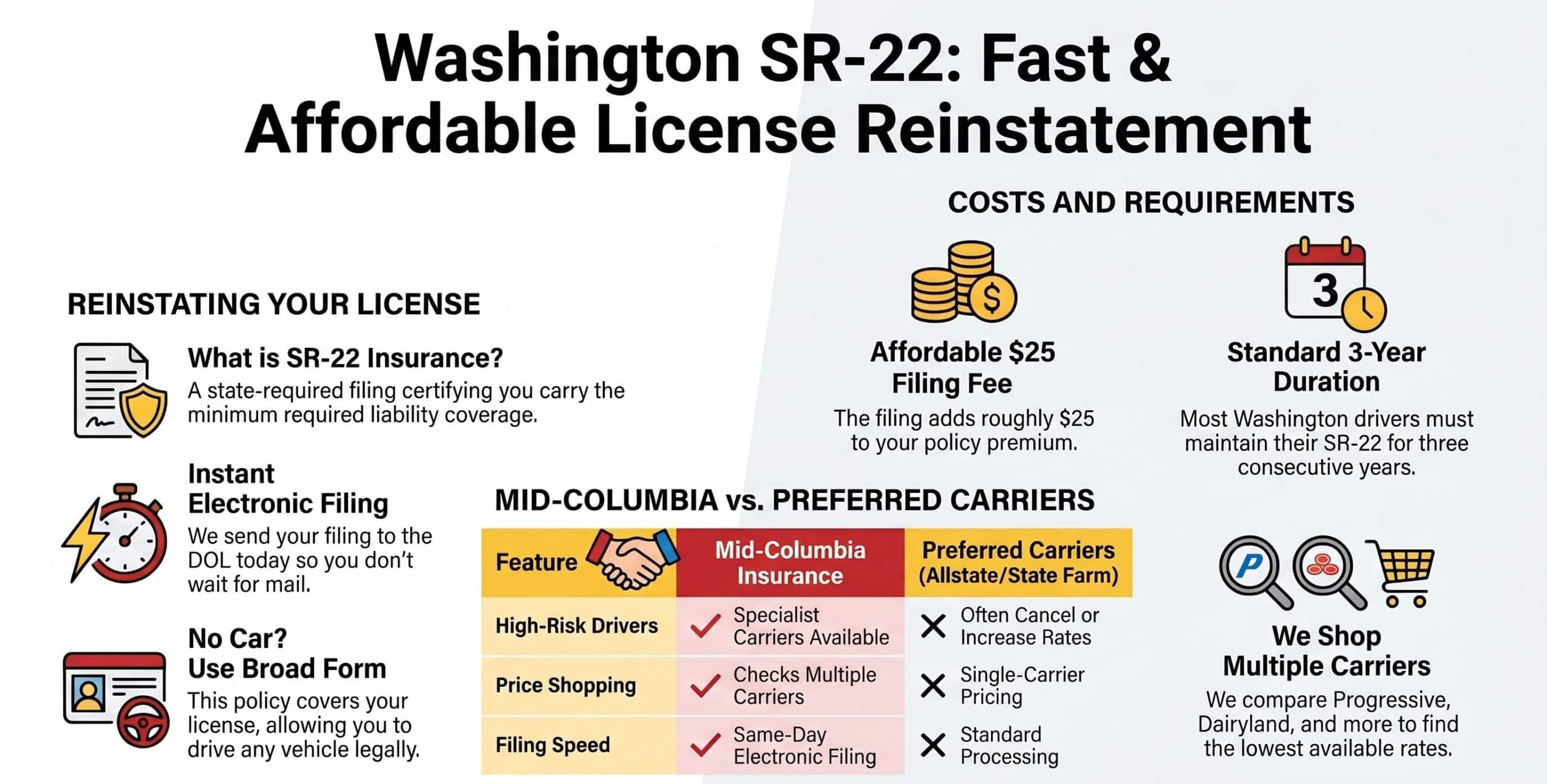
- Broad Form Liability Coverage: A unique option available in Washington State. Broad Form coverage protects a single named individual regardless of what passenger vehicle they operate—whether owned or non-owned. Adding an SR-22 endorsement to a Broad Form policy is often a cost-effective option for high-risk single drivers operating older or multiple vehicles.
Step 3: Request Quotes from Licensed Insurers
Not all national insurance carriers underwrite high-risk drivers or issue SR-22 filings. Contact insurers authorized by the Washington Office of the Insurance Commissioner. When requesting quotes:
- Explicitly state upfront that you require a Washington SR-22 filing.
- Provide accurate details regarding your driving history, including conviction dates and license suspension reasons. Omitting violations will lead to inaccurate quotes or post-underwriting policy cancellations.
- Compare premiums across specialized high-risk insurance companies as well as standard insurance carriers.
Step 4: Pay the Filing Fee and Confirm Electronic Filing
When you select a carrier and purchase your policy, the insurer will charge a one-time SR-22 filing fee, which usually ranges between $15 and $50.
Ensure that the insurer submits your SR-22 certificate electronically to the Washington Department of Licensing. While paper certificates (Form SR-22) were historically mailed, electronic transmission significantly accelerates processing times, typically updating state records within 24 to 72 business hours.
Step 5: Pay WA DOL Reinstatement Fees and Verify Status
Purchasing an SR-22 policy does not automatically restore your driving privileges. You must finalize the reinstatement process directly with the state:
- Log into your License eXpress account or visit a Washington DOL driver licensing office.
- Pay all applicable driver's license reinstatement fees (which vary based on the underlying offense, ranging from $75 to several hundred dollars).
- Confirm that your driving status has officially changed from Suspended to Valid. Do not drive until the state formally updates your record.
Comparing Washington SR-22 Insurance Options
Choosing the appropriate policy framework depends heavily on vehicle ownership, driving habits, and budget. The table below outlines key differences between policy types in Washington State.
| Policy Type | Vehicle Ownership Requirement | Coverage Extent | Average Relative Cost | Best Suited For |
|---|---|---|---|---|
| Owner SR-22 | Must own and register a vehicle in WA. | Covers listed vehicle(s) and permissive drivers operating listed vehicles. | Moderate to High | Drivers who own cars with loan/lease requirements or household vehicles. |
| Non-Owner SR-22 | Must NOT own a vehicle or live with accessible vehicles. | Secondary liability coverage when operating borrowed or rented personal cars. | Low to Moderate | Drivers without owned cars who need to clear license suspensions. |
| Broad Form SR-22 | Flexible (owned or non-owned passenger vehicles). | Covers one specific driver across personal passenger vehicles owned or operated. | Moderate | Single drivers who own multiple low-value cars or frequently switch vehicles. |
Note: Broad Form policies typically do not cover commercial driving, motorcycles, motorhomes, or household members driving your vehicles.
How Much Does SR-22 Insurance Cost in Washington State?
The SR-22 filing fee itself is minor ($15 to $50). However, the underlying auto insurance premium will reflect your status as a high-risk driver.
Key Factors Influencing Your Premium
- Underlying Violation: A major conviction like a DUI or reckless driving results in higher premium surcharges than a failure-to-appear or uninsured driving incident.
- Driving History: Multiple minor infractions or previous policy lapses compound rate increases.
- Location: Urban areas in Washington (such as Seattle, Tacoma, or Spokane) generally feature higher liability rates than rural counties due to traffic density and claim frequencies.
- Vehicle Type: For Owner SR-22 policies, expensive, high-horsepower, or newer vehicles requiring comprehensive and collision coverage will substantially raise premiums.
Strategies to Reduce SR-22 Insurance Rates
- Opt for High Deductibles: If purchasing physical damage coverage (comprehensive and collision) on an owned vehicle, increasing your deductible from $500 to $1,000 can lower annual premiums.
- Maintain Continuous Coverage: Never allow your policy to lapse. Premium rates drop over time as you demonstrate consecutive months of clean, uninterrupted coverage.
- Explore Non-Owner or Broad Form Policies: If you do not have financial liens or auto loans requiring comprehensive/collision protection, a Broad Form or Non-Owner policy provides legal compliance at a significantly lower cost.
- Complete a State-Approved Defensive Driving Course: Some Washington insurers offer voluntary discounts for completing accredited driver improvement courses.
Essential Rules for Maintaining Your SR-22 in Washington
To prevent restarting your suspension period, adhere strictly to Washington’s statutory compliance rules.
Required Duration: 36 Consecutive Months
In Washington State, the standard mandatory SR-22 filing period is three years (36 consecutive months) from the date you become eligible for license reinstatement.
- No Coverage Gaps: The 36-month requirement must be continuous.
- Consequences of a Lapse: If your policy drops for non-payment or cancellation, your insurance carrier is legally required to send an SR-26 form to the WA DOL. Upon receipt, the state immediately re-suspends your driver's license and resets your 36-month requirement counter back to day one.
Moving Out of Washington State
If you relocate to another state while under an active Washington SR-22 requirement, you cannot simply cancel your policy. Doing so will trigger a driver's license suspension in Washington, which will cross-report to your new state through the National Driver Register (NDR) and the Driver License Compact (DLC).
To maintain compliance when moving out of state:
- Obtain an auto insurance policy in your new state that meets or exceeds Washington’s minimum liability limits (25/50/10).
- Instruct your new insurance provider to execute an out-of-state SR-22 filing directly with the Washington DOL.
- Confirm with the Washington DOL that the out-of-state filing has been accepted before cancelling your original Washington policy.
Common Mistakes to Avoid
- Driving Before Reinstatement Confirmation: Purchasing SR-22 coverage is only one step. Driving before paying your state reinstatement fees and receiving confirmation of active status from the WA DOL can lead to new arrests for DWLS.
- Cancelling Coverage One Day Too Early: Do not assume your 36-month mandate ends on the third anniversary of your violation. Verify the exact compliance end date directly with the Washington DOL before cancelling your SR-22 endorsement.
- Failing to Update Address Records: The DOL sends official notices via physical mail to your legal address on file. If you move, update your address with the DOL within 10 days to avoid missing administrative deadlines or cancellation notices.
Frequently Asked Questions
Can I get an SR-22 without owning a car in Washington State?
Yes. You can purchase a Non-Owner SR-22 insurance policy. This policy supplies required statutory liability protection while you drive non-owned vehicles, allowing you to satisfy state licensing requirements without registering a personal automobile.
How quickly does the Washington DOL process an SR-22 filing?
When submitted electronically by an authorized insurer, the Washington DOL usually processes the filing within 1 to 3 business hours, though manual reviews or weekend submissions may take up to 72 business hours.
What is the difference between an SR-22 and an SR-26 in Washington?
An SR-22 is the certificate filed by your insurer confirming you have established required liability coverage. An SR-26 is the cancellation notice filed by your insurer notifying the state that your policy has lapsed, cancelled, or terminated.
Does an SR-22 requirement expire automatically?
While the legal mandate to maintain an SR-22 ends after your required duration (usually 3 years), the filing itself does not detach automatically. Once your 36 consecutive months are complete, contact the Washington DOL to confirm fulfillment, then inform your insurer to remove the SR-22 endorsement from your policy to avoid paying unnecessary administrative endorsement fees.
What happens if my insurance company drops my coverage?
If your insurer cancels your policy, immediately purchase a replacement SR-22 policy from another carrier without allowing any gap in dates. The new carrier must submit an SR-22 filing before the effective cancellation date of your old policy to prevent an SR-26 enforcement suspension.
Action Plan for Restoring Your Driving Privileges
If you need to establish an SR-22 filing in Washington State, take these immediate steps:
- Log into the Washington DOL License eXpress portal to confirm your exact reinstatement requirements, fees, and baseline suspension end dates.
- Determine whether an Owner, Non-Owner, or Broad Form policy best fits your driving setup and vehicle status.
- Obtain multiple quotes from carriers licensed in Washington, ensuring they handle electronic SR-22 state filings.
- Bind your policy, pay the filing fee, and confirm your insurer has transmitted the SR-22 electronically to the state.
- Pay all applicable WA DOL reinstatement fees and verify your license status shows Valid prior to operating any motor vehicle.
Disclaimer: Insurance rules, state statutes, and administrative procedures are subject to legal updates and administrative discretion. This guide is provided for educational purposes only and does not constitute formal legal or financial advice. For specific legal guidance regarding license suspensions or court mandates, consult a qualified attorney licensed in Washington State.
Image Gallery