Choosing the Best Online GMAT Prep Course for 2026 Success
An effective online GMAT prep course identifies your specific skill gaps and provides structured, adaptive learning paths to master the GMAT Focus Edition. By prioritizing platforms that offer high-quality practice questions, detailed...
An effective online GMAT prep course identifies your specific skill gaps and provides structured, adaptive learning paths to master the GMAT Focus Edition. By prioritizing platforms that offer high-quality practice questions, detailed analytics, and comprehensive coverage of the Quantitative, Verbal, and Data Insights sections, students can achieve competitive scores for top-tier MBA programs.
Contents
The Landscape of GMAT Preparation in 2026
The Graduate Management Admission Test (GMAT) remains the gold standard for business school admissions worldwide. As of 2026, the exam architecture is fully established under the "Focus Edition" framework, which streamlined the test by removing the Analytical Writing Assessment and emphasizing Data Insights. Consequently, an online GMAT prep course must do more than provide static video lessons; it must simulate the computer-adaptive nature of the actual exam while providing deep pedagogical support for integrated reasoning and data proficiency.
The shift toward digital-first education has made online courses the preferred choice over traditional classroom settings. Modern platforms utilize sophisticated algorithms to track student performance, suggesting specific modules to revisit based on error patterns. This level of personalization is critical because the GMAT is not merely a test of knowledge, but a test of executive decision-making and time management under pressure.
Essential Features of Top-Tier Online GMAT Courses
When evaluating prep providers, several technical and pedagogical features distinguish premium services from basic question banks. In 2026, the following components are considered the industry standard for high-performance preparation.
Adaptive Learning Algorithms
A computer-adaptive test (CAT) like the GMAT requires an adaptive preparation tool. High-quality courses use AI-driven engines to adjust the difficulty of practice sets in real-time. If you consistently answer medium-level Quantitative questions correctly, the system should automatically push you into "Hard" territory. This prevents "plateauing," a common issue where students spend too much time practicing concepts they have already mastered while avoiding their weaknesses.
Comprehensive Data Insights Coverage
The Data Insights (DI) section is often the most challenging for candidates because it requires synthesizing information from tables, graphs, and multi-source prompts. A robust online GMAT prep course must offer dedicated modules for:
- Data Sufficiency: Determining if provided statements are enough to solve a problem.
- Multi-Source Reasoning: Analyzing data from different tabs or sources.
- Table Analysis and Graphics Interpretation: Discerning trends and specific data points quickly.
- Two-Part Analysis: Solving complex problems with two interrelated components.
Performance Analytics and Error Logs
Success on the GMAT is often determined by the ability to recognize patterns. Advanced platforms now automate the creation of an error log. Instead of manually tracking every missed question in a spreadsheet, the software categorizes errors by topic (e.g., Number Properties, Sentence Structure, or Probability) and sub-topic. This allows students to see precisely where their "accuracy-to-time" ratio is failing.
Comparing Online GMAT Prep Delivery Models
Not all online courses are structured the same way. The choice between self-paced learning and live instruction depends heavily on your professional schedule and self-discipline.
Self-Paced On-Demand Courses
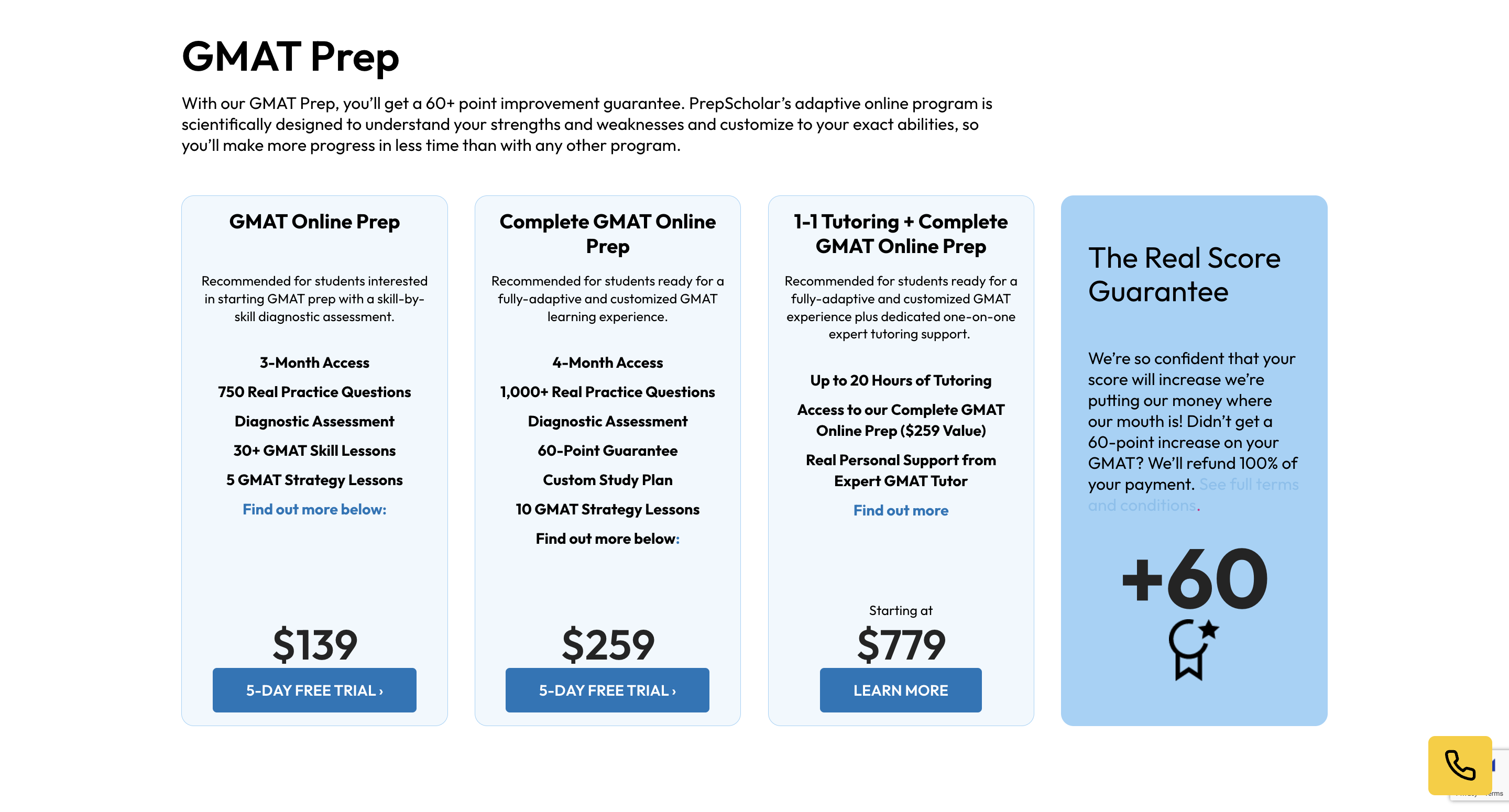
These are ideal for professionals with unpredictable schedules. These courses typically feature a library of pre-recorded video lessons, interactive quizzes, and a structured syllabus. The primary advantage is the ability to accelerate through familiar material and spend extra time on difficult concepts. Providers like Target Test Prep and Magoosh have historically led this segment by offering deep, granular content that students can consume at their own speed.
Live-Online Classrooms
For students who thrive on social accountability and real-time feedback, live-online courses mimic the traditional classroom experience via high-definition streaming. These sessions are led by instructors who have typically scored in the 99th percentile of the exam. The value here lies in the ability to ask clarifying questions during a lecture and engage in "breakout room" drills with peers. Manhattan Prep (part of the Kaplan family) is frequently cited for its high-caliber instructors and rigorous live curricula.
Private Online Tutoring
The most expensive but most direct path to a high score is one-on-one virtual tutoring. This model is best suited for students who have already reached a high baseline score (e.g., 605+) and need targeted strategy adjustments to break into the 705+ range. Tutors can diagnose subtle psychological barriers, such as testing anxiety or poor "guessing strategies," that automated platforms might miss.
Leading Online GMAT Prep Providers in 2026
Based on curriculum depth, platform stability, and student outcomes, the following organizations represent the top tier of prep options available this year.
| Provider | Primary Format | Target Audience | Key Strength |
|---|---|---|---|
| Target Test Prep (TTP) | Self-Paced | Quantitative Focus | Extremely granular, step-by-step Quant and DI mastery. |
| Manhattan Prep | Live-Online / Self-Paced | High-Achievers | Advanced strategies and high-quality mock exams. |
| Magoosh | Self-Paced | Value Seekers | Excellent mobile app and affordable price-to-content ratio. |
| e-GMAT | Self-Paced | Non-Native Speakers | Exceptional Verbal section pedagogy and logic-based learning. |
| Official GMAC Prep | Practice Tests | All Students | Uses the actual GMAT scoring algorithm and retired questions. |
Technical Requirements and User Experience
Before committing to a course, ensure your technical setup matches the platform’s requirements. Most modern GMAT platforms are cloud-based and accessible via standard browsers (Chrome, Safari, Firefox), but there are nuances to consider:
- Mobile Synchronization: Many students study during commutes. Ensure the course offers a dedicated mobile app or a responsive mobile web interface that syncs progress across devices.
- Exam Simulation: The practice exams (mocks) must look and feel exactly like the actual GMAT interface. This includes the "Question Review and Edit" feature, which allows you to bookmark questions and change up to three answers per section—a feature critical to the 2026 testing experience.
- Support and Responsiveness: Check if the course provides a "Help" or "Ask a Tutor" button. In 2026, many platforms use AI chatbots to provide immediate explanations, but the option to escalate to a human expert within 24 hours remains a hallmark of a high-quality service.
Understanding the GMAT Scoring Scale in 2026
It is vital to understand that the GMAT scoring scale was recalibrated with the introduction of the Focus Edition. The total score now ranges from 205 to 805, and all three sections (Quantitative, Verbal, and Data Insights) contribute equally to the final score.
Previously, Quantitative and Verbal were the primary drivers of the 200-800 score, with Integrated Reasoning scored separately. In 2026, a score of 645 is roughly equivalent to a 700 on the old scale. An online GMAT prep course must provide a percentile ranking for your practice scores so you can accurately gauge your standing relative to the global applicant pool. Comparing raw scores across different eras of the test is a common mistake that can lead to misaligned expectations during the application process.
Common Pitfalls When Using Online Prep Tools
While online courses provide the tools for success, students often fail to utilize them correctly. Avoiding these common mistakes can significantly improve your Return on Investment (ROI):
- Passive Watching: Simply watching video lessons without taking active notes or pausing to solve problems is ineffective. Treat every video as a lecture where you are an active participant.
- Neglecting the Official Guide (OG): No matter how good a prep course is, it is not the actual test maker. You must supplement any online course with official questions from the Graduate Management Admission Council (GMAC). Use your prep course to learn the methods, and use the Official Guide to apply them to real questions.
- Over-testing: Taking a practice exam every weekend is a recipe for burnout. Mocks should be used sparingly—perhaps once every three weeks—to measure progress. The bulk of your time should be spent on targeted drills.
Frequently Asked Questions
How long should I study with an online GMAT prep course?
Most successful candidates dedicate between 100 and 150 hours of study over a period of three to four months. This timeframe allows for a deep dive into the fundamentals followed by extensive practice and refinement. If you are starting from a significantly lower baseline than your target score, you may need up to 200 hours.
Can I get a refund if my score doesn't improve?
Many top providers, such as Magoosh and Target Test Prep, offer score improvement guarantees. However, these are subject to strict terms, such as completing 100% of the video lessons and practice questions before your exam date. Always read the fine print regarding "baseline" scores, as they usually require you to have a verified prior GMAT score to qualify for a refund.
Are online GMAT courses better than books?
Online courses are generally superior for the GMAT because they mimic the digital testing environment. Books are excellent for reading deep theory, but they cannot provide the timed practice or adaptive difficulty that is core to the GMAT experience. In 2026, the interactive nature of Data Insights is particularly difficult to replicate in a static print format.
Does the GMAT Focus Edition include an essay?
No, the GMAT Focus Edition, which is the standard in 2026, does not include the Analytical Writing Assessment (AWA). The exam is comprised solely of Quantitative Reasoning, Verbal Reasoning, and Data Insights. This allows the test to be shorter (roughly 2 hours and 15 minutes) and more focused on data literacy.
Is the Data Insights section harder than the old Integrated Reasoning?
The content is similar, but the stakes are higher because Data Insights now impacts your total score. In the past, business schools often discounted the IR score, but in 2026, your DI performance is just as important as your Math or Verbal performance. Online courses have responded by significantly increasing the volume of DI practice material.
Final Recommendation for Candidates
The "best" course is the one you will actually use consistently. For most students in 2026, Target Test Prep offers the most comprehensive Quantitative and Data Insights training, while Manhattan Prep remains the gold standard for those aiming for the highest percentiles through live-online instruction. Begin by taking a free diagnostic practice test on the official mba.com website to establish your baseline. Once you identify whether your weakness lies in Quant or Verbal, choose the provider that aligns with your specific needs and commit to their structured path.
Image Gallery