Understanding the MBA HR Management Pathway: A Strategic Career Guide
The MBA in Human Resource Management (HRM) pathway is a specialized postgraduate degree designed to bridge the gap between organizational strategy and human capital development. It equips professionals with the analytical tools to mana...
The MBA in Human Resource Management (HRM) pathway is a specialized postgraduate degree designed to bridge the gap between organizational strategy and human capital development. It equips professionals with the analytical tools to manage workforce planning, talent acquisition, labor relations, and organizational development, transitioning them from administrative HR functions into high-level strategic executive roles.
Contents
Defining the MBA HR Management Scope
The Master of Business Administration with a concentration in Human Resource Management is not merely an extension of personnel management. While traditional HR focuses on payroll, compliance, and employee documentation, the MBA pathway centers on the "human capital" component of an organization’s balance sheet.
In this program, students study the intersection of business operations and behavioral science. You will explore how labor costs affect bottom-line performance, how organizational culture influences retention rates, and how data analytics can predict future staffing needs. This degree is aimed at individuals seeking to move into roles such as Chief Human Resources Officer (CHRO), HR Director, or Talent Strategy Consultant, where decision-making must be backed by financial literacy and business acumen.
Core Prerequisites and Entry Requirements
To enter an MBA HR management program in 2026, most accredited institutions require a consistent baseline of professional and academic preparation. While specific mandates vary by university, the following requirements are standard across top-tier business schools:
- Bachelor’s Degree: A four-year undergraduate degree from an accredited institution. While a degree in business or psychology is common, many programs accept applicants from diverse academic backgrounds provided they demonstrate quantitative proficiency.
- Professional Experience: Most reputable MBA programs require two to five years of full-time work experience. For HR-specific tracks, experience within a business or HR setting is highly preferred, as it allows students to contextualize theoretical coursework.
- Standardized Testing: Many institutions have adjusted their policies to be test-optional; however, high scores on the GMAT or GRE remain a significant advantage for admission to competitive cohorts and for scholarship consideration.
- Language Proficiency: For international candidates, proof of language proficiency—typically through the TOEFL or IELTS—is mandatory to ensure success in rigorous, discussion-based seminar environments.
The Curriculum Structure: Bridging Theory and Application
The curriculum for this pathway is bifurcated into two distinct phases: the foundational MBA core and the specialized HR management concentration.
The MBA Core
The first year of study focuses on universal business literacy. You cannot lead an HR department effectively if you do not understand the mechanics of the rest of the business. You will likely complete coursework in:
- Financial Accounting and Management: Understanding how to interpret corporate P&L statements.
- Marketing Management: Analyzing consumer behavior, which informs employer branding strategies.
- Operations and Supply Chain Management: Learning how labor workflows influence production cycles.
- Strategic Management: Developing the skills to align human capital initiatives with long-term corporate goals.
The HR Specialization
Once the core is satisfied, the specialization dives into technical HR functions viewed through a strategic lens:
- Total Rewards and Compensation: Designing incentive programs that align with corporate fiscal policy and market competitiveness.
- Employment Law and Ethics: Analyzing jurisdictional regulatory compliance, such as labor standards, workplace safety, and anti-discrimination law, which are critical for minimizing organizational risk.
- Organizational Development (OD): Managing large-scale change, such as mergers, acquisitions, or restructuring, where human resistance and culture-shift are the primary challenges.
- HR Analytics: Utilizing predictive software to forecast turnover, measure performance metrics, and determine the ROI of training programs.
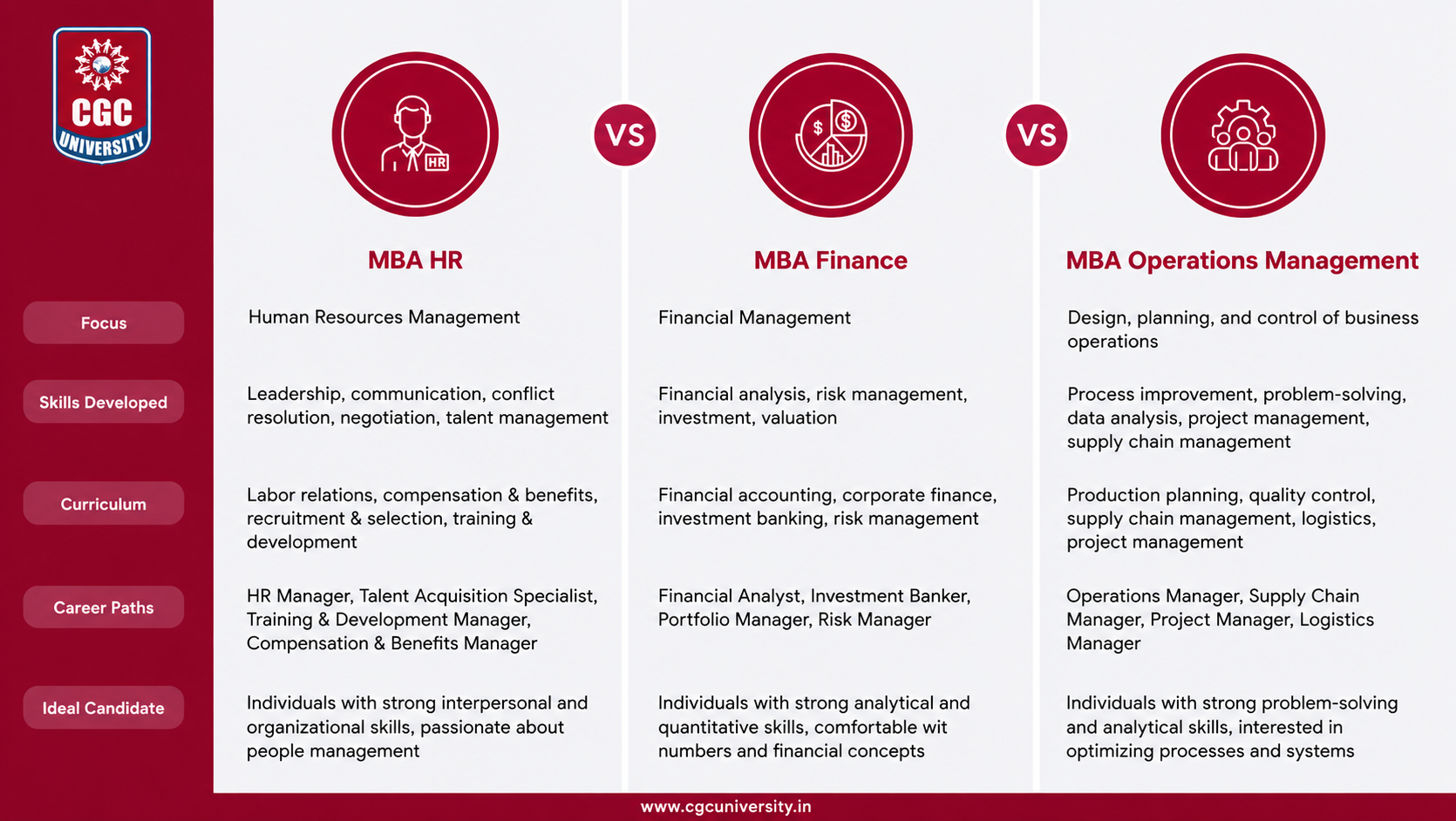
Comparative Overview: Traditional HR vs. MBA HR Pathway
Understanding the distinction between a Master’s in Human Resources (MHR) and an MBA with a concentration in HR is critical for long-term career planning.
| Feature | Master of Human Resources (MHR) | MBA in HR Management |
|---|---|---|
| Focus | Deep dive into specialized HR technical skills. | Balanced focus on business strategy and HR. |
| Career Goal | HR Generalist, HR Specialist, HR Business Partner. | CHRO, HR Director, General Manager. |
| Primary Audience | Early-career HR professionals. | Mid-career managers seeking executive pivots. |
| Breadth | Niche, functional, and operational. | Holistic, strategic, and financial. |
Navigating Costs and Financial Planning
The financial investment for an MBA in 2026 remains a significant consideration. Costs fluctuate drastically based on the institution's reputation, location, and the delivery method—full-time on-campus, executive (part-time/weekend), or online.
Beyond tuition, students must account for opportunity costs—the wages lost while studying full-time—and living expenses. However, the ROI of this degree is often measured by the salary ceiling increase. Graduates from competitive programs often transition into roles that offer not just higher base salaries, but significant equity, bonuses, and performance-based incentives that are standard in executive-level HR positions. It is recommended to investigate company-sponsored tuition reimbursement programs, as many mid-to-large enterprises provide financial assistance to employees pursuing graduate management degrees.
Addressing Common Challenges
The most common mistake prospective students make is viewing the MBA as a "check-the-box" activity. To maximize the pathway, you must engage with the program's networking opportunities. The value of an MBA often lies more in the cohort’s peer-to-peer knowledge sharing and the university’s alumni network than in the textbook content itself.
Another challenge is the "Generalist Trap." In the first year, it is easy to become overwhelmed by the sheer breadth of business subjects. To troubleshoot this, align your core projects—such as market analysis or financial simulations—with your HR interests. By applying your MBA core studies to HR scenarios, you build a unique portfolio that showcases your dual competence in business and human capital before you even graduate.
Frequently Asked Questions
Is an MBA in HR worth it if I already have years of experience? Yes, if your career goal involves reaching the C-suite. While experience provides practical knowledge, an MBA offers the theoretical framework and the business-wide perspective required for top-level strategic oversight, which is often a formal requirement for HR executive roles in large corporations.
Can I complete this pathway while working full-time? Many 2026 programs are designed for working professionals. Executive MBA (EMBA) programs and high-quality online tracks allow for the integration of full-time employment with academic study, though this requires high discipline and strong time-management skills.
Does the MBA accreditation matter? Accreditation by bodies like the AACSB or EQUIS is critical. It ensures that the degree is recognized by employers and that the institution meets rigorous standards for curriculum quality, faculty research, and student outcomes. Avoid unaccredited programs as they often lack the professional prestige required for top-tier HR leadership roles.
What is the most important technical skill to gain from this degree? HR Analytics. In 2026, organizations demand data-driven evidence for every HR decision. Learning how to translate qualitative human behaviors into quantitative metrics is the single most valuable skill for a modern HR strategist.
How does this degree affect global mobility? Because the MBA is a globally recognized degree, it facilitates transitions across international borders. However, you must pair the degree with localized knowledge of the labor laws in the region where you intend to practice, as employment regulations are inherently jurisdictional.
Next Steps for Aspiring Candidates
To successfully embark on the MBA HR management pathway, begin by auditing your current career trajectory. Determine if your professional growth has stalled due to a lack of financial, operational, or strategic training. If so, research three to five accredited programs that align with your career goals and budget. Request informational interviews with alumni from these programs to gauge the practical relevance of their curriculum. Finally, assess your readiness for the GMAT or GRE, as these scores are often the gatekeepers for high-ROI scholarship opportunities. Your path to executive leadership in HR begins with selecting a program that treats human capital as the most critical asset in any business ecosystem.
Image Gallery