Navigating the Balance Between Cloud Security and Privacy in Modern Architecture
Achieving the delicate balance between cloud security and privacy requires reconciling security teams' mandate to inspect and monitor data with individuals' legal right to data confidentiality. While cloud security focuses on protectin...
Achieving the delicate balance between cloud security and privacy requires reconciling security teams' mandate to inspect and monitor data with individuals' legal right to data confidentiality. While cloud security focuses on protecting systems from unauthorized access and breaches, privacy centers on how personal data is collected, processed, and shared. Organizations must design architectures that implement robust perimeter and endpoint defenses without violating regulatory frameworks or invading user confidentiality.
Contents
Understanding the Core Concepts: Security vs. Privacy
To manage the intersection of cloud security and privacy, organizations must first distinguish between the two pillars of data governance. Although they frequently overlap and support one another, their underlying objectives, operational metrics, and regulatory drivers differ significantly.
DATA GOVERNANCE
- CLOUD SECURITY
- Focus: Asset defense
- Goal: CIA Triad
- Methods: Encryption, IAM, Firewalls
- CLOUD PRIVACY
- Focus: Data rights
- Goal: Compliance
- Methods: Minimization, Consent, Anonymization
Defining Cloud Security
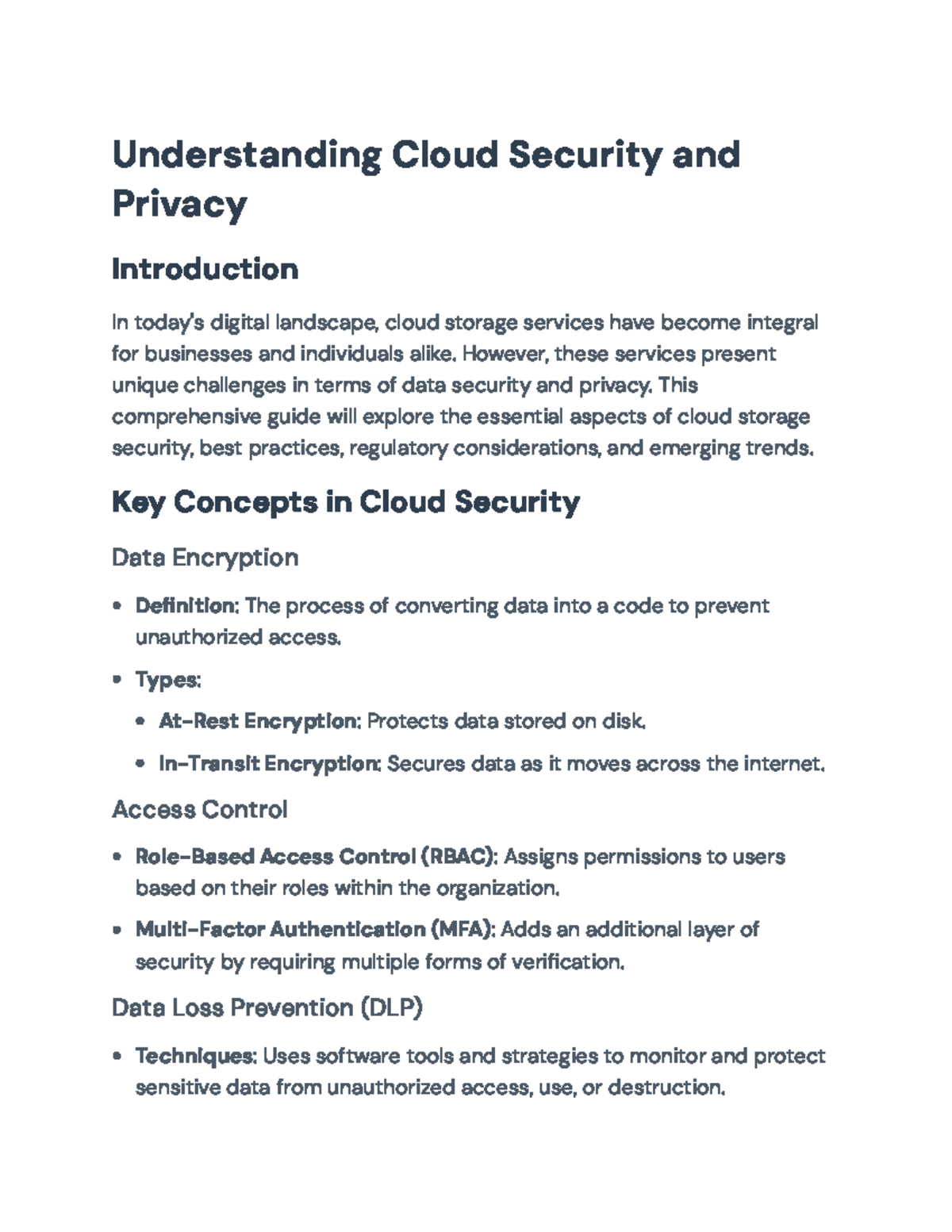
Cloud security encompasses the policies, technologies, controls, and services that protect cloud-native data, applications, and infrastructure from cyber threats. It relies heavily on the traditional CIA triad:
- Confidentiality: Ensuring that sensitive data is hidden from unauthorized entities.
- Integrity: Guaranteeing that data and systems are not altered maliciously or accidentally.
- Availability: Ensuring reliable, uninterrupted access to resources for authorized users.
In cloud environments, security is governed by the shared responsibility model. Cloud Service Providers (CSPs) like Amazon Web Services (AWS), Microsoft Azure, and Google Cloud Platform (GCP) secure the underlying infrastructure (the "security of the cloud"), while customers retain responsibility for configuring and protecting their workloads, identities, and data residing within the cloud (security in the cloud).
Defining Cloud Privacy
Cloud privacy centers on the appropriate collection, use, retention, disclosure, and disposal of personally identifiable information (PII) and sensitive corporate data. Privacy is less about keeping hackers out and more about ensuring that authorized users handle data in accordance with user consent, organizational policies, and legal statutes such as the European Union's General Data Protection Regulation (GDPR) or the California Consumer Privacy Act (CCPA).
Privacy frameworks mandate principles such as:
- Data Minimization: Collecting only the data strictly necessary for a specified purpose.
- Purpose Limitation: Using data solely for the reasons disclosed to the data subject.
- User Rights: Providing individuals with the ability to access, correct, or delete their personal records.
The Natural Tension Points in Cloud Deployments
Friction between security and privacy often surfaces during system design and incident response. Measures intended to harden an environment against external attacks can inadvertently undermine data privacy, and vice versa.
Comprehensive Logging vs. Data Minimization
Security operations centers (SOCs) depend on deep visibility to detect threats. This requires collecting massive volumes of telemetry, including user activity logs, network traffic metadata, and application traces. However, these logs frequently capture PII, IP addresses, and user behavior patterns.
Storing and centralizing this telemetry inside a security information and event management (SIEM) platform can violate data minimization principles, expanding the organization's privacy attack surface. If the SIEM is breached, the exposure radius includes sensitive user data inadvertently swept up by logging agents.
Deep Packet Inspection and Content Filtering
To block malware and data exfiltration, advanced cloud security tools often inspect traffic moving across virtual private clouds (VPCs). Deep packet inspection (DPI) analyzes the payload of network packets. If traffic is unencrypted, DPI exposes the exact contents of user communications.
Even when traffic is encrypted via Transport Layer Security (TLS), securing cloud microservices often requires service mesh proxies to terminate and re-encrypt traffic, giving the inspection infrastructure temporary visibility into plaintext user sessions. This creates a compliance dilemma for organizations handling highly confidential communications or healthcare records.
Technical Strategies for Harmonizing Security and Privacy
Modern cloud architectures provide advanced cryptographic and identity management capabilities designed to reconcile security mandates with privacy requirements.
Advanced Encryption and Key Management
Encryption is the primary technical bridge connecting security and privacy. Properly implemented encryption renders intercepted data unreadable to attackers (security) while ensuring that unauthorized internal administrators cannot view plaintext user records (privacy).
- Encryption at Rest: Securing stored data using robust algorithms such as AES-256. Organizations should maintain sole control over their encryption keys using dedicated Cloud Key Management Services (KMS) or hardware security modules (HSMs). Keeping keys isolated prevents CSP administrators from accessing customer data, satisfying both privacy mandates and zero-trust security postures.
- Encryption in Transit: Protecting data moving across networks using modern protocols like TLS 1.3.
- Homomorphic Encryption: An advanced cryptographic approach that allows computation on ciphertexts without decrypting them first. While computationally intensive, homomorphic encryption permits cloud providers or third-party analytics engines to process secure data without ever gaining access to the underlying plaintext privacy data.
Zero-Trust Architecture and Identity Governance
A Zero-Trust architecture operates on the principle of "never trust, always verify." In the context of balancing security and privacy, Zero-Trust limits lateral movement during an attack while strictly enforcing the principle of least privilege for human administrators.
ZERO-TRUST PRINCIPLES
- Continuous Verification of Identity & Device Health
- Strict Least-Privilege Access (Just-In-Time / Just-Enough)
- Micro-Segmentation to Contain Blast Radius
- Assumption of Breach Across All Cloud Boundaries
By enforcing role-based access control (RBAC) alongside attribute-based access control (ABAC), organizations ensure that security teams can investigate incidents without being granted blanket read permissions over private user data repositories. Just-in-time (JIT) access grants administrators temporary, audited access only when an operational need arises.
Comparative Matrix: Security Controls vs. Privacy Impacts
The following matrix illustrates how common cloud security controls interact with privacy requirements, detailing potential conflicts and mitigation techniques.
| Security Control | Primary Security Objective | Potential Privacy Impact | Mitigation Strategy |
|---|---|---|---|
| Centralized SIEM Logging | Detect unauthorized access and lateral movement. | Ingestion of PII and user activity telemetry into third-party storage. | Implement log masking, hashing, and tokenization before export. |
| Data Loss Prevention (DLP) | Block exfiltration of proprietary or regulated data. | Deep inspection of user files, emails, and messaging payloads. | Restrict DLP inspection rules to exact hash matches or narrow regex patterns. |
| Privileged Access Management (PAM) | Prevent account compromise and insider threats. | Extensive monitoring, session recording, and keystroke logging of admins. | Anonymize non-security metadata and restrict video playback of admin sessions to verified privacy officers. |
| Multifactor Authentication (MFA) | Verify identity and stop credential stuffing attacks. | Collection of biometric data, phone numbers, or hardware tokens. | Offer diverse MFA options (e.g., FIDO2 hardware keys) that do not harvest biometric profiles. |
Regulatory and Compliance Frameworks
Compliance frameworks act as binding contracts that force organizations to balance technical security protections with strict privacy rights. Understanding these standards prevents costly penalties and structural misalignment.
General Data Protection Regulation (GDPR)
Enforced across the European Union, the GDPR demands stringent technical and organizational security measures under Article 32, requiring pseudonymization and encryption of personal data. However, GDPR also protects privacy through the "right to be forgotten" (Article 17).
This requirement creates a technical challenge in cloud security: immutable backups and write-once-read-many (WORM) audit logs designed to secure data against ransomware can prevent administrators from deleting individual user records upon request. Architects must employ cryptographic erasure—destroying the encryption key associated with a specific user's data—to render backups unrecoverable while preserving storage integrity.
Health Insurance Portability and Accountability Act (HIPAA)
In the healthcare sector, HIPAA mandates security safeguards for electronic Protected Health Information (ePHI). Cloud deployments require Business Associate Agreements (BAAs) with CSPs.
Security tools must be configured to ensure that unauthorized healthcare staff cannot access patient records without a clinical justification, bridging clinical privacy rules with electronic access controls.
Common Implementation Mistakes
Organizations frequently misconfigure cloud environments when attempting to satisfy security and privacy simultaneously. Avoiding these pitfalls ensures smoother compliance audits and tighter defenses.
- Over-Reliance on Perimeter Defenses: Relying solely on cloud firewalls and assuming data is safe once inside the perimeter. This exposes internal assets if an attacker achieves credential compromise.
- Ignoring Data Classification: Treating all cloud storage buckets with the same security tier. Organizations must discover, tag, and classify data so that privacy-heavy assets receive dedicated cryptographic controls.
- Neglecting Third-Party Subprocessors: Failing to audit Software-as-a-Service (SaaS) vendors and third-party API integrations that ingest cloud telemetry, inadvertently leaking user data outside governed perimeters.
Frequently Asked Questions
Does implementing strong cloud security automatically guarantee data privacy?
No. Security protects data from unauthorized access, theft, and destruction, whereas privacy governs whether the data should have been collected or processed in the first place. An organization can have an impenetrable cloud environment that securely stores data it had no legal right to gather.
How can organizations comply with privacy erasure requests while maintaining secure, immutable security logs?
Organizations utilize cryptographic erasure. By encrypting individual user datasets with unique keys, deleting the specific key renders the ciphertext permanently unreadable. This satisfies privacy deletion mandates without requiring modifications to immutable backup logs.
What is the shared responsibility model in relation to privacy?
While Cloud Service Providers handle infrastructure security, compliance, and physical data center security, the customer remains legally responsible for classifying data, managing user consent, configuring privacy settings, and securing applications deployed in the cloud.
How does Zero-Trust architecture impact user privacy?
Zero-Trust improves privacy by continuously verifying access requests and limiting data exposure to the minimum necessary for a specific task. This prevents broad administrative overreach and ensures that internal actors cannot freely browse sensitive user information.
Are cloud-native security tools compliant with international privacy laws by default?
No. Cloud security tools are designed to protect infrastructure and detect threats, but their default configurations often log extensive metadata. Administrators must actively configure data masking, tokenization, and retention limits to align these tools with privacy laws.
Conclusion and Next Actions
Balancing cloud security and privacy requires deliberate architectural planning rather than treating them as interchangeable concepts. Security teams must move away from total-visibility models that compromise user confidentiality, while privacy officers must embrace modern cryptographic tooling.
To operationalize this balance:
- Conduct an immediate data discovery and classification audit across all cloud environments to map where PII resides.
- Implement customer-managed encryption keys (CMEK) to ensure exclusive control over data decryption.
- Review SIEM and logging pipelines to introduce real-time data masking and tokenization, stripping unnecessary PII before analysis.
Image Gallery