Is Group Life Insurance Cheaper Than Individual?
Group life insurance is generally much cheaper than individual life insurance, and often provided at little to no cost by employers, because the risk is spread across a large pool of employees without requiring individual medical under...
Group life insurance is generally much cheaper than individual life insurance, and often provided at little to no cost by employers, because the risk is spread across a large pool of employees without requiring individual medical underwriting.
Contents
When planning financial security for dependents, understanding the mechanics of life insurance costs is vital. Employees, association members, and business owners frequently face the choice between relying on employer-sponsored group life insurance or purchasing a standalone individual policy. While the short answer indicates that group coverage is the more affordable route, the financial reality involves nuances regarding coverage limits, portability, underwriting standards, and long-term value. To determine which option best fits a financial strategy, it is necessary to examine how both types of coverage operate, how premiums are calculated, and what tradeoffs accompany each approach.
Understanding Group Life Insurance
Group life insurance is a single master contract that provides coverage to a specific group of people, typically the employees of a company or members of a labor union or professional association. The primary structural advantage of group coverage is risk pooling. Instead of evaluating every single applicant's health history, family medical background, and lifestyle habits, the insurance provider assesses the overall mortality risk of the entire group.
Because healthier individuals subsidize higher-risk individuals within the pool, insurance companies can offer simplified issue or guaranteed issue policies. Guaranteed issue means that applicants can secure a baseline amount of coverage—often equal to one or two times their annual salary—without answering medical questionnaires or undergoing a physical examination. This makes group life insurance exceptionally accessible, particularly for individuals who might otherwise face high premiums or outright denial in the individual market due to pre-existing medical conditions.
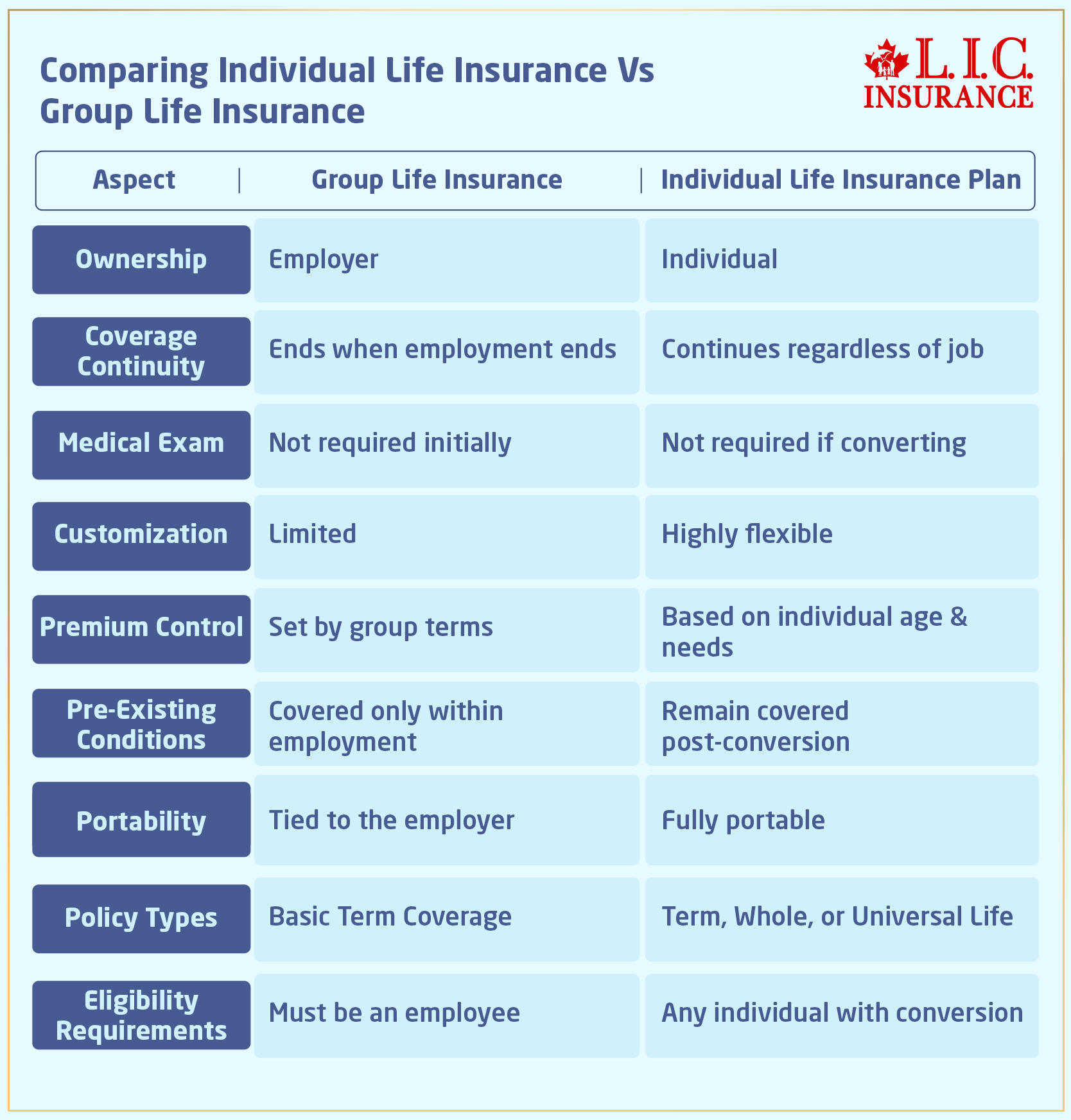
However, this accessibility comes with certain operational limitations. Group life insurance policies are typically tied to employment or membership. If an individual leaves the company, changes jobs, or retires, the group coverage usually terminates. While some policies offer a conversion option to transition the group certificate into an individual permanent policy, these conversion rates are notoriously expensive because they bypass current underwriting and capture high-risk individuals leaving the pool.
Understanding Individual Life Insurance
Individual life insurance, by contrast, is a private contract purchased directly from an insurance carrier by an individual policyholder. Unlike group plans, individual policies—whether term life or permanent options like whole or universal life—require a rigorous underwriting process.
Underwriters evaluate a wide array of personal health metrics to determine the applicant's exact risk profile. This process typically includes a detailed medical history questionnaire, a prescription database check, a motor vehicle report, and a paramedical exam involving blood and urine samples. For young, healthy non-smokers, this individual underwriting works to their financial advantage. Because they represent a very low statistical risk of mortality, they can qualify for preferred or super-preferred rate classes that yield remarkably low monthly or annual premiums.
The defining benefit of an individual life insurance policy is ownership and portability. Once an individual policy is issued, the premiums are locked in for the duration of the term (in the case of level-term insurance), or structured according to permanent policy guarantees. The coverage stays with the policyholder regardless of employment status, career changes, or health deteriorations later in life. This ensures long-term stability and guarantees that coverage cannot be arbitrarily altered or canceled by an employer.
Cost Comparison: Group Versus Individual Policies
To answer whether group life insurance is truly cheaper than individual coverage, one must evaluate immediate out-of-pocket costs against long-term financial exposure. The financial dynamics change dramatically depending on age, health status, and the amount of coverage required.
Employer-Paid Versus Voluntary Group Coverage
In many corporate benefit structures, a baseline amount of group term life insurance—such as a $50,000 policy—is provided entirely free of charge by the employer. In this specific scenario, group insurance is undeniably cheaper, as the cost to the employee is zero dollars. However, employers often allow workers to purchase supplemental or voluntary group life insurance for higher coverage amounts. These voluntary group premiums increase with age, often utilizing age-banded rate tables that step up every five years.
Age and Health Determinants
For a healthy 25-year-old, an individual 20-year level term policy can sometimes rival or beat the cost of voluntary supplemental group coverage, while offering a much higher death benefit and locked-in rates. Conversely, for a 55-year-old with managed hypertension or high cholesterol, individual underwriting will reflect those health conditions, driving individual rates significantly higher. For this demographic, group life insurance—which ignores personal health conditions for standard or guaranteed tiers—is almost always substantially cheaper.
| Feature / Factor | Group Life Insurance | Individual Life Insurance |
|---|---|---|
| Underwriting Required | None for basic tiers (Guaranteed Issue) | Comprehensive medical exam and history |
| Who Pays | Often employer-paid or heavily subsidized | Policyholder pays 100% of the premium |
| Portability | Generally terminates upon leaving the employer | Fully portable; stays with you for life |
| Coverage Amount | Typically limited to 1x–3x annual salary | Customizable up to millions based on need |
| Rate Stability | Rates can increase annually or by age bracket | Locked in for the duration of a term policy |
Key Limitations of Relying Solely on Group Coverage
Relying exclusively on employer-sponsored group life insurance to protect a family introduces several structural vulnerabilities. Understanding these pitfalls prevents gaps in financial protection during critical life stages.
Insufficient Coverage Caps
Most group plans cap coverage at modest multiples of salary, such as $100,000 or $200,000. For a young family with a mortgage, replacement income needs, and future college tuition obligations, this amount is often wholly inadequate. Financial planners frequently recommend a death benefit equal to 10 to 12 times annual income, making supplemental individual coverage a necessity.
Lack of Control and Portability
As labor markets evolve, career transitions are frequent. Relying on group insurance means that every job change results in the forfeiture of existing coverage. If an individual develops a chronic health condition while covered under a group plan, attempting to secure an individual policy later in life after leaving the job will result in drastically higher rates or uninsurability.
Tax Implications on High Limits
Under United States tax code regulations, employer-provided group term life insurance exceeding $50,000 in death benefit triggers imputed income. The IRS calculates a taxable value for the cost of coverage above $50,000 using a standardized table known as Table I, meaning employees pay income tax on the phantom benefit provided by the employer.
Frequently Asked Questions
Is group life insurance always cheaper than individual life insurance?
No. While group life insurance is frequently free or heavily discounted for baseline amounts, young and healthy individuals can often secure lower rates on high-coverage individual term policies because individual underwriting rewards optimal health metrics.
Can I keep my group life insurance if I quit my job?
In most cases, no. Group policies terminate when employment ends. Some policies feature a conversion privilege that allows conversion to an individual permanent policy without medical exams, but the premium rates for converted policies are typically very high.
What is guaranteed issue group life insurance?
Guaranteed issue refers to coverage tiers where insurance carriers cannot deny coverage or adjust pricing based on individual health history. This is common in baseline employer plans to ensure every worker qualifies regardless of pre-existing conditions.
How much group life insurance do employers typically provide?
Employers frequently provide a baseline policy equal to one times the employee's annual salary at no cost, with options to purchase supplemental coverage up to a specified cap, such as three to five times salary.
Should I drop my individual policy if my new job offers free life insurance?
You should not drop an individual policy until you evaluate whether the group policy meets your long-term family protection needs, account for its lack of portability, and verify that the group coverage amount is sufficient.
Strategic Next Actions
To establish a resilient financial safety net, evaluate your current employer-provided group life insurance policy documents to verify your exact death benefit limits and whether you pay any voluntary deductions. Next, calculate your total household financial obligations, including outstanding mortgage balances, debt, and income replacement needs for dependents. If your group coverage falls short of these calculations or leaves you vulnerable to employment changes, obtain independent quotes for a level-term individual life insurance policy while you are young and healthy to lock in affordable, portable protection.
Image Gallery