How Much Does an Egg Cost in the USA?
In the United States, a single egg costs between $0.20 and $0.65 on average, depending on the retail region, egg size, and farming method. A standard carton of a dozen conventional Grade A large eggs averages approximately $2.50 to $3....
In the United States, a single egg costs between $0.20 and $0.65 on average, depending on the retail region, egg size, and farming method. A standard carton of a dozen conventional Grade A large eggs averages approximately $2.50 to $3.50, while specialty varieties like organic, cage-free, or pasture-raised range from $4.50 to over $7.00 per dozen.
Contents
Understanding grocery pricing requires looking past the single price tag on a store shelf. Retail egg prices in the U.S. fluctuate significantly due to underlying agricultural factors, transportation overhead, regulatory mandates, and regional market forces. This guide breaks down the true cost per egg across categories, explains the key drivers behind price swings, and offers strategies to stretch your grocery budget.
Average Cost Breakdown: Per Egg vs. Per Dozen
When shopping for eggs, standard consumer packaging presents prices by the dozen (12 eggs), half-dozen (6 eggs), or bulk cartons (18, 30, or 60 eggs). Translating these carton prices into a per-unit cost makes it easier to evaluate value across different brands and farming styles.
- U.S. Egg Pricing Spectrum
- Conventional (Dozen): $2.50 - $3.50: ~$0.21 - $0.29 per egg
- Cage-Free (Dozen): $3.50 - $4.80: ~$0.29 - $0.40 per egg
- Certified Organic: $4.50 - $6.00: ~$0.38 - $0.50 per egg
- Pasture-Raised: $6.00 - $7.50+: ~$0.50 - $0.63+ per egg
Conventional Grade A Eggs
Conventional eggs are produced by hens housed in standard commercial poultry facilities. These represent the baseline market price for protein in American supermarkets.
- Cost per Dozen: $2.50 – $3.50
- Cost per Egg: $0.21 – $0.29
Cage-Free Eggs
Cage-free hens are housed in open barn systems rather than individual battery cages. They are allowed to walk, nest, and spread their wings, though they may not have access to the outdoors.
- Cost per Dozen: $3.50 – $4.80
- Cost per Egg: $0.29 – $0.40
Certified Organic Eggs
Organic eggs come from uncaged hens that are fed a certified organic, non-GMO diet free of synthetic pesticides and fertilizers. These birds must also have outdoor access.
- Cost per Dozen: $4.50 – $6.00
- Cost per Egg: $0.38 – $0.50
Pasture-Raised Eggs
Pasture-raised represents the highest commercial standard for animal welfare, requiring at least 108 square feet of outdoor pasture per hen. Hens forage on pasture plants and insects, which often yields darker yolks and higher nutrient density.
- Cost per Dozen: $6.00 – $7.50+
- Cost per Egg: $0.50 – $0.63+
Comparative Cost Matrix by Egg Category
To compare prices effectively, consumers must look at both carton pricing and unit value while understanding the production standards behind each price point:
| Egg Category | Avg. Price (12-ct Carton) | Cost Per Egg | Housing / Production Standard | Primary Feed Type |
|---|---|---|---|---|
| Conventional Large | $2.50 – $3.50 | $0.21 – $0.29 | Enriched colony / cage housing | Standard grain mixture (corn/soy) |
| Cage-Free Large | $3.50 – $4.80 | $0.29 – $0.40 | Open indoor housing without cages | Standard commercial grain feed |
| Free-Range | $4.00 – $5.20 | $0.33 – $0.43 | Indoor housing + continuous outdoor access | Standard or non-GMO grain |
| Certified Organic | $4.50 – $6.00 | $0.38 – $0.50 | Uncaged + outdoor access | 100% Organic, non-GMO feed |
| Pasture-Raised | $6.00 – $7.50+ | $0.50 – $0.63+ | Outdoor pasture access (108 sq ft/bird) | Foraged flora/insects + non-GMO grain |
| Omega-3 Enriched | $4.20 – $5.50 | $0.35 – $0.46 | Varies (Cage-free or indoor) | Feed supplemented with flaxseed/algae |
Key Drivers Behind U.S. Egg Prices
Retail egg prices rarely remain static for long periods. Unlike processed, shelf-stable goods, eggs are fresh agricultural commodities governed by supply, demand, regulatory shifts, and bird health.
1. Avian Influenza (HPAI) Outbreaks
Highly Pathogenic Avian Influenza (HPAI) is the single largest cause of price spikes in the egg industry. When a commercial flock contracts HPAI, entire farm populations must be depopulated under federal agricultural safety mandates to stop the spread of the virus.
According to tracking by the U.S. Department of Agriculture (USDA), losing millions of egg-laying hens slashes national egg production almost overnight. It takes six to nine months for farms to replace pullets (young hens) and return to full production capacity, causing retail supply shortages and driving unit prices higher.
2. State-Level Animal Welfare Mandates
State legislation plays a massive role in regional retail pricing. States such as California (Proposition 12), Massachusetts, Colorado, Washington, and Michigan have enacted laws banning the sale of eggs from caged hens.
Egg producers must make heavy capital investments to convert traditional battery-cage facilities into compliant cage-free housing systems. These structural upgrades increase operational expenses, costs which are passed along to retail shoppers in mandated states.
3. Feed and Energy Inflation
Feed costs account for roughly 60% to 70% of the overall expense of raising egg-laying hens.
- Corn and Soy Prices: Broad changes in global grain markets directly influence the price of feed. Droughts or poor harvests raise raw feed expenses for poultry farmers.
- Packaging and Transport: Fuel prices directly affect refrigerated trucking costs, while paper pulp and plastic supply chains govern the cost of packaging egg cartons.
4. Seasonal Demand Patterns
Egg prices display clear seasonal patterns throughout the year:
- Peak Demand: Prices rise ahead of major baking seasons like Thanksgiving and Christmas, as well as during Spring around Easter and Passover.
- Off-Peak Demand: Retail prices tend to drop during late spring and summer when consumer baking drops off and production typically stabilizes.
Regional Price Variations Across the United States
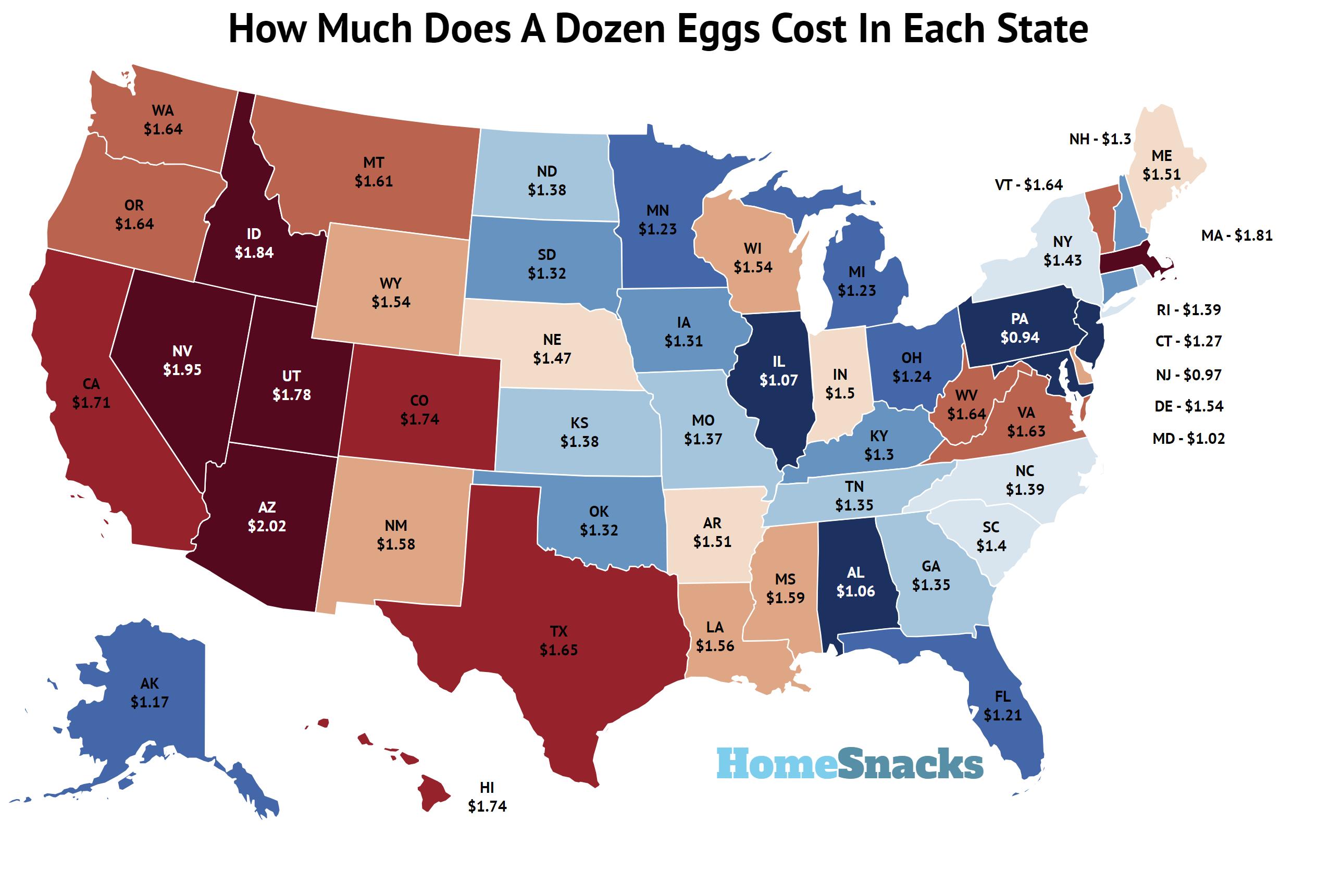
Grocery prices vary dramatically based on location, state regulations, and local supply chains. Data gathered by the U.S. Bureau of Labor Statistics (BLS) shows clear pricing differences across the country.
- U.S. Regional Price Spectrum
- Midwest / Grain Belt: Lowest Cost ($2.10 - $2.90 per dozen)
- Southeast / South: Moderate ($2.40 - $3.20 per dozen)
- Northeast Urban Hubs: High ($3.20 - $4.50 per dozen)
- West Coast / Regulated: Highest ($4.00 - $5.50+ per dozen)
- Alaska & Hawaii: Premium ($5.50 - $7.00+ per dozen)
High-Cost Regions
- California and the Pacific Northwest: Cage-free mandates combined with high transportation overhead and strict labor standards keep average retail prices higher than the national baseline.
- Non-Contiguous States (Hawaii and Alaska): Because fresh produce and refrigerated eggs must be shipped long distances by sea or air, consumers in Hawaii and Alaska routinely pay the highest prices in the nation, often topping $5.50 to $7.00 per dozen for standard eggs.
- Metropolitan Areas (NYC, Boston, San Francisco): Elevated commercial rents and higher retail operating costs mean urban corner stores and high-end supermarkets mark up cartons significantly more than suburban grocery chains.
Lower-Cost Regions
- The Midwest Grain Belt: States like Iowa, Ohio, Indiana, and Pennsylvania are home to large commercial egg-laying operations and abundant grain supplies. Proximity to feed and low transportation costs help keep Midwest retail prices well below the national average.
- Southern Rural Markets: Lower real estate, operational, and distribution costs allow grocers across the Southeast to maintain lower price points on conventional eggs.
How to Calculate True Value When Purchasing Eggs
Retail shoppers often look only at the price per carton without accounting for egg size and total weight. USDA egg grades establish strict weight standards per dozen, which help reveal the true cost per ounce of protein.
Weight Classes per Dozen
- Medium: 21 ounces total (approx. 1.75 oz per egg)
- Large: 24 ounces total (approx. 2.00 oz per egg)
- Extra Large: 27 ounces total (approx. 2.25 oz per egg)
- Jumbo: 30 ounces total (approx. 2.50 oz per egg)
Evaluating the Cost per Ounce
If a carton of Large eggs costs $3.00, you are buying 24 ounces of egg at $0.125 per ounce.
If a carton of Extra Large eggs at the same store costs $3.20, you are buying 27 ounces at $0.118 per ounce. In this scenario, purchasing Extra Large eggs gives you more raw product per dollar spent, even though the carton cost is higher.
Cost-per-Ounce Formula: (Carton Retail Price) / (Total Ounces per Dozen) = Cost per Ounce
Practical Strategies to Save Money on Eggs
For consumers looking to stretch their household budgets without cutting back on nutrient-dense foods, small changes in shopping habits can deliver real savings over time.
- Buy in Bulk at Warehouse Clubs: Costco, Sam's Club, and BJ's Wholesale Club frequently sell 24-count, 30-count, or 60-count egg packages. Purchasing bulk flats can reduce the cost per egg by 15% to 30% compared to standard 12-count cartons.
- Opt for Private-Label Store Brands: Major supermarkets purchase eggs from the same agricultural distributors as national brands. Opting for store-brand conventional or cage-free eggs over national brand-name cartons can save $0.50 to $1.50 per dozen.
- Compare Egg Sizes: Don't automatically grab Large eggs out of habit. Compare the price difference to Medium or Extra Large sizes. When Medium eggs go on clearance or sale, buying two cartons of Medium eggs can yield more weight per dollar than a single carton of Large eggs.
- Buy Local Farm-Direct: In rural and suburban areas, local homesteads and small farms sell fresh eggs directly to consumers. Farm-gate prices are often lower than retail store prices for comparable free-range or organic standards, as farm-direct sales eliminate retail middleman markups.
- Check Expiration and Expiry Codes: Extend product shelf-life and reduce food waste by selecting cartons with the furthest out sell-by date. Properly refrigerated eggs remain safe and edible for 3 to 5 weeks past the pack date stamped on the carton.
Frequently Asked Questions
Why are organic and pasture-raised eggs so much more expensive?
Organic and pasture-raised production requires significantly higher operational inputs. Farmers pay a premium for certified organic non-GMO feeds, maintain larger land areas to meet per-bird space requirements, and incur higher certification costs. Lower hen stocking densities mean fewer total eggs produced per acre, driving up the cost per egg.
How many eggs are in a standard U.S. grocery carton?
The standard egg carton in the United States holds 12 eggs (one dozen). However, stores commonly carry half-dozen (6-count) cartons, 18-count cartons, and bulk flats containing 30 or 60 eggs.
What is the difference between Grade AA, Grade A, and Grade B eggs?
The USDA grades eggs based on interior quality and shell integrity. Grade AA eggs have thick, firm whites and high, round yolks free of defects. Grade A eggs—the most common grade in retail stores—have slightly less firm whites. Grade B eggs may have minor shell stains or thinner whites and are typically used in commercial liquid egg products rather than sold raw in cartons.
Do brown eggs cost more to produce than white eggs?
Yes. Brown eggs are laid by larger breeds of hens, such as Rhode Island Reds, which consume more feed daily than the smaller White Leghorn hens that lay white eggs. The higher feed consumption increases production costs for brown eggs, though their nutritional profile is virtually identical to white eggs.
How long do eggs stay fresh in the refrigerator?
Raw eggs in their original carton can remain fresh and safe to eat for 3 to 5 weeks when stored in a home refrigerator kept at 40°F (4°C) or lower. Storing eggs on an inside shelf rather than the door maintains a consistent temperature.
Final Recommendation: Balancing Cost, Quality, and Value
Finding the right egg for your kitchen comes down to balancing your household budget with your dietary preferences and animal welfare standards. If your top priority is minimizing your grocery bill, purchasing private-label conventional or cage-free Large eggs in bulk flats (30 or 60 counts) delivers the best cost per ounce of high-quality protein.
If ethical farming practices or egg flavor profiles drive your decisions, look for pasture-raised or certified organic options at high-volume grocers or local farmers markets to avoid excessive retail markups. Always check unit weight and carton pack dates to ensure you get the freshest product for your dollar.
Image Gallery